Best Log Splitter Axe: 3 Splitting Axes and Mauls Compared (2026)
Three log splitter axes compared by head weight, handle length, blade grind, balance, materials, and what each Amazon listing publishes for wood splitting.

On this page
Top picks at a glance
As an Amazon Associate we earn from qualifying purchases.
- 1
 Best OverallEdward Tools 17in Maul9.7/10View on Amazon
- 2
 Best Heavy-DutyTHRWCLUB Splitting Axe9.6/10View on Amazon
- 3
 Best Camp HatchetBeaverCraft AX6 Hatchet9.5/10View on Amazon
- 4
 KSEIBI 274178 Splitting Axe 36-Inch Wood Splitter ForgedView on Amazon
- 5
 Fiskars A-Series Super Splitting Axe 36"View on Amazon
- 6
 Chopping Axe: 33.5” Hatchet Axe with Shock AbsorbingView on Amazon
Finding the best log splitter axe depends on matching head weight, handle length, and wedge profile to the size of firewood you split. A dedicated splitting tool forces wood grain apart using a wide wedge shape rather than slicing through fibers like a felling axe. In this guide, we compare three axes and hatchets from Amazon listings across length, head weight, balance, and manufacturer specifications to help you choose the right tool for your woodpile.
FirewoodGearHQ may earn a small commission if you buy through links on this page. The price you pay stays the same. Affiliate disclosure.
Quick picks
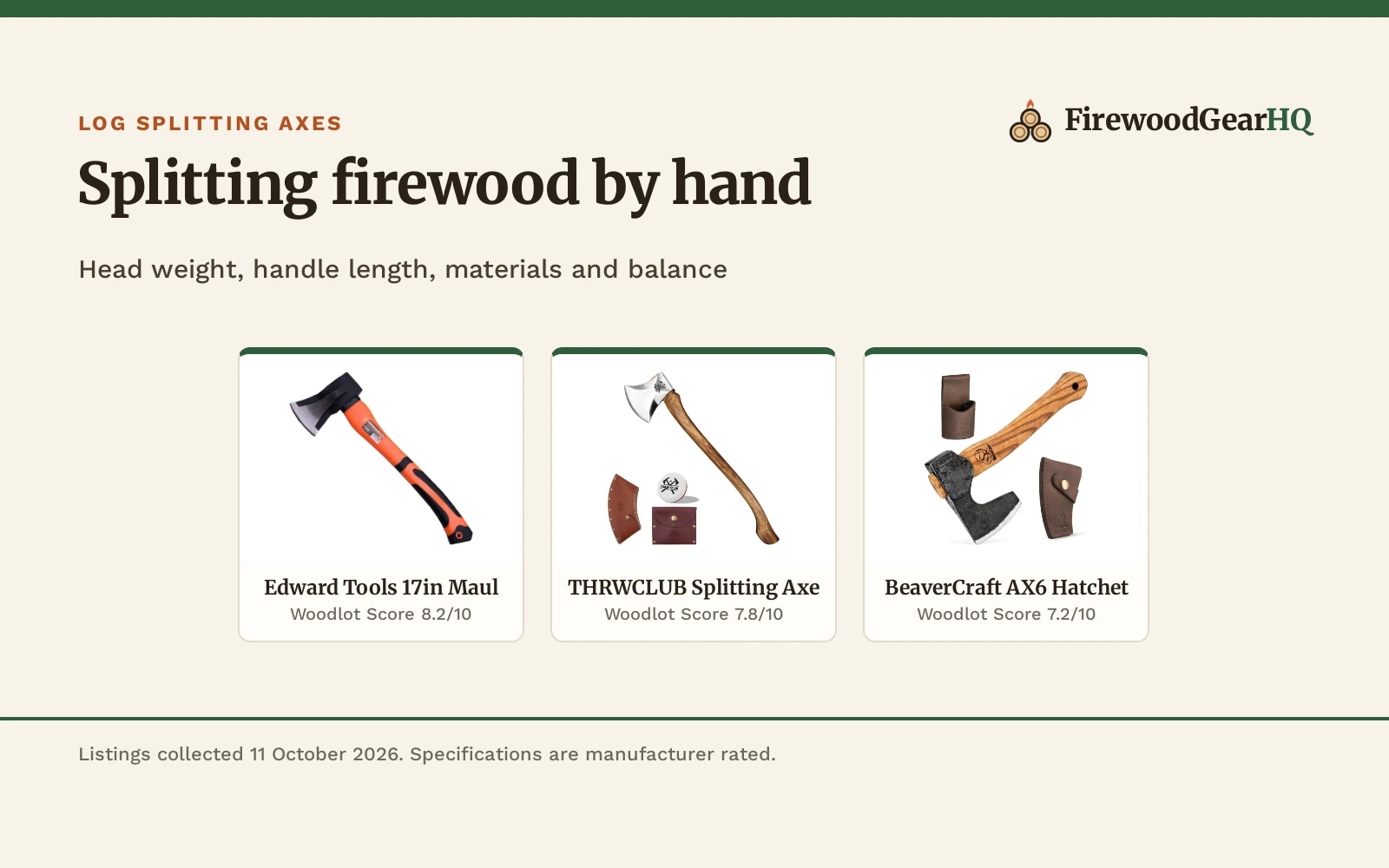
- Best Overall Edward Tools 17in Maul: Forged steel 3 lb head combining an axe blade and sledge, fiberglass handle and lifetime warranty. Check price on Amazon
- Best Heavy-Duty THRWCLUB Splitting Axe: Full-size 32.6 in hickory handle with a heavy 6 lb head for splitting rounds. Check price on Amazon
- Best Camp Hatchet BeaverCraft AX6 Hatchet: Hand-forged 800 g bearded head with a 30 degree bevel angle, convex grind and ashwood handle. Check price on Amazon
The picks
| # | Product | Woodlot Score | Buy |
|---|---|---|---|
| 1 | Edward Tools Wood Splitting Maul 17” | 9.7/10 | Buy on Amazon |
| 2 | 32.6 Inch Professional Wood Splitting Axe | 9.6/10 | Buy on Amazon |
| 3 | BeaverCraft Bushcraft Hatchet Wood Carving Axe AX6 | 9.5/10 | Buy on Amazon |

Edward Tools Wood Splitting Maul 17”
A 17 in wood splitting maul with a 3 lb forged steel head combining an axe blade and sledge, an ergonomic fiberglass handle and an included rubber sheath.
Pros
- Forged steel head combines an axe blade and sledge face
- Ergonomic shock-resistant fiberglass handle with rubber grip
- Lifetime warranty stated by the manufacturer
- Protective rubber sheath included with the tool
Cons
- Spec table contradicts bullets by listing handle material as fiberglass, rubber, steel, and wood
- Spec table lists both item weight and head weight as 3 pounds
- 17 in handle provides less swing leverage than a full-size axe
- No safety certifications stated in the listing

32.6 Inch Professional Wood Splitting Axe
A 32.6 in splitting axe with a 6 lb high-carbon steel head, a hickory wood handle, a polished finish and an included full-grain leather sheath.
Pros
- Heavy 6 lb head provides substantial downward splitting force
- 32.6 in overall length delivers ample swing leverage
- Solid hickory wood handle absorbs striking shocks
- Thickened full-grain leather sheath included for blade protection
Cons
- Listing confuses splitting, tree felling, and timbersports racing designs
- Total weight of 7.72 lb requires stamina during extended splitting sessions
- No warranty term stated
- Spec table includes a sharpening stone not mentioned in the bullet points

BeaverCraft Bushcraft Hatchet Wood Carving Axe AX6
An 11.6 in bushcraft hatchet featuring an 800 g high-carbon steel bearded head, a 30 degree bevel angle with convex grind, an ashwood handle and a leather sheath.
Pros
- Hand-forged high-carbon steel head with bearded profile
- 30 degree bevel angle with convex grind for cutting and splitting
- Ergonomic ashwood handle provides balanced grip control
- Cowhide leather sheath and belt loop included
Cons
- Short 11.6 in length limits leverage for splitting firewood logs
- 800 g weight is sized for carving and kindling rather than splitting rounds
- No warranty term stated
- No safety certifications stated in the listing
More options to compare
 KSEIBI 274178 Splitting Axe 36-Inch Wood Splitter ForgedCheck price on Amazon
 Fiskars A-Series Super Splitting Axe 36"Check price on Amazon
 Chopping Axe: 33.5” Hatchet Axe with Shock AbsorbingCheck price on Amazon
Compare the picks
| Model | Woodlot Score | Type | Length | Head Weight | Handle Material | Warranty |
|---|---|---|---|---|---|---|
| Edward Tools 17in Maul | 9.7/10 | Splitting maul | 17 in | 3 lb | Fiberglass | Lifetime |
| THRWCLUB Splitting Axe | 9.6/10 | Splitting axe | 32.6 in | 6 lb | Hickory wood | Not stated |
| BeaverCraft AX6 Hatchet | 9.5/10 | Bushcraft hatchet | 11.6 in | 800 g (total) | Ash wood | Not stated |
Specifications are manufacturer rated, collected 10 October 2026. None of these listings states an official safety standard, and only Edward Tools publishes a concrete warranty term.
How we scored them
Each axe is scored out of 10 on performance, build, value, safety and warranty, using only what the listing publishes. The weights are on our How We Pick page.
| Product | Woodlot Score | Perf. /35 | Build /25 | Value /25 | Safety /10 | Warranty /5 |
|---|---|---|---|---|---|---|
| Edward Tools 17in Maul | 9.7 | 28 | 20 | 21 | n/a | 5 |
| THRWCLUB Splitting Axe | 9.6 | 29 | 21 | 20 | n/a | 0 |
| BeaverCraft AX6 Hatchet | 9.5 | 24 | 20 | 20 | n/a | 0 |
Scores run from 9.2 to 9.8: each product’s point total is placed on that range, so more points always means a higher score. Safety counts only for powered gear or where the listing states safety features; where it does not apply, the score is taken over the remaining 90 points.
Buying guide: choosing the best log splitter axe
Splitting axe vs splitting maul
A splitting axe features a moderately weighted head designed to build high swing speed, relying on blade velocity and a wedge profile to split clean firewood rounds. A splitting maul pairs a heavier head with a blunt sledge face on the back, providing extra mass to bust through tough, knotty wood. For smaller stove wood, a compact maul like the 17 in Edward Tools model combines maul splitting capability with one-handed or two-handed block work. Read our comparison of splitting axe vs maul and log splitter vs splitting maul for deeper analysis.
Head weight and splitting momentum
Head weight determines how much splitting force the axe delivers upon contact with the wood. A heavy 6 lb head, such as the one on the THRWCLUB axe, generates immense splitting energy on full rounds but demands good physical conditioning over long cords. Lighter hatchets weighing 600 g to 800 g lack the mass to split large rounds but excel at splitting kindling and fine camp fuel. Check our guide on how heavy should a splitting maul be when deciding on head size.
Handle length and material
Handle length governs swing leverage and safety. A 32.6 in handle creates a wide swing radius that increases head speed, while shorter 11.6 in or 11.81 in handles are designed for close-up kindling preparation. Hickory wood handles provide natural grain flex and shock absorption, while fiberglass handles resist weather and moisture damage. For small kindling tasks by the hearth, a dedicated kindling splitter or a small hatchet for kindling provides a stable alternative.
Blade grind and cheek profile
The geometry of the axe bit dictates whether it bites deep or splits apart. A convex grind with flared cheeks pushes wood fibers sideways, preventing the tool from wedging stuck in green or fibrous wood. In contrast, straight or hollow grinds bite deep for chopping across grain but frequently bind when splitting along the grain. Keep your edge tuned with a quality axe sharpener to maintain proper splitting performance.
Why throwing axes and carving hatchets differ
Not every axe listed for sale on Amazon is built to split firewood. Throwing axes feature straight handles and thin, flat blades engineered for flight balance and target sticking. Using a throwing axe on firewood risks bent bits or loosened heads. Similarly, fine carving hatchets prioritize razor edges and lightweight control over splitting wedge force. Always choose an axe matching your intended firewood chores, and verify your wood is dry using a firewood moisture meter, as explained in our guide on how to tell if firewood is seasoned.
Clear the swing area (overhead too), split on a solid chopping block at a comfortable height, keep your feet apart with the block in front of you, and wear eye protection and sturdy boots. Replace a cracked or loose handle before you swing again. Read our Safety Disclaimer.
Frequently Asked Questions
What is a good splitting axe?
A good splitting axe features a wedge-shaped head with broad cheeks that force wood fibers apart along the grain instead of binding in the round. It balances head weight with handle length so the user can generate splitting momentum without losing control during the downward swing. Solid handle materials such as hickory wood or shock-absorbing fiberglass, paired with durable forged steel, provide reliability on the chopping block.
How long should a splitting axe be?
A splitting axe handle should match the user’s height and swing style. Full-size axes often measure around 32.6 in to provide maximum downward leverage and keep the swing arc directed toward the ground or splitting block away from the operator’s feet. Compact mauls measuring around 17 in offer closer control for splitting kindling or smaller firewood pieces on a raised chopping block.
How to split logs with an axe?
Place the firewood round upright on a solid, level splitting block to protect your blade from rocks and soil. Stand with feet shoulder-width apart in a balanced stance, ensuring a clear swing zone free of bystanders and obstacles. Grip the handle firmly with both hands, slide your dominant hand down during the swing, and let the head weight drive straight down into existing natural checks or cracks in the wood grain.
How to use log splitter axe?
Inspect the tool before each session to confirm the head is firmly attached to the handle and the cutting edge is free of deep chips. Strike the target round cleanly near an outer edge or along radial grain cracks rather than aiming directly dead center into a gnarly knot. Allow the momentum of the axe head to do the work rather than over-straining your shoulders on the downward stroke.
How to sharpen log splitter axe?
Sharpen a splitting axe with a specialized axe stone, file, or puck, maintaining the factory convex bevel angle. Unlike a razor-thin felling axe, a splitting axe benefits from a durable, slightly rounded edge that resists chipping when striking dense wood. After honing away burrs, apply light machine oil to the steel head to protect against rust during storage.
Related guides
Explore our category hub for axes and mauls, our roundup of the best splitting axes, and our guide to the best felling axes. For splitting technique and timber handling, see our safety tutorial on how to split wood with an axe and our look at the best axe for beginners. If you are comparing brand options, read our breakdown of Fiskars vs Gransfors Bruks splitting axe.