Best Felling Axe Under $100 (2026): 5 Chopping Axes Compared
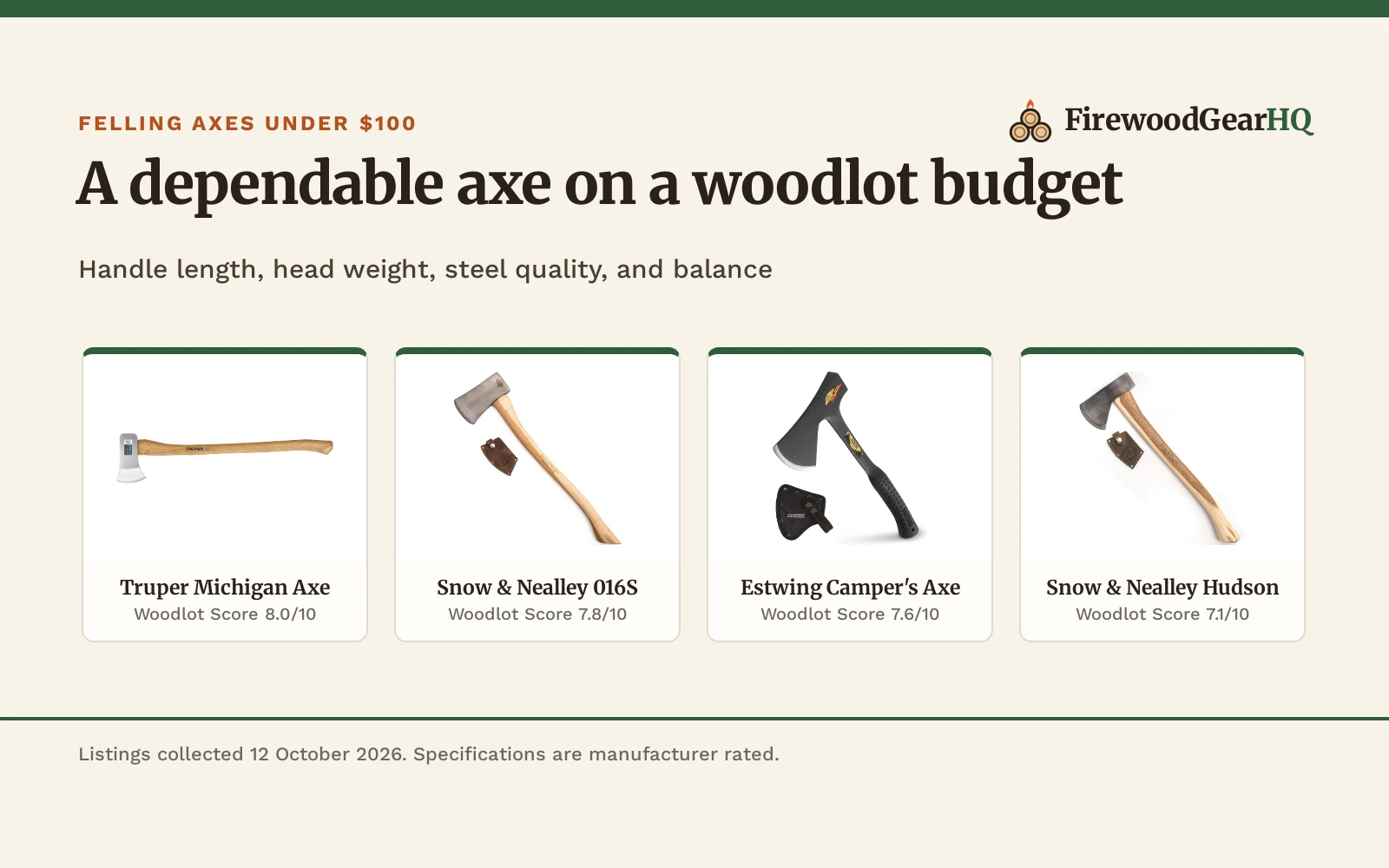
Five felling axes under $100 compared by handle length, head weight, steel quality, balance, and sheaths, from a 35-inch Truper to a 26-inch forged Estwing.

On this page
Top picks at a glance
As an Amazon Associate we earn from qualifying purchases.
- 1
 Best OverallTruper Michigan Axe9.6/10View on Amazon
- 2
 Best Mid-Size PickSnow & Nealley 016S9.6/10View on Amazon
- 3
 Most DurableEstwing Camper’s Axe9.6/10View on Amazon
- 4
 Best Pack AxeSnow & Nealley Hudson9.5/10View on Amazon
- 5
 Chopping Axe: 33.5” Hatchet Axe with Shock AbsorbingView on Amazon
- 6
 INTERTOOL 36 Inch Chopping AxeView on Amazon
In fall and early winter, cutting down standing deadwood and clearing problem trees around the woodlot is the first step toward next year’s firewood stack. A dependable axe makes clean work of chopping directional notches, dropping trunks, and limbing branches before bucking. If you need a reliable tool without overspending, finding the best felling axe under 100 comes down to handle length, head geometry, steel quality, and firm head attachment. This guide compares five chopping axes under $100 to help you pick the right balance of swing power and control.
FirewoodGearHQ may earn a small commission if you buy through links on this page. The price you pay stays the same. Affiliate disclosure.
Quick picks
- Best Overall Truper Michigan Axe: Full-size 35-inch hickory handle with a 3.5 lb forged Michigan felling head and dual-wedge assembly. Check price on Amazon
- Best Mid-Size Pick Snow & Nealley 016S: 28 3/16-inch hickory handle and 2-1/4 lb fire-tempered single-bit head ground on stone wheels. Check price on Amazon
- Most Durable Estwing Camper’s Axe: Forged American steel 26-inch build with a patented grip engineered to cut vibration by 70%. Check price on Amazon
- Best Pack Axe Snow & Nealley Hudson: Lightweight 1 3/4 lb Hudson Bay head on a 24-inch hickory handle with an included leather sheath. Check price on Amazon
The picks


Truper Michigan Axe, 3.5 lb Forged Steel Head
A full-sized felling axe featuring a 3.5 lb forged carbon steel Michigan pattern head, a 35-inch North American hickory handle, and a dual-wedge wood and steel assembly.
Pros
- Full-size 35-inch hickory handle delivers maximum leverage and swing velocity
- Classic 3.5 lb Michigan pattern head designed for felling and limbing
- Dual-wedge assembly with wood and steel wedges secures head connection
- High-carbon steel head is heat-treated for edge retention
Cons
- Listing table states a 4.2-pound head weight, contradicting the 3.5-pound title
- No warranty term is stated on the listing
- Long 35-inch length requires a wide swing area in tight brush
- Total listed weight of 2.19 kg demands two-handed control

Snow & Nealley 016S Our Best Single Bit Snow
A mid-sized single bit utility axe with a 2-1/4 lb fire-tempered carbon steel head ground on stone wheels, fitted to a 28 3/16-inch hickory handle.
Pros
- 28 3/16-inch hickory handle balances chopping power with close-quarters control
- 2-1/4 lb carbon steel head is fire-tempered for durability
- Cutting edge is ground on stone wheels at the factory
- Protective axe sheath included in the box
Cons
- Spec table rounds length to 28 inches and weight to 3 pounds
- Spec table notes a stainless steel factory edge while listing carbon steel blade material
- No warranty term is stated on the listing
- Head is lighter than full-sized felling patterns for large trunks
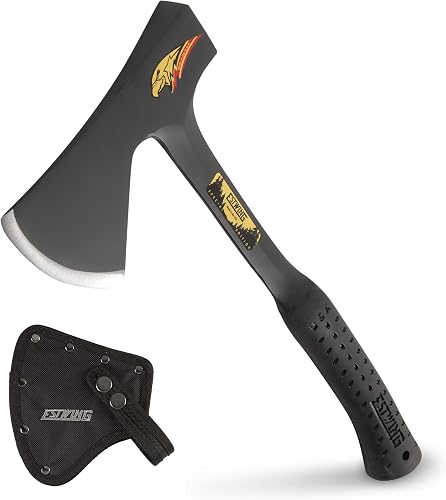
ESTWING Camper's Axe, 26" Black Long Handled
An all-steel 26-inch outdoorsmen axe forged in the USA from American steel, featuring a soldered tubular steel handle and patented shock reduction grip.
Pros
- Forged steel construction with soldered bond eliminates loose axe heads
- Patented shock reduction grip is engineered to cut vibration by 70%
- American made in Rockford, IL from American steel since 1923
- Heavy-duty ballistic nylon sheath with belt loop included
Cons
- Spec table classifies head type as hatchet despite the 26-inch handle
- No concrete warranty term is stated on the listing
- Steel handle transfers more cold in winter than hickory wood
- Head weight is not stated separately from the 3.5-pound total weight

Snow & Nealley Hudson Bay Axe
A classic 24-inch Hudson Bay axe carrying a 1 3/4 lb alloy steel head on a hickory handle, supplied with a genuine leather blade sheath.
Pros
- Classic Hudson Bay pattern offers a wide 4-inch cutting edge on a light head
- Genuine leather blade sheath included for edge protection and safety
- Hickory handle provides natural flex and shock absorption
- Compact 2-pound total listed weight packs easily around the property
Cons
- Bullets state a 24-inch handle while spec table lists 22.75 inches
- Bullets state a 1 3/4# head while spec table lists 1.8 pounds
- No concrete warranty term is stated on the listing
- Light head lacks driving mass for felling mature timber

Camping Hatchet -Chopping Axe with Leather Sheath
A 22.3-inch chopping and splitting axe with a 5.3-inch forged carbon steel convex blade, beech wood handle, leather sheath, and whetstone.
Pros
- Wide 5.3-inch convex cutting edge covers significant chopping surface
- Forged carbon steel head is heat-treated to retain edge sharpness
- Leather sheath and sharpening stone included with the tool
- Ergonomic handle grip designed to reduce strain during use
Cons
- Spec table lists both head weight and item weight as 3.8 pounds
- Beech wood handle is generally less resilient than American hickory
- No warranty term is stated on the listing
- Wedge head geometry is tailored more for splitting than clean felling
More options to compare
 Chopping Axe: 33.5” Hatchet Axe with Shock AbsorbingCheck price on Amazon
 INTERTOOL 36 Inch Chopping AxeCheck price on Amazon
Compare the picks
| Model | Woodlot Score | Length | Head weight | Handle material | Head pattern | Warranty (stated) |
|---|---|---|---|---|---|---|
| Truper Michigan Axe | 9.6/10 | 35 in | 3.5 lb | Hickory | Michigan felling | Not stated |
| Snow & Nealley 016S | 9.6/10 | 28 3/16 in | 2-1/4 lb | Hickory | Single bit | Not stated |
| Estwing Camper’s Axe | 9.6/10 | 26 in | Not stated | Alloy steel | Camper’s | Not stated |
| Snow & Nealley Hudson | 9.5/10 | 24 in | 1 3/4 lb | Hickory | Hudson Bay | Not stated |
| THKFWD 22.3 Axe | 9.4/10 | 22.3 in | 3.8 lb | Beech wood | Wedge chopping | Not stated |
Specifications are manufacturer rated, collected 12 October 2026. Weights and lengths are as listed in each product entry. None of these five listings states a concrete warranty term.
How we scored them
Each axe is scored out of 10 on performance, build, value, safety and warranty, using only what the listing publishes. An axe whose listing does not state a concrete warranty term receives zero for warranty. The criteria weights are detailed on our How We Pick page.
| Product | Woodlot Score | Perf. /35 | Build /25 | Value /25 | Safety /10 | Warranty /5 |
|---|---|---|---|---|---|---|
| Truper Michigan Axe | 9.6 | 30 | 21 | 22 | 6 | 0 |
| Snow & Nealley 016S | 9.6 | 29 | 22 | 21 | 5 | 0 |
| Estwing Camper’s Axe | 9.6 | 28 | 22 | 20 | 6 | 0 |
| Snow & Nealley Hudson | 9.5 | 26 | 20 | 20 | 5 | 0 |
| THKFWD 22.3 Axe | 9.4 | 24 | 18 | 19 | 5 | 0 |
Scores run from 9.2 to 9.8: each product’s point total is placed on that range, so more points always means a higher score.
Buying guide: best felling axe under 100
Handle length and swing velocity
Handle length governs the mechanical leverage and head speed you generate during a swing. A full-length 35-inch handle delivers maximum head momentum, allowing a 3.5 lb head to sink deep across wood fibers when notching and felling medium to large trees. Shorter handles measuring 24, 26, or 28 inches sacrifice top-end swing speed for improved agility in dense brush, along trail paths, or when limbing downed trunks at waist height.
Head pattern: felling vs splitting
A true felling axe utilizes a relatively thin, tapered bit designed to sever wood grain cleanly rather than force it apart. Traditional patterns such as the Michigan pattern feature rounded corners and a narrow cheek profile that bites into green timber without sticking excessively. In contrast, axes with thick wedge geometry act more like splitting tools; while useful for splitting rounds, thick wedges tend to glance or bounce when chopping into the side of a standing trunk.
Handle materials: hickory vs steel vs beech
North American hickory remains the traditional woodlot standard because its long grain naturally absorbs impact shock and allows replacement if damaged. Forged all-steel construction eliminates the risk of an axe head coming loose from its handle, though steel transmits more vibration unless paired with a dampening grip. Beech wood provides a rigid handle on budget tools, but generally lacks the grain flexibility and durability of seasoned hickory.
Head attachment and safety
Head separation is a critical hazard when swinging an axe. Quality wooden-handled axes employ a dual-wedge assembly, combining a wooden wedge with a steel cross wedge to expand the handle wood firmly inside the eye. All-steel axes solve this by soldering the tubular steel handle directly to the forged head in a permanent bond. Always inspect the head and handle junction before chopping.
Listing contradictions on budget axes
Budget tool listings often contain conflicting figures between bullet highlights and specification tables. Several listings here show discrepancies between handle lengths or head weights, such as a head weight listed identical to total weight, or rounded figures in tables. We prioritize the primary title and bullet statements over automated specification tables when evaluating tools.
If you need to process rounds into firewood after felling, explore our guide to the best splitting axe under $100. To understand head geometry differences in detail, read our comparison on splitting axe vs maul. If you want to compare premium options beyond the budget tier, see our guide to the best felling axe.
Clear the swing area (overhead too), split on a solid chopping block at a comfortable height, keep your feet apart with the block in front of you, and wear eye protection and sturdy boots. Replace a cracked or loose handle before you swing again. Read our Safety Disclaimer.
Around the Woodpile
- Always establish a clear swing zone around your stance by clearing brush, low branches, and tripping hazards before chopping.
- Place the protective leather or ballistic nylon sheath over the cutting edge immediately after chopping to safeguard the blade and prevent accidental contact.
- Check the head attachment before each work session; dual-wedge assemblies with wood and steel wedges help keep the head seated under heavy impact.
- Keep rubberized shock reduction grips clean and free of oil to maintain a firm two-handed grasp while working in wet conditions.
Frequently Asked Questions
What is the difference between a felling axe and a splitting axe?
A felling axe features a thin, sharp bit engineered to sever wood fibers across the grain when notching and dropping trees or cutting limbs. A splitting axe or maul features a broader wedge-shaped head designed to push wood grain apart along the length of a firewood round.
Can a 26-inch or 28-inch axe fell a tree?
An axe measuring 26 or 28 inches can fell saplings and smaller woodlot trees, and excels at limbing downed timber where a long handle feels unwieldy. For dropping mature standing trees, a 35-inch handle and a 3.5 lb head deliver far greater chopping depth per strike.
Why do none of these axes earn warranty points?
Our scoring awards warranty points only when a listing publishes a concrete warranty term such as years, months, or a lifetime policy. These budget listings either omit warranty information entirely or state general manufacturer coverage without specifying duration.
How should I maintain an axe cutting edge?
Touch up the factory edge using a flat file or a handheld whetstone, following the original bevel angle. Keep the bit lightly oiled to guard against rust, and always store the axe inside its sheath. For dedicated sharpening gear, see our guide to the best axe sharpener.
Should I fell large trees myself?
For large, leaning, or storm-damaged trees, particularly near buildings or power lines, hire an insured professional tree service. Tree felling is hazardous work, and we do not publish tree felling instructions.
Related guides
See our axes and mauls hub for more tools. For splitting firewood rounds, review the best splitting axe and the best splitting maul. Beginners can consult our guide to the best axe for beginners, or read our step-by-step instructions on how to split wood with an axe. For hearth preparation, see the best hatchet for kindling and the best kindling splitter. To compare tool styles, read our breakdowns on maul vs axe and hatchet vs axe.