How Does a Log Splitter Work: Step-by-Step Guide
How a log splitter works through hydraulic, kinetic and manual force, breaking down key components, splitting mechanics, cycle times and safety basics.

On this page
Top picks at a glance
As an Amazon Associate we earn from qualifying purchases.
- 1
 KABIN Kindle Quick Log Splitter9.7/10View on Amazon
- 2
 Kindling Splitter L9.6/10View on Amazon
- 3
 Cast Iron Kindling Splitter with 3Lbs Sledge Hammer9.6/10View on Amazon
- 4
 BILT HARD Log Splitter 6.5 TonView on Amazon
- 5
 Landworks Portable 20-Ton Gas Log SplitterView on Amazon
- 6
 1844 Helko Werk Germany Vario Heavy Log SplitterView on Amazon
- 7
 SuperHandy Hydraulic Log SplitterView on Amazon
- 8
 YARDMAX YS0650 6.5 Ton Electric Log SplitterView on Amazon
- 9
 BILT HARD 6.5 Ton Log SplitterView on Amazon
When autumn rounds pile up in the yard and the wood stove season approaches, splitting cords of oak or maple by hand with a maul takes a heavy toll on your back and shoulders. Understanding how does a log splitter work comes down to mechanical leverage replacing muscle power. A log splitter uses a power source to drive a hardened steel wedge through the grain of a wood round, forcing the fibers apart along their natural lines of weakness. Whether powered by a hydraulic cylinder, a kinetic flywheel or a manual lever, the machine concentrates tons of splitting force against a rigid beam until the log yields cleanly.
More options to compare
 BILT HARD Log Splitter 6.5 TonCheck price on Amazon
 Landworks Portable 20-Ton Gas Log SplitterCheck price on Amazon
 1844 Helko Werk Germany Vario Heavy Log SplitterCheck price on Amazon
 SuperHandy Hydraulic Log SplitterCheck price on Amazon
 YARDMAX YS0650 6.5 Ton Electric Log SplitterCheck price on Amazon
 BILT HARD 6.5 Ton Log SplitterCheck price on Amazon
FirewoodGearHQ may earn a small commission if you buy through links on this page. The price you pay stays the same. Read our affiliate disclosure.
The quick answer
A log splitter converts mechanical energy into linear splitting force to drive a metal wedge into a cut log. In hydraulic models, an engine or electric motor spins a pump that directs hydraulic fluid toward a cylinder. As pressurized fluid drives a heavy piston rod forward, it either forces the log against a fixed wedge or pushes a moving wedge through a stationary log. When the wedge penetrates the end grain, it forces the wood fibers apart along their natural cleavage lines until the round splits. Reversing the control valve routes fluid to the opposite side of the piston, retracting the ram for the next piece.
How does a log splitter work step by step
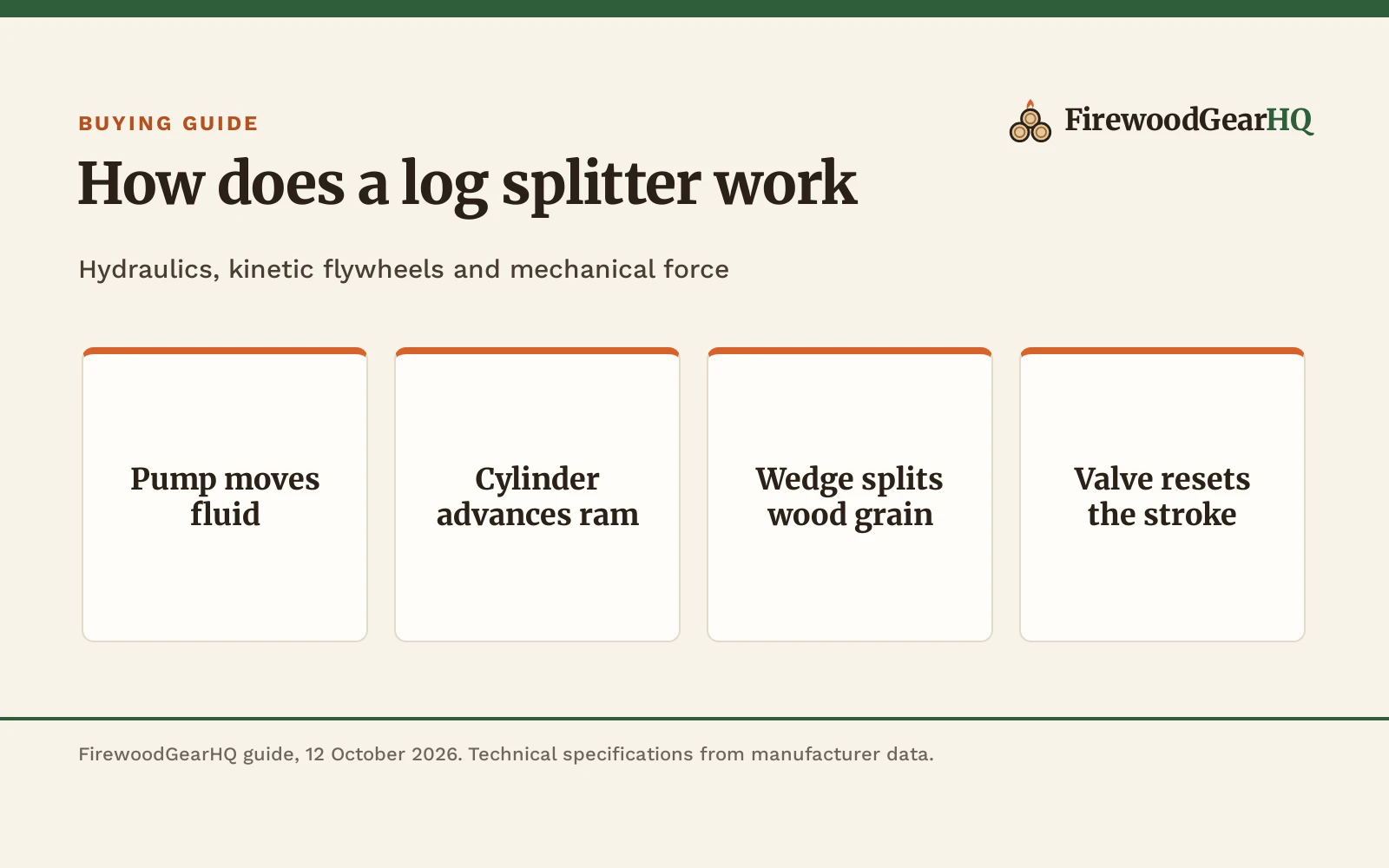
The splitting cycle transfers energy through distinct stages from the motor shaft to the falling firewood halves:
Mechanical power spins the pump
The cycle begins at the power source. An engine or electric motor spins the drive shaft of a hydraulic pump, drawing oil from the reservoir tank. The pump produces continuous fluid flow through the hydraulic circuit.
Control valve directs fluid flow
When the operator pushes the control lever forward, the directional valve opens an internal passage, routing oil into the base of the hydraulic cylinder barrel behind the piston. As the piston and log resist movement, hydraulic pressure builds in the cylinder.
Hydraulic cylinder extends the ram
Pressurized fluid fills the cylinder barrel, driving the piston and chrome-plated steel rod forward along the heavy steel beam. The advancing ram pushes the log into the wedge or drives the wedge into the braced log.
Wedge splits the wood grain
The tapered steel wedge penetrates the end grain of the round. Acting as an inclined plane, its expanding shoulders exert outward lateral force, popping the wood cells apart along the grain.
Valve returns the cylinder
Shifting the valve handle into reverse directs fluid to the rod side of the cylinder, pulling the piston back while returning displaced oil through the return filter to the reservoir tank.
Key components of a hydraulic log splitter
A hydraulic splitter relies on several core components working in a closed loop:
- Hydraulic pump: Draws oil from the reservoir and delivers continuous fluid flow to the control valve.
- Hydraulic cylinder: Houses the piston and chrome rod that convert fluid flow and pressure into linear splitting force.
- Directional control valve: Directs fluid flow to extend, hold or retract the ram via a hand lever.
- Steel beam and foot plate: Provides the rigid structural foundation that supports splitting thrust.
- Splitting wedge: A hardened steel blade shaped to penetrate and spread wood fibers apart.
- Fluid reservoir and return filter: Stores hydraulic oil, dissipates heat and cleans returning oil through a filter before it recirculates.
- Motor or engine: Provides rotational mechanical torque to drive the pump shaft.
Types of log splitters and how their mechanisms differ
Wood splitters rely on different power sources and driving mechanisms depending on the job at hand:
Gas-powered hydraulic splitters
Gas splitters use an onboard combustion engine to run anywhere on a woodlot without electrical cords. Many feature pivoting beams that switch between horizontal splitting for light rounds and vertical splitting for heavy logs. To compare power options, read our guide on gas vs electric log splitter models, or review tractor alternatives in 3 point log splitter vs gas.
Electric hydraulic splitters
Electric models replace the gas engine with an electric motor running on standard household power. They operate quietly without exhaust fumes, making them ideal for barns, garages and suburban woodpiles.
Kinetic log splitters
Kinetic splitters bypass hydraulics. An electric motor or gas engine spins heavy flywheels to store energy. Engaging the lever locks a rack-and-pinion gear onto the flywheel shaft, firing a push block forward in a rapid burst. Compare the mechanics in our guide on kinetic vs hydraulic log splitter tools.
Manual hydraulic splitters
Manual splitters use hand-pumped levers to build hydraulic pressure inside a compact cylinder. They require no gas or electricity, providing quiet, fume-free operation for small woodpiles or remote areas. See how mechanical splitting compares to manual swinging in our analysis of log splitter vs splitting maul options.
Understanding tonnage, cycle time and splitting capacity
Splitting force is specified as a manufacturer-rated tonnage figure. On hydraulic machines, manufacturer-rated tons represent hydraulic math, calculated by multiplying maximum fluid pressure by the surface area of the cylinder piston. Sunluway publishes replacement cylinder specifications with a 4.5″ bore, 24″ stroke and 1.75″ rod that operates up to 3500 PSI, manufacturer rated for approximately 27 tons of force. Titan Attachments lists a Cat 1 3-point tractor splitter delivering a manufacturer-rated 25 Ton of force for logs up to 25″ x 8.5″.
For gas machines, Full Boar lists a manufacturer-rated 20 Ton gas log splitter powered by a 209cc engine with a 10.5 GPM two-stage pump, an 8.5-second cycle time, a 5° wedge angle, a 45mm piston rod, a 1.45 Gallon hydraulic capacity, and a weight of 147.7 pounds. AidBuilt lists a manufacturer-rated 20 Ton gas splitter with a 7HP 4-stroke engine, an 8-second cycle time, and capacity for logs measuring 21″ long by 16.5″ wide on 10-inch tires. SuperHandy lists a manufacturer-rated 25 Ton gas splitter weighing 245 pounds.
For heavy rounds, Full Boar lists a manufacturer-rated 35 Ton gas log splitter featuring a 306cc engine, 4-Way and 6-Way blades, 3.55 inches of vertical wedge positioning, a 700 lbs hydraulic log lift, and a weight of 1045 pounds. Learn more about multi-blade setups in our guide to a log splitter with box wedge.
Kinetic splitters focus on cycle speed. FORESTWEST lists a manufacturer-rated 18Ton kinetic splitter with a 2.0HP, 13.6-Amp electric motor, an average cycle time of 2s to 3s on logs up to 16″ long, and a weight of 246 pounds. Review how speed impacts productivity in what is cycle time on a log splitter.
For manual splitters, GARVEETECH lists a manufacturer-rated 12 T manual hydraulic splitter with 37 in handles and two-speed operation for logs up to 18.7 in length and 8 in diameter. BIG RED lists a manufacturer-rated 12 ton manual splitter with 37 in handles for logs up to 17.7 in long and 7.9 in diameter. To protect your equipment outdoors, Goctoke lists a 1200D Oxford cloth cover weighing 4 lbs for 15-60 Ton splitters, measuring 94.5″ L x 49.6″ W x 41.7″ H with 2 ground stakes and 2 vents. For sizing recommendations, consult what size log splitter do I need and how many tons of log splitter do I need.
Log splitter safety and operating rules
The hydraulic force required to split logs demands strict woodlot safety practices:
- One operator at the controls: A log splitter is strictly a one operator machine. The person positioning the log must control the hydraulic lever to eliminate accidental pinch points.
- Keep hands clear of the wedge: Grip firewood rounds by the bark sides, never by the ends facing the wedge or foot plate. Keep hands clear of the wedge during the entire stroke.
- Wear personal protective equipment: Always wear eye protection against flying bark and splinters. Wear sturdy steel-toe boots and snug leather gloves.
- Position on level ground: Operate on flat, solid ground with wheels chocked so the splitter cannot roll or tip under heavy loads.
- High-pressure fluid caution: Never check for hydraulic leaks with bare hands. Fluid under thousands of pounds of pressure can penetrate skin; use cardboard to inspect fittings.
- Ventilation safety: Run gas engines outdoors only. Consumer guidance from the U.S. Consumer Product Safety Commission (CPSC) emphasizes that engine exhaust contains toxic carbon monoxide.
Review operational guidelines in our complete guide on log splitter safety rules.
One operator only, with hands well clear of the wedge and the ram. Wear eye protection and gloves, set the splitter on stable, level ground, and keep kids and pets away from the work area. Run gas splitters outdoors only, and never reach in to clear a jammed log while the ram can move. Read our Safety Disclaimer.
Frequently Asked Questions
How does hydraulic pressure create splitting force?
A pump drives hydraulic oil toward a closed cylinder barrel behind a piston. When the advancing ram meets the resistance of a log, pressure builds rapidly against the piston surface, driving the chrome rod forward to force the wood into the wedge.
What does a two-stage pump do on a log splitter?
A two-stage pump shifts between high fluid flow at low pressure to advance the ram quickly, and low fluid flow at high pressure to push through dense, knotty grain when resistance rises.
Why is cycle time important on a log splitter?
Cycle time measures the seconds needed for the ram to extend and return. A shorter cycle time speeds up firewood production, letting you process more cords in less time.
How does a kinetic splitter differ from a hydraulic splitter?
A kinetic splitter stores energy in spinning flywheels rather than fluid pressure. Tripping the lever discharges flywheel inertia into a rack-and-pinion arm that pops the round open in a rapid snap.
Can a log splitter split green firewood?
Yes. A log splitter handles green rounds, and many common species like oak or ash split cleanly when fresh because the grain separates readily. Some stringy species like elm or wet gum can cling to the wedge, requiring the stroke to push the wood fully through the blade.
Related guides
Explore our complete library of woodlot guides: read the log splitters hub, compare options in gas vs electric log splitter and kinetic vs hydraulic log splitter, or evaluate machine layouts in horizontal vs vertical log splitter. If you are shopping for equipment, browse the best log splitter for home use, review versatile machines in the best vertical log splitter guide, evaluate ownership options in renting vs buying a log splitter, or find budget options in cheap wood splitter. To keep your equipment running smoothly, see what hydraulic fluid for a log splitter, troubleshoot pressure issues in why wont my log splitter split, inspect cycle delays in why is my log splitter slow, and maintain electrical setups with electric log splitter troubleshooting. For seasonal storage and upkeep, consult how to winterize a log splitter, protect outdoor machinery with the best log splitter cover, check safety advisories in log splitter recalls what owners should check, and review operational safeguards in log splitter safety rules.