Brushless Chainsaw Meaning: How It Works and Cordless Saw Guide
What a brushless chainsaw means, how its electronic motor works without carbon brushes, and how it compares with brushed and gas saws for firewood cutting.

On this page
Top picks at a glance
As an Amazon Associate we earn from qualifying purchases.
- 1
 Greenworks 40V 16" Brushless Cordless Chainsaw9.7/10View on Amazon
- 2
 WORX Cordless Chainsaw9.7/10View on Amazon
- 3
 16 Inch Electric Chainsaw Cordless9.7/10View on Amazon
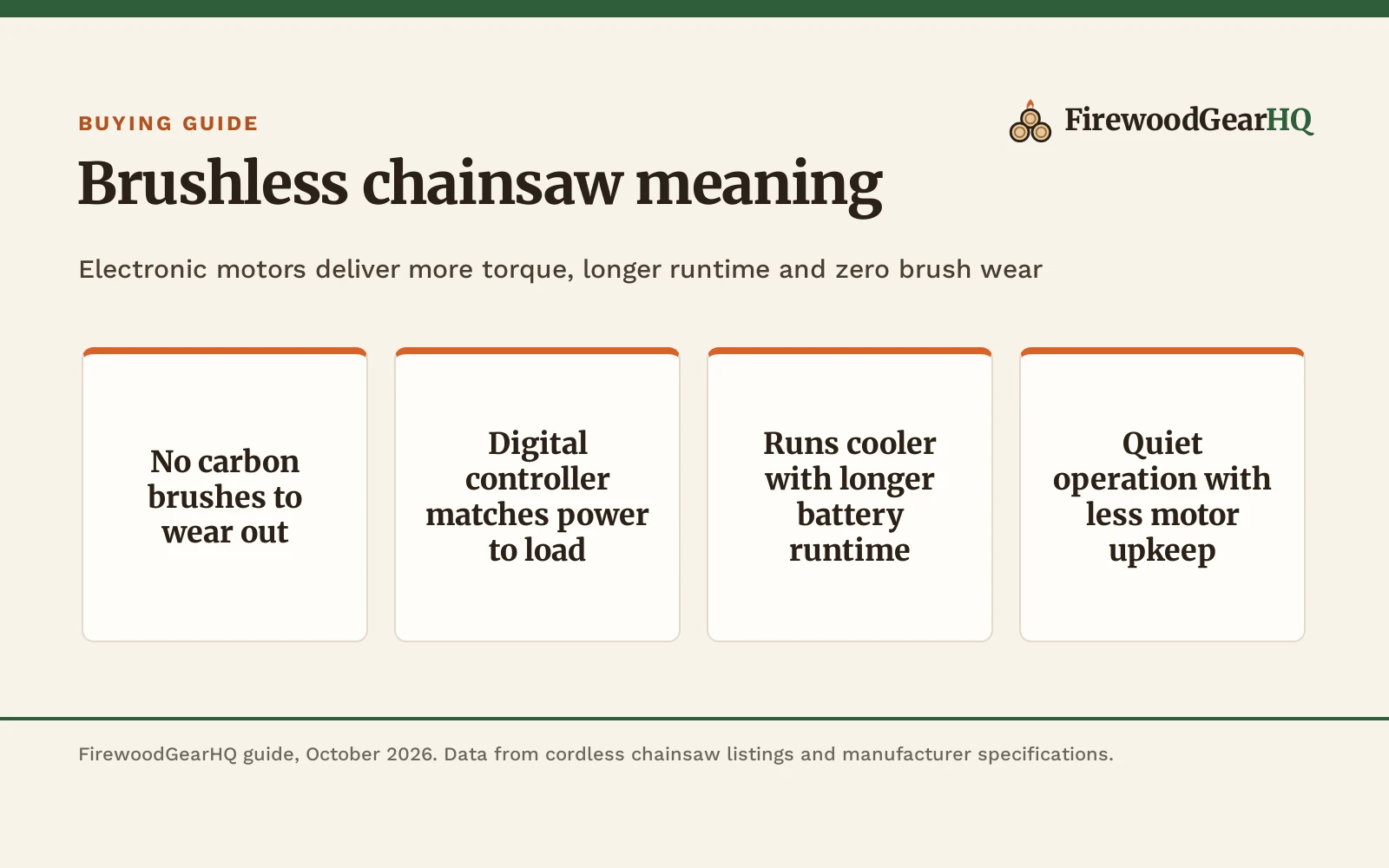
Understanding brushless chainsaw meaning comes down to how the electric motor delivers cutting power without mechanical carbon brushes. A brushless chainsaw is a cutting tool driven by an electric motor where an electronic circuit board and magnetic sensors direct electrical current instead of physical contact points. In practical wood cutting, this motor design produces higher torque under load, longer battery runtime, cooler operating temperatures, and extended service life without motor brush maintenance.
FirewoodGearHQ may earn a small commission if you buy through links on this page. The price you pay stays the same. Read our affiliate disclosure.
Brushless chainsaw meaning: the quick answer
The term brushless refers to an electric motor that reverses conventional motor architecture. In traditional brushed tools, carbon blocks rub a rotating commutator to transfer current into spinning coils. In a brushless motor, copper windings remain stationary on the outer stator while permanent magnets spin on the rotor shaft. A solid-state controller coordinates current pulses to the coils, eliminating brush friction so more electrical energy turns into rotational cutting force instead of waste heat.
This design delivers practical advantages on the woodpile. When bucking dense logs, the motor draws more current to maintain cutting power, while lighter trimming demands less energy from the battery pack. In higher-voltage models, this efficient power delivery allows cordless saws to tackle firewood cutting tasks with less noise and zero motor maintenance.
Brushed vs brushless chainsaws
| Feature | Brushed electric chainsaw | Brushless electric chainsaw |
|---|---|---|
| Electrical commutation | Physical carbon brushes and commutator ring | Solid-state electronic controller and sensors |
| Internal wear components | Carbon brushes wear down from contact | Permanent magnets on rotor; zero brush wear |
| Operating temperature | Brush friction generates internal heat | Runs cooler with no brush friction |
| Motor maintenance | Periodic brush inspection and replacement | Zero motor brush maintenance |
| Stated motor power | Not stated in reference listings | 200 watts to 1500 watts across stated listings |
| Stated guide bar length | Not stated in reference listings | 10-inch, 12-inch, 16-inch, and 18-inch in stated listings |
| Stated voltage platforms | Not stated in reference listings | 20V, 21V, 42V, and 60V across stated listings |
While brushed motors cost less to produce, brushless saws deliver longer runtime per charge and years of dependable cutting without brush replacements.
How a brushless chainsaw motor works
Electronic commutation replaces mechanical brushes
In a brushed motor, spring-loaded carbon blocks press against rotating copper contacts. In a brushless chainsaw, an integrated circuit board replaces wearing parts, using solid-state transistors to switch electrical current rapidly without physical contact.
Permanent magnets on the spinning rotor
A brushless motor places copper windings on the outer stator shell, while permanent magnets mount directly onto the center drive shaft. Because the windings stay stationary, they dissipate heat efficiently through the motor housing.
Digital sensors and adaptive load management
Magnetic sensors monitor the position of the spinning rotor shaft. As the cutters engage wood, the controller senses the mechanical load and regulates current flow from the battery, supplying the necessary torque to maintain cutting momentum without stalling.
Practical benefits for cutting firewood
Extended battery runtime on the woodpile
Eliminating brush friction ensures more battery energy reaches the drive sprocket. For example, the Sihuird listing publishes that its 60V saw with 6.0Ah battery capacity delivers up to 560 cuts on 4×4 lumber on a single charge. The AVADA listing states its 42V chainsaw with dual batteries completes up to 200 cuts per charge, reducing downtime between charges.
Consistent chain speed and cutting torque
Brushless motors deliver rapid torque response under load. The Sihuird listing advertises a motor speed of 15000RPM delivering an ultra-high chain speed of 42.58 ft/s. The PBUO listing publishes a no-load chain speed of 46 ft/s driven by a 1500 watts brushless motor. The AVADA listing claims a chain speed of 44.3 ft/s and a top speed of 12,000 RPM, stating power equivalent to a 39cc gasoline saw that cuts through 12 inches of wood in seconds.
Cooler operation and extended tool lifespan
Excessive heat degrades motor magnets and drains batteries. Because brushless motors run cooler during sustained bucking, tools last longer. PBUO notes its brushless motor reduces heat while extending lifespan, and Sihuird backs its 60V saw with a 3-year tool warranty and a 2-year battery warranty.
Zero motor brush maintenance
Brushless saws eliminate housing disassembly to clean commutators or replace worn brushes. The NANWEI listing states its brushless motor runs cooler and requires zero motor maintenance, backed by a 12-month warranty.
Understanding cordless chainsaw listing specifications
Battery voltage indicates power delivery to the motor. Compact saws like the DOOYUTOOL 10-inch and NANWEI 12-inch run on standard 20V systems. The PBUO 12-inch saw uses 21V, while larger cutting saws utilize higher voltages: AVADA lists a 16-inch bar at 42V, and Sihuird pairs an 18-inch bar with 60V.
Motor power ratings appear in watts or horsepower. NANWEI records a rating of 200 watts, while DOOYUTOOL and FXAFXA list 1000 watts motors. Heavy-duty saws from PBUO and Sihuird specify 1500 watts motors. AVADA rates its motor at 2.3 hp, claiming equivalence to a 39cc gasoline saw, while the WORX 20V pole saw listing cites 2.7 hp.
Tool weight affects handling during long cutting sessions. Compact saws save weight: DOOYUTOOL weighs 4 pounds, and PBUO weighs 4 pounds, noting it is 40-50% lighter than gas-powered chainsaws. Mid-sized saws carry more mass: NANWEI lists an assembled weight of 7 pounds, and the WORX 20V pole saw lists 8 pounds.
Chainsaw safety, protective gear and field practices
Regardless of motor type, high-speed saw chains require strict safety precautions. Chainsaw operators must wear protective leg chaps, a safety helmet with a face screen and hearing protection, gloves, and steel-toe work boots. The OSHA logging eTool outlines these mandatory personal protective standards. Review our chainsaw safety gear checklist and protective chainsaw chaps before cutting.
Kickback occurs when the guide bar tip contacts an object, throwing the bar toward the operator. To mitigate this hazard, Sihuird includes an instantaneous stop chain brake, while PBUO uses a 4-layer protection system with a front hand guard and safety lock. Engage the chain brake or ensure the motor trigger is completely released and the chain has stopped before taking steps between cuts.
Never cut alone in the woods; keep a partner within shouting distance. Stand with balanced footing, never cut above shoulder height, and point tree felling to certified professional arborists.
Maintaining your brushless chainsaw
While the brushless motor requires no internal upkeep, cutting parts demand regular care. Sihuird, DOOYUTOOL, NANWEI, and PBUO feature automatic lubrication systems with clear windows to monitor fluid levels; keep clean bar and chain oil filled. Check chain tension frequently using the tool-free adjustment knobs on NANWEI, PBUO, and Sihuird models.
A dull chain forces excess downward pressure, straining the motor and draining battery power. Sharp cutters should produce distinct chips rather than fine dust. Check how often should you sharpen a chainsaw chain, keep a chainsaw sharpener in your kit, and review what size chainsaw do I need for firewood to match your bar length to typical log sizes.
Frequently Asked Questions
What does brushless mean on a cordless chainsaw?
Brushless means the electric motor uses a digital circuit board and magnetic sensors to rotate the motor shaft instead of mechanical carbon brushes. Eliminating brush friction increases efficiency, produces less waste heat, delivers higher cutting torque, and eliminates brush replacement.
Are brushless chainsaws better than brushed models?
Yes. Brushless chainsaws deliver higher torque under load, provide longer battery runtime per charge, run cooler, and last longer than brushed models. While brushed saws cost less initially, brushless tools deliver superior cutting performance with zero motor maintenance.
Can a brushless battery chainsaw cut firewood as well as a gas saw?
High-voltage brushless saws handle firewood cutting and storm cleanup effectively. For example, AVADA claims its 42V brushless motor matches a 39cc gasoline saw, while the Sihuird 60V saw delivers a chain speed of 42.58 ft/s and up to 560 cuts per charge on 4×4 lumber. Compact 20V models are suited for light branch trimming rather than heavy bucking.
Do brushless chainsaws require any motor maintenance?
No. Brushless motors contain no carbon brushes to replace and no commutators to clean. The motor assembly is sealed and requires zero upkeep. Standard chainsaw maintenance remains necessary, including replenishing bar oil, tensioning the chain, and keeping cutters sharp.
Why are brushless chainsaws more expensive than brushed chainsaws?
Brushless chainsaws cost more because they require electronic controllers, sensors, and permanent magnets instead of simple mechanical brushes. The higher upfront cost is offset by greater energy efficiency, longer battery runtime, and extended durability.
Related guides
Explore our chainsaw hub to compare saw types and equipment. Homeowners evaluating cordless tools should read our guide to the best battery chainsaw for homeowners and review trade-offs in our gas vs battery chainsaw comparison. For heavier cutting, see the best chainsaw for firewood and maintain sharp teeth with a chainsaw sharpener. Ensure safe work habits with our chainsaw safety gear checklist and protective chainsaw chaps.