Why Does My Chainsaw Chain Keep Coming Off?
Why a chainsaw chain keeps coming off the bar, the most common causes from improper tension to worn guide rails, and how to fix each problem step by step.
 By FirewoodGearHQ Editorial
Updated October 9, 2026
By FirewoodGearHQ Editorial
Updated October 9, 2026
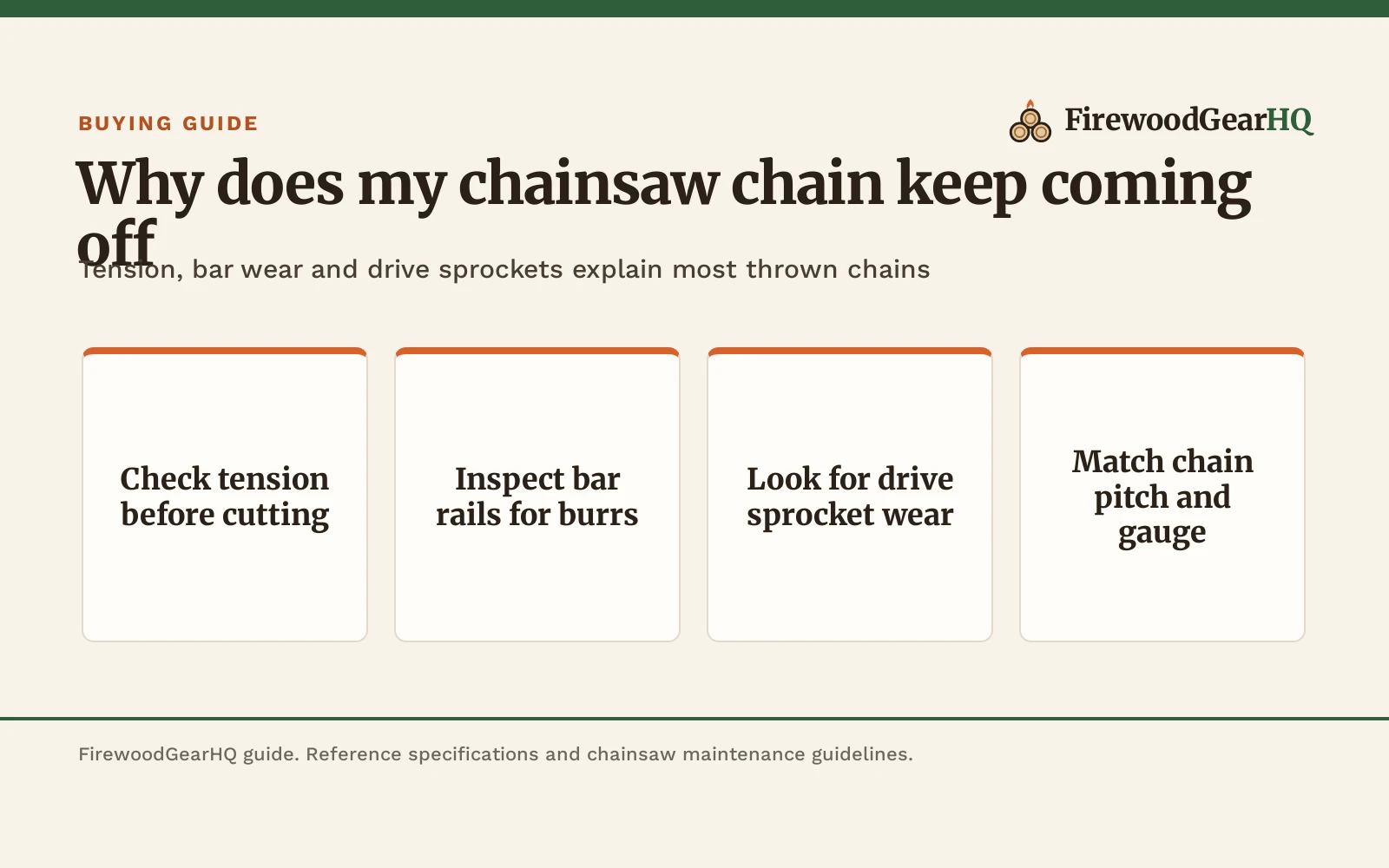
Why does my chainsaw chain keep coming off? A chainsaw chain keeps coming off the guide bar primarily because of inadequate chain tension, worn guide bar rails, or a damaged drive sprocket. Thermal expansion during cutting causes the chain to loosen, while dull cutters force the bar to wander and twist the drive links out of the groove. Correcting tension, dressing bar rails, and ensuring adequate lubrication will keep the chain tracking securely.
FirewoodGearHQ earns a commission when you buy through links on our product pages, at no extra cost to you. Read our affiliate disclosure.
Why does my chainsaw chain keep coming off
Chainsaw chain derailment happens when drive links slip out of the guide bar groove. Centrifugal force pulls the spinning chain outward as it rounds the nose and drive sprocket. Friction heats the metal chain loop, causing thermal expansion that creates excess slack. If you need a reliable chain jumping off bar fix, addressing this tension change and inspecting the rails for abrasive wear provides the immediate solution.
Chainsaw chain specifications and guide bar fit
A replacement chain must match the saw across pitch, gauge, and drive link count. Installing mismatched parts causes derailment regardless of tension settings.
- Pitch: The size classification of the chain loop, determined by rivet spacing. Common pitches include 1/4″, .325″, and 3/8″ LP (low profile). Pitch must match the drive sprocket, as well as the nose sprocket on sprocket-nose guide bars.
- Gauge: Drive link thickness. Common gauges include .043″ and .050″. Running a .043″ chain in a .050″ groove allows wobble and throws the chain.
- Drive link count: The number of drive tangs along the loop, dictated by bar length and power head mount.
Specifications from manufacturer replacement listings show how dimensions vary by specific model rather than establishing universal standards for an entire bar length or engine class.
| Brand and Model | Bar Length | Pitch | Gauge | Drive Links | Listed Fitment in Reference Data |
|---|---|---|---|---|---|
| KUZA | 6 inch | 1/4″ (0.25 inches) | .043″ | 37 | Listed for 6 inch pole saws |
| DILIGENTOOLS | 8 inch | 3/8″ LP (0.38 inches) | .043″ | 33 | Listed for 8 inch pruning saws |
| PBUO | 12 inch | 3/8″ LP | .043″ | 45 | Listed for Dewalt 20V DCCS620 |
| CHJC | 20 inch | .325″ | .050″ | 78 | Listed for select 38 to 55 cc models |
A CHJC listing specifies a 20 inch bar length with .325″ pitch, .050″ gauge, and 78 drive links for select chainsaws in the 38 to 55 cc displacement range, but other 20 inch bars use different counts. A PBUO listing pairs a 12 inch bar with 3/8″ LP pitch, .043″ gauge, and 45 drive links for a 20V battery model. A KUZA listing provides a 6 inch loop with 1/4″ pitch, .043″ gauge, and 37 drive links, while a DILIGENTOOLS listing features an 8 inch loop with 3/8″ LP pitch, .043″ gauge, and 33 drive links. Always verify your bar stamp before selecting a replacement loop.
Common causes of chainsaw chain derailment
Improper chain tension
An overly loose chain sags away from the bar, allowing drive links to disengage during cuts. Conversely, an over-tightened chain strains the sprocket and bearings while preventing oil circulation. If tensioned while hot, a chain contracts as it cools, binding tightly against the bar.
Worn or burred guide bar rails
Friction mushrooms the rail edges, forming burrs that catch drive links. Sawdust wear also makes the groove shallow, forcing drive link tangs to bottom out and tip sideways off the bar.
Worn drive sprocket
Drive links wear deep grooves into sprocket teeth. Worn teeth no longer seat links smoothly, kicking the chain off the side as the sprocket turns.
Inadequate bar and chain oil lubrication
Running without sufficient oil spikes friction and heat, accelerating thermal chain expansion and scorching the rails.
Dull cutting teeth and forced cutting pressure
Dull cutters produce powder rather than shavings. Forcing the cut flexes the guide bar and twists the drive links out of the groove.
Worn chain tensioner pin
A stripped tension screw or dislodged pin allows the guide bar to slide backward during cutting, causing sudden slack.
How to fix a chainsaw chain that keeps coming off
Follow these steps to restore proper chain tracking:
- Shut down and cool: Shut off the engine, engage the chain brake, and disconnect the spark plug boot on gas saws or remove the battery on cordless models. Allow the cutting assembly to cool completely. Wear heavy leather gloves.
- Clean bar groove and oil ports: Scrape packed grime out of the bar groove and clear the oil inlet holes near the bar mount.
- Dress the rails: Remove outer rail burrs with a flat file so the rails are square. Flip the guide bar when reinstalling to balance rail wear.
- Inspect the sprocket: Replace the drive sprocket if teeth show visible grooving before mounting a chain.
- Seat chain and tensioner: Loop the chain over the drive sprocket and into the bar groove with top cutter edges pointing forward toward the bar nose. Engage the adjustment pin in the bar hole and install the clutch cover finger-tight.
- Set tension: Hold the bar nose upward while turning the tension screw clockwise until slack vanishes from the bottom rail. Tighten the bar mounting nuts securely with a scrench.
- Verify snap: Release the chain brake and rotate the chain by hand. Pull down gently on the bottom strand: drive link tangs should pull slightly away while remaining engaged in the groove, snapping back firmly when released.
Safety risks when a chainsaw chain comes off
A thrown chain whips backward at high speed, creating severe laceration risks and kickback hazards. To protect against injury, always wear complete protective equipment:
- Chainsaw chaps: Specialized cut-retardant ballistic fibers that stop a moving chain. Learn how protective layers work in our guide on how chainsaw chaps work.
- Head and face protection: A forestry helmet with mesh face screen and hearing protection. See options in our guide to chainsaw gear.
- Boots and gloves: Steel-toe boots with cut-resistant liners and heavy leather gloves.
- Kickback mitigation: Use low-kickback chain. Listings in our reference data specify chain models meeting ANSI B175.1-2012 kickback requirements as well as CSA Standard Z62.3 safety criteria.
- Operational awareness: Never cut alone. Maintain communication with a partner, following logging practices from the OSHA logging eTool.
Maintaining cutting gear for firewood processing
Regular maintenance ensures smooth cutting. If you need a dedicated firewood saw, review our recommendations for the best chainsaw for firewood. Match cutting capacity to engine size with our guide on how long a chainsaw bar should be. Maintain keen edges with the best chainsaw sharpener and pick replacement loops from the best chainsaw chain guide.
Wear cut-resistant chaps, a helmet with face screen and hearing protection, gloves and sturdy boots. Know where the kickback zone is (the upper tip of the bar), keep the chain brake working and the chain sharp, and never cut alone in the woods. Felling trees is hazardous work: hire a professional for large, leaning or storm-damaged trees, especially near buildings or power lines. See OSHA logging safety for chain saw operators. Read our Safety Disclaimer.
Frequently Asked Questions
Why does my chainsaw chain keep coming off when cutting?
Heat from cutting causes the metal chain loop to expand and loosen. Dull cutters increase cutting pressure, which flexes the bar and twists drive links out of the groove.
How tight should a chainsaw chain be on the bar?
A chain should fit snugly against the bottom rail without sagging. When pulled down gently, drive link tangs should pull slightly away while remaining engaged in the groove, snapping back firmly upon release.
Why does a new chainsaw chain stretch so quickly?
New chains undergo initial break-in elongation as rivets and link holes seat under load. Let the chain cool and re-tension as needed until elongation stabilizes.
Can a worn guide bar cause the chain to derail?
Yes. As rails wear, the groove becomes shallow and outer edges develop burrs, allowing drive links to tip sideways and jump off the bar.
When should a chainsaw drive sprocket be replaced?
Replace the drive sprocket whenever teeth develop noticeable grooving or when drive links begin catching during rotation.
Related guides
Explore advice in the chainsaw hub. If preparing firewood, consult the best chainsaw for firewood, check bar lengths with how long should a chainsaw bar be, and size your saw using what size chainsaw do I need for firewood. Keep cutters sharp with the best chainsaw sharpener and choose loops with the best chainsaw chain. Review safety gear in do chainsaw chaps work and chainsaw gear, or compare platforms in gas chainsaws and battery chainsaws.
About the author
The FirewoodGearHQ editorial team researches firewood and wood heating equipment from published specifications, ratings and warranty terms, and scores every pick the same way. We do not run our own product trials.