Wood Stove vs Wood Furnace: Which One Should You Buy?
Wood stoves and wood furnaces compared on heat distribution, venting, fuel capacity and upkeep, with four product examples from the listings we reviewed.
 By FirewoodGearHQ Editorial
Updated October 9, 2026
By FirewoodGearHQ Editorial
Updated October 9, 2026
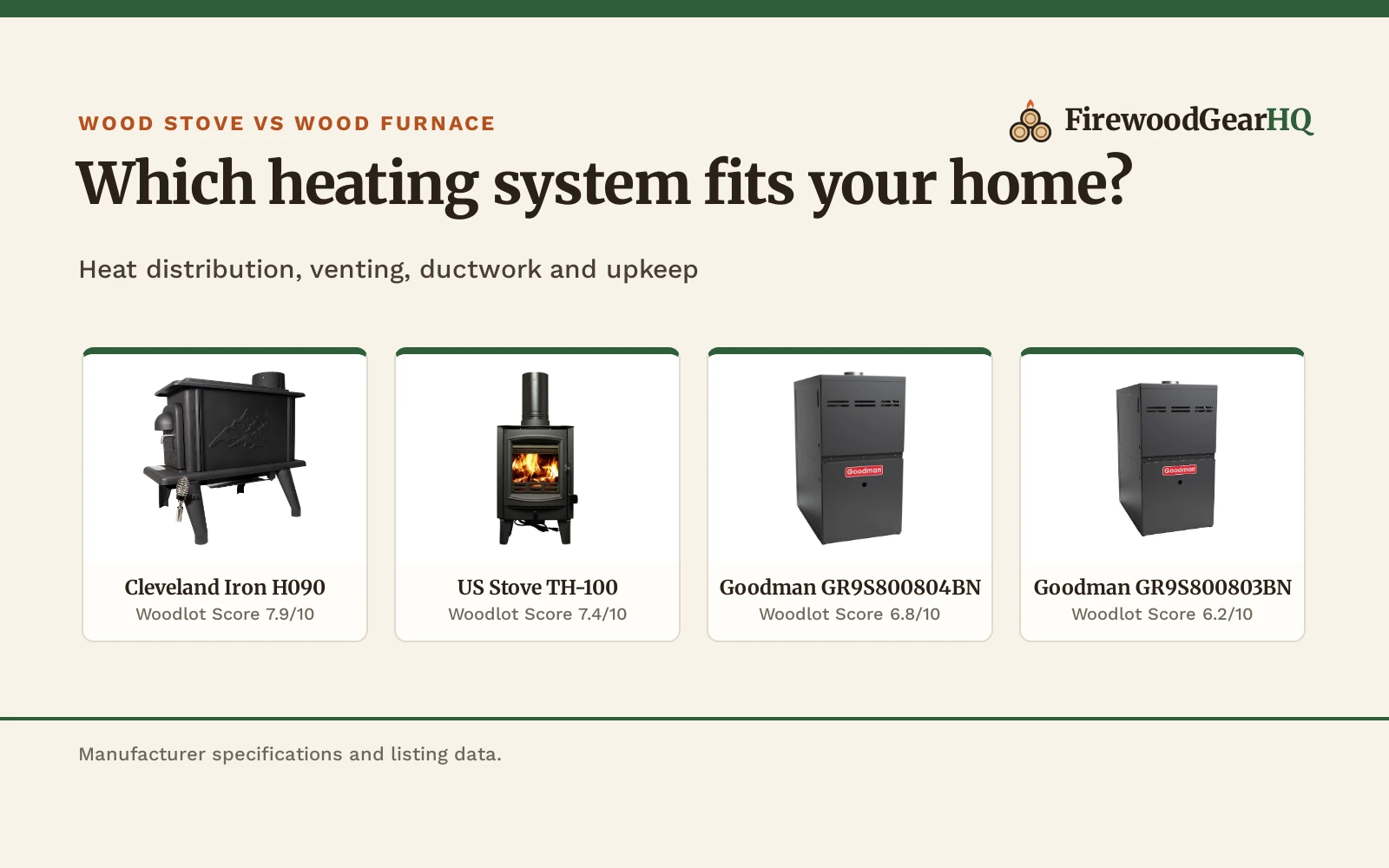
Verdict: Choose a wood stove if you want direct radiant heat, cozy ambiance, and reliable zone heating for a living space or small home without ductwork. Choose a wood furnace if you need central whole-home heating connected to ductwork to warm multiple rooms evenly from a basement or utility room.
Wood stoves and central furnaces heat residential spaces through fundamentally different distribution methods. Comparing a wood stove vs wood furnace comes down to whether you want radiant room warmth in a living area or ducted whole-house airflow from a central heating unit. This comparison covers how both systems operate, followed by four product examples from the listings we reviewed.
FirewoodGearHQ earns a commission when you buy through links on this page, at no extra cost to you. Affiliate disclosure.
Side by side
| Factor | Wood stove | Wood furnace | Verdict |
|---|---|---|---|
| Heating scope | Single room or zone heating | Whole-home central heating | Furnace for whole house, stove for single area |
| Heat distribution | Direct radiant heat and room convection | Forced warm air through central ductwork | Furnace for ducted airflow, stove for radiant warmth |
| Installation location | Living area on hearth pad with proper clearances | Basement, utility room or mechanical space | Stove for living area, furnace for utility space |
| Venting system | Direct flue pipe or chimney (6 in on CIW example) | Central chimney flue or dedicated exhaust vent | Both require professional venting and local code compliance |
| Power dependency | Operates without power (optional corded blower) | Requires electrical power for blower motor | Stove for power outages, furnace needs electricity |
| Upkeep | Ash cleanout, door gasket and chimney sweeping | Filter changes, ductwork and blower maintenance | Stove requires ash removal, furnace requires filter changes |
| Example: Cleveland Iron Works H090 | 27,000 BTU, 900 sq ft, 18 in logs, 77 lb | Not applicable | Cast iron stove pick |
| Example: US Stove TH-100 | 26,000 BTU, 750 sq ft, 11 in logs, 139 lb | Not applicable | Alloy steel stove pick |
| Example: Goodman GR9S800804BN | Not applicable | 80,000 BTU, 80% AFUE, 17.5 in cabinet | Central furnace pick |
| Example: Goodman GR9S800803BN | Not applicable | 80,000 BTU, 80% efficiency, 175 lb | Central furnace pick |
Ranges are typical of the listings we reviewed; example figures are manufacturer rated, collected 9 October 2026.
Wood stove vs wood furnace: heat distribution
A freestanding wood stove sits inside the living area and delivers direct radiant warmth to the room around it. The stove body heats up and radiates energy to walls, furniture, and people, while natural convection circulates warm air through open doorways. This makes wood stoves effective for zone heating or open-concept floor plans, as covered in our guide to the best wood stoves for heating a house.
A central furnace is installed in a basement, mechanical closet, or utility space. Instead of heating the immediate room through radiation, the furnace transfers heat across an internal heat exchanger and uses an electric blower to push forced warm air through ductwork into every connected room. A central furnace warms bedrooms, bathrooms, and closed living areas evenly, but it provides none of the visual flame ambiance or direct radiant glow of a stove.
Venting and installation clearances
Both heating appliances require dedicated venting systems and strict adherence to safety clearances. Never attempt a do-it-yourself installation without proper credentials. Certified heating professionals and chimney sweeps certified by the Chimney Safety Institute of America (CSIA) must handle installation and venting in compliance with manufacturer instructions and National Fire Protection Association (NFPA) standards, as well as local building codes.
Wood stoves vent through a chimney pipe, such as the 6 in flue exhaust collar on the Cleveland Iron Works example. Freestanding stoves require specified clearance distances from combustible walls and must rest on an approved non-combustible floor protector or hearth pad. In addition, home safety standards from the Consumer Product Safety Commission (CPSC) require working smoke alarms and carbon monoxide alarms on every living level of the home, alongside an annual chimney inspection and cleaning by a CSIA-certified sweep.
Fuel capacity and burn time
Wood burning appliances depend on clean, dry firewood to operate efficiently and minimize flue deposits. Following EPA Burn Wise recommendations, wood burners should burn only clean, properly seasoned firewood rather than wet wood, treated lumber, or household trash.
Firebox dimensions determine how large a log a wood stove can accept and how long it burns between reloads. Among the stove listings we reviewed, the compact US Stove example accepts logs up to 11 in with a stated burn time of up to 8 hours, whereas the Cleveland Iron Works listing bullets state capacity for 18 in firelogs with a 1.8 cubic ft firebox. By comparison, the Goodman furnace listings specify heating output rather than log capacity or burn cycles, reflecting their central forced-air configuration.
Power dependency and blowers
A major advantage of a freestanding wood stove is emergency heating independence. A basic wood stove radiates heat by natural draft without requiring electricity, keeping living quarters warm during winter grid outages. Optional blowers, such as the CB36 blower referenced in the US Stove listing, or wood stoves with blowers improve air circulation but require an outlet, while heat-powered fans can circulate warm air without corded power.
In contrast, a central furnace requires continuous electrical power to operate its forced-air blower motor. The Goodman furnace examples feature multi-speed ECM motors that regulate duct airflow. Without electricity from the grid or an auxiliary generator, a central furnace blower cannot distribute warm air through household ducts.
Upkeep and maintenance
Both heating setups require seasonal maintenance. Wood stoves require routine ash cleanouts from the firebox, periodic door rope gasket checks to maintain an airtight seal, and annual chimney flue sweeping. Ash removal is made easier using dedicated tools, such as those in our best ash vacuums for wood stoves guide.
Central ducted furnaces require regular return air filter replacements, duct cleaning, and periodic inspections of the blower motor and heat exchanger. Heating appliances should be inspected annually by a certified technician before each heating season.
Four examples
| Award | Product | Woodlot Score About the HQ ScoreThe Woodlot Score runs from 0 to 10 and weighs performance (35%), build (25%), value (25%), safety (10%, where it applies) and warranty (5%), using only what the manufacturer and the listing publish. How we pick › | |
|---|---|---|---|
 Cleveland Iron Works Single Burn Rate Stove
|
7.9/10 | Buy | |
 US STOVE 750 SQ FT STOVE, 75% EFFICIENT
|
7.4/10 | Buy | |
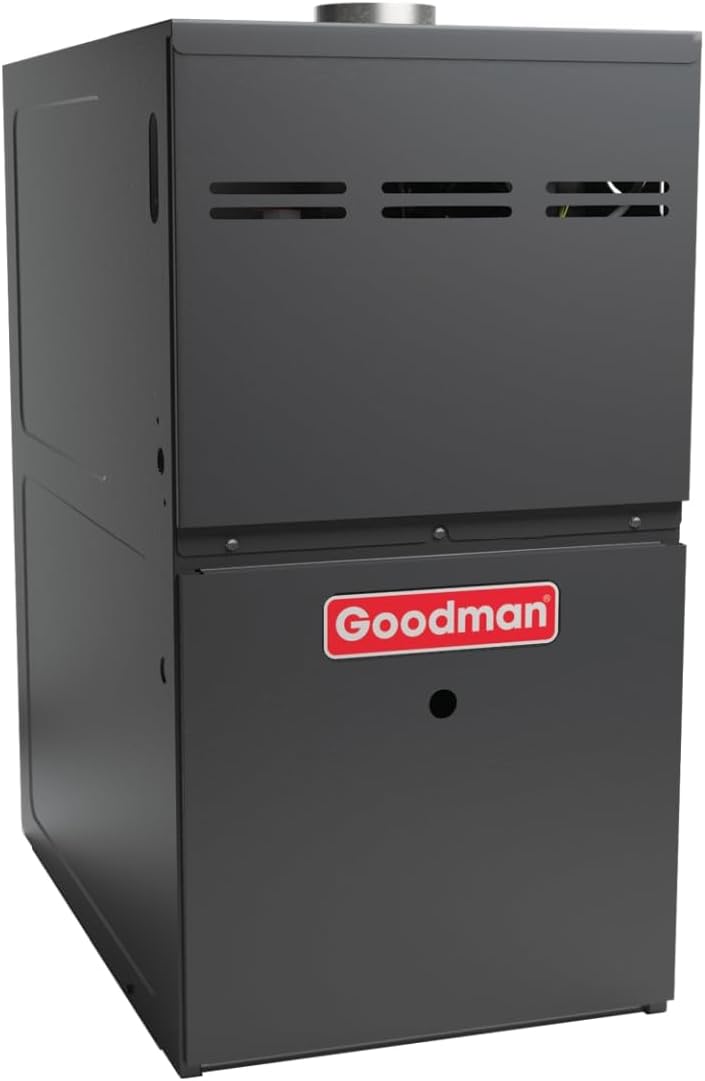 Goodman 80,000 BTU 80% Efficiency multi-speed
|
6.8/10 | Buy | |
 Goodman 80,000 BTU 80% Efficiency Multi-Speed
|
6.2/10 | Buy |
Cleveland Iron Works Single Burn Rate Stove
A freestanding single burn rate cast iron wood stove rated for 27,000 BTU, heating up to 900 sq ft, holding 18 in logs, with EPA listing and a 1 year limited warranty.
Pros
- Cast iron construction with ceramic rope door gasket
- EPA Listed and approved for clean burning
- Accommodates up to 18 in logs per bullet claims
- 1 year limited warranty stated by the manufacturer
Cons
- Spec table contradicts bullets on coverage (2,000 vs 900 sq ft)
- Spec table lists 16 in log length while bullets state 18 in
- Single burn rate design offers limited burn rate adjustment
- Listed weight of 77 lb requires care during placement
US STOVE 750 SQ FT STOVE, 75% EFFICIENT
An alloy steel freestanding wood stove rated at 26,000 BTU, heating up to 750 sq ft, with EPA certification, 75% efficiency, and mobile home approval.
Pros
- EPA Certified with a stated 75% efficiency rating
- Mobile home approved for installation in the USA
- Stated burn time of up to 8 hours
- Heavy 139 lb alloy steel freestanding build
Cons
- No warranty term is stated
- Accepts logs only up to 11 in long
- Blower is not included and sold separately (CB36)
- Stove pipe is not included
Goodman 80,000 BTU 80% Efficiency multi-speed
An 80,000 BTU multi-speed central furnace with 80% efficiency, aluminized steel heat exchanger, and 10-year parts limited warranty upon registration.
Pros
- 80,000 BTU output for central whole-home heating
- Multi-speed ECM motor enhances airflow control
- Aluminized steel primary heat exchanger
- 10-year parts and unit replacement limited warranty upon registration
Cons
- Tagged under wood furnace but spec table states natural gas fuel
- Spec table contains an erroneous 40 ton capacity claim
- No safety certification is stated in the listing
- Thermostat, linesets, and LP conversion kit sold separately
Goodman 80,000 BTU 80% Efficiency Multi-Speed
An 80,000 BTU multi-speed central furnace featuring 80% efficiency, aluminized steel heat exchanger, 17.5 in cabinet, and listed 175 lb weight.
Pros
- 80,000 BTU heating capacity for ducted systems
- Multi-speed ECM motor for controlled airflow
- Aluminized steel primary heat exchanger
- 17.5 in wide cabinet fits standard furnace footprints
Cons
- No warranty term is stated
- No safety certification is stated in the listing
- Spec table lists absurd 762 x 901.7 x 469.9 in dimensions
- Thermostat, linesets, and LP conversion kit sold separately
How we scored them
Each example is scored out of 100 on performance, build, value, safety and warranty, using only what the listing publishes. The weights are on our How We Pick page.
| Product | Woodlot Score | Perf. /35 | Build /25 | Value /25 | Safety /10 | Warranty /5 |
|---|---|---|---|---|---|---|
| Cleveland Iron H090 | 7.9 | 29 | 19 | 20 | 8 | 3 |
| US Stove TH-100 | 7.4 | 27 | 20 | 19 | 8 | 0 |
| Goodman GR9S800804BN | 6.8 | 28 | 18 | 19 | 0 | 4 |
| Goodman GR9S800803BN | 6.2 | 28 | 16 | 18 | 0 | 0 |
Install stoves and inserts to the manufacturer's instructions and your local code, usually by a certified installer with a permit and inspection. Keep the listed clearances to combustibles, run working smoke and carbon monoxide detectors, have the chimney inspected and cleaned every year to prevent creosote fires, burn only seasoned wood, and check local burn rules. See EPA Burn Wise, NFPA heating safety, CPSC carbon monoxide guidance and the Chimney Safety Institute of America (CSIA). Read our Safety Disclaimer.
Frequently Asked Questions
What is the primary difference between a wood stove and a wood furnace?
A wood stove is a room heater that radiates heat directly into living spaces, while a wood furnace is a central appliance that distributes heated air through ductwork to the entire house.
Can a wood stove heat an entire house?
A freestanding wood stove is designed primarily for zone heating rather than even whole-house distribution. While a stove can warm an open layout, rooms separated by walls or doors will remain significantly cooler without central ductwork.
Where should you place a wood stove thermometer?
Place a magnetic stove thermometer on the stovetop or on the single-wall flue pipe above the stove, following the meter maker’s placement guidelines.
Do wood stoves work during a power outage?
Yes. Freestanding wood stoves rely on natural draft and radiant heat transfer, so the stove continues to provide radiant heat without electrical power, although optional electric blowers will not operate during an outage. Central furnaces require electricity to run their blower motors.
Is the federal wood stove tax credit still available?
No. The federal tax credit for biomass stoves expired for recent installations and is no longer available.
Related guides
See the wood stove hub, the best wood stoves for heating a house, the best wood burning stoves with blower, our guide on how long to season firewood, the best wood stove thermometers, and the best ash vacuums for wood stoves.
About the author
The FirewoodGearHQ editorial team researches firewood and wood heating equipment from published specifications, ratings and warranty terms, and scores every pick the same way. We do not run our own product trials.