Wood Burning Stove vs Fireplace: Which One Should You Buy?
Wood burning stoves and fireplaces compared on heat delivery, smoke drafting, safety certifications, clearances and fuel options, with four examples from the listings we reviewed.
 By FirewoodGearHQ Editorial
Updated October 9, 2026
By FirewoodGearHQ Editorial
Updated October 9, 2026
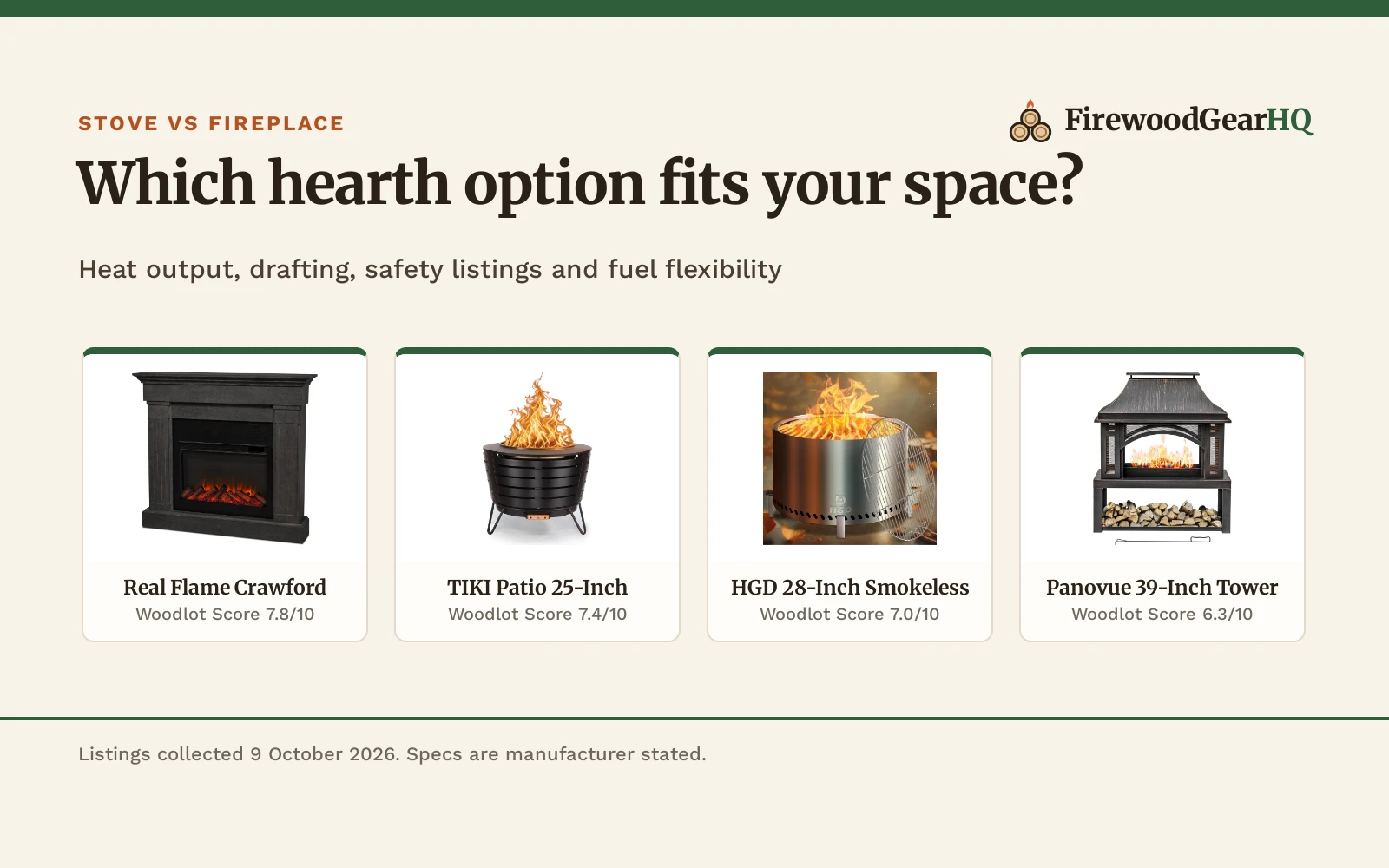
Verdict: In the wood burning stove vs fireplace debate, choose a wood burning stove if you want secondary combustion airflow for cleaner outdoor burning, concentrated warmth, or patio cooking with an included grill grate. Choose a fireplace if you want open flame visibility with a chimney flue to direct smoke overhead, or vent-free supplemental indoor electric heating with a mantel.
When deciding between a wood burning stove vs fireplace, both hearth styles provide warmth and fireside ambiance, but they direct airflow and heat differently. The wood burning stove listings in our review use double-wall construction to promote secondary combustion, burning wood gases more thoroughly with less smoke. The fireplace listings focus on traditional hearth drafting through a vertical chimney stack, or provide vent-free electric supplemental heat for indoor rooms. This head-to-head comparison breaks down what separates the two sides, using four concrete listing examples from our review.
FirewoodGearHQ earns a commission when you buy through links on this page, at no extra cost to you. Affiliate disclosure.
Side by side
| Factor | Wood burning stove | Outdoor fireplace | Electric fireplace |
|---|---|---|---|
| Primary location | Outdoors (patio, deck, campsite) | Outdoors (patio, garden, campsite) | Indoors (living room, bedroom) |
| Combustion style | Secondary combustion airflow with double walls | Natural vent chimney tower | Vent-free electric heating element |
| Smoke management | Smokeless secondary burn airflow | Upward chimney drafting | Zero smoke or emissions |
| Cooking capability | Grill grate included on HGD; optional griddle for TIKI | Not stated on Panovue | None on electric Real Flame |
| Safety certification | Not stated on TIKI or HGD listings | Not stated on Panovue listing | CSA and FCC certified with automatic shut-off |
| Warranty term | Not stated on TIKI or HGD listings | Not stated on Panovue listing | Not stated |
| Weight example | 29.8 lb (HGD) to 45 lb (TIKI) | 20 lb (Panovue) | 87 lb (Real Flame) |
| Dimensions example | 24.75 x 18.75 in (TIKI) to 28 x 17.5 in (HGD) | 39 x 21.2 x 45.66 in (Panovue) | 47.5 x 9.5 x 42 in (Real Flame) |
Specifications are based on the listings we reviewed; example figures are manufacturer stated, collected 9 October 2026.
Wood burning stove vs fireplace: heating and airflow
The primary operational difference between these two hearth styles is how they manage combustion airflow and exhaust. The wood burning stoves we reviewed, including the TIKI Patio 25-Inch and the HGD 28-Inch models, use double-wall airflow channels. As the fire burns, air enters lower vents, rises between the walls where it preheats, and exits upper vents into the flame. This secondary combustion burns smoke particles before they escape, keeping smoke output low around seating areas.
The fireplace category offers two distinct approaches in our review. The Panovue outdoor fireplace uses a classic chimney tower design with natural drafting, drawing combustion air through a mesh-screened firebox and directing smoke upward above seating height. For indoor living spaces, the Real Flame Crawford electric fireplace eliminates combustion entirely, using a 1500-watt heating element and fan to circulate warm air into rooms up to 1,000 sq ft while displaying simulated flame effects.
Installation, clearances, and safety
Safe operation depends on the appliance style, fuel type, and installation setting. For any indoor wood-burning stove or built-in masonry fireplace, building codes and NFPA standards mandate strict clearances to combustible walls, dedicated hearth pads, and proper flue drafting. Homeowners should never attempt structural stove or chimney installations on their own; always consult certified professionals, such as CSIA-certified sweeps or NFI-certified technicians, and maintain working smoke and carbon monoxide alarms on every level.
Outdoor units require different precautions. Freestanding wood stoves and chiminea fireplaces like the TIKI, HGD, and Panovue models should be operated on stable, noncombustible surfaces with adequate clearance from combustible overhangs and dry vegetation. In accordance with EPA Burn Wise guidance, burning only dry, seasoned firewood reduces excess sparking and unburned residues. For indoor electric fireplaces, venting is unnecessary: the Real Flame unit is CSA and FCC certified, requires no chimney, and plugs directly into a standard three-prong household outlet with automatic overheat shut-off. Note that the federal tax credit for biomass stoves has expired and is no longer available.
Cooking and outdoor versatility
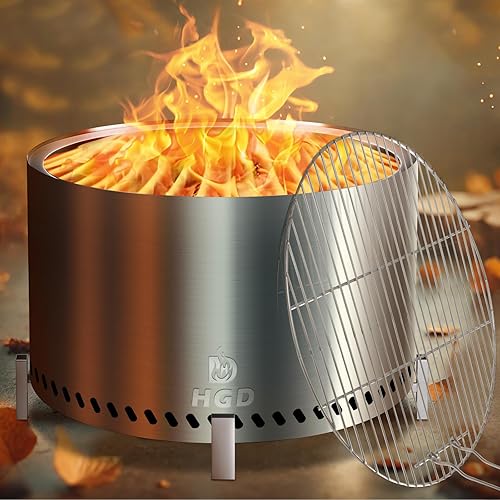
Another separation point is cooking functionality. Dedicated outdoor wood burning stoves frequently incorporate cooking surfaces. For example, the HGD 28-inch wood burning stove includes an integrated top grill grate that converts the fire bowl into an outdoor barbecue and cooking station, while the TIKI listing notes compatibility with optional griddle and tabletop accessories. In contrast, outdoor chiminea fireplaces like the Panovue unit prioritize spark containment with a full mesh screen, fire poker handling, and integrated firewood storage rather than food preparation.
Four examples from our review
| Award | Product | Woodlot Score About the HQ ScoreThe Woodlot Score runs from 0 to 10 and weighs performance (35%), build (25%), value (25%), safety (10%, where it applies) and warranty (5%), using only what the manufacturer and the listing publish. How we pick › | |
|---|---|---|---|
 Real Flame Crawford Slim Indoor Electric Fireplace
|
7.8/10 | Buy | |
 TIKI Patio 25-Inch Smokeless Outdoor Wood Burning
|
7.4/10 | Buy | |
 HGD 28" Smokeless Fire Pit with Stand & Grill
|
7.0/10 | Buy | |
 Panovue 39 Inch Fire Pits with Outdoor Chimney
|
6.3/10 | Buy |
Real Flame Crawford Slim Indoor Electric Fireplace
A freestanding indoor electric fireplace with a 47.5-inch mantel, 5100 BTU heater rated for up to 1,000 sq ft, multi-color flame settings, remote control, and anti-topple safety hardware.
Pros
- CSA and FCC certified with automatic shut-off
- Adjustable thermostat and timer up to 9 hours
- Rated to heat up to 1,000 sq ft with 5100 BTUs
- Six flame colors and five brightness levels
Cons
- Indoor electric only; requires wall outlet
- Contradicts heat output between 5100 and 4,780 BTUs
- Assembly required for 87 lb mantel unit
- Mantel holds up to 30 lbs, cannot hold a direct TV
TIKI Patio 25-Inch Smokeless Outdoor Wood Burning
A 25-inch outdoor smokeless wood-burning fire pit built from 16-gauge stainless steel with a powder-coated black finish, 4-foot heat radius, removable ash pan, stand, and weather-resistant cover.
Pros
- Built from 16-gauge stainless steel with powder coating
- Removable ash pan simplifies post-fire cleanout
- Includes stand and weather-resistant cover
- Burns standard cut firewood or fuel packs
Cons
- No warranty term is stated
- No safety certifications are stated
- Outdoors only; listed at 45 pounds
- Accessories like screen and griddle sold separately
HGD 28" Smokeless Fire Pit with Stand & Grill
A 28-inch round stainless steel outdoor wood-burning stove and fire pit with secondary combustion, 360-degree airflow, integrated grill grate, stand base, and removable ash pan.
Pros
- Integrated grill rack included for campfire cooking
- Double-wall secondary combustion airflow design
- Polished stainless steel construction
- Includes stable stand base and removable ash pan
Cons
- No warranty term is stated
- No safety certifications are stated
- Outdoors only; requires outdoor ventilation
- 28-inch footprint requires dedicated patio space
Panovue 39 Inch Fire Pits with Outdoor Chimney
A 45.66-inch tall outdoor chiminea fireplace with chimney-style smoke ventilation, full mesh spark screen, removable bottom base plate, built-in log storage, and fire poker.
Pros
- Chimney directs smoke upward away from seating
- Full mesh spark screen and fire poker included
- Built-in lower compartment for firewood storage
- Dual-use design with removable bottom base plate
Cons
- Listing contradicts material between steel and iron
- No warranty term is stated
- No safety certifications are stated
- Only 20 lb listed weight for a 45.66-inch tower
How we scored them
Each example is scored out of 100 on performance, build, value, safety and warranty, using only what the listing publishes. The weights are on our How We Pick page.
| Product | Woodlot Score | Perf. /35 | Build /25 | Value /25 | Safety /10 | Warranty /5 |
|---|---|---|---|---|---|---|
| Real Flame Crawford | 7.8 | 28 | 21 | 21 | 8 | 0 |
| TIKI Patio 25-Inch | 7.4 | 30 | 22 | 21 | 0 | 0 |
| HGD 28-Inch Smokeless | 7.0 | 29 | 20 | 21 | 0 | 0 |
| Panovue 39-Inch Tower | 6.3 | 26 | 18 | 20 | 0 | 0 |
Install stoves and inserts to the manufacturer's instructions and your local code, usually by a certified installer with a permit and inspection. Keep the listed clearances to combustibles, run working smoke and carbon monoxide detectors, have the chimney inspected and cleaned every year to prevent creosote fires, burn only seasoned wood, and check local burn rules. See EPA Burn Wise, NFPA heating safety, CPSC carbon monoxide guidance and the Chimney Safety Institute of America (CSIA). Read our Safety Disclaimer.
Frequently Asked Questions
Is a wood burning stove a fireplace?
No. While both provide hearth warmth, a wood burning stove typically relies on specialized air channels or an enclosed combustion chamber for focused heat. A traditional fireplace uses an open hearth with an upward drafting chimney flue, while an electric fireplace uses an electric heating element with fan circulation.
What is a wood burning stove for?
A wood burning stove is designed for controlled heating. Outdoor double-wall stoves provide concentrated warmth and low-smoke flames for patio gatherings and campfire cooking, while indoor wood stoves are built to heat indoor living quarters.
Can wood burning stoves emit carbon monoxide?
Yes. Any wood-burning appliance produces carbon monoxide when fuel burns. Outdoor wood burning stoves must always be used in open outdoor areas with natural air movement. Indoor wood-burning appliances require dedicated venting flues and nearby carbon monoxide alarms.
Do outdoor wood burning stoves need a chimney?
Not necessarily. Outdoor smokeless stoves like the TIKI and HGD models use secondary airflow vents to reduce smoke without a tall chimney. In contrast, chiminea-style outdoor fireplaces like the Panovue model use a vertical chimney stack to direct smoke upward above head height.
Related guides
Explore our complete wood stoves category, compare options in our best wood stove for heating a house guide, or see the best wood burning stove with blower review. For fireplace hearth setups, read our guides on the best electric fireplace inserts and the fireplace screen for wood burning stove.
About the author
The FirewoodGearHQ editorial team researches firewood and wood heating equipment from published specifications, ratings and warranty terms, and scores every pick the same way. We do not run our own product trials.