Best Wood Stove Fan: 5 Heat-Powered Fans Compared
Five heat-powered wood stove fans compared by blades, operating temperature, airflow, size, overheat protection and warranty, from a Canadian-made Ecofan to 8-blade budget fans.
 By FirewoodGearHQ Editorial
Updated October 5, 2026
By FirewoodGearHQ Editorial
Updated October 5, 2026
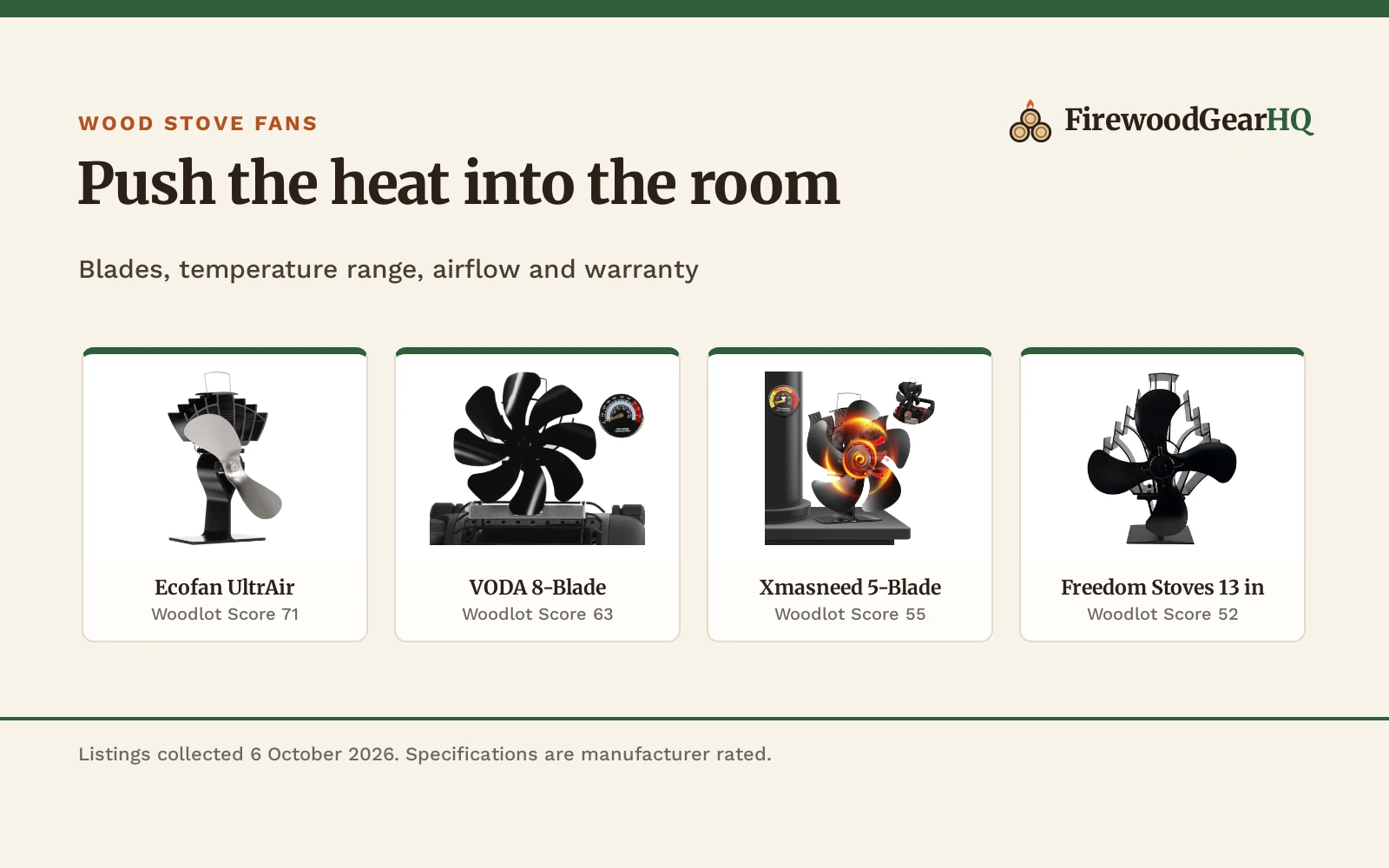
A wood stove heats the air above it first, and that warm air tends to pool near the ceiling and the stove. A heat-powered stove fan sits on the stove top, makes its own electricity from the heat, and pushes warm air out into the room with no cord or battery. This guide compares five fans by blades, operating temperature, airflow, size, overheat protection and warranty.
FirewoodGearHQ earns a commission when you buy through links on this page, at no extra cost to you. Affiliate disclosure.
Quick picks
- Best Overall Ecofan UltrAir: Ecofan UltrAir: made in Canada, 125 CFM, FingerSafe blades, replacement motors and a 2 year warranty. Check price
- Best Value VODA 8-Blade: VODA 8-blade with overheat lift, a stove thermometer, a bracket and a 12 month warranty. Check price
- Most Airflow Stated Freedom Stoves 13 in: Freedom Stoves 13 in, dual motor, 348 CFM for medium to large rooms. Check price
- Best 5-Blade Xmasneed 5-Blade: Xmasneed 5-blade with bimetal overheat protection and a magnetic thermometer. Check price
Compare the picks
| Model | Woodlot Score | Blades | Operating temperature | Airflow (stated) | Height | Overheat protection | Warranty (stated) |
|---|---|---|---|---|---|---|---|
| Ecofan UltrAir | 71 | 2 | Not stated | 125 CFM | 10.5 in | Not stated | 2 years |
| VODA 8-Blade | 63 | 8 | Starts about 140F; 176 to 653F | Not stated | 6.5 in | Bimetal lift | 12 months |
| Xmasneed 5-Blade | 55 | 5 | 158 to 644F | Not stated | Not stated | Bimetal lift | Not stated |
| Freedom Stoves 13 in | 52 | 4 | Not stated | 348 CFM | 13 in | Not stated | Satisfaction guarantee only |
| COMBIUBIU 4-Blade | 51 | 4 | 176 to 482F (max 662F) | 210 CFM | 8.8 in | Not stated | Not stated |
Specifications are manufacturer rated, collected 5 October 2026. Airflow figures are the brands’ own and are not comparable between brands.
The picks
| Award | Product | Woodlot Score About the HQ ScoreThe Woodlot Score runs from 0 to 100 and weighs rated performance, build, value, safety listing and warranty, using only what the manufacturer and the listing publish. How we pick › | |
|---|---|---|---|
 Ecofan UltrAir Heat Powered Stove Fan
|
71/100 | Buy | |
 VODA Wood Stove Fan Heat Powered 8 Blades
|
63/100 | Buy | |
 Wood Stove Fan, Fireplace Fan for Wood Burning
|
55/100 | Buy | |
 Freedom Stoves Heat Powered Stove Fan
|
52/100 | Buy | |
 COMBIUBIU Wood Stove Fan 4 Blade Fireplace Fan
|
51/100 | Buy |
Ecofan UltrAir Heat Powered Stove Fan
A heat-powered thermoelectric stove fan made in Canada by Caframo, with two FingerSafe aluminum blades, 125 CFM airflow, replacement motors available and a 2 year warranty.
Pros
- Designed and made in Canada by Caframo
- 2 year manufacturer warranty, replacement motors sold
- FingerSafe blades
- 125 CFM stated airflow from a 2-blade design
Cons
- Operating temperature range not stated on the listing
- Costs several times more than generic fans
- Two blades look less impressive than 5 or 8
- No overheat protection described
VODA Wood Stove Fan Heat Powered 8 Blades
A heat-powered 8-blade stove fan that starts spinning around 140F, runs from 176 to 653F, lifts itself off the stove near its maximum, and comes with a stove thermometer and bracket.
Pros
- Bimetal strip lifts the fan near maximum temperature
- Stove thermometer and mounting bracket included
- Clear operating range: 176 to 653F
- 12 month warranty stated
Cons
- Airflow not stated
- Small: 6.5 in tall
- Bracket is aimed at portable propane heaters, not wood stoves
- Mixed owner ratings for a best seller
Wood Stove Fan, Fireplace Fan for Wood Burning
A heat-powered 5-blade stove fan rated for 158 to 644F stove surfaces, with a bimetal strip that lifts the fan near its maximum and a magnetic thermometer included.
Pros
- Bimetal overheat protection
- Magnetic thermometer included
- Wide stated range: 158 to 644F
- Placement advice in the listing
Cons
- Plastic blades per the listing table
- Airflow not stated
- No warranty term stated
- Listed dimensions look like the box, not the fan
Freedom Stoves Heat Powered Stove Fan
A large heat-powered dual-motor stove fan, 13 in tall with 4 metal blades and a stated 348 CFM, for wood and pellet stoves in medium to large rooms.
Pros
- 348 CFM stated, the most here
- Dual motor, 4 blades
- 13 in tall, clears most stove pipes
- Durable aluminum build
Cons
- Bullets say 14 in blade design, table says 13 in fan
- No temperature range stated
- No overheat protection described
- Satisfaction guarantee, no warranty term
COMBIUBIU Wood Stove Fan 4 Blade Fireplace Fan
A heat-powered 4-blade stove fan rated for 176 to 482F with a 662F maximum, a stated 210 CFM and about 25 dB, sitting 8.8 in tall.
Pros
- Clear operating range and hard maximum
- Aluminum blades
- Quiet, 25 dB stated
- No assembly
Cons
- 210 CFM claim is high for a 4-blade fan this size
- No overheat protection described
- No warranty term stated
- Listing table says wood material, which is wrong
How we scored them
Each fan is scored out of 100 on performance, build, value, safety and warranty, using only what the listing publishes. Overheat protection and finger-safe blades earn safety credit. The weights are on our How We Pick page.
| Product | Woodlot Score | Perf. | Build | Value | Safety | Warranty |
|---|---|---|---|---|---|---|
| Ecofan UltrAir | 71 | 22 | 19 | 14 | 6 | 10 |
| VODA 8-Blade | 63 | 21 | 13 | 18 | 5 | 6 |
| Xmasneed 5-Blade | 55 | 20 | 13 | 17 | 5 | 0 |
| Freedom Stoves 13 in | 52 | 24 | 14 | 14 | 0 | 0 |
| COMBIUBIU 4-Blade | 51 | 19 | 11 | 18 | 3 | 0 |
Buying guide: choosing a wood stove fan
How heat-powered fans work
A thermoelectric module in the base produces a small current when its bottom is hot and its top fins are cooler. The bigger the temperature difference, the faster the fan spins. That is why these fans slow down if the room gets very hot, and why placement matters.
Operating temperature
Every fan has a maximum stove-top temperature; above it the module can be damaged. A bimetal strip that lifts the fan near the limit is a useful safeguard. Either way, keep a stove thermometer on the top and stay within the range.
Blades and airflow
More blades do not always mean more air. Larger, well-shaped blades on a quality motor can move more air than many small ones. Brands rate airflow differently, so compare fans by reputation and warranty as much as by CFM.
Placement
Set the fan toward the back of the stove top, beside the flue pipe, so it pulls cooler air from behind and pushes warm air into the room. Keep it away from the pipe itself and off any surface hotter than its rating.
Size and fit
Check stove-top space and clearance under any shelf or pipe. A tall fan on a small stove can tip.
A fan helps most when the stove is sized right and burning dry wood. Use the wood stove size calculator and check your wood with a firewood moisture meter.
Estimate the heat output and stove size class for your space from square footage, insulation and climate.
Install stoves and inserts to the manufacturer's instructions and your local code, usually by a certified installer with a permit and inspection. Keep the listed clearances to combustibles, run working smoke and carbon monoxide detectors, have the chimney inspected and cleaned every year to prevent creosote fires, burn only seasoned wood, and check local burn rules. See EPA Burn Wise, NFPA heating safety, CPSC carbon monoxide guidance and the Chimney Safety Institute of America (CSIA). Read our Safety Disclaimer.
Frequently Asked Questions
Do wood stove fans really work?
They move warm air away from the stove and into the room, which usually makes the room feel more even. They do not add heat; they spread what the stove makes.
Where should I put a wood stove fan?
Toward the back of the stove top, beside the flue pipe, facing the room, within the fan’s temperature range.
Why does my stove fan spin slowly?
Either the stove top is not hot enough, or the room around the fan’s fins is too warm. Moving it further back toward cooler air often helps.
Can a stove fan overheat?
Yes. Running above the stated maximum can damage the module. Use a stove thermometer and choose a fan with overheat protection if your stove runs hot.
Do I need a fan on a stove with a blower?
Usually not. A built-in blower moves more air. Heat-powered fans suit stoves without one.
Related guides
See the stove accessories hub and wood stoves. Burn dry wood stored on a covered firewood rack, and see which species burn hottest in our firewood species guide, from hickory to oak. Wet wood is the most common reason a stove underheats; check it with a firewood moisture meter.
About the author
The FirewoodGearHQ editorial team researches firewood and wood heating equipment from published specifications, ratings and warranty terms, and scores every pick the same way. We do not run our own product trials.