Who Makes the Best Log Splitter?
Who makes the best log splitter depends on whether your woodpile needs compact electric power, portable manual hydraulics or high-speed kinetic splitting.

On this page
Top picks at a glance
As an Amazon Associate we earn from qualifying purchases.
- 1
 KABIN Kindle Quick Log Splitter9.7/10View on Amazon
- 2
 Kindling Splitter L9.6/10View on Amazon
- 3
 Cast Iron Kindling Splitter with 3Lbs Sledge Hammer9.6/10View on Amazon
- 4
 BILT HARD Log Splitter 6.5 TonView on Amazon
- 5
 Landworks Portable 20-Ton Gas Log SplitterView on Amazon
- 6
 1844 Helko Werk Germany Vario Heavy Log SplitterView on Amazon
- 7
 SuperHandy Hydraulic Log SplitterView on Amazon
- 8
 YARDMAX YS0650 6.5 Ton Electric Log SplitterView on Amazon
- 9
 BILT HARD 6.5 Ton Log SplitterView on Amazon
When crisp autumn mornings arrive and rounds of freshly bucked firewood start piling up in the yard, deciding who makes the best log splitter comes down to how much wood you burn and what kind of timber sits on your ground. No single manufacturer builds the right machine for every woodlot. The best maker depends on whether your woodpile demands a clean electric hydraulic unit for residential rounds, a portable manual hydraulic pump for quiet off-grid work, or a heavy gas kinetic machine built for rapid production speed.
More options to compare
 BILT HARD Log Splitter 6.5 TonCheck price on Amazon
 Landworks Portable 20-Ton Gas Log SplitterCheck price on Amazon
 1844 Helko Werk Germany Vario Heavy Log SplitterCheck price on Amazon
 SuperHandy Hydraulic Log SplitterCheck price on Amazon
 YARDMAX YS0650 6.5 Ton Electric Log SplitterCheck price on Amazon
 BILT HARD 6.5 Ton Log SplitterCheck price on Amazon
FirewoodGearHQ may earn a small commission if you buy through links on this page. The price you pay stays the same. Read our affiliate disclosure.
The quick answer: who makes the best log splitter
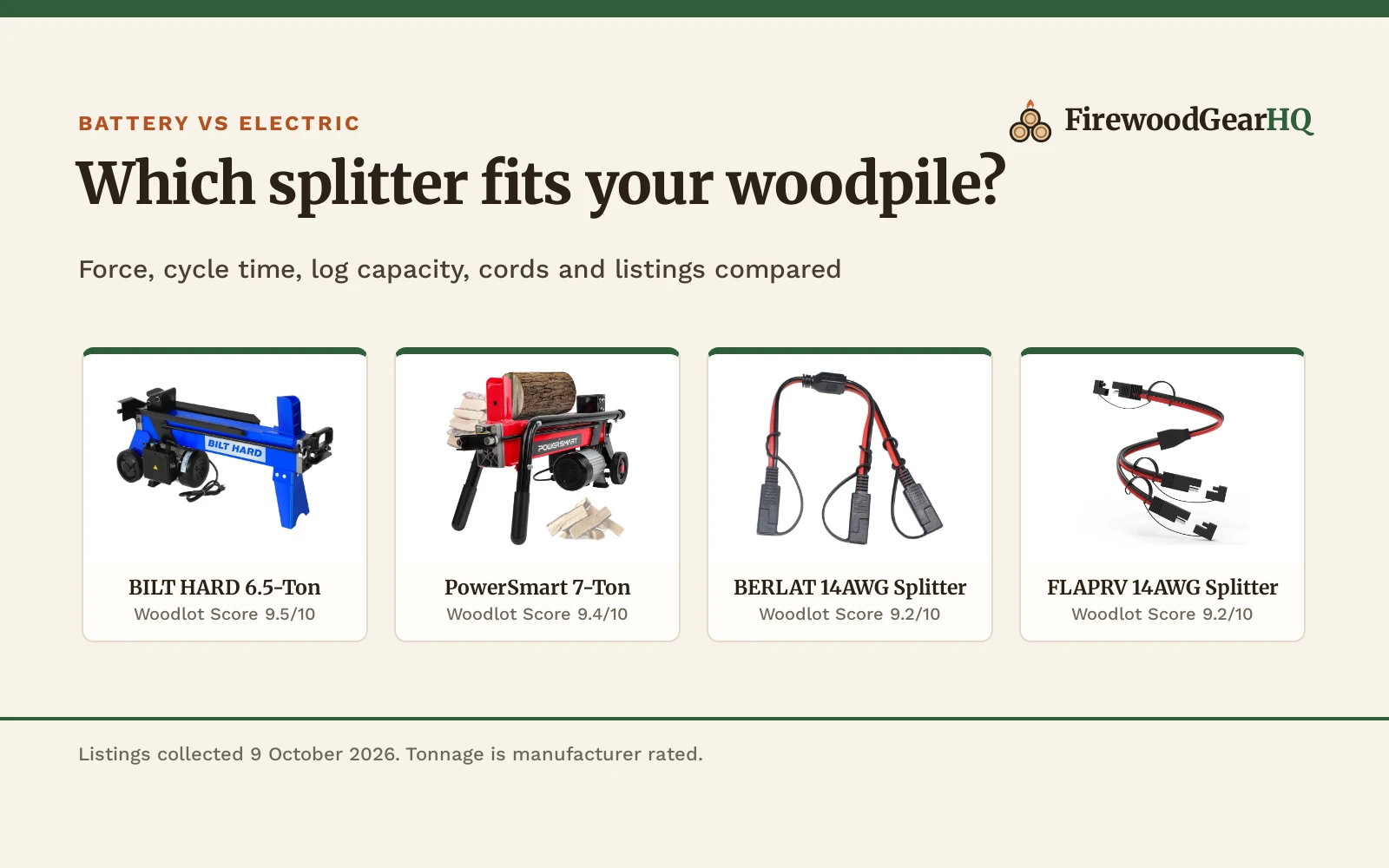
For residential firewood near an outlet, electric hydraulic makers like BILT HARD and ROCKCUB eliminate engine maintenance and exhaust fumes. BILT HARD builds a 6.5-ton electric splitter with a 15 amp motor that takes logs up to 9.8 inches in diameter and 20.5 inches long, elevating the bed to a 33-inch working height on 120V power. ROCKCUB offers a 7-ton electric hydraulic unit with a 3 HP motor, an 18-second cycle time, and a 22-inch log capacity, weighing 95 pounds.
For remote campsites or off-grid cabins, Takywep produces a 12-ton manual hydraulic splitter with a 2-speed hand pump, 37 in. handles, and a 97.4-pound frame handling logs up to 18.7 in. long and 8 in. in diameter. For high-volume cutting, MechMaxx manufactures a 34-ton kinetic splitter with a 7 HP Ducar gas engine (212 cc), a 3-second cycle time, and a 28-inch diameter capacity at 545 pounds, alongside a 20-ton processor with an 18-inch chainsaw for logs up to 24 inches long and 15 inches in diameter.
Choosing the best log splitter for home use or shopping for the best vertical log splitter means matching tonnage, cycle speed and drive mechanism to your woodpile.
Log splitter specifications by manufacturer
| Manufacturer | Drive type and rating | Stated specifications | Woodpile role |
|---|---|---|---|
| BILT HARD | Electric hydraulic (6.5-ton) | 15 amp motor; 120V; 9.8 in. diameter; 20.5 in. length; 33-inch stand height | Residential hearth wood and garage splitting near an outlet |
| ROCKCUB | Electric hydraulic (7-ton) | 3 HP motor; 18-second cycle time; 22-inch log length; 95 pounds | Yard firewood prep and kindling splitting |
| Takywep | Manual hydraulic (12-ton) | 2-speed pump; 37 in. handles; 18.7 in. length; 8 in. diameter; 97.4 pounds | Remote property maintenance, off-grid cabins and quiet camping prep |
| MechMaxx | Gas kinetic (34-ton) | 7 HP Ducar gas engine (212 cc); 3-second cycle time; 28 in. diameter; 545 pounds | High-volume firewood cutting where flywheel speed accelerates production |
| MechMaxx | Combined processor (20-ton) | 20-ton splitting ram; 18-inch chainsaw; 24 in. length; 15 in. diameter | Integrated log bucking and splitting for property owners |
Use these manufacturer figures as direct planning baselines. Compare your typical round diameter against stated machine capacity before hauling logs to your splitting area.
What sets the best log splitter manufacturers apart
Hydraulic pump design and cycle speed
Cycle speed determines how quickly you work through a woodpile. In traditional hydraulic systems, a pump pushes fluid to drive the ram forward, then retracts. In our guide to what is cycle time on a log splitter, we explain how pressure and pump sizing govern this stroke. A home unit like the ROCKCUB 7-ton electric splitter operates with an 18-second cycle time. In contrast, kinetic splitters use an engine to spin heavy flywheels, disengaging fluid entirely. The MechMaxx 34-ton kinetic splitter delivers a 3-second cycle time, cycling significantly faster than hydraulic units. Reviewing a kinetic vs hydraulic log splitter comparison helps clarify whether your woodpile prioritizes rapid flywheel action or steady hydraulic force.
Electric versus gasoline power systems
Power source dictates where you can split. Electric splitters, like the BILT HARD 6.5-ton model with its 15 amp motor on 120V power, start with a switch, emit zero fumes, and run quietly inside a ventilated garage or shed. Gasoline models, such as the MechMaxx 34-ton kinetic unit with its 7 HP Ducar 212 cc engine, travel anywhere a vehicle can tow them, providing complete field mobility for remote timber. Review our gas vs electric log splitter guide to assess your power access.
Chassis strength and working ergonomics
Splitting wood strains the lower back when working on ground-level beams. Manufacturers solve this with elevated stands and balanced transport frames. BILT HARD equips its 6.5-ton machine with a stand lifting the bed to a 33-inch working height. For mobility, lighter units like the ROCKCUB 7-ton (95 pounds) or Takywep manual splitter (97.4 pounds) roll easily on built-in wheels, whereas commercial machines like the 545-pound MechMaxx model require dedicated towing hitches.
Safety controls and operator protection
Log splitters generate intense crushing force. Core safety standards require one operator, keeping hands clear of the wedge and moving ram, and wearing eye protection against flying bark. Operating rules prohibit a second person from holding logs during the stroke. Quality builders install physical safeguards: BILT HARD and ROCKCUB use two-hand safety controls requiring simultaneous lever and switch activation, keeping hands out of pinch points, while Takywep uses 37 in. pump handles to keep operators back. Review our log splitter safety rules for safe operation.
How to evaluate a log splitter manufacturer
When comparing manufacturers across the firewood industry, evaluate machines by these practical standards:
- Rated splitting tonnage: Splitting force must match your wood. A 6.5-ton or 7-ton electric ram handles straight-grained rounds, while tough or knotted timber demands 12-ton manual hydraulic power or heavy 20-ton processor force to shear through twisted grain.
- Log bed dimensions: Verify bed length and diameter limits against your firewood rounds, ensuring the beam accepts your cut lengths without requiring extra chainsaw trimming.
- Structural steel and welds: Look for reinforced steel frames, clean welds and durable powder coating that resist rust and resin buildup.
- Cycle time efficiency: Hydraulic cycle times vary with cylinder bore and pump flow, while kinetic models use flywheel energy to complete strokes in rapid succession, such as the 3-second cycle on the MechMaxx 34-ton unit.
- Safety recall standing: Check official CPSC notices and review our guide on log splitter recalls before buying.
What happens if you choose an undersized splitter
Selecting an undersized splitter leads to stalled rams in knotty or stringy grain. Stalling an electric motor trips household breakers and risks motor overheating, while stalled hydraulic rams force relief valves to bypass, heating hydraulic fluid and degrading pump seals. Jams also force operators to hammer rounds loose, creating hazardous pinch points. Review how many tons of log splitter do I need and what size log splitter do I need to match tonnage to your woodpile.
Commercial processors and rental alternatives
For processing large volumes of timber each season, commercial firewood processors streamline work. Units like the MechMaxx 20-ton combined machine integrate an 18-inch chainsaw and conveyor, handling logs up to 24 inches long and 15 inches in diameter without manual lifting. Learn more in our guide to what is a firewood processor. If you only split wood once a year, renting a commercial unit for a weekend avoids year-round storage and engine upkeep. Read our analysis on renting vs buying a log splitter.
Turn a stack's length, height and depth into full and face cords, and estimate how much wood a winter takes.
Frequently Asked Questions
Which brand makes the most durable log splitter?
Durability depends on steel gauge, hydraulic component quality and engine design rather than brand names. Solid steel beams, proven engines like Ducar, and protected cylinders last for seasons when protected with regular log splitter maintenance.
Is a kinetic log splitter better than a hydraulic splitter?
A kinetic splitter is faster, while a hydraulic splitter delivers steady pushing power. The MechMaxx 34-ton kinetic unit achieves a 3-second cycle time for straight-grained wood, whereas hydraulic splitters like the ROCKCUB 7-ton machine provide controlled force through stubborn grain.
What size log splitter do I need for home firewood?
A 6.5-ton or 7-ton electric splitter handles seasoned rounds up to 9.8 in. in diameter and 22 in. in length. Large logs up to 28 in. in diameter or dense green wood require higher capacity equipment like a 12-ton manual hydraulic splitter, a 20-ton processor or a 34-ton kinetic machine.
Can an electric log splitter handle knotty hardwood?
Electric splitters handle seasoned hardwoods within their stated limits, such as 9.8 in. diameter on the BILT HARD 6.5-ton unit or 22 in. length on the ROCKCUB 7-ton model. Large crotches and green knots can stall electric rams, requiring higher hydraulic tonnage.
How often does a log splitter require maintenance?
Inspect hydraulic hoses, fluid levels and safety guards before each session, and keep the beam slide free of wood debris. Gasoline engines require seasonal oil changes, air filter cleaning and fuel stabilization before winter storage.
Is it safer to split logs horizontally or vertically?
Neither is universally safer. Vertical splitting is safer for your back on heavy rounds because you roll logs onto the base plate without lifting. Horizontal splitters keep small logs securely cradled, and an elevated stand like the BILT HARD 33-inch mount eliminates bending fatigue. See our horizontal vs vertical log splitter guide.
Related guides
See the log splitters hub, the best log splitter for home use and the best vertical log splitter. Compare drive types in our gas vs electric log splitter guide and our kinetic vs hydraulic log splitter breakdown. Sizing your machine? Check what size log splitter do I need and how many tons of log splitter do I need. Also see our best kindling splitter. Also see our cheap wood splitter. Also see our log splitter safety rules. Also see our log splitter maintenance. Also see our renting vs buying a log splitter. Also see our electric vs kinetic log splitter. Also see our horizontal vs vertical log splitter. Also see our what is cycle time on a log splitter. Also see our log splitter recalls. Also see our best hand wood splitter. Also see our best log splitter cover. Also see our how does a log splitter work. Also see our log splitter comparison. Also see our what is a firewood processor. Also see our what hydraulic fluid for a log splitter. Also see our how to winterize a log splitter. Also see our electric log splitter troubleshooting.