VODA Wood Stove Fan Review: Pros, Cons & Who It’s For
A research-based look at the VODA 6-blade heat-powered wood stove fan: what the listing promises, what it leaves out on airflow and warranty, and who should buy it.

On this page
Top picks at a glance
As an Amazon Associate we earn from qualifying purchases.
- 1
 VODA Wood Stove Fan Heat Powered 8 Blades Fireplace Fan with9.6/10View on Amazon
- 2
 VODA Wood Stove Fan Heat Powered Fireplace Fans 8 Blades Non9.6/10View on Amazon
- 3
 VODA Wood Stove Fan Heat Powered 8-Blade Fireplace Fan for9.6/10View on Amazon
- 4
 Tomersun Wood Stove Fan Heat Powered Stove Fan HeaterView on Amazon
- 5
 Ecofan UltrAir Heat Powered Stove FanView on Amazon
- 6
 AC Infinity AXIAL S1238DView on Amazon
- 7
 Wood Stove Fan Heat PoweredView on Amazon
- 8
 Tomersun Wood Stove Fan Heat Powered Stove Heater FanView on Amazon
- 9
 Hongso Speed Variable S31105 Wood Stove Blower Fan 110V ~View on Amazon
This VODA wood stove fan review comes down to one practical job: moving warmth off the stovetop and out into the room without cords or batteries. While rising heat naturally pools near the ceiling during long winter burns, a thermoelectric fan uses the temperature difference across its base to spin 6 aluminum blades and push that air forward. It is not an electric blower, and the Amazon listing we read leaves key details unstated, most notably the CFM rating and warranty. We have not run this fan ourselves; the review is based on the manufacturer’s listing on Amazon, collected 14 October 2026, and what its specs mean for wood stove heating.
FirewoodGearHQ may earn a small commission if you buy through links on this page. The price you pay stays the same. Read our affiliate disclosure.

VODA 6-Blade Heat Powered Wood Stove Fan
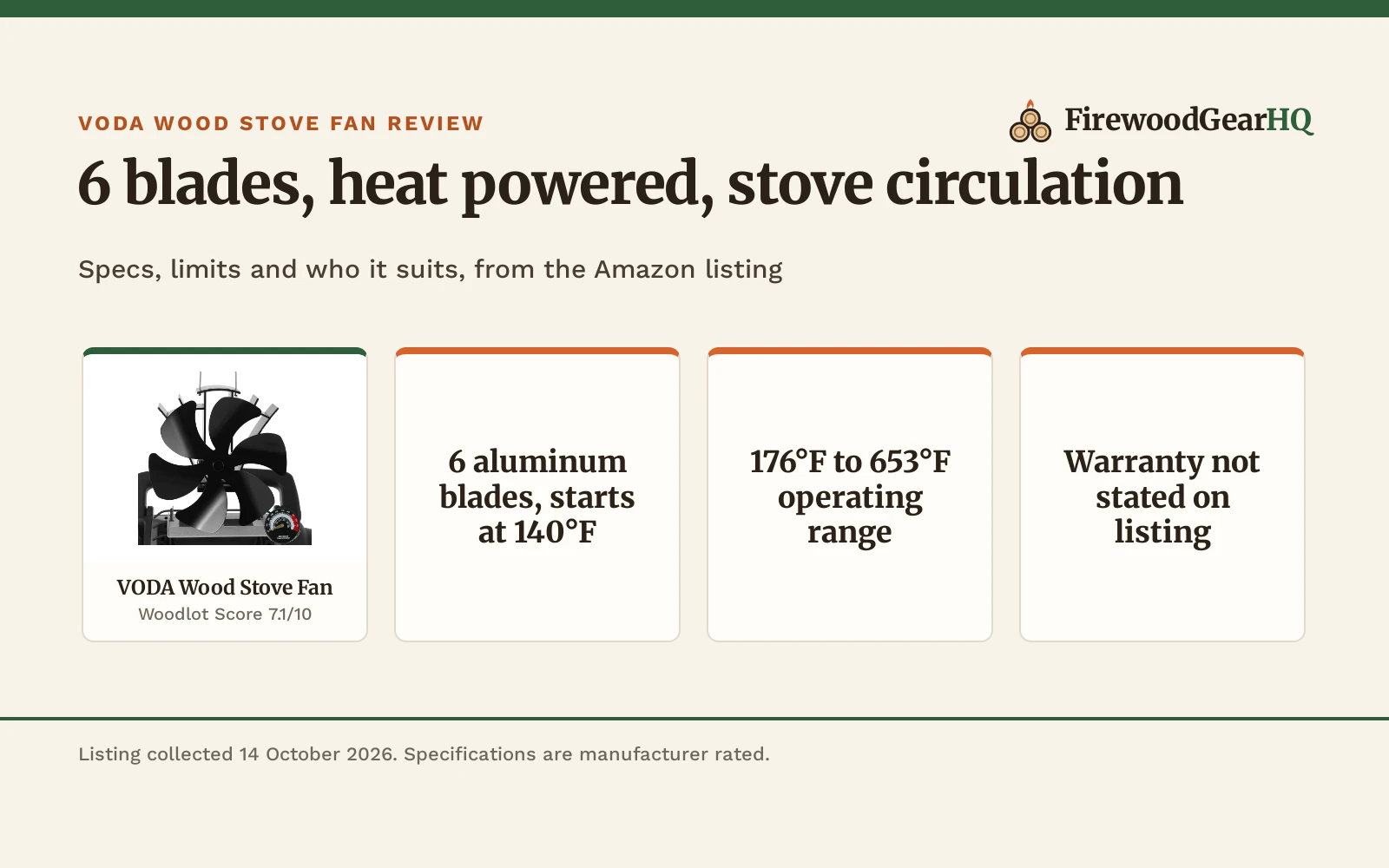
A heat-powered 6-blade aluminum stove fan that starts spinning around 140°F, operates up to 653°F, includes a magnetic thermometer and mounting bracket, and uses a bimetallic strip for overheat protection.
Pros
- 6-blade aluminum design stated to divert warm air horizontally instead of rising vertically
- Starts spinning around 140°F and operates between 176°F and 653°F without batteries or electricity
- Built-in bimetallic overheat protection strip raises the fan edge as temperatures approach 653°F
- Ships with an included magnetic stove thermometer and a heater mounting bracket
Cons
- Warranty term is not stated on this listing
- Airflow volume in CFM is not stated
- Listing spec table contradicts itself by describing touch control and table fan design
- Operating continuously above 653°F risks damaging the thermoelectric module
More options to compare
 Tomersun Wood Stove Fan Heat Powered Stove Fan HeaterCheck price on Amazon
 Ecofan UltrAir Heat Powered Stove FanCheck price on Amazon
 AC Infinity AXIAL S1238DCheck price on Amazon
 Wood Stove Fan Heat PoweredCheck price on Amazon
 Tomersun Wood Stove Fan Heat Powered Stove Heater FanCheck price on Amazon
 Hongso Speed Variable S31105 Wood Stove Blower Fan 110V ~Check price on Amazon
VODA wood stove fan review: the short verdict
Thermoelectric stove fans have become a familiar sight across rural hearths, sitting quietly on the back corner of a steel or cast-iron wood burner. The VODA model builds on that concept by pairing 6 aluminum blades with a bimetallic overheat safety strip and an included magnetic thermometer. The listing states it starts spinning around 140°F, operates from 176°F to 653°F, and reaches its peak efficiency around 482°F, circulating warm air horizontally into your living area.
For someone burning cordwood through cold winter snaps, that heat-powered circulation helps distribute warmth into the immediate living area without adding electric motor hum to a quiet evening. The package also includes a mounting bracket intended for buddy heaters, giving it extra versatility. The drawbacks lie in documentation: no warranty term is stated, CFM airflow volume is omitted, and the spec table contains odd listing contradictions such as touch controls on a non-electric unit.
Key specs
| Model | Power Source | Blades | Operating Range |
|---|---|---|---|
| VODA Wood Stove Fan | Heat powered | 6 aluminum blades | 176°F to 653°F |
Specifications are manufacturer rated, as published on the Amazon listing. The listing features 6 aluminum blades designed to divert warm air horizontally rather than vertically. The spec table contains marketplace listing errors, including touch control, a table fan classification, and a single fixed speed, whereas the bullets clarify that blade speed varies with stovetop temperature and operates without electrical controls. We relied on the title and bullet descriptions for operational facts. CFM airflow volume is not stated, and the 1.1 lb item weight represents a compact, lightweight unit that sits easily on most stovetops.
The fan
What the VODA wood stove fan does well
Self-powered thermoelectric operation
The fan generates its own electricity through the Seebeck effect, converting heat conducted from the stovetop into an electric current that spins the motor. That means no electricity bills, no cords crossing the hearth, and no batteries to replace mid-winter. The listing notes it begins turning around 140°F, enters its primary operating window between 176°F and 653°F, and runs most efficiently around 482°F, matching typical stovetop temperatures during a steady burn.
Six blades for horizontal air movement
Many basic stove fans use 4 blades, but this model upgrades to a 6-blade aluminum assembly. The manufacturer claims its 6-blade configuration provides greater air volume than 4-blade alternatives. Like all stovetop fans, the goal is to direct warmth horizontally into the living space instead of letting heat rise straight to the ceiling by unassisted natural convection. Diverting that thermal energy outward improves warmth distribution across seating areas.
Built-in bimetallic overheat protection
Extreme heat is the primary enemy of thermoelectric generator modules. The VODA fan incorporates an in-built metallic strip at its base designed to bend and raise the edge of the fan slightly as temperatures approach the maximum limit of 653°F (345°C). By lifting the base, it reduces contact with the hot stovetop surface to protect internal elements, then lowers back down automatically as temperatures decrease.
Included magnetic thermometer and bracket
Monitoring stove surface heat is critical for both wood burning efficiency and fan longevity. This package includes a magnetic stove thermometer in the box, allowing you to track stovetop temperatures and remove the fan if heat climbs beyond 653°F. It also ships with a mounting bracket, allowing the unit to mount to portable buddy heaters or alternative heating setups.
Quiet 25 dB aluminum construction
Electric blower fans can create background drone that disrupts the peace of a wood fire. The listing rates this fan at 25 dB, which is barely audible whisper level. Built from brushed black aluminum with dimensions of 3.9″D x 6.8″W x 7.5″H, its compact footprint fits onto crowded stove decks without blocking cook surfaces or kettle placement.
Limitations
- No warranty on this listing. The listing does not state a warranty term. Ask the seller to clarify replacement coverage before buying, as our Woodlot Score awards zero warranty points when no concrete term is published.
- Airflow CFM is not stated. While the listing asserts that 6 blades move more air than 4 blades, it provides no cubic feet per minute (CFM) rating. Without a verified number, comparing circulation volume against competing fans remains subjective.
- Strict temperature ceiling. Continuous operation above 653°F (345°C) can permanently degrade the thermoelectric generator and motor. You must keep an eye on the stove thermometer during intense burns.
- Listing contradictions. The spec table describes touch control and table fan design, which contradict the heat-powered, non-electric reality of the product. Buyers must ignore the spec table errors and rely on the bullet descriptions.
- Requires sufficient surface heat. Because the fan needs approximately 140°F to start spinning, it will not operate on convection stoves with outer heat shields, double-wall convective jackets, or cool-top pellet stoves that do not reach that threshold.
How we scored it
The Woodlot Score weighs performance, build, value, safety and warranty, using only what the listing publishes. The full method is on our How We Pick page.
| Product | Woodlot Score | Perf. /35 | Build /25 | Value /25 | Safety /10 | Warranty /5 |
|---|---|---|---|---|---|---|
| VODA Wood Stove Fan | 9.5 | 27 | 20 | 20 | 4 | 0 |
Scores run from 9.2 to 9.8: each product’s point total is placed on that range, so more points always means a higher score.
Who should buy the VODA wood stove fan, and who should skip it
Buy it if
- You heat with a freestanding steel or cast-iron wood stove that reaches regular operating temperatures between 176°F and 653°F.
- You want to push warm air horizontally into your living space without electric power cords or motor noise.
- You appreciate having an included magnetic thermometer to monitor stovetop temperatures and avoid overfiring.
- You plan to use the included bracket to mount the fan on a compatible buddy heater for camp or workshop warmth.
Skip it if
- You require a written manufacturer warranty backed by a stated term before making a purchase.
- You want verified CFM airflow measurements to calculate precise room air turnover.
- Your stove has double-wall shielding or a convective top jacket that keeps the outer surface below the fan’s operating temperature.
- You need high-volume forced air circulation across multiple rooms, where an electric blower from our stove fan vs blower comparison is more suitable.
Alternatives to consider
Tomersun Wood Stove Fan. A staple compact option reviewed in our Tomersun wood stove fan review, featuring a small footprint tailored for tighter stove decks and smaller living areas.
Compact Stove Fans. If your stove top is crowded with humidifiers and kettles, explore our roundup of the best wood stove fan for small stoves to find low-profile alternatives that save space.
Multi-Fan Comparisons. To see how heat-powered models stack up across airflow designs and blade styles, check our comprehensive guide to the best wood stove fan options on the market.
Safety and gear
Wear eye protection and gloves for cutting, splitting and handling, follow every tool's manual, install stoves to code, and have the chimney inspected and cleaned every year. See EPA Burn Wise and NFPA heating safety. Read our Safety Disclaimer.
Stove fans sit directly on scorching metal surfaces, so safety around the hearth demands disciplined habits. Always wear heavy-duty heat-resistant hearth gloves from our best fireplace gloves for wood stoves guide when handling, moving, or adjusting the fan during a burn. Maintain proper clearances between the stove and combustible walls per your stove manual and local building codes. Protect your home with working smoke detectors and a dedicated alarm from our best carbon monoxide detector for wood stove homes guide. Never burn unseasoned cordwood; burn dry, seasoned firewood, which you can track using our guide on how long to season firewood, and schedule regular chimney inspections by a certified sweep to prevent creosote buildup.
Around the Woodpile
- Position the fan toward the rear or side edge of your stovetop rather than directly adjacent to the stovepipe, allowing cooler room air to draw across the cooling fins.
- Keep the magnetic stove thermometer mounted in clear view on the stovetop to monitor surface heat, and move the fan away if temperatures exceed 653°F (345°C).
- Inspect the aluminum blades when the stove is cold to clear away stray wood ash and soot that could hinder free spinning.
- Allow the fan base to cool completely on the hearth before packing or transporting it with the heater mounting bracket.
Frequently Asked Questions
How does the VODA wood stove fan generate power without electricity?
The fan relies on a thermoelectric module that utilizes the Seebeck effect. When the aluminum base warms up on the hot stovetop while the upper fins stay cooler, the temperature variance generates a small electrical voltage that drives the motor and turns the blades.
What temperature is needed for the VODA fan to start spinning?
The listing states that the fan starts spinning around 140°F. It enters its operational temperature window between 176°F and 653°F, operating with peak efficiency around 482°F.
How does the overheat protection strip work?
An in-built bimetallic strip installed at the base of the fan expands as temperatures near 653°F (345°C), lifting the edge of the fan slightly off the stovetop surface. This action reduces heat absorption to safeguard the thermoelectric generator until temperatures decline.
Does the VODA wood stove fan come with a warranty?
No warranty term is stated on this Amazon listing. If warranty coverage is important to you, contact the seller or manufacturer prior to ordering to ask about their policy.
Can this fan be used on buddy heaters?
Yes. The package includes an attachable mounting bracket designed to secure the fan onto compatible portable buddy heaters, allowing you to circulate heat from outdoor or shop heaters as well as traditional wood stoves.
Related guides
Explore our complete accessories collection on the stove accessories hub, find out whether heat-powered airflow makes sense for your setup in our breakdown on do wood stove fans really work, and read our Tomersun wood stove fan review to compare competing thermal models.