Skip Tooth vs Full Comp Chain: Which One Should You Buy?
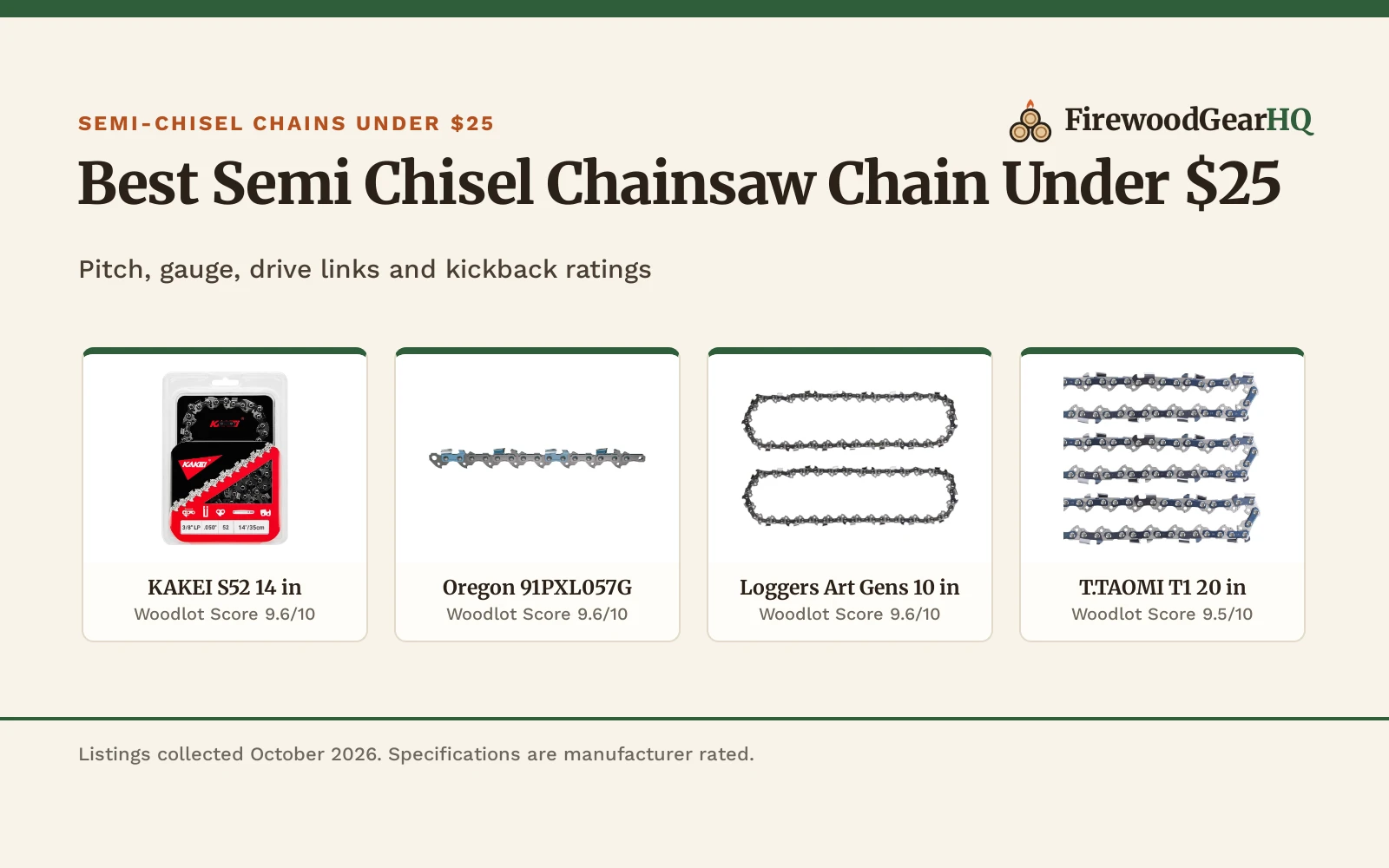
How skip tooth and full comp chainsaw chains compare in cutter spacing, bar length suitability, chip clearance, engine drag and sharpening maintenance.

On this page
Top picks at a glance
As an Amazon Associate we earn from qualifying purchases.
- 1
 Sharp Pebble Electric Chainsaw Sharpener Kit9.4/10View on Amazon
- 2
 8TEN Full Chisel Chainsaw Chain 18" Bar .050 Gauge 3/8 Pitch9.7/10View on Amazon
- 3
 Oregon Chainsaw Chain for 20" Bar9.6/10View on Amazon
- 4
 Full Chisel Skip Tooth Chainsaw Chain 32 Inch .050 3/8 105 DLView on Amazon
- 5
 3-Pack Full Chisel Skip Tooth Chainsaw Chain 24 Inch .058 3/8View on Amazon
- 6
 Husqvarna 585548993 C85S 28" Skip Tooth Chisel Chainsaw ChainView on Amazon
- 7
 8TEN Full Chisel Skip Tooth Chainsaw Chain 36" Bar .050 3/8View on Amazon
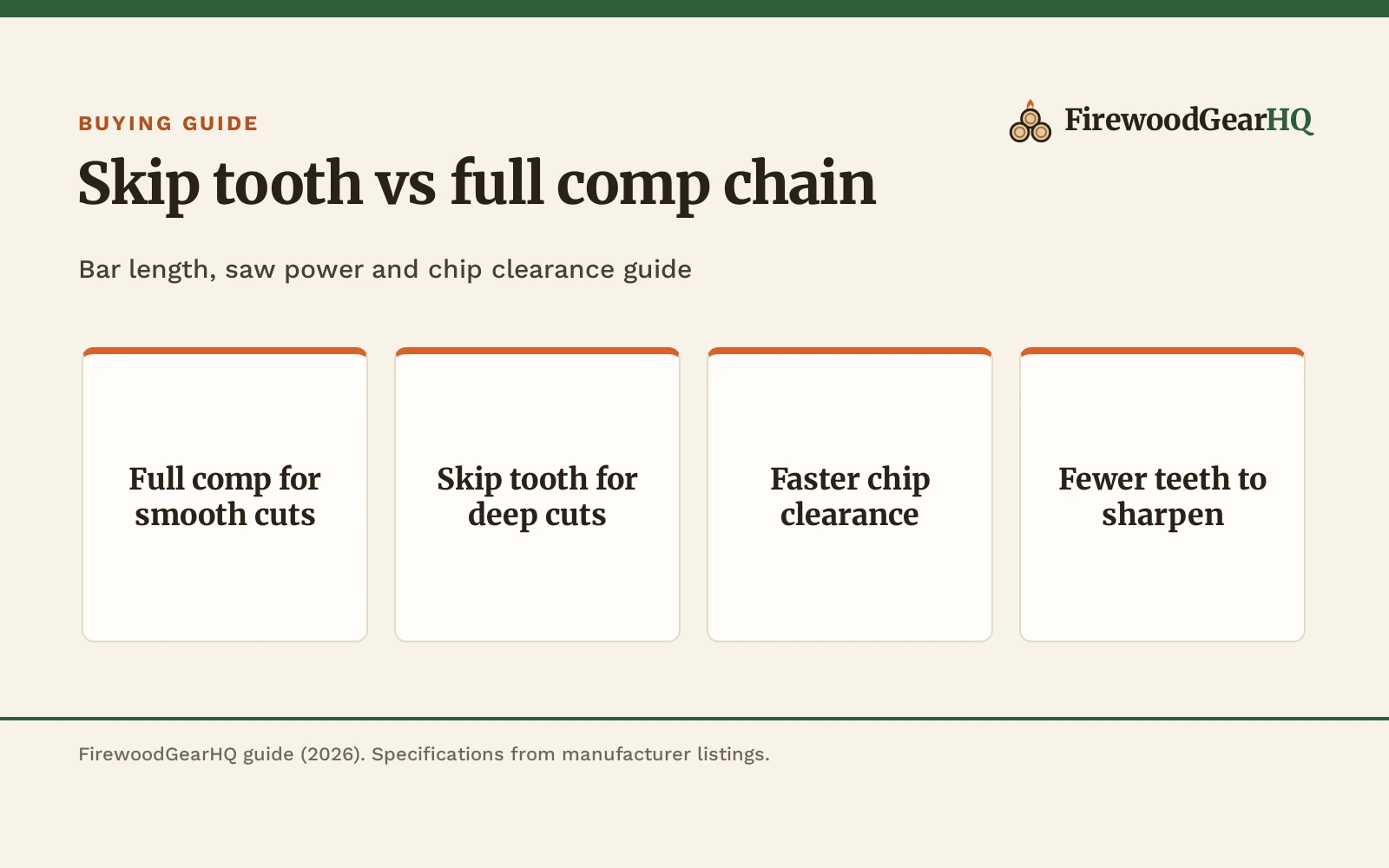
When fall cutting weather arrives and logs pile up at the landing, deciding between a skip tooth vs full comp chain determines how your saw pulls through firewood. Full comp (full complement) chains feature standard cutter spacing for clean, smooth bucking across general firewood cutting. Skip tooth chains place extra tie straps and drive links between cutting teeth, reducing engine drag and clearing chips efficiently on longer bars and deep cuts. For most firewood cutters working small to medium logs, full comp is the smoother choice, but skip tooth excels when pulling through wide timber where engine drag or chip clearing becomes an issue.
More options to compare
 Full Chisel Skip Tooth Chainsaw Chain 32 Inch .050 3/8 105 DLCheck price on Amazon
 3-Pack Full Chisel Skip Tooth Chainsaw Chain 24 Inch .058 3/8Check price on Amazon
 Husqvarna 585548993 C85S 28" Skip Tooth Chisel Chainsaw ChainCheck price on Amazon
 8TEN Full Chisel Skip Tooth Chainsaw Chain 36" Bar .050 3/8Check price on Amazon
FirewoodGearHQ may earn a small commission if you buy through links on this page. The price you pay stays the same. Read our affiliate disclosure.
The quick answer
Choose a full comp chain for standard firewood bucking, limbing, and general woodlot chores. Its continuous sequence of cutters minimizes chatter and delivers clean, smooth cuts. Choose a skip tooth chain when pulling long guide bars through large logs where full-depth cuts drag down saw motors, or when deep cuts generate heavy chip volume. By widening cutter spacing, skip tooth maintains high engine RPM, clears chips without packing, and reduces filing time on the woodpile. For general firewood cutting, combine the best chainsaw for firewood with a loop from our guide to the best chainsaw chain, or see what chainsaw chain do I need for sizing.
Skip tooth vs full comp chain
The primary mechanical difference lies in cutter spacing along the loop. Full comp chains follow a standard alternating sequence across the loop. Skip tooth chains insert extra tie straps and drive links between teeth, widening the space between cutters.
| Chain sequence | Cutter arrangement | Reference guide bars | Sharpening demand | Primary woodpile role |
|---|---|---|---|---|
| Full complement | Standard alternating sequence across the loop | Listed on 20 inch bars (KAKEI with 81 drive links) and 36 inch bars (T.TAOMI with 114 drive links) | Standard filing time across all left and right cutters | Smooth bucking, limbing, and clean firewood cutting across short to long bars |
| Skip tooth | Extended spacing with extra tie straps and drive links | Listed on 24 inch bars (MUMUTIPS with 84 drive links), 28 inch bars (SawWorks with 93 drive links), and 32 inch bars (8TEN with 105 drive links) | Reduced filing time due to fewer total cutters per loop | Deep bucking cuts in large hardwood logs, long bar operation on moderate powerheads, and rapid chip clearance |
Match your chain sequence to the guide bar length and engine capacity of your saw. While full comp remains the universal standard for typical cordwood prep, skip tooth becomes advantageous as bar length and log diameter increase.
How chain sequence affects cutting performance
Cutter spacing and chip clearance
During cutting, the gullet below each cutter edge carries wood chips through the cut. In wide logs where the guide bar is fully buried, gullets can overfill before exiting, creating friction and slowing the chain. Skip tooth chains provide extended clearance between cutters, letting chips tumble freely without packing the kerf. This rapid evacuation keeps cutting speed steady in thick rounds of oak, ash, or maple.
Engine load and bar length
Every cutter engaged in wood demands engine torque. On long bars, such as a 28 inch bar listed by SawWorks or a 32 inch bar listed by 8TEN, full comp places numerous cutters into timber simultaneously, which can bog down mid-displacement engines. Skip tooth reduces the count of cutters biting at once, keeping the saw in its optimal power band and maintaining chain speed through deep cuts.
Sharpening time and maintenance
Cutting firewood often involves gritty bark that dulls cutting edges. Keeping teeth sharp with a best chainsaw sharpener is vital for performance. Because skip tooth loops feature fewer total teeth, filing takes noticeably less time. Dressing a 32 inch skip tooth loop with 105 drive links takes far less bench effort than a full comp equivalent, returning you to cutting sooner.
Vibration and cut smoothness
Full comp chains cut smoothly because cutters maintain continuous contact with timber, preventing grabbing and producing clean, square kerfs with low vibration. Skip tooth chains cut rougher. Because wider gaps separate cutters, the chain can chatter when cutting small limbs, thin branches, or soft sapwood where teeth do not stay consistently loaded.
Kickback risk and safe operation
Chainsaw safety is critical with any chain. Wider gaps on skip tooth loops can increase grab if the bar nose contacts wood unexpectedly. Stated listings, such as T.TAOMI full complement loops, note compliance with the kickback performance requirement of ANSI Standards. Safe operation requires full personal protective equipment: heavy chainsaw chaps (see our guide to the best chainsaw chaps), a forestry helmet with face screen and hearing protection, sturdy steel-toe boots, and durable protective gloves (reviewed in our guide to the best chainsaw gloves). Never cut alone, maintain secure footing, keep both hands firmly on the saw, and follow logging practices in the OSHA logging eTool.
How to choose between skip tooth and full comp
Review these operational factors before purchasing a replacement chain:
- Guide bar length and power balance: On bars measuring 20 inches or shorter, full comp is standard. On longer bars (24 inches, 28 inches, 32 inches, or 36 inches), high-output professional saws pull full comp, while moderate saws benefit from skip tooth to avoid bogging.
- Log diameter: When cutting logs that bury the full bar, skip tooth clears chips cleanly. For smaller logs, full comp prevents chatter.
- Saw power capacity: Saws with modest displacement running long bars need skip tooth to maintain RPM. High-torque saws handle full comp even in deep cuts.
- Sharpening routine: In gritty logs, skip tooth cuts filing time substantially because fewer teeth need dressing.
- Cutting tasks: For mixed chores like limbing and bucking, full comp is smoother. Reserve skip tooth for bucking large logs and felling cuts.
What happens if you run the wrong chain sequence
Running a mismatched chain compromises cutting efficiency and operator control. Mounting a full comp chain on an overly long bar driven by a mid-size saw causes engine bogging and clutch heat. When the saw bogs, operators often lean on the bar, causing uneven kerfs and bar wear. If your cuts wander, see why does my chainsaw cut crooked and review how often should you sharpen a chainsaw chain.
Installing skip tooth on a short bar for limbing causes severe chatter and grab. Without thick timber to load the cutters, the chain snags on thin branches, causing jerky operation. Match your bar and chain properly; see our guide on how long should a chainsaw bar be for sizing advice.
Semi-skip chain and cutter tooth profiles
Semi-skip chain provides a middle ground, alternating between standard cutter spacing and wider gaps for mid-length guide bars where extra chip clearance helps without losing all cut smoothness.
Cutter tooth grind also matters. Full chisel chains feature sharp square corners that sever fibers rapidly, as listed on 20 inch KAKEI and 28 inch SawWorks models. Semi chisel chains use rounded working corners that hold edges longer in dirty wood. Explore tooth profiles in our guide to full chisel vs semi chisel chain and our reviews of the best semi chisel chainsaw chain and the best chainsaw chain for hardwood. For ripping lumber along the grain, see ripping chain vs crosscut chain.
Frequently Asked Questions
What is the difference between skip tooth and full comp chain?
A full comp chain features standard cutter spacing arranged continuously across the loop. A skip tooth chain inserts extra tie straps and drive links between cutters, widening the space between teeth to improve chip clearing and reduce drag on long guide bars.
Is skip tooth chain faster than full comp chain in firewood?
Not in every case. Full comp cuts faster whenever saw power is sufficient, because more cutters take bites per revolution. Skip tooth becomes faster when pulling long bars through wide timber where full comp would bog the engine down or pack the kerf with chips.
What bar length requires a skip tooth chain?
No bar length strictly requires skip tooth. Professional saws regularly pull full comp chains on 36 inch bars (like the 36 inch T.TAOMI loop with 114 drive links). Skip tooth is practical on 24 inch, 28 inch, or 32 inch bars when saw power or chip clearance is limited.
Does a skip tooth chain dull faster than a full comp chain?
Individual teeth do slightly more work per pass, so they can dull faster in abrasive bark. However, because the chain has fewer total cutters, filing the loop with a round file takes far less time.
Can you use a skip tooth chain for limbing and firewood?
Skip tooth handles large firewood rounds well, but chatters and grabs in small limbs and brush. Full comp is safer and far smoother for general limbing chores around the woodpile.
Why do loggers use skip tooth chains?
Loggers run skip tooth on long bars in big timber to reduce engine load, evacuate chips from deep kerfs, and minimize field sharpening time between cuts.
Related guides
Explore our library in the chainsaw gear section and the broader chainsaws hub. To pick replacement loops, read what chainsaw chain do I need and compare options in the best chainsaw chain review. For tough wood, see our guides on the best chainsaw chain for hardwood, the best chainsaw chain for dirty wood, and the best chainsaw chain for professional use. Maintain cutting accuracy with guides on how often should you sharpen a chainsaw chain, why does my chainsaw cut crooked, and why does my chainsaw chain keep coming off. Check bar sizing in how long should a chainsaw bar be, stay protected with our chainsaw safety gear checklist, and lubricate with the best bar and chain oil. For field work, review how to bucking firewood safely with a chainsaw, compare saws in gas vs battery chainsaw and homeowner vs professional chainsaw, and sharpen using the stump vise for chain saw sharpening and how to use a stump vise.