What Size Log Can a 27 Ton Log Splitter Split?
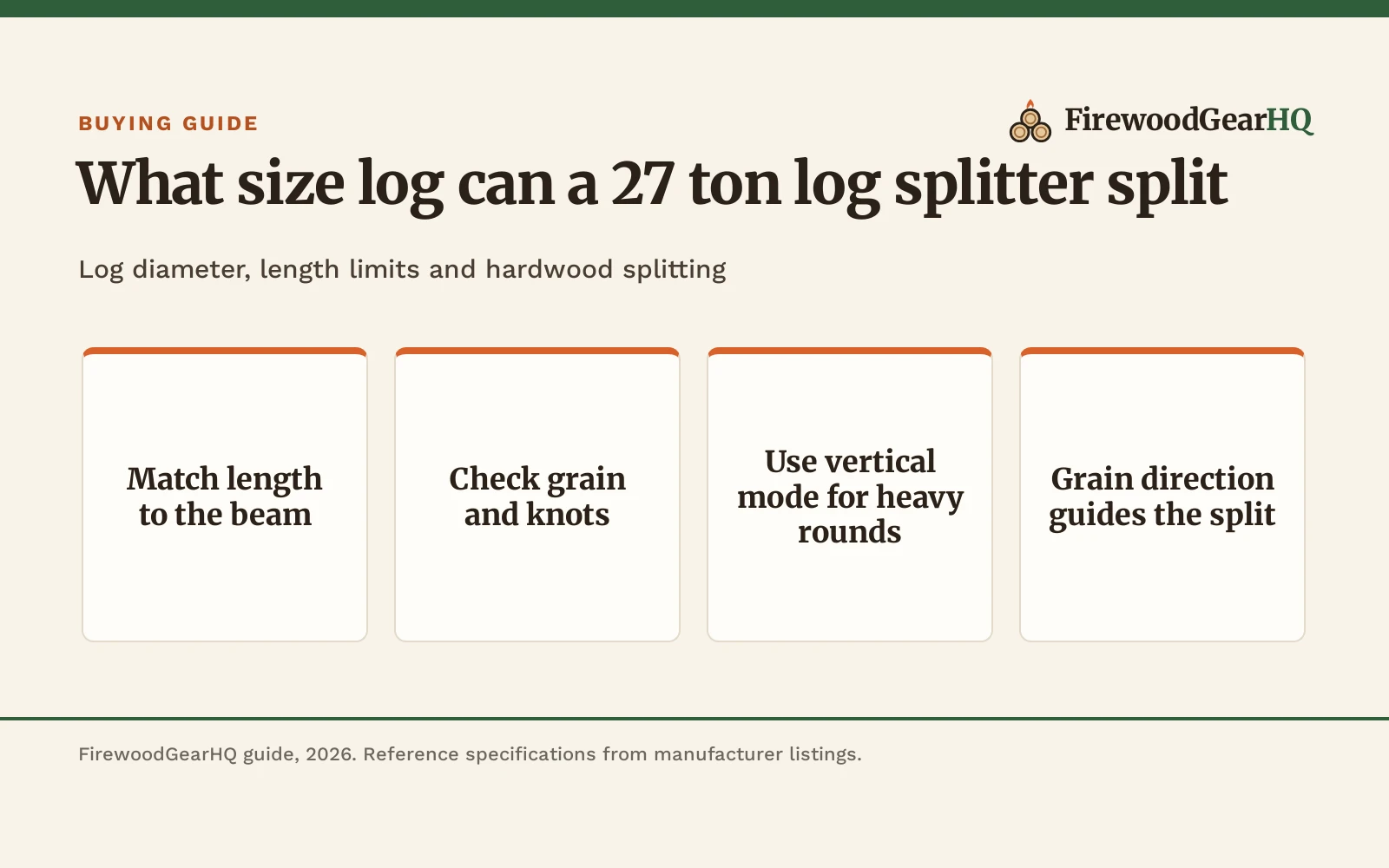
A 27 ton log splitter delivers sufficient force to split wide hardwood rounds across common firewood diameters, with beam length and wood grain determining practical capacity.

On this page
Top picks at a glance
As an Amazon Associate we earn from qualifying purchases.
- 1
 KABIN Kindle Quick Log Splitter9.7/10View on Amazon
- 2KABIN Kindle Quick Log Splitter9.5/10View on Amazon
- 3
 SPEED FORCE Firewood Kindling Log Wood Splitter9.5/10View on Amazon
As autumn arrives and rounds pile high by the shed, preparing winter firewood supplies requires reliable hydraulic power. When assessing what size log can a 27 ton log splitter split, a 27-ton rating provides ample hydraulic force to split dense hardwood rounds across typical firewood diameters, while log length depends on the beam stroke. Physical cradle length sets the maximum cut length, while wood density and grain dictate resistance across wide rounds. Operators can split heavy oak, maple, or hickory, using vertical mode when logs prove too heavy to lift.
FirewoodGearHQ may earn a small commission if you buy through links on this page. The price you pay stays the same. Read our affiliate disclosure.
What size log can a 27 ton log splitter split
A 27 ton log splitter delivers the hydraulic force needed for demanding firewood cutting. The practical boundaries of what you can process depend on log length, diameter, and grain structure.
Log length is mechanically limited by the distance between the retracted wedge and the foot plate. Manufacturers list varying beam capacities: BILT HARD rates log length up to 24 inches, while YARDMAX accommodates logs up to 26.5 inches. For diameter, 27 tons easily splits rounds exceeding typical stove sizes on straight-grained timber, while vertical mode allows splitting heavy rounds directly on the ground without lifting.
Stated log capacities and reference specifications
Examining published manufacturer specifications provides practical benchmarks. The specifications below come directly from reference listings on the log splitters market:
| Splitter rating | Brand cited | Stated log capacity | Stated specifications |
|---|---|---|---|
| 20 Ton | Mutaomay | Max 21 in length by 16.5 in diameter | 8 seconds cycle time, 7 HP engine |
| 25 Ton | SuperHandy | Not stated | Portable gas design, durable steel wedge |
| 27 Ton | YIHUITONG | 17.32 in cutting diameter | 739cc engine, 20 in saw, 6-way wedge |
| 35 Ton | BILT HARD | Up to 24 in length | 16 seconds cycle time, 8 in wedge, 10 HP |
| 35 Ton | FULL BOAR | Not stated | 306cc engine, 700 lbs hydraulic lift, 3.55 in wedge adjustment |
| 40 Ton | BILT HARD | Up to 24 in length | 16 seconds cycle time, 8 in wedge, 13 HP |
| 40 Ton | YARDMAX | Up to 26.5 in length | U-beam design, internal reservoir filter |
As these stated figures show, maximum log length on dedicated splitters reaches 24 inches on BILT HARD units and 26.5 inches on YARDMAX equipment. For diameter, Mutaomay publishes a 16.5-inch limit on its 20-ton unit, while YIHUITONG specifies a 17.32-inch cutting capacity governed by the 20-inch saw on its 27-ton processor. A dedicated 27-ton splitter provides greater force than a 20-ton unit and features an open beam that accepts wider rounds.
What determines what size log a 27 ton log splitter can handle
Several physical and mechanical factors dictate how effectively a 27-ton machine splits timber at the woodpile. Evaluating these elements helps operators gauge what their machine can process without jamming or causing excessive wear.
Log length versus beam stroke capacity
Log length has a strict mechanical limit based on cylinder stroke. If a round is bucked longer than the clearance between the wedge and anvil, it cannot fit onto the beam. Reference listings show capacities like 24 inches on BILT HARD and 26.5 inches on YARDMAX. Bucking rounds cleanly keeps timber within stroke limits. See what size log splitter do I need.
Log diameter and hydraulic splitting force
Tonnage determines how effectively a machine splits wide diameters. A 27-ton system concentrates manufacturer rated hydraulic force onto the wedge, such as the 8-inch hardened steel wedge on BILT HARD splitters. On straight grain, lateral pressure cracks wide rounds apart before the wedge completes its stroke. To compare force requirements, read how many tons of log splitter do I need.
Wood species, density, and grain structure
Wood species affects splitting resistance. Straight-grained hardwoods like oak and ash split cleanly along growth rings. In contrast, stringy species like elm or sweetgum have interwoven fibers that resist separation, requiring full cylinder force. Softwoods like pine split easily except around dense limb knots. Review hardwood vs softwood firewood to compare wood properties.
Green wood versus seasoned logs
Moisture content influences splitting behavior. In straight-grained hardwoods like oak, green wood shears cleanly under pressure. In stringy woods like elm, green fibers cling together, requiring the wedge to push fully through. Seasoning creates drying cracks that assist splitting, though dry hardwoods can become hard. Check drying with the best firewood moisture meter and read is it easier to split wood green or seasoned.
Horizontal versus vertical splitting position
Large hardwood rounds can be heavy, as highlighted by FULL BOAR with its 700 lbs hydraulic lift. Lifting massive rounds onto a horizontal beam creates back strain. Dual-mode splitters from BILT HARD and YARDMAX tilt vertically, allowing operators to roll heavy rounds onto the foot plate without lifting. See the best vertical log splitters and horizontal vs vertical log splitters.
Log splitter safety and safe woodpile operation
Hydraulic splitters require safe operating habits per guidelines in the OSHA logging eTool.
A central rule is that only one operator should control the valve lever. When an assistant handles logs while another pulls the lever, severe pinch injuries can occur. The person positioning the log must operate the control. Always keep hands clear of the wedge and splitting zone while the ram is in motion.
Wear impact-rated eye protection alongside work gloves and steel-toe boots to protect against flying wood chips. Operate only on level ground, and review our log splitter safety rules and how to move heavy logs safely.
Maintaining optimal splitting performance
Routine maintenance keeps a 27-ton splitter operating at peak hydraulic force. Check fluid levels regularly and replace hydraulic oil to prevent pump cavitation. See what hydraulic fluid for a log splitter. If cycling becomes sluggish, consult why a log splitter is slow and why a log splitter will not split. Seasonal procedures are detailed in our log splitter maintenance guide.
To compare machines, explore heavy gas log splitters, the best log splitter for home use, and cheap wood splitters.
Turn a stack's length, height and depth into full and face cords, and estimate how much wood a winter takes.
Frequently Asked Questions
Can a 27 ton log splitter split oak and hickory?
Yes. A 27 ton log splitter provides ample manufacturer rated force for dense hardwoods like oak and hickory. On splitters with vertical mode, tilting the beam allows positioning the wedge along grain fault lines to split knotty rounds cleanly.
What is the maximum log length a 27 ton log splitter can split?
Maximum log length depends on beam and cylinder stroke length rather than tonnage. Gas splitters typically list beam capacities like 24 inches on BILT HARD or 26.5 inches on YARDMAX.
Can a 27 ton log splitter handle green wood?
Yes. A 27-ton machine easily splits green wood. Straight-grained green hardwoods shear cleanly, though stringy species like elm may require running the full stroke to separate clinging fibers.
Is a 27 ton log splitter big enough for large tree rounds?
Yes. A 27-ton rating handles trunk rounds wider than standard fireplace wood. Operating in vertical mode allows rolling heavy rounds directly onto the foot plate without lifting.
What should you do if a log splitter gets stuck in a log?
Never strike the wedge or cylinder. Retract the cylinder so stripper plates push the wood off, or shut down the engine and safely free the round with a manual splitting wedge.
How fast does a 27 ton log splitter cycle?
Cycle times depend on pump rating and engine size. BILT HARD lists a 16-second cycle on 35-ton and 40-ton splitters, while Mutaomay lists an 8-second cycle on a 20-ton model.
Related guides
Explore our complete firewood equipment guides to get the most from your woodpile. Check the log splitters hub and our guide to gas log splitters. To evaluate sizing, see what size log splitter do I need and how many tons of log splitter do I need. Compare setups in horizontal vs vertical log splitters and gas vs electric log splitters. Review heavy gas log splitters, the best vertical log splitters, and the best log splitter for home use, alongside cheap wood splitters. For care, see log splitter maintenance, discover why a log splitter will not split, and check what hydraulic fluid for a log splitter. Learn machine basics in how a log splitter works and what is cycle time on a log splitter. Keep safe with log splitter safety rules, read how to move heavy logs safely, and check log splitter recalls what owners should check. For transport and storage, see can you tow a log splitter on the road, choose the best log splitter cover, and learn how to winterize a log splitter. For wood prep, explore is it easier to split wood green or seasoned, compare hardwood vs softwood firewood, check moisture with the best firewood moisture meter, and cut rounds with the best chainsaw for firewood and best chainsaw sharpener.