Poplar vs Maple Firewood: Which One Should You Buy?
Poplar vs maple firewood: the light wood against the dense wood, and which one suits your stove, fireplace or fire pit.

On this page
Top picks at a glance
As an Amazon Associate I earn from qualifying purchases.
- 1
 Smoak Firewood 12inch Length Premium Cooking Wood & FirewoodView on Amazon
- 2
 Smoak Firewood Cooking Wood LogsView on Amazon
- 3
 Wilson Maple Split FirewoodView on Amazon
- 4
 MESA Sticks: Kiln Dried Hardwood Firewood Oak Cherry MapleView on Amazon
- 5
 Smoak Firewood’s Cooking Wood ChunksView on Amazon
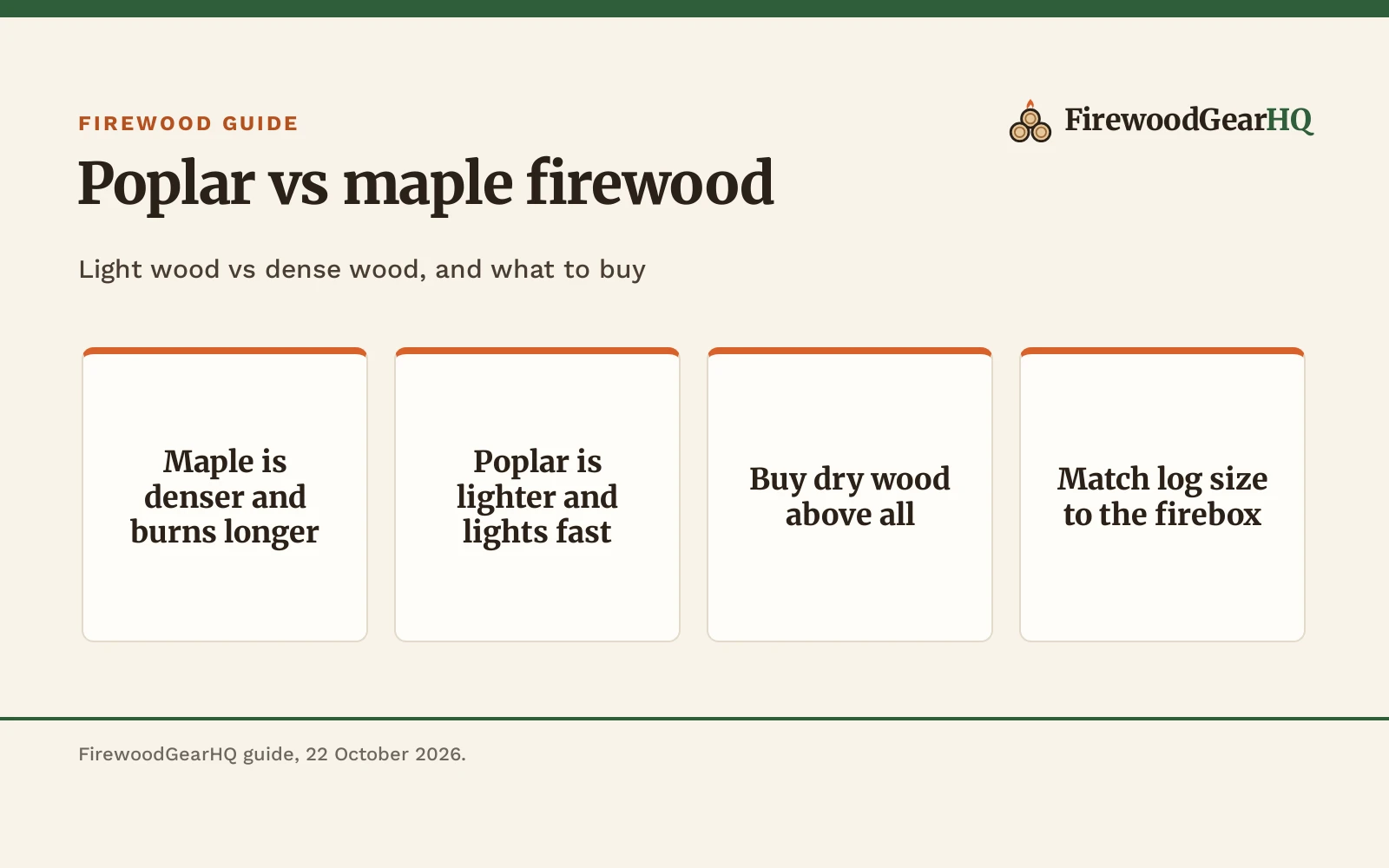
When the first cold nights of fall arrive and the woodpile has to be sorted by job, the question is which logs go to the stove and which go to the fire pit. That is the poplar vs maple firewood decision, and one difference settles most of it: poplar is the lighter wood and maple is the denser wood. Denser wood packs more fuel into each log, so maple gives the longer, steadier burn. Poplar lights easily and works for quick fires, but it burns through faster. For a wood stove or fireplace you heat with, maple is the pick. For kindling and short campfire sessions, poplar does the job.
More options to weigh up
 Smoak Firewood 12inch Length Premium Cooking Wood & FirewoodCheck price on Amazon
 Smoak Firewood Cooking Wood LogsCheck price on Amazon
 Wilson Maple Split FirewoodCheck price on Amazon
 MESA Sticks: Kiln Dried Hardwood Firewood Oak Cherry MapleCheck price on Amazon
 Smoak Firewood’s Cooking Wood ChunksCheck price on Amazon
FirewoodGearHQ earns a small commission if you buy through links on this page. The price you pay stays the same. Affiliate disclosure.
Poplar vs maple firewood: the quick answer
Choose maple when you want heat that lasts. Choose poplar when you want a fire that starts fast and you do not mind feeding it. Denser wood holds more wood fiber in the same space, so a maple log takes longer to burn through and leaves coals longer into the night. Poplar sits on the light end of the scale and gives up its heat quickly.
Neither species is the wrong firewood. The wrong firewood is wet firewood. Whichever species you choose, buy it dry or season it until it is, because that matters more than the name on the label.
Density decides the burn
Poplar is a light wood. Maple is a dense wood. In firewood, density is burn time: a denser log holds more fuel, so it lasts longer in the firebox and needs fewer trips to the woodpile. A light log of the same size is gone sooner.
This is why maple is the stove wood and poplar is the shoulder-season wood. On a cold night you want the dense log that still has coals in the morning. On a mild evening when you just want a quick fire, the light log that catches fast is no penalty.
How each wood lights and behaves
Poplar catches easily. Split small, it makes a good starter for a fire, and it brings a stove up to temperature quickly. The trade-off is that you will be reloading more often, and the fire will not hold the same steady bed of coals.
Maple is slower to catch but holds its heat. Once a maple fire is going, it settles into a long, even burn. That makes it the better choice for the hours when nobody wants to tend the stove.
Many wood burners keep both. Poplar to get the fire going, maple to carry it. The two work well in the same firebox, and mixing them costs you nothing.
Moisture matters more than species
Wet wood of any species burns poorly, smokes and builds creosote in the chimney. A dry poplar log will outperform a wet maple log every time, so check the wood before you judge the species. A moisture meter is the simple way to check a split before it goes in the stove.
Seasoning time follows the density rule. Poplar, being light, gives up its moisture faster. Maple, being denser, takes longer to dry through and needs more time in the stack. If you buy green wood, give poplar the shorter seasoning window and maple the longer one, stack it off the ground with air moving through the pile, and keep the top covered.
What to buy for each job
For heating with a wood stove or fireplace, buy the densest dry hardwood you can find. Maple fits that job well: it burns long, it holds coals and it cuts down on refills during cold weather.
For a quick patio fire or a mild evening, poplar is enough. It lights fast and does not ask for much kindling. It is a convenience fuel for short sessions rather than the wood you heat a house with.
For campfires, either works. Poplar gets the fire going with less fuss; maple keeps it going with less feeding.
Whatever you buy, match the log to the firebox. Check the length your stove, fireplace or fire pit calls for in the maker’s manual before you order or cut, and split the wood to suit. Oversized logs are hard to load and slow to catch, and logs that are too short burn through too fast.
FAQ: wood, fire and gear
Is poplar or maple better for a wood stove?
Maple. It is the denser wood, and denser wood burns longer. Poplar works for quick fires but you will feed the stove more often.
Does poplar burn faster than maple?
Yes. Poplar is the lighter wood and burns through faster. Maple is the denser wood and holds its heat longer.
Can I mix poplar and maple in the same fire?
Yes. Use poplar to get the fire going and maple for the long burn. The light wood catches fast; the dense wood keeps it going.
How dry should the wood be?
Dry enough that it lights easily and burns with little smoke. Buy wood sold dry, or season your own until it is, and confirm with a moisture meter before burning.
Which dries faster, poplar or maple?
Poplar. Being lighter, it gives up its moisture sooner. Maple needs a longer season in the stack before it burns well.
More firewood guides
See our cottonwood vs poplar firewood comparison and our walnut vs maple firewood guide.