Poplar vs Ash Firewood: Which One Should You Buy?
Poplar vs ash firewood compared through the makers' stated facts: seasoned hardwood for heating, an ash blend for cooking, and kiln-dried picks with stated moisture figures.

On this page
Fall cutting fills the woodpile, and the question that follows is which wood to carry to the fire. Poplar vs ash firewood is a choice between a wood the picks below do not name and a wood the picks do name, so the answer has to come from what the makers state. No poplar product is named in the picks below, while ash is named in a cooking blend and in a hardwood comparison. For heat in a fireplace, a stove or a fire pit, the makers point to dry, seasoned hardwood, and for cooking, the ash blend is described as long-lasting wood with high heat and an easy start.
As an Amazon Associate I earn from qualifying purchases. FirewoodGearHQ earns a small commission if you buy through links on this page. The price you pay stays the same. Read our affiliate disclosure.
Poplar vs ash firewood: the quick answer
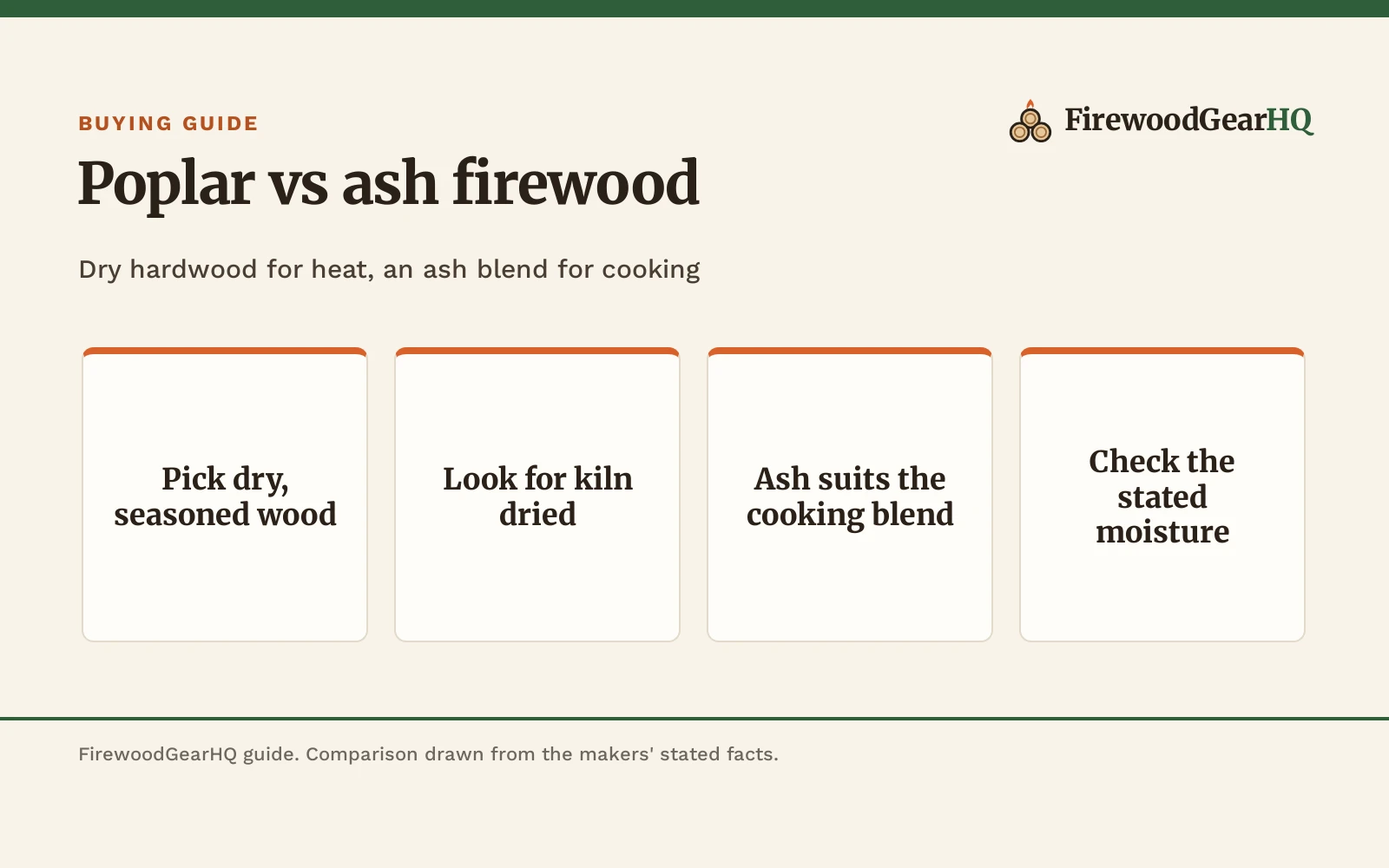
For heating, choose dry, seasoned hardwood. The hardwood pick is stated to last longer than ash logs, with a bright flame and high heat, and it carries Ready to Burn certification. The maker describes hardwood fires as longer and cleaner. For cooking, the ash blend is described as long-lasting wood with high heat and an easy start, kiln dried to less than 10% moisture. Poplar has no stated figures here, so judge a poplar offer by the same stated marks: dry and seasoned, kiln dried, or Ready to Burn certified, with a stated moisture figure.
Poplar vs ash firewood at a glance
| Wood | What the maker states | Suited to |
|---|---|---|
| Poplar | No poplar product is named in the picks below, and no poplar figures are stated | Judge it by the stated marks: dry and seasoned, kiln dried, Ready to Burn certified |
| Ash | Named in the Savory Blend with oak, maple, black birch and beech; the blend is described as long-lasting cooking wood with high heat and an easy start; kiln dried to less than 10% moisture | Grills, smokers and pizza ovens |
| Hardwood | Stated to last longer than ash logs; dry and seasoned; Ready to Burn certified; bright flame and high heat; the maker describes hardwood fires as longer and cleaner | Fireplaces, stoves, fire pits and campfires |
Use the table to match the wood to the fire, not to guess at figures the makers do not state.
The gear: 3 firewood picks in order
The picks below run in order, from the plain hardwood for heating to the cooking blend and the fuel blocks. Each pick is described only by what the maker states.
Peach Country Hardwood Firewood
The maker lists a 50-pound box of hardwood firewood for outdoor fire pits, fireplaces, wood burning stoves and campfires, with a fire starter in the box. The wood is described as dry and seasoned, Ready to Burn certified, quick to light, with a bright flame and high heat, low smoke and an aromatic burn. The maker describes hardwood fires as longer and cleaner, and states that hardwood is known to last longer than ash logs. The wood suits stoves, fireplaces and outdoor fires, along with barbecue smoking, pizza ovens, fire pits and camping. The box is packed tight for carrying to a campsite or into the home.
NEW ENGLAND COOKWOOD Savory Blend
The maker lists a 14-pound box of 5-inch cooking wood, about 1000 cubic inches, in a savory hardwood blend of oak, maple, black birch, beech and ash. The wood is kiln dried and described as long-lasting cooking wood with high heat and an easy start, delivered at less than 10% moisture. Each piece is cut to fit grills, smokers and pizza ovens, with pieces that never exceed 5.25 inches and widths from 0.75 to 1.75 inches. Half-size boxes hold 575 cubic inches at 8 to 9 pounds. The packaging is plastic-free Kraft packaging sourced within New England.
Firewood Central Envi Hardwood Fuel Blocks
The maker lists a 3-pack of hardwood fuel blocks at 7 pounds, made from 100% kiln-dried hardwood sawdust with no additives, binders or toxins. Each block is stated to burn 8 to 10 hours in controlled stoves or 2 to 3 hours in open fireplaces and fire pits, with long-lasting, high-heat burns and minimal ash or creosote. The blocks suit fireplaces, fire pits, stoves and furnaces, indoors and outdoors, and the uniform shape stacks for clean storage free from debris.
How to choose between poplar and ash
Start with dry wood. The makers describe their wood as dry and seasoned, kiln dried, or Ready to Burn certified, and they state moisture at less than 10% for the cooking blend and 8% for the fuel blocks. Wood that carries a stated moisture figure or Ready to Burn certification is ready to burn; a seasoned claim on its own still needs a meter reading before the wood goes in the stove.
Match the wood to the fire. For heat in a fireplace, a stove or a fire pit, the hardwood pick is stated to last longer than ash logs, with a bright flame and high heat. For cooking, the ash blend is described as long-lasting wood with high heat and an easy start. For a steady, long burn in a controlled stove, the fuel blocks are stated to burn 8 to 10 hours each.
Poplar has no stated figures here, so a poplar offer should be judged by the same marks: dry and seasoned, kiln dried, or Ready to Burn certified, with a stated moisture figure.
How to tell when firewood is ready to burn
Read the stated marks first: kiln dried, a stated moisture figure, or Ready to Burn certified. Then look at the wood itself: seasoned wood feels light for its size next to a fresh split piece, cracks run out from the center on the ends, the ends turn gray or yellow, bark loosens and peels away, and 2 seasoned pieces knocked together make a hollow clack while wet pieces sound dull.
Split the wood small and stack it off the ground, cover the top only and leave the sides open to the air, in a sunny, windy spot. A meter reading on a fresh split face gives the surest check before the wood goes in the stove.
What happens if you burn wood that is not dry
Wet wood is hard to light, burns cool and smoky, and puts out little heat. The smoke carries unburned vapor that condenses in the flue as creosote, a chimney fire risk, and it clouds the stove glass. Wet wood also wastes work, because much of the heat goes into boiling off water.
Kiln-dried and store-bought wood
Kiln-dried wood is dried in a kiln to a set moisture level, and the picks here state less than 10% moisture and 8% moisture. Wood sold as seasoned is not always dry, so read a split piece with a meter before buying.
Turn a stack's length, height and depth into full and face cords, and estimate how much wood a winter takes.
FAQ: wood, fire and gear
Is ash firewood good for a fireplace?
Ash is named in the cooking blend as long-lasting wood with high heat, and the hardwood pick is stated to last longer than ash logs. For a fireplace, the makers point to dry, seasoned hardwood, with ash as a cooking wood in the blend.
Is poplar firewood good for heating?
No poplar product is named in the picks, and no poplar figures are stated, so the guide gives no poplar verdict from the makers. Judge a poplar offer by the same stated marks: dry and seasoned, kiln dried, or Ready to Burn certified, with a stated moisture figure.
How long does a fuel block burn?
Each block is stated to burn 8 to 10 hours in controlled stoves or 2 to 3 hours in open fireplaces and fire pits.
What size is the cooking wood?
The pieces are 5 inches, never exceed 5.25 inches, and run 0.75 to 1.75 inches wide. Half-size boxes hold 575 cubic inches at 8 to 9 pounds, and the full box is about 1000 cubic inches at 14 pounds.
Does kiln-dried firewood burn cleaner?
The kiln-dried picks state less than 10% moisture and 8% moisture. The fuel blocks state minimal ash or creosote, and the makers describe the kiln-dried picks as high heat, easy to start and long-lasting. The hardwood pick is also Ready to Burn certified and described as low smoke.
More firewood guides
Compare the woods side by side in poplar vs maple firewood, poplar vs oak firewood, poplar vs birch firewood, poplar vs pine firewood and cottonwood vs poplar firewood, or see how ash fares in hickory vs ash firewood, ash vs cherry firewood, ash vs walnut firewood and ash vs beech firewood, and learn the drying basics in dry wood vs green wood.