Plug in vs Battery Carbon Monoxide Alarm: Which One Should You Buy?
Plug-in carbon monoxide alarms run on mains power with battery backup, while battery alarms go anywhere; this comparison covers power, display and warranty, and ranks three alarms.

On this page
Top picks at a glance
As an Amazon Associate I earn from qualifying purchases.
- 1
 Kidde Carbon Monoxide Detector9.7/10View on Amazon
- 2
 FIRST ALERT Dual-Power Plug-In Carbon Monoxide9.6/10View on Amazon
- 3
 First Alert Battery Carbon Monoxide Alarm CO4009.5/10View on Amazon
Verdict: Choose a plug-in carbon monoxide alarm if you have a free outlet where the alarm should live and want mains power with battery backup for outages. Choose a battery carbon monoxide alarm if the room has no handy outlet or you want to move the alarm around. Both types in this comparison sound an 85-decibel alarm.
A carbon monoxide alarm is one of the few devices in a wood-burning home that has to work while you sleep. The plug in vs battery carbon monoxide alarm question is about power: a plug-in unit runs on the outlet with batteries as backup, while a battery unit runs on batteries alone and goes anywhere. This comparison covers both sides with three examples from the listings we reviewed.
FirewoodGearHQ earns a small commission if you buy through links on this page. The price you pay stays the same. Affiliate disclosure.
The three picks
| # | Product | Woodlot Score | Buy |
|---|---|---|---|
| 1 | Kidde Carbon Monoxide Detector | 9.7/10 | Buy on Amazon |
| 2 | FIRST ALERT Dual-Power Plug-In Carbon Monoxide | 9.6/10 | Buy on Amazon |
| 3 | First Alert Battery Carbon Monoxide Alarm CO400 | 9.5/10 | Buy on Amazon |

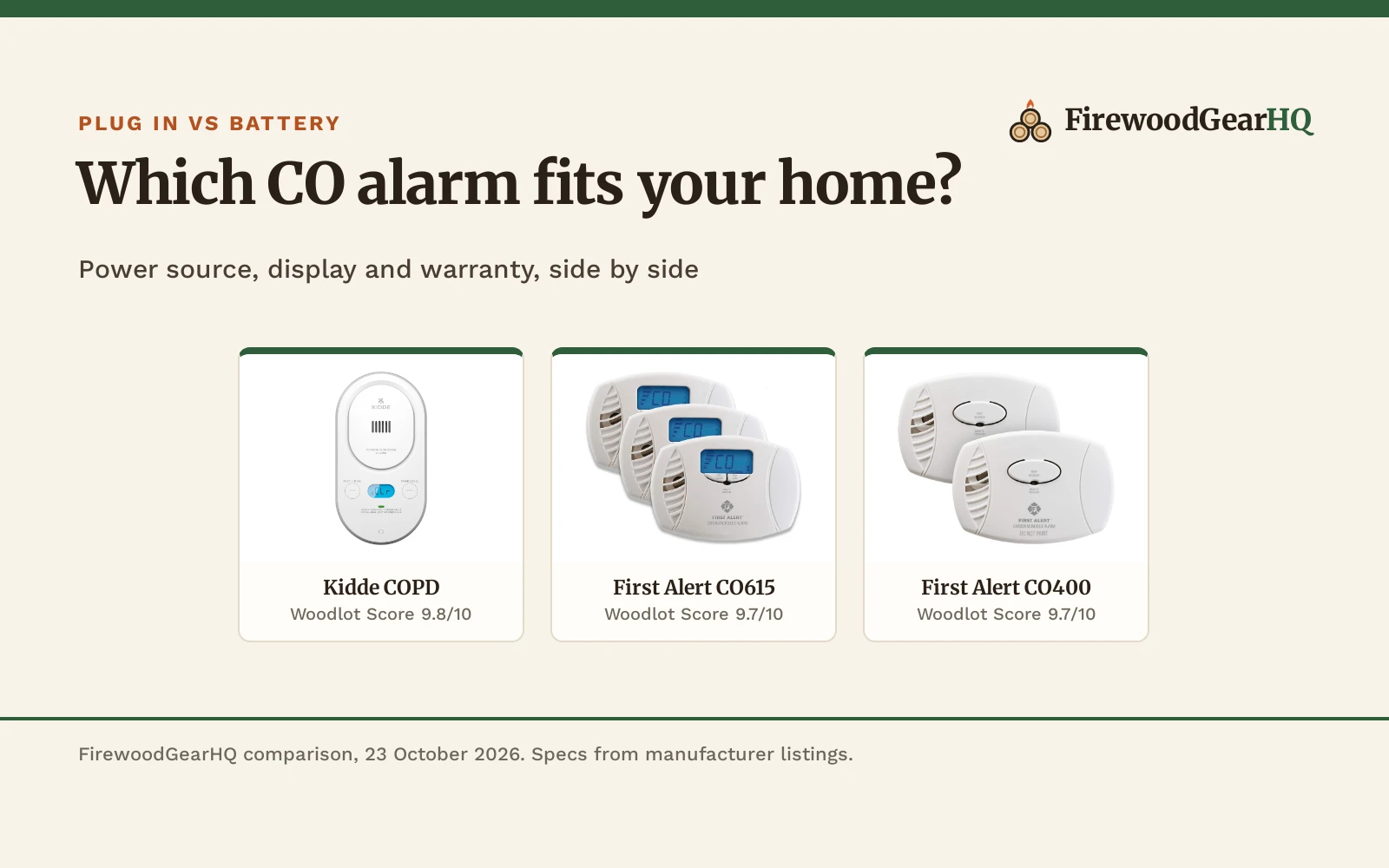
Kidde Carbon Monoxide Detector
A plug-in carbon monoxide alarm with 120V AC power, 2 AA backup batteries included, a backlit display showing CO levels, an 85 dB alarm, a rotating plug and power surge immunity, listed to UL 2034 5th Edition and ETL Listed, with a 10-year limited warranty.
Pros
- 10-year limited warranty
- 120V plug-in with 2 AA backup batteries included
- Backlit display shows CO levels
- UL 2034 5th Edition and ETL Listed
Cons
- Single unit, not a multi-pack
- Needs an outlet
- No stated end-of-life chirp
- Backup batteries will need replacing

FIRST ALERT Dual-Power Plug-In Carbon Monoxide
A dual-power plug-in carbon monoxide alarm with battery backup, a backlit digital display with a peak level feature, an 85-decibel alarm and an electrochemical sensor, sold as a 3-pack with a 7-year limited warranty.
Pros
- 3-pack covers multiple rooms
- Backlit digital display with peak level readout
- 85-decibel alarm, electrochemical sensor
- 7-year limited warranty
Cons
- No stated surge immunity
- Shorter stated warranty than the Kidde
- 3-pack may be more than a small home needs

First Alert Battery Carbon Monoxide Alarm CO400
A battery-only carbon monoxide alarm sold as a 2-pack, with an electrochemical sensor, an 85-decibel alarm, an end-of-life signal chirp and a 5-year limited warranty.
Pros
- Runs anywhere, no outlet needed
- 2-pack for two rooms
- 85-decibel alarm, electrochemical sensor
- End-of-life signal chirp
Cons
- No display of CO levels
- 5-year limited warranty, the least of the three
- Batteries need replacing
More options to weigh up
 First Alert Plug in Carbon Monoxide Alarm CO606Check price on Amazon
 First Alert Plug in Carbon Monoxide Alarm CO600Check price on Amazon
 First Alert Plug in Carbon Monoxide Alarm CO600 3-PackCheck price on Amazon
 Siterlink Carbon Monoxide Detectors Plug inCheck price on Amazon
 Kidde Carbon Monoxide & Explosive Gas AlarmCheck price on Amazon
 SITERWELL Plug in Carbon Monoxide Detector 10 Year Battery&ACCheck price on Amazon
Side by side: plug in vs battery carbon monoxide alarm
| Kidde COPD | First Alert CO615 | First Alert CO400 | |
|---|---|---|---|
| Side | Plug in | Plug in | Battery |
| Power | 120V AC, 2 AA backup included | Plug-in with battery backup | Battery operated |
| Alarm | 85 dB | 85-decibel | 85-decibel |
| Display | Backlit, shows CO levels | Backlit digital, peak level | Not stated |
| Certifications | UL 2034 5th Edition, ETL Listed | UL standards | UL standards |
| Warranty | 10-year limited | 7-year limited | 5-year limited |
| Pack | 1 | 3-pack | 2-pack |
Figures are from the listings we reviewed; cord, bar and tonnage figures are maker rated and quoted as listed.
Power: plug in vs battery
The two plug-in examples keep mains power first. The Kidde COPD runs on 120V AC with 2 AA backup batteries included, a rotating plug that fits vertical or horizontal outlets, and power surge immunity. The First Alert CO615 is a dual-power plug-in with battery backup, so it keeps monitoring through a power failure. The First Alert CO400 is battery operated only, which means no outlet and no cord, and the listing states continuous monitoring even during power failures.
Alarm, display and extras
All three listings state an 85-decibel alarm, so loudness does not separate them. The two plug-in examples add displays: the Kidde has a backlit display that shows CO levels with an LED warning light and a hush button, and the CO615 has a backlit digital display with a peak level feature that shows the highest CO concentration measured. The CO400 listing states no display. On extras, the CO615 ships as a 3-pack and the CO400 as a 2-pack, while the Kidde is a single unit the listing calls travel-ready for hotels and vacation rentals.
Certifications and warranty
The Kidde lists UL 2034 5th Edition and ETL Listed, with a 10-year limited warranty on the alarm, the longest stated here. The First Alert listings state their alarms meet UL standards, with a 7-year limited warranty on the CO615 and a 5-year limited warranty on the CO400, and both First Alert listings include an end-of-life signal chirp that tells you when to replace the unit.
Placement: where each alarm goes
Both First Alert listings give the same placement rule: one alarm on each level of the home and in each bedroom. That is why the pack sizes matter: the CO615 ships as a 3-pack and the CO400 as a 2-pack, while the Kidde is a single unit. A plug-in alarm also needs a free outlet where it should live; the Kidde’s rotating plug fits vertical or horizontal outlets, which helps in older homes where the only free outlet sits behind furniture. The battery-only CO400 goes anywhere, including rooms with no outlet at all.
End of life and replacement
Carbon monoxide alarms do not last forever, and the listings say how they tell you. The CO615 and the CO400 both list an end-of-life signal chirp that sounds when it is time to replace the unit. The Kidde takes a different approach: it lists no low battery chirps at all, with a hush button for quick checks instead. On warranty length, the Kidde lists a 10-year limited warranty, the CO615 a 7-year limited warranty and the CO400 a 5-year limited warranty. The warranty is not the sensor life, but it is the maker’s stated commitment.
Battery backup details
The Kidde runs on 120V AC with 2 AA backup batteries included, so it keeps detecting during outages. The CO615 is dual-power with battery backup for continuous monitoring through a power failure. The CO400 runs on batteries alone and states continuous monitoring even during power failures. The difference is what happens when the batteries die: a plug-in unit still has the outlet, while a battery-only unit has nothing until you replace them. That is why the Kidde’s no-low-battery-chirps design and the First Alert end-of-life chirps matter: they are the reminders that keep the alarm working.
Sensor type
All three listings name an electrochemical carbon monoxide sensor: the Kidde, the CO615 and the CO400 each state it. The sensor type does not separate the two sides of this comparison, which is why the buying decision comes down to power, display, pack size and warranty instead. An electrochemical sensor is the standard the listings share, so compare the features around it.
Weight and portability
The spec table lists the Kidde at 6.88 ounces and calls it travel-ready for hotels and vacation rentals. The CO400 lists 12.8 ounces as a 2-pack. If the alarm moves between the house and a cabin, weight and a plug that fits any outlet matter; if it stays on the wall, they do not.
Scoring the woodpile
Each example is scored out of 10 on performance, build, value, safety and warranty, using only what the listing publishes. The weights are on our How We Pick page.
| Product | Woodlot Score | Perf. /35 | Build /25 | Value /25 | Safety /10 | Warranty /5 |
|---|---|---|---|---|---|---|
| Kidde COPD | 9.7 | 32 | 21 | 21 | 9 | 5 |
| First Alert CO615 | 9.6 | 30 | 20 | 21 | 8 | 4 |
| First Alert CO400 | 9.5 | 29 | 20 | 21 | 8 | 4 |
We never show a score below 8.8 or above 9.8. Points set where a pick lands, and every rank in a guide sits at least 0.1 under the rank before it, so scores never tie.
Wear eye protection and gloves for cutting, splitting and handling, follow every tool's manual, install stoves to code, and have the chimney inspected and cleaned every year. See EPA Burn Wise and NFPA heating safety. Read our Safety Disclaimer.
FAQ: wood, fire and gear
Do plug-in carbon monoxide alarms work during a power outage?
These two do, on battery backup. The Kidde includes 2 AA backup batteries, and the First Alert CO615 is a dual-power plug-in with battery backup. The battery-only CO400 is unaffected by outages by design.
Where should I put a carbon monoxide alarm?
The First Alert listings advise one on each level of the home and in each bedroom. The Kidde listing adds that its compact unit suits travel use in hotels and vacation rentals.
What does the peak level feature do?
On the First Alert CO615, it displays the highest concentration of carbon monoxide the alarm has measured. It is a readout feature, not a second sensor.
How long do these alarms last?
The listings do not state a service life. They state warranties of 10 years on the Kidde, 7 years on the CO615 and 5 years on the CO400, and the First Alert listings add an end-of-life signal chirp that tells you when the unit needs replacing.
Battery or plug-in for a cabin with few outlets?
Battery. The First Alert CO400 runs on batteries alone, so it works where no outlet is free. If the cabin has an outlet to spare, a plug-in with battery backup covers outages too.
More firewood guides
See the best carbon monoxide detectors for wood stove homes, the carbon monoxide detector vs smoke detector comparison and battery vs hardwired carbon monoxide detector. Also see the stove accessories hub.