Battery vs Hardwired Carbon Monoxide Detector: Which One Should You Buy?
Battery against plug-in with backup for stove homes: four CO detectors compared by power, display, product life and warranty, with placement advice.

On this page
Top picks at a glance
As an Amazon Associate we earn from qualifying purchases.
- 1
 Kidde Smoke & CO Detector9.8/10View on Amazon
- 2
 X-Sense Smoke Detector Carbon Monoxide Alarm Combo9.7/10View on Amazon
- 3
 SITERWELL Smoke & CO Detector Interconnected9.6/10View on Amazon
- 4
 First Alert Battery Carbon Monoxide Alarm CO400 6-PackView on Amazon
- 5
 First Alert Battery Carbon Monoxide Alarm CO400View on Amazon
- 6
 Kidde Carbon Monoxide DetectorView on Amazon
- 7
 First Alert 10-Year Battery Carbon Monoxide Alarm withView on Amazon
- 8
 First Alert 10-Year Battery Combination Smoke & CarbonView on Amazon
- 9
 First Alert Battery Carbon Monoxide Alarm CO400 3-PackView on Amazon
A wood stove makes carbon monoxide part of daily life, so the detector on the wall matters as much as the stove pipe. Battery vs hardwired carbon monoxide detector comes down to this: battery units mount anywhere with no wiring and keep working in an outage, while mains-powered units never need a battery swap but go dark when the power fails unless they carry a backup. One honest note up front: none of the four listings here is a wired-in hardwired unit. Three are battery-powered and one is plug-in with a 10-year battery backup, so this guide compares battery against plug-in with backup, the two power styles the listings actually document.
More options to compare
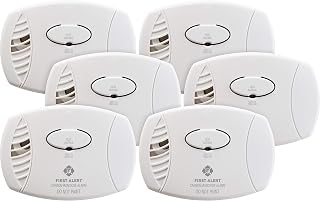 First Alert Battery Carbon Monoxide Alarm CO400 6-PackCheck price on Amazon
 First Alert Battery Carbon Monoxide Alarm CO400Check price on Amazon
 Kidde Carbon Monoxide DetectorCheck price on Amazon
 First Alert 10-Year Battery Carbon Monoxide Alarm withCheck price on Amazon
 First Alert 10-Year Battery Combination Smoke & CarbonCheck price on Amazon
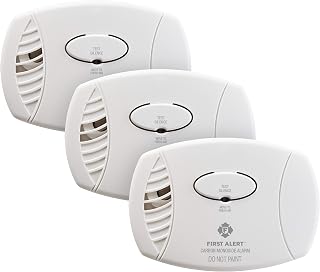 First Alert Battery Carbon Monoxide Alarm CO400 3-PackCheck price on Amazon
FirewoodGearHQ may earn a small commission if you buy through links on this page. The price you pay stays the same. Read our affiliate disclosure.
The quick answer
Choose battery if you want the detector anywhere: on the wall by the stove, in the bedroom hall, or packed for a cabin trip. All three battery listings here state they work during power failures. Choose plug-in with backup if you have a spare outlet near the stove and want mains power with a 10-year battery covering outages. Either way, put a detector on each level of the home and near sleeping areas, and replace the unit when its stated product life ends.
Battery vs hardwired carbon monoxide detector: what the listings show
The battery side is three units. The Kidde C3010D runs on a sealed 10-year lithium battery that the listing says never needs replacing, with a digital display that updates every 15 seconds, an 85-decibel alarm, peak level memory and a hush button. The Kidde COB runs on 2 included AA batteries, sounds an 85 dB alarm, and is stated as travel-ready and lightweight at 5.92 oz. The SITERWELL GS828A runs on 2 AA alkaline batteries with a stated 7-year product life, an LCD showing real-time CO levels and a 3-color LED.
The mains side is one unit. The SITERWELL plug-in detector is corded electric with a stated 10-year battery backup, so it runs on the outlet and the backup carries it through power failures. It ships as a 2-pack with a breathing light, green for normal, yellow for fault and red for alarm, and a one-touch silence function. No listing here wires into house mains, so a true hardwired unit would be a separate purchase from an electrical supplier.
The gear: four detectors, ranked
1. Kidde C3010D, sealed 10-year battery
The C3010D is the set-and-forget pick: a 10-year sealed lithium battery the listing says never needs replacing, so it detects during power failures with no battery swaps for the life of the unit. The digital display updates every 15 seconds with the CO level, 3 LEDs show green for normal, red for CO and amber for replace, and peak level memory records the last CO event. It is UL certified with a 10-year limited warranty, at 1.5 x 4.5 x 2.75 in and 8 oz. Who it is for: a stove home that wants a decade of no battery changes. Who should skip it: anyone who wants a replaceable battery.
2. Kidde COB, AA-powered travel pick
The COB is the portable pick: AA battery-powered with 2 batteries included, an 85 dB alarm with LED status lights and a hush button, at 1.52 x 5.14 x 2.83 in and 5.92 oz. The listing calls it travel-ready for hotels and vacation rentals, and it meets UL 2034 5th Edition standards with ETL listing. A 10-year limited warranty on the alarm is stated, and the box includes mounting screws and a user guide. Who it is for: renters, travelers and anyone who wants a detector that moves between homes. Who should skip it: anyone who wants a sealed battery with no changes.
3. SITERWELL plug-in, mains with 10-year backup
The plug-in SITERWELL is the mains pick: corded electric with a stated 10-year battery backup that keeps it working during outages. It uses an electrochemical sensor, shows a breathing light with green, yellow and red states, and includes a one-touch silence function. The listing names wood-burning fireplaces, clogged chimneys and running vehicles among the CO sources it detects. It ships as a 2-pack at 6.4 oz with a CR123A battery and user manual in the box. One listing wrinkle: the bullets give 4.72 x 2.76 x 1.65 in while the spec table gives 2.24 x 3.62 x 2.24 in; the bullets win. No warranty term is stated. Who it is for: a home with a spare outlet near the stove that wants mains power plus backup. Who should skip it: anyone who wants a stated warranty.
4. SITERWELL GS828A, 4-pack with LCD
The GS828A is the multi-room pick: a stated 7-year product life on 2 AA alkaline batteries, an LCD with real-time CO levels, a 3-color LED and an alarm of no less than 85 dB at 3 meters, ETL listed. The listing says it suits families, schools, hotels and garages, with wall-mount or free-standing installation. One wrinkle: the title says 4-pack while the spec table says the number of items is 1; the title wins. A 3-year limited warranty is stated. Who it is for: covering several rooms or a garage and a cabin in one purchase. Who should skip it: anyone who wants a single detector with a display.
Placement and power outages
Where to put them in a stove home
Put one near the stove room, one in the hall outside bedrooms and one on each additional level. The listings state wall-mount or tabletop placement for the Kidde units and wall or free-standing for the SITERWELL 4-pack. Keep detectors away from the direct blast of the stove door and out of humid bathrooms.
What happens in a power outage
The three battery listings state they keep detecting during power failures, which is exactly when a stove works hardest in a winter storm. The plug-in SITERWELL states its 10-year battery backup carries it through outages. A plug-in without a backup would go dark, so check the backup before relying on a mains unit.
When to replace
The Kidde C3010D states a 10-year battery and a 10-year limited warranty, the SITERWELL 4-pack states a 7-year product life, and the Kidde COB states a 10-year limited warranty on the alarm. When the amber replace LED shows or the stated life ends, replace the whole unit, not just the battery.
Wear eye protection and gloves for cutting, splitting and handling, follow every tool's manual, install stoves to code, and have the chimney inspected and cleaned every year. See EPA Burn Wise and NFPA heating safety. Read our Safety Disclaimer.
Frequently Asked Questions
Is a battery or a plug-in detector better for a wood stove home?
Battery for flexibility: the three battery listings state they mount with no wiring and keep working in outages. Plug-in with backup for a fixed spot near an outlet: the SITERWELL plug-in states mains power with a 10-year battery backup. No listing here is a wired-in hardwired unit.
Do I need a detector on every floor?
The listings do not state placement rules, but standard guidance is one per level and near sleeping areas. The SITERWELL 4-pack and the plug-in 2-pack are the multi-unit options here.
How long do the batteries last?
The Kidde C3010D states a sealed 10-year lithium battery, the plug-in SITERWELL states a 10-year battery backup, the SITERWELL 4-pack states a 7-year product life on AA batteries, and the Kidde COB runs on 2 included AA batteries with no stated life.
Can I take a detector to a cabin or rental?
The Kidde COB is stated as travel-ready and lightweight, and the SITERWELL plug-in is stated as portable for travel. Battery units are the simpler travel choice since they need no outlet.
What does the display show?
The Kidde C3010D display updates every 15 seconds with the CO level, and the SITERWELL 4-pack LCD shows real-time CO levels. Both Kidde units add LED status lights, and the plug-in SITERWELL uses a breathing light with green, yellow and red states.
Related guides
See the best carbon monoxide detector for a cabin, the carbon monoxide detector vs smoke detector comparison and the best carbon monoxide detector for wood stove homes. Also see our wood stove accessories list.