Log Splitter vs Firewood Processor: Which One Should You Buy?
A log splitter cracks one log at a time for home firewood, while a firewood processor saws, splits and conveys wood in one pass for production volumes.

On this page
Top picks at a glance
As an Amazon Associate we earn from qualifying purchases.
- 1
 KABIN Kindle Quick Log Splitter9.7/10View on Amazon
- 2
 Kindling Cracker Original Firewood Kindling Splitter9.7/10View on Amazon
- 3
 Kindling Splitter L9.6/10View on Amazon
- 4
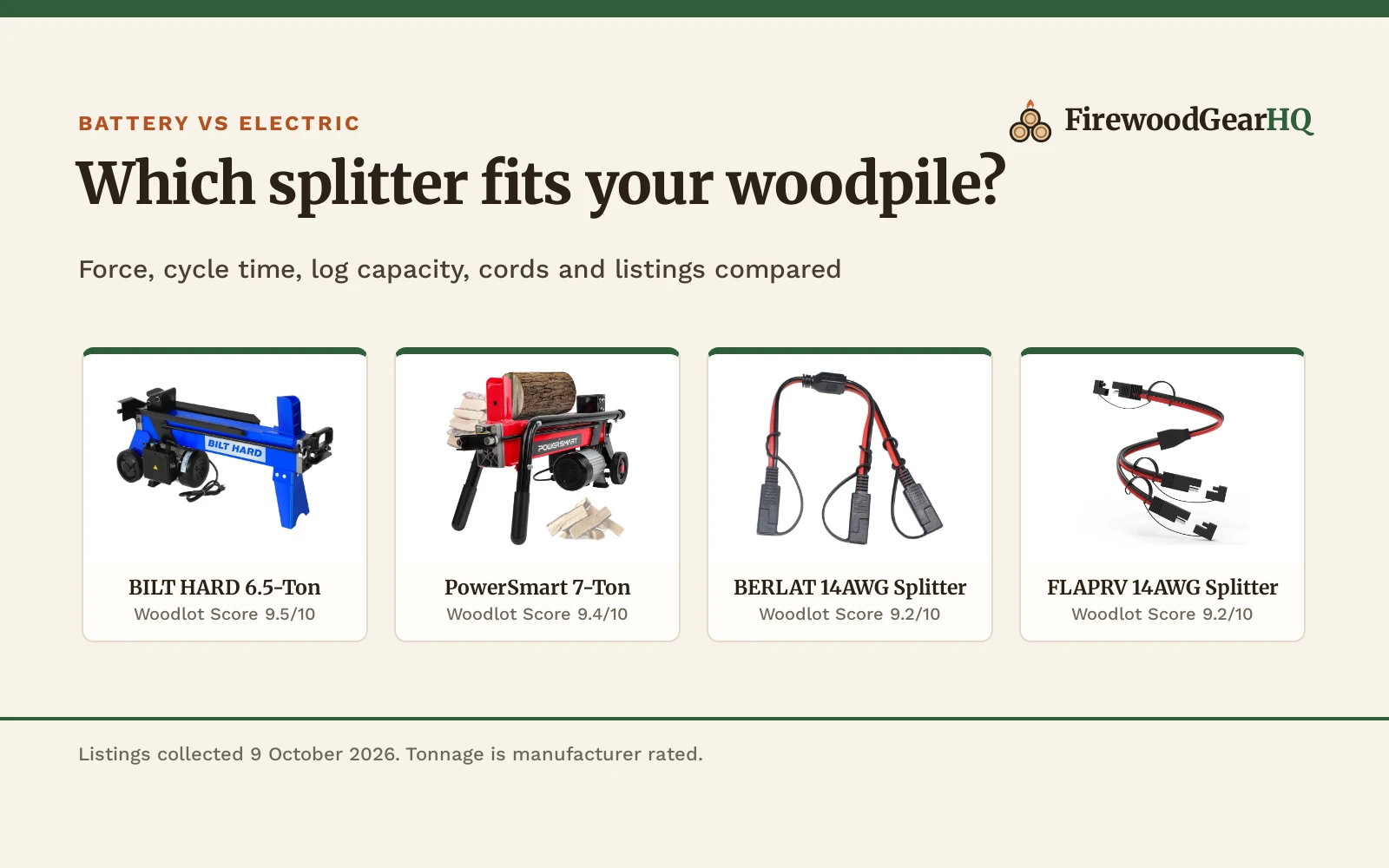
 BILT HARD Log Splitter 6.5 TonView on Amazon
- 5
 Landworks Portable 20-Ton Gas Log SplitterView on Amazon
- 6
 1844 Helko Werk Germany Vario Heavy Log SplitterView on Amazon
- 7
 SuperHandy Hydraulic Log SplitterView on Amazon
- 8
 BILT HARD 6.5 Ton Log SplitterView on Amazon
- 9
 5 Pcs Firewood Log Splitter Drill BitView on Amazon
Fall is splitting season: the wood you cut in spring is stacked, the stove is waiting and the job is turning rounds into stove-length pieces before the cold sets in. For log splitter vs firewood processor, the short answer is scale. A log splitter cracks one log at a time and you feed it by hand, which suits a few cords a year for your own stove. A firewood processor is a production machine: it saws logs to length, splits them through a multi-way wedge and carries the split wood away on a conveyor in one pass. If you heat with wood you cut yourself, buy the splitter. If you sell firewood by the cord or heat several buildings, look at the processor.
More options to compare
 BILT HARD Log Splitter 6.5 TonCheck price on Amazon
 Landworks Portable 20-Ton Gas Log SplitterCheck price on Amazon
 1844 Helko Werk Germany Vario Heavy Log SplitterCheck price on Amazon
 SuperHandy Hydraulic Log SplitterCheck price on Amazon
 BILT HARD 6.5 Ton Log SplitterCheck price on Amazon
 5 Pcs Firewood Log Splitter Drill BitCheck price on Amazon
FirewoodGearHQ may earn a small commission if you buy through links on this page. The price you pay stays the same. Read our affiliate disclosure.
log splitter vs firewood processor: the short answer
- A log splitter handles one log per cycle: you place each round, the wedge or ram splits it and you stack the pieces.
- A firewood processor chains three jobs together: the YIHUITONG listings show 25 in and 20 in saw bars, 45-ton and 27-ton splitting force and 3 m conveyors that move split wood to the pile.
- Splitters in these listings run from a 6.5-ton electric unit to 22-ton gas machines; the two processors weigh 2150 and 3000 lb.
- Match the machine to your volume: a few cords a year points to a splitter, production volumes point to a processor.
What a log splitter does
A splitter does one job: push a log against a wedge until it cracks. Electric models like the WEN 6.5-ton plug in and split logs up to 10 in in diameter and 20.5 in in length, with a 15A motor the maker rates at over 13,000 pounds of cracking pressure; it comes with a 34 in stand and 5.5 in never-flat wheels and weighs 118.7 lb. Gas models step up: the BILT HARD delivers 22 tons from a 209cc engine, splits logs up to 21 in long, cycles in 7 seconds and tows at up to 25 MPH on 13 in wheels. The FULL BOAR 20-ton runs a 209cc EPA-certified engine, cycles in 8.5 seconds and rides on 10 in flat-free tires, though the listing notes it is not towable and hydraulic oil is not included.
Manual hydraulic splitters skip fuel and cords entirely. The XtremepowerUS 12-ton handles logs up to 18.5 in long and 8 in in diameter with a two-speed pump and spring-loaded ram return, and the Takywep 12-ton takes 18.7 in logs with 37 in handles for leverage. Both weigh under 100 lb, so one person can roll them to the woodpile. Cycle times on manual units are whatever your arms make them, which is the trade for zero running cost.
Safety on a splitter is simple and non-negotiable: one operator, hands clear of the wedge and eye protection on. Our how a log splitter works guide walks through the cycle step by step.
What a firewood processor does
A processor runs three jobs in one pass. A chainsaw bar bucks the log to length, a hydraulic wedge splits it and a conveyor carries the split pieces to a pile or trailer. The YIHUITONG YHT45T500 lists a 20HP GX630 gas engine, 45 tons of splitting force, a 25 in chainsaw, a max cutting diameter of 500 mm (19.6 in) and a max split length of 580 mm (22.83 in); its 4/6-way wedge turns each log into 4 or 6 pieces in one stroke, and a 9.84 ft (3 m) conveyor with a 2.55M height moves the wood out. The smaller YHT27T450 lists 27 tons, a 739cc RATO engine, a 20 in saw, 17.32 in max cutting capacity, a 6-way wedge, a hydraulic log lifter and a 3M conveyor. Both list an emergency stop button, and the 45T adds a safety net over the chainsaw; the 45T listing notes assembly is required.
The processor’s real product is throughput: one operator feeds logs at one end and stacked-ready firewood comes out the other, with no hand splitting and no separate bucking step. That is why they show up in commercial firewood yards rather than backyards.
The dividing line is volume
Think in cords per year, not in tons. A splitter owner handles each log several times: lift it, place it, split it, stack the pieces. That is fine for a winter’s worth of wood and it is how most stove owners work. A processor owner handles each log once: the machine cuts, splits and conveys, and the operator’s job is feeding and stacking. The listings put numbers on the gap: a 22-ton splitter cycles one 21 in log in 7 seconds of machine time plus all the handling, while a 45-ton processor turns whole logs into 4 or 6 stove pieces per stroke and conveys them away. If your woodpile fits in a season of weekends, the splitter wins on cost, space and simplicity. If you are filling a barn or a delivery truck, the processor earns its keep.
Space, weight and power
Processors are the biggest machines here by far: 3000 lb for the 45T and 2150 lb for the 27T, which means a truck or tractor to move them and a level working pad with room for log decks and the conveyor discharge. Splitters are far more modest: 118.7 lb for the WEN electric, 147.7 lb for the FULL BOAR and 274 lb for the towable BILT HARD. Power is another split: the WEN needs an outlet, gas splitters need fuel and oil, manual splitters need neither, and the processors run big gas engines with a 20HP unit on the 45T. Noise follows the engine: the little CRYBY screw-type splitter lists about 60 dB from its 64cc 2-stroke, while a 20HP processor engine is in a different league, so neighbors and working hours matter.
Which one should you buy
- Buy a log splitter if you burn a few cords a year for your own home. Pick electric (WEN 6.5-ton, 10 in by 20.5 in capacity) for quiet work near an outlet, gas (BILT HARD 22-ton, 21 in logs, 7-second cycle) for bigger rounds away from power, or manual (12-ton, under 100 lb) for the simplest possible setup.
- Buy a firewood processor if you produce firewood at volume: for sale, for several buildings or for a farm. The YIHUITONG 27T and 45T list the saw, wedge, log lifter and conveyor as one working unit, which is the whole point.
- Measure your space first: a processor needs room for the machine plus infeed and outfeed; a splitter needs a corner of the woodlot. Compare the full range in our log splitter comparison and the best log splitter for home use picks.
Frequently Asked Questions
Can a firewood processor replace my chainsaw?
Only for bucking. The processors here list 25 in and 20 in saw bars for cutting logs to stove length, but felling and limbing are separate work for a trained cutter with proper gear. See what a firewood processor is for the full picture.
Is a 6.5-ton electric splitter enough for home use?
For typical stove wood it is. The WEN lists logs up to 10 in in diameter and 20.5 in in length at 6.5 tons. Knotty or oversized rounds may need a bigger machine, like the 22-ton BILT HARD.
How much space does a processor need?
More than the machine’s footprint. The listings show 3000 and 2150 lb machines with 3 m conveyors, so allow room for the machine, a log deck at the infeed and a pile or trailer at the discharge. A splitter fits wherever you stack wood.
Do processors need assembly?
The YHT45T500 listing states assembly is required and notes that installation instructions and video tutorials are provided. The other listings do not state assembly terms, so check the listing before it arrives.
Can I tow a splitter to the woodlot?
Some. The BILT HARD lists towing at up to 25 MPH on 13 in wheels; the FULL BOAR listing states it is not towable. See our towing rules and safe transport guide.
Gas or manual splitter for a small woodpile?
Manual if the pile is small and you want no fuel, no cords and minimal upkeep: the 12-ton manual units here weigh under 100 lb and split 18.5 in logs. Gas if you want speed: the 22-ton BILT HARD cycles in 7 seconds. Our gas vs kinetic log splitter guide covers the power types.
Related guides
See the log splitters hub, what a firewood processor is and the log splitter comparison. Also see our how a log splitter works and best log splitter for home use.