How to Sharpen Chainsaw Chain With Grinder: A Step-by-Step Guide
How to sharpen chainsaw chain with grinder, from matching the wheel to the chain pitch to taking a light pass across each cutter.

On this page
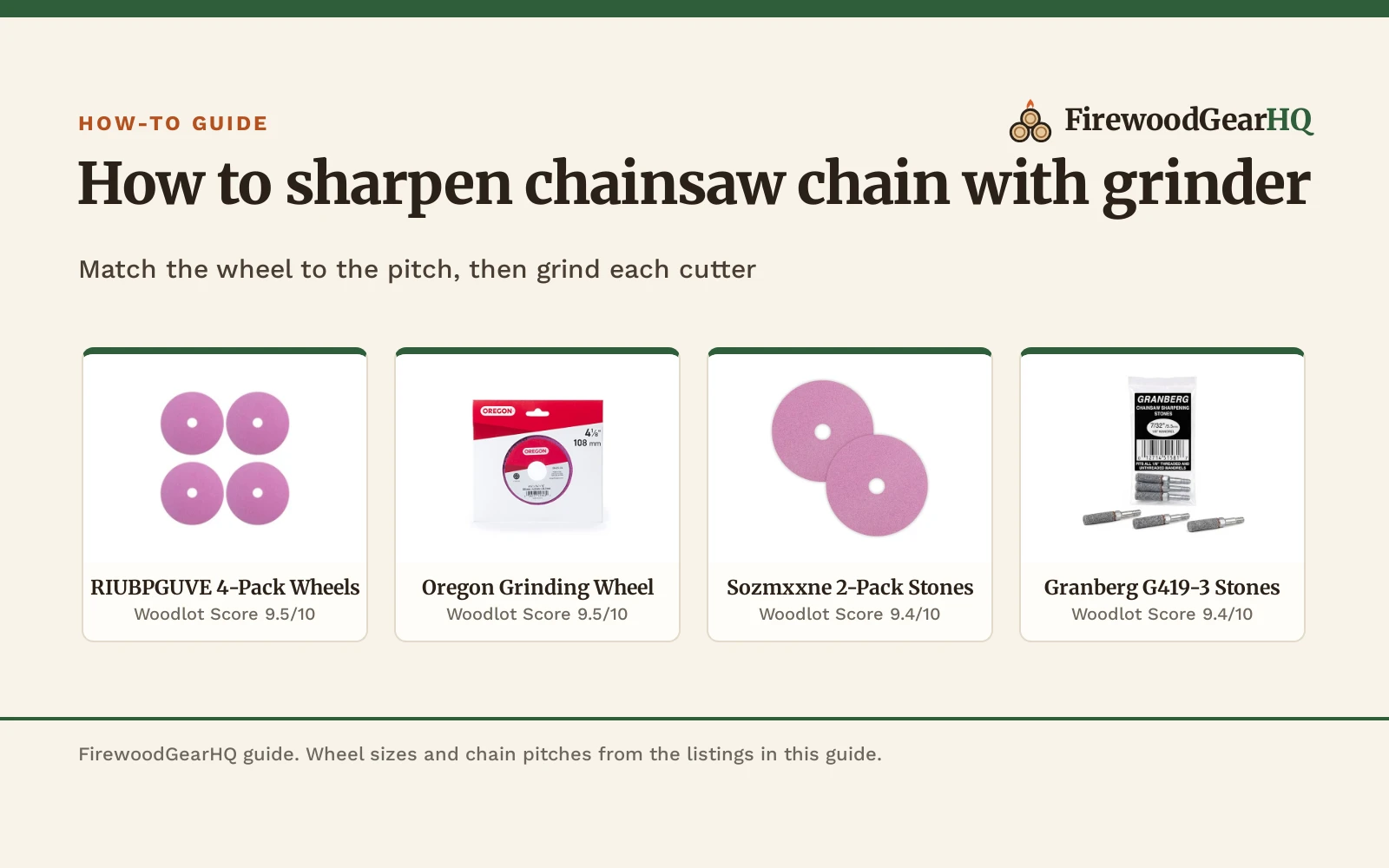
Top picks at a glance
As an Amazon Associate I earn from qualifying purchases.
- 1
 RIUBPGUVE OR534-316A Chainsaw Grinding Wheel9.3/10View on Amazon
- 2
 Oregon Chain Sharpener Grinding Wheel9.2/10View on Amazon
- 3
 Sozmxxne 2-Pack OR534-18 Chainsaw Sharpening9.1/10View on Amazon
- 4
 Granberg G419-3 7/32 Inch Coarse Grinding Stones9.0/10View on Amazon
By the time the woodpile is stacked and the stove is lit for the season, the saw has already done its hardest work, and a chain that once bit cleanly starts to skate across the wood instead of cutting it. A dull chain makes every cut slower and turns a day of bucking into a long push, and it is the usual sign that the cutters need a fresh edge. That is when the question turns practical: how to sharpen chainsaw chain with grinder. The answer is simple: clamp the chain in the grinder, match the wheel to the chain pitch, and take a light, even pass across each cutter until the edge is bright and sharp again.
FirewoodGearHQ earns a small commission if you buy through links on this page. The price you pay stays the same. Read our affiliate disclosure.
RIUBPGUVE OR534-316A Chainsaw Grinding Wheel
A set of four 3/16 in grinding wheels for 325, 3/8 and 404 pitch chains, made to fit benchtop chain grinders and keep a spare wheel on hand.
Pros
- Four wheels in the pack, so a spare is on hand
- Fits all benchtop chainsaw chain grinders, per the listing
- Stated maximum speed of 4500 r/min
- Covers 325, 3/8 and 404 pitch chains
Cons
- No warranty term stated in the listing
- No weight stated in the listing
- Only the 3/16 in thickness is offered in this listing
- No wheel material stated in the listing
Oregon Chain Sharpener Grinding Wheel
A 3/16 in Oregon grinding wheel for .325, 3/8 and .404 pitch chains, with a 4-1/8 in diameter and a 7/8 in shaft for the grinder.
Pros
- Resists burning of the cutters and leaves a precision finish, per the listing
- Fits .325, 3/8 and .404 pitch chains
- 4-1/8 in outer diameter with a 7/8 in shaft
- Part number OR4125-316A is stated for easy reordering
Cons
- Only one wheel in the pack
- No warranty term stated in the listing
- No maximum speed stated in the listing
Sozmxxne 2-Pack OR534-18 Chainsaw Sharpening
A 2-pack of ceramic grinding wheels made for 3/8 and 325 pitch chains, fitting Tecomec, Oregon and other chain grinders.
Pros
- Two wheels in the pack for extended sharpening sessions or a spare
- Ceramic construction for faster, cooler grinding, per the listing
- Fits Tecomec, Oregon and other chain grinders
- Made for 3/8 and 325 pitch chains
Cons
- Title lists both 1/8 in wheels and the OR534-316A model, which do not agree
- No maximum speed stated in the listing
- No warranty term stated in the listing
- No weight stated in the listing
Granberg G419-3 7/32 Inch Coarse Grinding Stones
A 3-piece set of 7/32 in coarse grinding stones on alloy steel mandrels, made for Granberg motorized sharpeners and hedge trimmer attachments.
Pros
- Coarse abrasive stones for chainsaw cutters
- Alloy steel mandrels included
- Fits 1/8 in mandrels
- Three stones in the pack
Cons
- Only one bullet of detail in the listing, and no pitch range stated
- No maximum speed stated in the listing
- No warranty term stated in the listing
- No diameter stated in the listing
How to sharpen chainsaw chain with grinder
Sharpening with a grinder is a bench job, not a field job, and it rewards a steady hand and a wheel that suits the chain. Work through the steps below in order, and check the edge after each pass before moving on.
Match the wheel to the chain
Read the chain pitch from the chain or the saw manual, then pick a wheel whose thickness suits that pitch. The benchtop wheels in this guide list .325, 3/8 and .404 pitch chains, in thicknesses of 1/8 and 3/16 in, and the Granberg stones (on Amazon) are 7/32 in with no pitch range stated, so the pitch decides the wheel. A wheel that is too thick for the pitch will not sit in the cutter, and one that is too thin will not shape the edge.
Mount the wheel and set the chain
Fit the wheel on the grinder arbor and check that it runs true before the chain goes in. Clamp the bar or the chain in the grinder vise so the cutter sits square to the wheel, and work in good light so the edge stays in sight. Wear gloves, eye protection and hearing protection, and keep the work area clear of clutter.
Grind each cutter with a light pass
Bring the wheel down onto the cutter with a light touch and lift it clear between passes, so the steel stays cool and the edge keeps its bite. The Oregon listing puts it plainly: a good wheel resists burning of the cutters and leaves a precision finish. Grind every cutter on one side of the chain first, then turn the chain around and do the other side, keeping each pass the same so the cutters stay even.
Check the depth gauges and the chain
After the cutters, look at the depth gauges that sit ahead of each cutter and take down any that stand at or above the cutter tops. Then check that the chain still moves freely around the bar and that the tension is snug. See how to tighten a chainsaw chain if the chain hangs loose on the bar.
Clean up and check the cut
Brush the filings off the chain and bar, oil the chain, and make a check cut in a scrap log. A sharp chain pulls itself into the wood and throws clean chips. A chain that still skates or throws dust needs another pass on the grinder.
The gear for sharpening with a grinder
The grinding wheels in this guide cover the chain pitches the benchtop listings state, and each one suits a different grinder setup, so pick the wheel that matches the chain pitch and the grinder on the bench.
How to pick a grinding wheel
Start with the chain pitch, since that sets the wheel thickness, then check the wheel diameter and the arbor size against the grinder. The wheels that state a diameter run from 4-1/8 in to 5-3/4 in across, with a 7/8 in arbor stated on the RIUBPGUVE and Oregon wheels and 1/8 in mandrels on the Granberg stones. A multi-wheel pack suits anyone who sharpens often, while a single brand-name wheel suits a grinder that lists one part number. Where a listing disagrees with itself, trust the title and bullets over the spec table and confirm the thickness before ordering.
Wear cut-resistant chaps, a helmet with face screen and hearing protection, gloves and sturdy boots. Know where the kickback zone is (the upper tip of the bar), keep the chain brake working and the chain sharp, and never cut alone in the woods. Felling trees is hazardous work: hire a professional for large, leaning or storm-damaged trees, especially near buildings or power lines. See OSHA logging safety for chain saw operators. Read our Safety Disclaimer.
FAQ: wood, fire and gear
What size grinding wheel do I need for my chainsaw chain?
Match the wheel thickness to the chain pitch. The benchtop wheels in this guide run 1/8 and 3/16 in thick and list .325, 3/8 and .404 pitch chains, while the Granberg stones are 7/32 in and state no pitch range. Check the listing for the pitch range before ordering, and note that the Sozmxxne listing disagrees with itself on thickness, so confirm it with the seller.
Can one grinding wheel sharpen every chainsaw chain?
No. Each benchtop wheel in this guide lists the pitches it covers, and no single wheel here covers every pitch. A 3/16 in wheel suits the pitches its listing names, and a chain outside that range needs a different wheel.
How do I know the wheel fits my grinder?
Check the arbor or mandrel size against the grinder. The RIUBPGUVE and Oregon wheels use a 7/8 in arbor, the Granberg stones fit 1/8 in mandrels, and the Sozmxxne listing names Tecomec and Oregon grinders as fits. If the grinder is not named in the listing, check the arbor size first.
Why does my chain still cut poorly after grinding?
Uneven cutters are the usual cause: a pass that is heavier on one side leaves cutters of different heights, and the chain pulls to one side. A wheel that is too thick or too thin for the pitch also leaves a poor edge. Grind each cutter with the same light pass, then check the depth gauges and the chain tension.
Should I use a grinder or a file to sharpen a chain?
A grinder suits a chain with nicks and damage, since the wheel grinds the damage away and restores the edge, as the Sozmxxne listing describes. A file suits a quick touch-up on a chain that is only slightly dull. See the best chainsaw sharpener roundup for both kinds of tool.
More firewood guides
See the /Chainsaw Gear/ hub for more chain gear, the best chainsaw sharpener roundup, and the best chainsaw for firewood guide.