How to Tighten Chainsaw Chain: A Step-by-Step Guide
How to tighten a chainsaw chain with a scrench, from loosening the bar nuts to the snap-back check, with the gear that handles each step.

On this page
Top picks at a glance
As an Amazon Associate I earn from qualifying purchases.
- 1
 KAKEI Chainsaw Chain 16 Inch 3/8" LP Pitch .043" Gauge 559.6/10View on Amazon
- 2
 3 Pack 18 Inch Chainsaw Chain 3/8" LP Pitch .050" Gauge 629.6/10View on Amazon
- 3
 SawWorks 16 Inch Chainsaw Chain 3/8" LP Pitch .050" Gauge 579.7/10View on Amazon
Fall cutting season leaves a saw that has run hard all week, and a chain that has gone slack is easy to spot: it sags along the bottom of the bar and rattles in the cut. A loose chain cuts slow, wears the bar and can jump the bar entirely, so learning how to tighten chainsaw chain before the next round of bucking pays off. The fix is simple: loosen the bar nuts, turn the tension screw until the chain sits snug against the bar, and check the snap-back before you cut. It takes a scrench and a flat spot to work, and the steps below walk through it from a cold saw to the final check.
FirewoodGearHQ earns a small commission if you buy through links on this page. The price you pay stays the same. Read our affiliate disclosure.
How to tighten chainsaw chain: the quick answer
Loosen the bar nuts with the socket end of a scrench, then turn the tension screw with the flathead end until the chain sits snug against the bar. Lift the chain at the middle of the bar: it should rise a little and snap back flat when you let go, with the drive links still seated in the bar groove. Hold the bar nose up, snug the bar nuts back down, and check the tension again before you cut.
Before you start
Work on a cold saw on flat ground, with the bar pointing away from you and the chain brake released, so the chain can move for the checks below. Put on chaps, gloves and boots, plus a helmet with a face screen and hearing protection, before you touch the chain: a slack chain still has sharp cutters. Keep the scrench close and the work area clear, and never cut alone once the saw is running again.
A cold saw matters because a chain tightened while hot grows tighter as it cools and contracts, so set the tension before cutting starts for the day and recheck it after the saw has worked for a while, when heat and wear have let it slacken.
How to tighten chainsaw chain step by step
Take it slow and check as you go: small moves of the tension screw beat big ones, and the snap-back check at the end tells you whether the job is done.
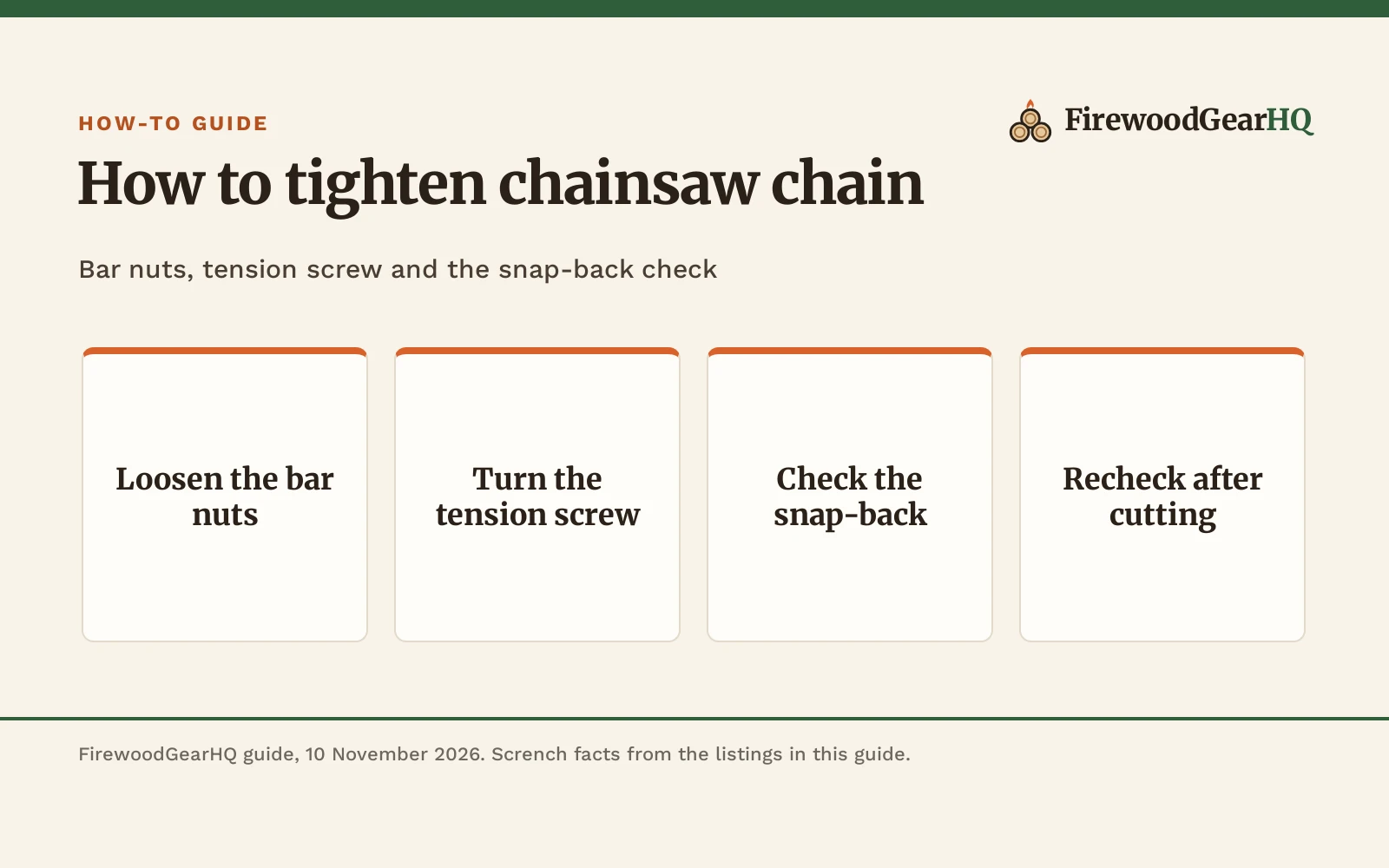
- Loosen the bar nuts. Fit the socket end of the scrench over the bar nuts and back them off until the bar can slide. Do not remove them; the bar needs to stay on its studs while you adjust.
- Turn the tension screw. The flathead end of the scrench turns the tension screw, which slides the bar out and takes up the slack. Turn in small moves and watch the chain pull snug against the underside of the bar.
- Check the tension. Lift the chain at the middle of the bar with a gloved hand. It should rise a little and snap back flat against the bar when you let go, with the drive links still seated in the groove.
- Hold the bar nose up and snug the nuts. Lift the nose of the bar while you tighten the bar nuts, so the bar stays where the tension screw put it. Snug the nuts firmly with the socket end.
- Recheck before you cut. Pull the chain around the bar by hand with a glove on. It should move freely without binding, and the snap-back check should still pass. If it sags again, repeat the steps.
The gear for the job
Every step above needs the same small tool: a scrench whose socket fits the bar nuts and whose flathead end turns the tension screw. The four screnches below cover that job in different ways, ranked from the strongest stated specs to the plainest, and each handles the bar nuts, the tension screw and the spark plug.
COMOWARE ratchet scrench
The COMOWARE scrench (on Amazon) leads the set: a 36-tooth ratchet with a 15° swing arc that works in tight spaces, dual sockets in 13mm and 19mm sizes (1/2 inch and 3/4 inch), and S2 steel the maker lists as resistant to bending, wear and deformation. The flathead screwdriver tip at the end of the handle turns the tension screw and cleans the bar groove, so this tool handles the bar nuts, the tension screw and the groove cleaning.
Stihl 3 in 1 scrench
The Stihl scrench (on Amazon) is a 3 in 1 tool: 13mm and 19mm wrench openings for the bar nuts, a socket for spark plug removal and a flat screwdriver for the tension screw and other screws. The listing states a weight of 0.42 pounds and dimensions of 8.82 inches by 4.02 inches by 1.3 inches, so it rides in a pocket or a saw box without adding bulk. It handles the bar nuts, the tension screw and the spark plug, which covers the whole tightening job.
Husqvarna chainsaw scrench
The Husqvarna scrench (on Amazon) is a 2-in-1 screwdriver and wrench that works as a chain tensioner and removes bar nuts, tank caps, spark plugs and air filter covers. It measures 1.5 inches by 3.2 inches by 11.5 inches, weighs 0.2 pounds, and carries a 90-day warranty against defects in manufacturing. The listing states it fits all Husqvarna chainsaw models and other select chainsaw brands, which makes it a good fit for a household that runs a Husqvarna saw.
OSROENE 3 pack scrench
The OSROENE scrench (on Amazon) comes as a pack of 3, so a spare can live in the truck, the toolbox and the woodpile while the working tool stays with the saw. Each tool has 13 by 19mm sockets (1/2 by 3/4), a flathead end for the tension screw, and a rubber protective sleeve over the blade head, with a stamped steel drum body, a welded shaft and a rust-proof coating. The bright orange color is easy to spot outdoors, and the sockets fit Stihl, Husqvarna and other brands the listing names.
How to tell the tension is right
Trust the snap-back check over how the chain looks at rest. Lift the chain at the middle of the bar and let go: it should snap back flat, with the drive links seated in the groove and no sag along the underside of the bar. Pull the chain around the bar by hand with a glove on; it should travel freely without binding or catching. If the chain feels stiff and will not move freely, it is too tight: loosen the bar nuts and back the tension screw off a little, then recheck.
Mistakes that loosen a chain
Tightening the bar nuts before checking the tension is the common slip: the nuts lock the bar where it sits, so set the tension with the screw and check it before you snug the nuts down. Letting the bar nose drop while you tighten the nuts has the same effect, which is why the steps above hold the nose up. A chain adjusted on a hot saw can sit too tight once the saw cools, so set the tension on a cold saw and recheck it after a round of cutting. And a chain that keeps going slack after every round of cutting may have a worn bar or a stretched chain, which no amount of screw turning will fix: inspect the bar groove and the chain, and replace worn parts.
FAQ: wood, fire and gear
How often should I check chainsaw chain tension?
Check it before cutting starts for the day and after a round of cutting, since cutting loosens a chain as it works. A chain that was adjusted recently still deserves a look before the saw runs again.
Can I tighten a chainsaw chain without a scrench?
Yes, if you have a socket that fits the bar nuts and a flathead screwdriver for the tension screw: the screnches in this guide carry 13mm and 19mm sockets, so check your own saw’s bar nut size first. A scrench just combines both tools, so it is the handier choice to keep with the saw.
What happens if a chainsaw chain is too tight?
A chain that is too tight binds on the bar, makes the saw work harder and wears the bar and the chain faster. Back the tension screw off until the chain moves freely by hand and passes the snap-back check.
What happens if a chainsaw chain is too loose?
A loose chain sags under the bar, cuts rough and can jump the bar, which is dangerous for the operator and hard on the saw. Loosen the bar nuts, take up the slack with the tension screw and recheck the snap-back before cutting.
Do I loosen the bar nuts before adjusting the tension screw?
Yes. The tension screw slides the bar, and the bar nuts lock it in place, so the nuts have to be loose for the screw to move the bar. Adjust with the nuts snug and the screw fights the nuts instead of moving the bar.
More firewood guides
See the chainsaw gear hub, the best chainsaw for firewood and the best chainsaw sharpener to keep the saw cutting clean.