Oregon Bench Chain Grinder Review: Pros, Cons and Who It’s For
A research-based look at the Oregon 410-120 bench chain grinder: a 120V sharpener with 3 grinding wheels, what the listing promises, what it leaves out and who should buy it.


On this page
Top picks at a glance
As an Amazon Associate we earn from qualifying purchases.
- 1
 Oregon 410-120 Bench Chain Grinder9.5/10View on Amazon
- 2
 Oregon Chainsaw Chain for 18" Bar9.6/10View on Amazon
- 3
 Oregon 2400W Corded Electric Chainsaw with 16" Guide Bar &9.6/10View on Amazon
- 4
 Mamba Whip Electric GrinderView on Amazon
- 5
 DEWALT DW758 8-Inch Bench GrinderView on Amazon
- 6
 WEN BG4260 2.1-Amp 6-Inch Single Speed Bench GrinderView on Amazon
- 7
 WEN BG625V 2.5-Amp 6-Inch Variable Speed Bench Grinder withView on Amazon
When the cutting season begins in the woods, nothing slows down firewood processing faster than a dull saw chain. A chain that hits frozen dirt or rocky bark loses its keen edge quickly, turning clean chips into fine dust and making the saw work harder. This Oregon bench chain grinder review examines whether the Oregon 410-120 bench sharpener deserves dedicated space on your workshop workbench. Operating on 120V household power and built to sharpen chain pitches up to .404 in, this corded tool replaces hand filing with consistent, mechanically guided cutter angles. We have not run this grinder ourselves; the review is based on the manufacturer’s listing on Amazon, collected 14 October 2026, and what its specs mean for firewood work.
FirewoodGearHQ may earn a small commission if you buy through links on this page. The price you pay stays the same. Read our affiliate disclosure.

Oregon 410-120 Bench Chain Grinder
A 120V corded electric bench or wall-mounted chainsaw chain grinder that sharpens chains up to .404 in pitch, with three 5-3/4 in wheels, a dressing brick, profile guide, and manual clamp vise.
Pros
- Universal chain pitch capacity up to .404 in covers common firewood saw chains
- Includes three 5-3/4 in wheels (3.2mm, 4.7mm, and 6.0mm flat profile disc) plus dressing brick
- Sturdy 17 lb alloy steel build mounts to a workbench or wall with two included bolts
- One-way motor rotation is designed for operator safety during grinding
Cons
- Warranty term is not stated on this listing
- Spec table contradicts bullets by listing hydraulic assist when the tool has a manual vise
- Listing conflicts on motor power, showing both 300W (0.4 HP) and 220W (0.19 hp)
- Bench or wall mounting takes up permanent dedicated workspace in a garage or shed
More options to compare
 Mamba Whip Electric GrinderCheck price on Amazon
 DEWALT DW758 8-Inch Bench GrinderCheck price on Amazon
 WEN BG4260 2.1-Amp 6-Inch Single Speed Bench GrinderCheck price on Amazon
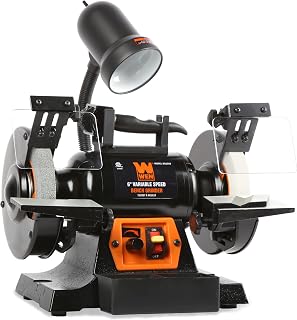 WEN BG625V 2.5-Amp 6-Inch Variable Speed Bench Grinder withCheck price on Amazon
Oregon bench chain grinder review: the short verdict
Oregon is one of the most recognized names in saw chain manufacturing, and the 410-120 represents its compact bench-mounted sharpener for home workshops and regular wood cutters. Rather than balancing a file guide on a guide bar in the cold, a bench grinder lets you set exact grinding angles in a comfortable shop environment and sharpen cutters systematically under good workshop lighting. The 410-120 package includes three 5-3/4 in grinding wheels to handle standard cutter sharpening as well as depth gauge lowering, along with a dressing brick and profile guide.
For someone bucking firewood regularly, an electric bench sharpener brings uniformity that freehand filing rarely matches. Cutter teeth can be ground to uniform angles and lengths, helping the saw track straight through hardwood rounds. The primary drawbacks lie in the product listing itself: the page contains glaring contradictions regarding motor wattage and vise operation, while omitting any written warranty term.
Key specs
| Product | Mount | Power | Pitch Capacity |
|---|---|---|---|
| Oregon 410-120 | Bench or wall mount | 120V, 4.3A | Up to .404 in |
Specifications are manufacturer rated, as published on the Amazon listing. The listing displays notable contradictions between different sections. In one section, the motor is rated at 300W, 4.3A, 0.4 HP, and 3400 RPM. In another section of the same spec table, the listing shows 220 watts, 0.19 hp, and 3150 rpm. Furthermore, the spec table claims a hydraulic assist automatic vise under special features, whereas the bullet points specify a manual chain clamping vise. Following editorial guidelines, we trust the bullet points over the spec table: this unit features a manual clamp vise. The 17 lb listed weight reflects a solid alloy steel frame designed to remain steady while grinding.
The grinder
What the Oregon 410-120 does well
Consistent cutter angles across the whole chain
The main reason to own a bench chain grinder is consistency. When filing by hand, fatigue and angle drift often lead to uneven left and right cutter lengths, causing the saw to pull to one side during bucking cuts. The Oregon 410-120 uses a rigid vise and adjustable guide stops, allowing the operator to grind cutter teeth to consistent angles and depths on both sides of the chain. That uniformity helps keep your saw tracking straight through seasoned oak, maple, and hickory logs.
Comprehensive wheel package in the box
The Oregon 410-120 ships with three 5-3/4 in diameter wheels directly in the box. You receive a 3.2mm wheel for smaller pitches, a 4.7mm wheel for standard pitch chains, and a 6.0mm flat profile disc dedicated to lowering depth gauges (rakers). A dressing brick and a profile guide template are also included to maintain wheel shape and verify cutter geometry.
Solid alloy steel build and dual mounting
Vibration during grinding leads to chatter marks on cutter teeth and uneven edges. The Oregon 410-120 is constructed from alloy steel and weighs 17 pounds, providing the rigidity needed for precise work. The bullets state that the tool easily mounts to a workbench or wall using two included bolts, giving workshop owners flexibility in how they configure their workspace.
One-way motor rotation
The manufacturer listing highlights one-way motor rotation as an operator safety feature. Unlike higher-end commercial grinders with reversible motors that change rotation direction when switching between left and right cutters, the 410-120 runs in a single fixed direction, keeping the motor and controls straightforward.
Limitations
- No warranty stated on listing. The listing does not publish a warranty term for this model. Buyers should check with the seller or Oregon customer service prior to purchase to confirm coverage. Our Woodlot Score assigns zero points for warranty when no concrete term is published.
- Contradictory motor specifications. The listing spec table shows conflicting electrical ratings: 300W, 4.3A, and 0.4 HP with 3400 RPM in one area, and 220 watts and 0.19 hp with 3150 rpm in another. Clarification from the manufacturer is recommended if specific electrical draw is a concern.
- Vise specification conflict. While the spec table mentions a hydraulic assist vise for automatic clamping, the product bullet points explicitly state that the grinder includes a manual chain clamping vise. Expect a manual clamping mechanism on this compact model.
- Permanent workshop footprint. At 17 pounds and measuring 15″L x 8″W x 11″H, this grinder is meant for permanent bench or wall installation rather than quick transport to a woodlot.
- Setup and adjustment care required. Electric grinders can quickly overheat cutter teeth and ruin metal temper if adjusted improperly or forced into the tooth. Users must dress the wheels regularly with the included dressing brick and take light, controlled passes.
How we scored it
The Woodlot Score weighs performance, build, value, safety and warranty, using only what the listing publishes. The full method is on our How We Pick page.
| Product | Woodlot Score | Perf. /35 | Build /25 | Value /25 | Safety /10 | Warranty /5 |
|---|---|---|---|---|---|---|
| Oregon 410-120 | 9.5 | 27 | 20 | 19 | 5 | 0 |
Scores run from 9.2 to 9.8: each product’s point total is placed on that range, so more points always means a higher score.
Who should buy the Oregon bench chain grinder, and who should skip it
Buy it if
- You cut firewood regularly through the season and want sharp, straight-cutting chains without filing by hand.
- You maintain multiple saw chains across different pitches up to .404 in and need consistent cutter angles.
- You want a complete setup in one box, including three grinding wheels, dressing brick, profile guide, and mounting bolts.
- You have dedicated workbench or wall space in your workshop or garage for a permanent 17 lb tool.
Skip it if
- You cut firewood only occasionally and prefer touching up cutters in the field with a hand file from our chainsaw file for 3/8 chain guide.
- You require a portable sharpener for the woods, such as the compact models in our best portable chainsaw saw sharpener guide.
- You need commercial-scale automatic hydraulic clamping for high-volume production sharpening.
- You require a confirmed written warranty before ordering and the seller cannot provide documentation.
Alternatives to consider
Hand filing with field tools. For many firewood cutters who work far from an electrical outlet, a hand file paired with a stump vise remains the most practical field solution. Our guide on using a stump vise for chain saw sharpening covers how to lock the guide bar securely on a woodlot stump for quick touch-ups between refuels.
Portable chain sharpeners. If you want mechanized sharpening without committing to a dedicated workshop bench, review our best portable chainsaw saw sharpener roundup. Portable units clamp onto the bar or run cordless, providing flexibility when cutting on remote woodlots.
Full shop grinder roundups. If you want to evaluate other bench-mounted sharpeners and complete filing kits before deciding, visit our best chainsaw sharpener guide for a broader comparison of workshop and field sharpening options.
Safety and gear
Wear eye protection and gloves for cutting, splitting and handling, follow every tool's manual, install stoves to code, and have the chimney inspected and cleaned every year. See EPA Burn Wise and NFPA heating safety. Read our Safety Disclaimer.
Operating a bench chain grinder requires strict adherence to workshop safety practices. Always wear ANSI-approved eye protection or a full face shield, along with hearing protection and sturdy gloves when grinding chains. High-speed grinding wheels produce hot sparks and fine metal debris that can cause severe injury. Inspect grinding wheels before every use for chips or hairline cracks, and never operate a damaged wheel. Use the included dressing brick to keep wheel faces clean and square, preventing excessive heat buildup that could soften cutter teeth. Always unplug the 120V power cord before changing wheels, adjusting the vise, or performing maintenance. For field chain work, inspect safety apparel and equipment regularly using our chainsaw safety gear checklist.
Around the Woodpile
- Mount securely before use: Fasten the 17 lb grinder firmly to a sturdy workbench or wall with the two included bolts so the machine cannot shift during operation.
- Match wheel to the chain: Use the 3.2mm wheel for smaller pitch chains, the 4.7mm wheel for standard cutters, and reserve the 6.0mm flat disc specifically for depth gauge maintenance.
- Dress the wheel face: Run the included dressing brick against the spinning wheel periodically to remove glazed metal build-up and maintain the correct wheel profile.
- Account for spark discharge: Because the motor runs in one direction, wheel rotation remains constant while the chain vise angle changes between left and right cutters, so ensure your workshop space is clear of flammables in both discharge paths.
Frequently Asked Questions
What chain pitches can the Oregon 410-120 sharpen?
The manufacturer bullets state that the sharpener handles chains up to .404 in pitch, covering common chains from Oregon, Stihl, Husqvarna, and other makers. The spec table lists compatibility with 1/4 in, 3/8 in Low profile, .325 in, 3/8 in, and .404 in pitch chains, as well as 3/4 in.
Does the Oregon 410-120 have an automatic hydraulic vise?
No. While the listing spec table mistakenly mentions hydraulic assist clamping under special features, the product bullet points specify a manual chain clamping vise. Operators clamp and release each link manually during the sharpening process.
What grinding wheels are included with this grinder?
The package includes three 5-3/4 in grinding wheels: a 3.2mm wheel, a 4.7mm wheel, and a 6.0mm flat profile disc for lowering depth gauges. The box also contains a dressing brick, profile guide template, and two mounting bolts.
Can the Oregon 410-120 be mounted on a wall?
Yes. The listing bullet points state that the grinder can be mounted to either a workbench or a wall using the two included bolts, allowing users to save bench space in a compact workshop.
How often should you sharpen a chainsaw chain?
A chain should be sharpened whenever cutting performance drops, when the saw begins producing fine sawdust instead of distinct wood chips, or immediately after contacting dirt or stones. Learn the signs of chain wear in our guide on how often should you sharpen a chainsaw chain.
Related guides
See every saw guide on our chainsaws hub, compare more sharpening options in our best chainsaw sharpener roundup, and learn field maintenance routines with our guide on how often should you sharpen a chainsaw chain. For woodlot touch-ups, see our guide on a stump vise for chain saw sharpening.