How to Exhaust a Pellet Stove: Venting, Parts and Clearances
How to exhaust a pellet stove, from the stove adapter and vent pipe to the wall thimble and termination cap, with the clearances and temperature limits the venting kits state.

On this page
Top picks at a glance
As an Amazon Associate I earn from qualifying purchases.
- 1
 Selkirk Corp 3VP-36 3" x 3' Pellet Stove Vent Pipe Brand:9.6/10View on Amazon
- 2
 Midwest Hearth 832-1680 Quadra-Fire Door Gasket Kit9.7/10View on Amazon
- 3
 Rutland 3-Inch Pellet Stove/Dryer Vent Brush with 20-Feet9.5/10View on Amazon
When a pellet stove runs, it has to breathe out as well as in, and how to exhaust a pellet stove is the question that decides where the flue gases go. The stove burns compressed wood pellets, and an exhaust blower pushes the flue gases out through pellet vent pipe to the outdoors. This guide explains the venting path, the parts it needs, the clearances and temperature limits the kits state, and where a certified pro should take over.
FirewoodGearHQ earns a small commission if you buy through links on this page. The price you pay stays the same. Read our affiliate disclosure.
How to Exhaust a Pellet Stove: The Short Version
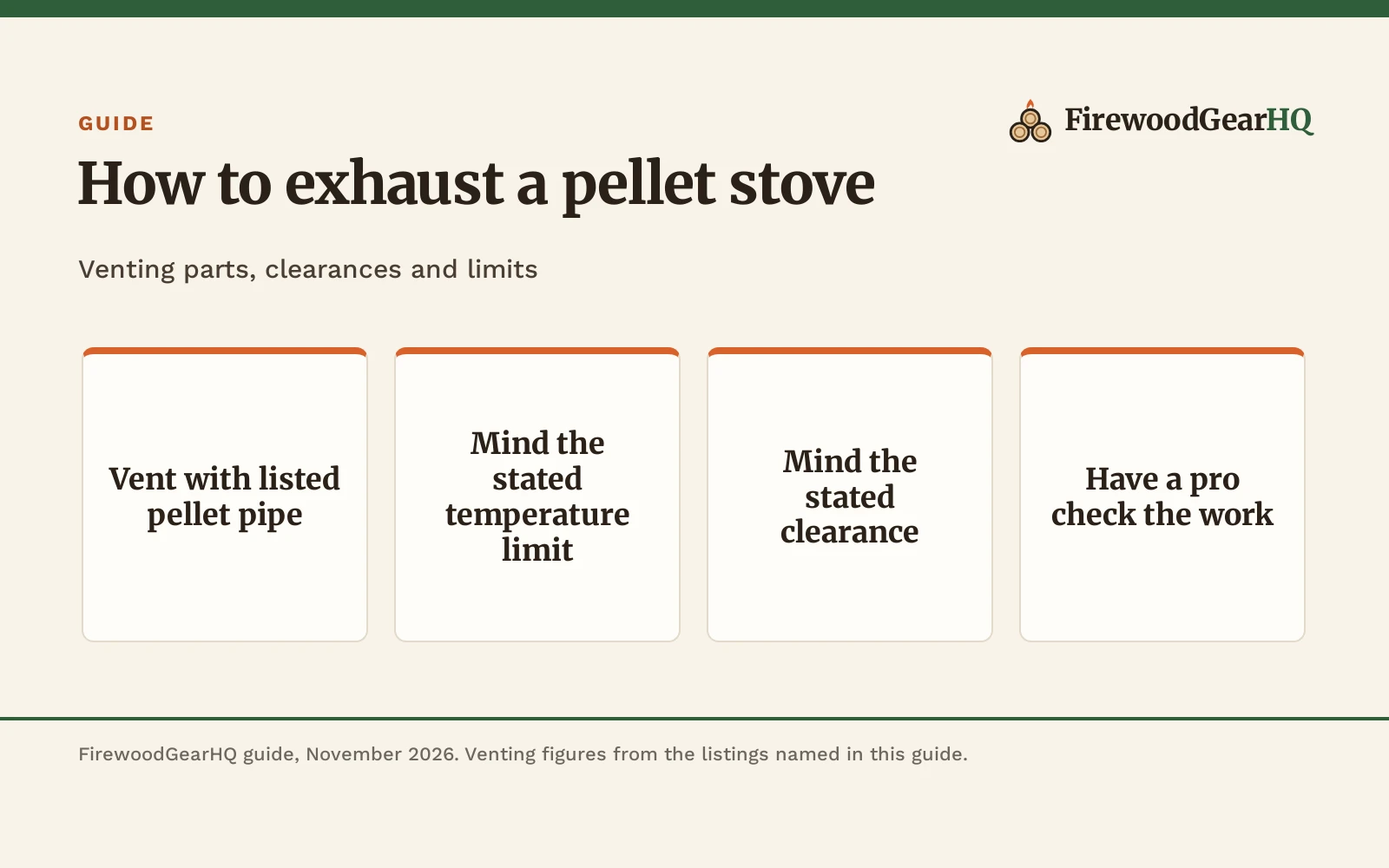
A pellet stove exhausts through pellet vent pipe: the stove adapter connects the stove outlet to the pipe, the pipe runs to the wall or up through the roof, and a cap terminates the run outside. The vent pipe must be listed pellet vent pipe, sized to the stove, with the clearances the kit states. Because the work touches fire safety and local code, a certified pro should look over the plan and the finished job.
What Pellet Stove Exhaust Means
Exhaust is the flue gas leaving the stove. The stove burns pellets in a burn pot, and the exhaust blower moves the gases from the firebox into the vent pipe and out of the house. Fresh air intake is the opposite flow: outside air coming in for combustion, through a separate intake kit. Intake and exhaust serve different jobs, and each needs its own pipe.
The Parts of a Pellet Vent Run
The Comfortbilt 3 inch kit shows the parts in a typical horizontal run: a stove adapter, a cleanout tee, 4 pieces of 12 inch straight pipe, a 45 degree swivel cap, an exterior wall brace and a 3 inch wall thimble. The stove adapter joins the stove outlet to the vent pipe. The cleanout tee gives a place to clear ash from the vent. The straight pipe carries the gases to the wall. The wall thimble shields the pipe where it passes through the wall, and the swivel cap terminates the run outside. Note that the Comfortbilt kit does not include a 90 degree elbow for a down turn, so a run that turns down needs that part from elsewhere.
How the Venting Goes, Step by Step
Size the pipe
Pellet vent pipe comes in 3 inch and 4 inch sizes in the kits in this guide: DuraVent, Selkirk and Comfortbilt list 3 inch kits, and the Stove Parts 4 Less kit is 4 inch pipe. Match the pipe size to the stove outlet and to the kit.
Plan the route
A pellet vent can run straight out through a wall or up through the roof, and the Selkirk Type L kit (on Amazon) in this guide is designed for horizontal installations only. In the Comfortbilt kit, a horizontal run goes from the stove adapter to the wall thimble and out to the swivel cap. A vertical run rises through the roof instead, with the flashing and supports the roof calls for. Keep the run as short and straight as the house allows, with as few turns as possible.
Mind the clearances and the temperature limit
Pellet vent pipe runs hot, and two kits in this guide state the limits. The Selkirk kit states that flue gases must not exceed 570 F, and the Stove Parts 4 Less kit is rated for continuous use at flue temperatures up to 570 degrees Fahrenheit. That kit also states a 1 inch clearance to combustibles in the USA and Canada. Keep the pipe clear of wood, insulation and stored fuel by the clearance the kit states, and check the stove maker for any wider clearance the stove calls for.
Terminate outside
The run ends outside with a cap that lets the gases escape. The Comfortbilt kit ends in a 45 degree swivel cap. Point the termination away from windows, doors and walkways, and keep it clear of leaves and snow.
Have a pro check the work
A certified pro should review the plan, the pipe size, the clearances and the finished job. The pro also checks the venting against local code, which sets the rules for the termination point and the permit. Do not run the stove if the vent looks damaged or choked with ash.
Fresh Air Intake Is a Separate Job
Fresh air intake brings outside air in for combustion, and it uses its own kit and its own pipe. The Zhaoyao and VICAMB kits each use a 2 inch by 59 inch aluminum flex pipe that stretches to 59 inches, with plates and clamps. The Zhaoyao kit (on Amazon) adds a weatherboard, and the VICAMB kit (on Amazon) adds a moisture-proof plate and a protective screen. The Zhaoyao pipe can withstand high temperatures up to 752 degrees Fahrenheit, and its weatherboard slopes down at 45 degrees with a perforated screen that keeps rain, leaves and small animals out. The Comfort Glow kit (on Amazon) adds a rodent cover for the same job. These kits are sold for fresh air intake: they feed air to the fire, and they must not be confused with the vent pipe that carries gases out.
Safety Notes for a Pellet Stove
Run the stove per the maker and local code, keep smoke and CO alarms in place, and have the venting inspected each year. Burn only the fuel the stove maker lists, and never run the stove with a vent that is damaged or choked with ash. See the best carbon monoxide detector for wood stove homes for alarm options.
FAQ: wood, fire and gear
Can a pellet stove vent straight out through a wall?
Yes. The Selkirk Type L kit in this guide is designed for horizontal installations only, and it runs from the stove through the wall to a cap outside. A thru-the-wall run still needs the right pipe size, the stated clearance and a pro to check the plan.
What size vent pipe does a pellet stove need?
Match the pipe to the stove outlet and the kit. The kits in this guide list 3 inch pipe from DuraVent, Selkirk and Comfortbilt, and a 4 inch kit from Stove Parts 4 Less.
How hot can pellet vent pipe get?
Two kits in this guide state a 570 degree limit on flue gases. The Selkirk kit states that flue gases must not exceed 570 F, and the Stove Parts 4 Less kit is rated for continuous use at flue temperatures up to 570 degrees Fahrenheit.
What clearance does pellet vent pipe need from combustibles?
The Stove Parts 4 Less kit states a 1 inch clearance to combustibles in the USA and Canada. Follow the clearance the kit and the stove maker state for the run in question.
Does a pellet stove need fresh air intake?
Many stoves run better with outside air for combustion, and the intake kits in this guide feed it through a 2 inch by 59 inch flex pipe. Intake is separate from exhaust: the intake pipe brings air in, while the vent pipe carries gases out. Check the stove maker for whether the stove calls for an intake kit.
Can I use single-wall wood stove pipe for a pellet stove?
No. The kits in this guide that state their construction use double-wall pellet vent pipe: the Stove Parts 4 Less kit is laser-welded double-wall pipe listed to UL 641, the Comfortbilt kit is double walled, and the Selkirk kit is Type L pellet vent. Use listed pellet vent pipe, not wood stove pipe, for the exhaust run. See the single-wall vs double-wall stove pipe comparison.
More firewood guides
See the stove accessories hub, the best stove pipe for a pellet stove roundup and the single-wall vs double-wall stove pipe comparison. For upkeep, see the best chimney brush for a pellet stove, the best pellet stove igniter for homeowners and the best pellet stove gasket for homeowners.