How Long Do First Alert Carbon Monoxide Detectors Last: Sensor Life and Replacement
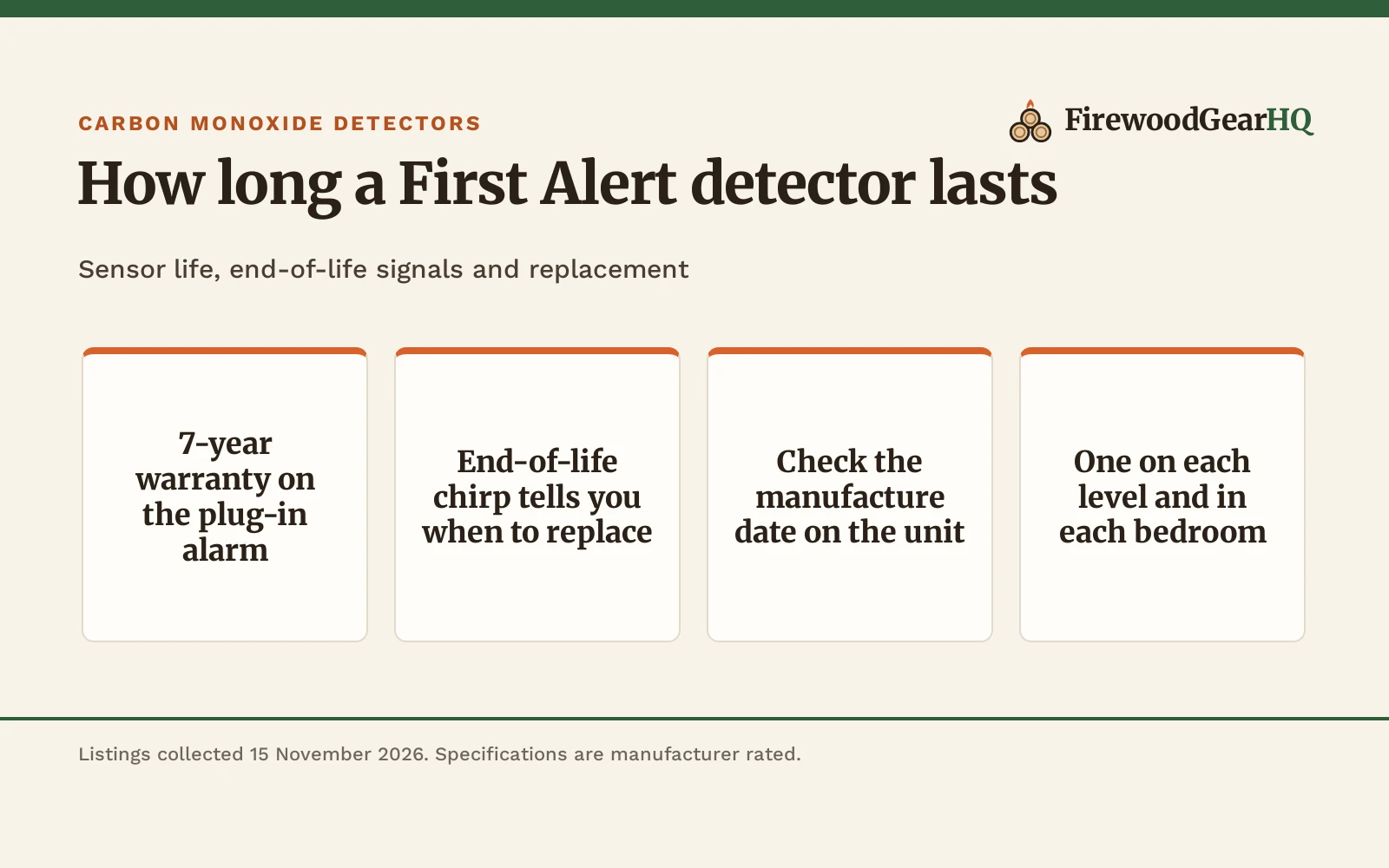
First Alert's plug-in carbon monoxide alarm carries a 7-year limited warranty and sounds an end-of-life chirp when the sensor reaches the end of its life; replace the unit when the signal sounds.

On this page
A carbon monoxide detector guards a home only while its sensor still works, and the sensor wears out with age. How long do first alert carbon monoxide detectors last? The plug-in alarm, model CO606, carries a 7-year limited warranty, and First Alert builds in an end-of-life signal that tells you when the unit must be replaced rather than left on the wall. This guide explains what sets that life, how to read the signals, and when to put a new unit in place.
As an Amazon Associate I earn from qualifying purchases. FirewoodGearHQ earns a small commission if you buy through links on this page. The price you pay stays the same.
How long do first alert carbon monoxide detectors last: the quick answer
First Alert’s plug-in carbon monoxide alarm, model CO606, carries a 7-year limited warranty and sounds an end-of-life chirp when it is time to replace the unit. The combination smoke and carbon monoxide alarm, model SMCO100, gives an end-of-life warning too, and the date shown on the product is the manufacture date, which tells you when the unit was produced. Plan on replacing a First Alert carbon monoxide detector when the end-of-life signal sounds, even if the alarm still seems to work.
Why the sensor wears out
The CO606 uses an advanced electrochemical carbon monoxide sensor, and that sensor ages with use. A sensor that has aged may no longer read carbon monoxide levels the way it did when new, so the maker builds in an end-of-life signal that tells you when to replace the unit. The alarm itself is loud, at 85 decibels, but loudness is not a sign of a healthy sensor: the end-of-life signal is the maker’s own indicator that the sensor has reached its end.
How to tell it is time to replace
Listen for the end-of-life signal. The CO606 sounds an end-of-life chirp, and the SMCO100 gives an end-of-life warning, both telling you to replace the alarm. Do not confuse that chirp with the low-battery signal: the CO606 lets you mute the low-battery signal for up to 8 hours, but the mute does not extend the life of the sensor. Check the manufacture date shown on the product as well, and write the date down when you put a new unit in place so you know its age.
What the numbers on the listing mean
Three figures on the CO606 listing are worth knowing. The 7-year limited warranty is a warranty term, not a promise that the sensor lasts 7 years: the end-of-life chirp is what tells you the sensor has reached its end. The 85-decibel alarm is the sound level when carbon monoxide reaches dangerous levels. The 9V battery backup keeps the alarm watching for carbon monoxide during a power failure. A Kidde plug-in detector (on Amazon), model KN-COB-DP2, carries a 10-year limited warranty with a 2-AA battery backup and an 85-decibel alarm, which shows that warranty terms differ by maker and model.
| Detector | Warranty | Alarm | Power |
|---|---|---|---|
| First Alert CO606 | 7-year limited | 85 decibels | 9V battery |
| First Alert SMCO100 | Not stated | Not stated | Battery-operated |
| Kidde KN-COB-DP2 | 10-year limited | 85 decibels | 2-AA batteries |
Where to put detectors
First Alert advises placing one detector on each level of the home and in each bedroom, so the alarm can be heard where people sleep. The CO606 plugs into a standard outlet and keeps watch with its battery backup during a power failure. The SMCO100 is battery-operated, so it can go where no outlet sits nearby. Put the alarm where the maker says to place it, and keep one on each level.
Carbon monoxide is not carbon dioxide
A CO2 monitor is a different device from a carbon monoxide detector. The Temtop listing states plainly that carbon monoxide cannot be detected by its CO2 detector, which measures carbon dioxide, temperature and humidity instead. Do not rely on a CO2 monitor or an air quality monitor to warn you about carbon monoxide: use an alarm made for carbon monoxide, and replace it when its end-of-life signal sounds.
FAQ: wood, fire and gear
How long do First Alert carbon monoxide detectors last?
The plug-in alarm, model CO606, carries a 7-year limited warranty and sounds an end-of-life chirp when the sensor wears out. The combination alarm, model SMCO100, gives an end-of-life warning too. Replace the unit when the signal sounds.
What does the end-of-life chirp mean?
It means the sensor has reached the end of its life and the unit must be replaced. The chirp is not a low-battery warning: the low-battery signal on the CO606 can be muted for up to 8 hours, while the end-of-life signal means the alarm itself is done.
How do I tell how old my detector is?
Read the manufacture date shown on the product, which identifies when the unit was produced. Write that date down when you install a new alarm so you know how old the unit is.
Can a CO2 monitor detect carbon monoxide?
No. The Temtop CO2 monitor (on Amazon) listing states that carbon monoxide cannot be detected by its CO2 detector. A CO2 monitor measures carbon dioxide, temperature and humidity, so it cannot warn you about carbon monoxide.
Do First Alert detectors need batteries?
The CO606 plugs into a standard outlet and has a 9V battery backup for power failures, while the SMCO100 is battery-operated. Check the battery when the low-battery signal sounds, and replace the unit when the end-of-life signal sounds.
More firewood guides
See the best carbon monoxide detectors, the best carbon monoxide detectors for wood stove homes and the battery vs hardwired carbon monoxide detectors. For the stove itself, see the stove accessories hub and the best wood stove for heating a house.