How Do Wood Burning Stove Fans Work
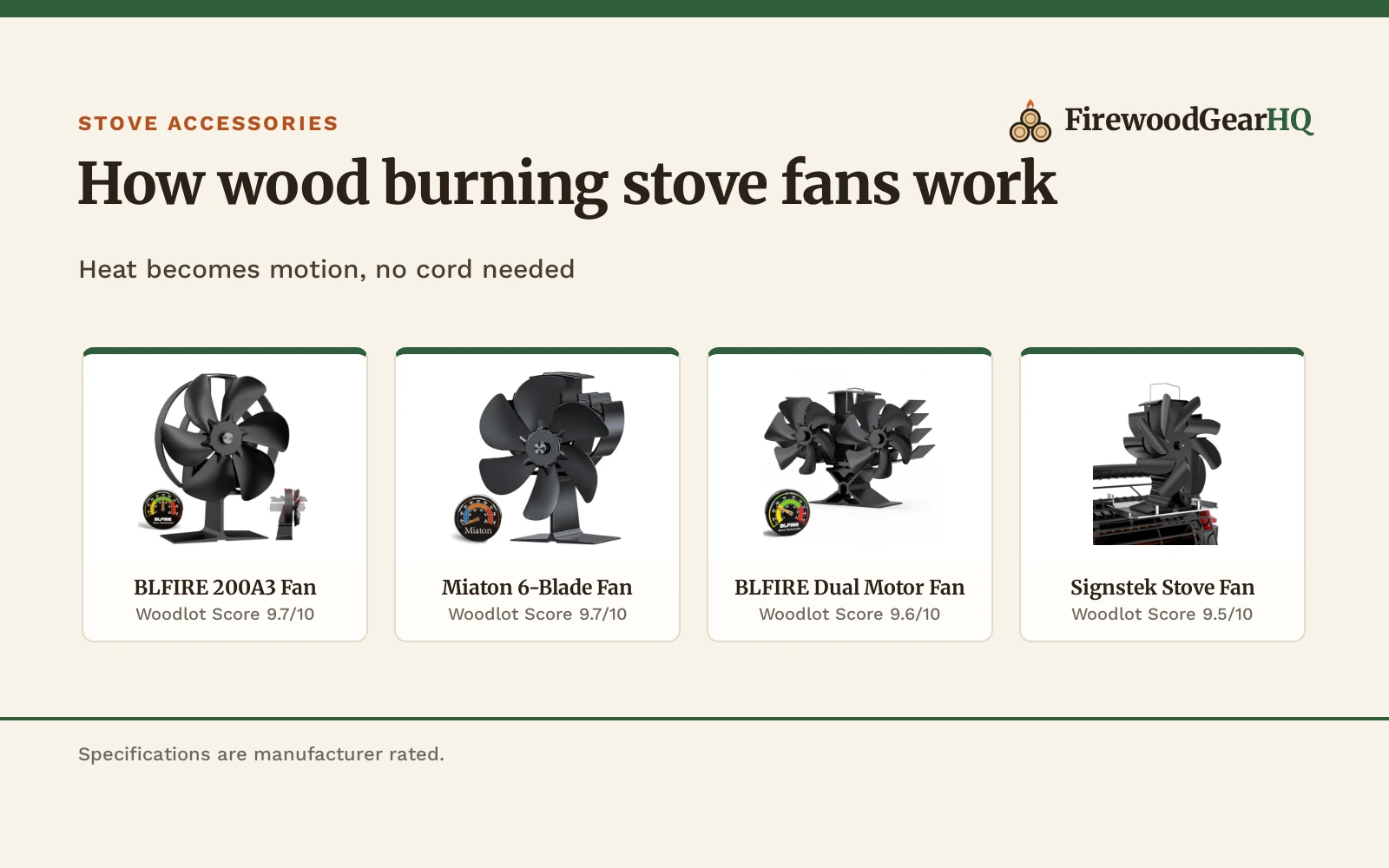
A heat-powered fan turns stove-top heat into motion, spinning blades that push warm air into the room, with no cord and no batteries.

On this page
Top picks at a glance
As an Amazon Associate I earn from qualifying purchases.
- 1
 BLFIRE 90°Adjustable Wood Stove Fan9.6/10View on Amazon
- 2
 Miaton Wood Stove Fan Heat Powered9.5/10View on Amazon
- 3
 BLFIRE Wood Stove Fan Heat Powered9.4/10View on Amazon
- 4
 Signstek Wood Stove Fan, Heat Powered Heater Fan9.2/10View on Amazon
The wood is stacked, the stove is lit, and the far end of the room stays cool while the air around the stove feels close. The fire is doing its work, but the warm air hangs near the stove instead of reaching the chairs. How do wood burning stove fans work? They sit on the hot stove top and turn that heat into motion, spinning blades that push warm air out into the room, with no cord and no batteries.
FirewoodGearHQ earns a small commission if you buy through links on this page. The price you pay stays the same. Read our affiliate disclosure.
| # | Product | Woodlot Score | Buy |
|---|---|---|---|
| 1 | BLFIRE 90°Adjustable Wood Stove Fan | 9.6/10 | Buy on Amazon |
| 2 | Miaton Wood Stove Fan Heat Powered | 9.5/10 | Buy on Amazon |
| 3 | BLFIRE Wood Stove Fan Heat Powered | 9.4/10 | Buy on Amazon |
| 4 | Signstek Wood Stove Fan, Heat Powered Heater Fan | 9.2/10 | Buy on Amazon |
BLFIRE 90°Adjustable Wood Stove Fan
A 6-blade heat-powered fan with 250 CFM airflow, a 90° adjustable head, a magnetic thermometer and a bimetal safety strip. It handles the adjustable, high-airflow fan in this guide.
Pros
- 250 CFM airflow, the highest stated here
- Tilts up to 90° to direct warmth higher or forward
- Starts at about 158°F and handles tops up to 662°F
- Magnetic thermometer included
Cons
- 1.61 lb, the heaviest stated weight here
- No room size is stated
- Replacement support is 30 days, while the warranty is 1 year
- Adjusting the angle needs the unit to cool completely first
Miaton Wood Stove Fan Heat Powered
A 6-blade heat-powered fan with 150 CFM airflow, a thermometer and overheat protection that lifts the fan above 350°C. It handles the compact, quiet fan in this guide.
Pros
- 150 CFM from six balanced blades
- Noise under 25 dB in typical use
- Anodized aluminum body resists heat, wear and corrosion
- 1-year warranty stated
Cons
- 150 CFM is lower than the 250 CFM fans here
- No room size is stated
- The title names a thermometer the bullets do not describe
- No start temperature is stated
BLFIRE Wood Stove Fan Heat Powered
A dual-motor heat-powered fan with 250 CFM airflow, a thermometer and a temperature sensing module. It handles the dual-motor fan in this guide.
Pros
- 250 CFM airflow from a dual motor
- Thermometer lets you monitor the fireplace temperature
- Temperature sensing module lifts the fan when too hot
- Noise less than 25db
Cons
- No warranty term is stated
- No weight is stated
- No blade count is stated
- No start or maximum temperature is stated
Signstek Wood Stove Fan, Heat Powered Heater Fan
A heat-powered fan with a hook, an upgraded motor and a bi-metallic strip for overheat protection. It handles the portable fan in this guide, for small spaces without power.
Pros
- Bi-metallic strip raises the fan edge near maximum temperature
- Noise less than 25db when operating
- Room area of 22 square meters stated
- Heat powered, no batteries or electricity needed
Cons
- No CFM airflow is stated
- No blade count is stated
- No warranty term is stated
- Title names a hook the bullets do not explain
The quick answer
A wood burning stove fan is a heat-powered fan that sits on the stove top. A thermoelectric module inside the base turns the heat of the stove surface into electricity, and that electricity runs a small motor that spins the blades. As the stove top gets hotter the fan spins faster, and as the stove cools it slows and stops.
How do wood burning stove fans work
The fan runs on stove heat alone. The base sits on the hot stove top and picks up heat, a thermoelectric module in the base turns that heat into electricity, and the electricity runs a small motor that spins the blades. The blades push warm air out into the room, so the heat reaches the far side instead of hanging near the stove. No cord, no batteries and no plug are needed, and the fan speeds up as the surface gets hotter and slows as it cools.
Speed follows the stove
The fan has no speed switch, because the stove top sets the speed. A hotter surface makes the module produce more electricity, so the motor spins faster and the blades move more air, and as the fire dies down the fan slows and stops. The BLFIRE 200A3 fan in this guide starts at about 158°F, or 70°C, and is designed for stove tops up to 662°F, or 350°C.
Where to place the fan
Place the fan on a flat stove top, beside the chimney pipe rather than directly in front of it, so the blades can push air across the room. The Miaton listing says to place it on either side of the chimney. The BLFIRE 200A3 listing adds that the surface must be level, stable and heat-conductive, and to let the unit cool completely before adjusting the angle. For the stove itself, see the best wood stoves guide.
Overheat protection: how the fan protects itself
A stove top can get hot enough to damage the motor, so these fans lift themselves away from the heat. The Miaton fan (on Amazon) lifts when temperatures exceed 350°C, or 660°F, the Signstek fan (on Amazon) has a bi-metallic strip that raises its edge near the maximum temperature, the BLFIRE 200A3 fan uses a strip that lifts the base and returns as the surface cools, and the BLFIRE dual-motor fan uses a temperature sensing module that lifts the fan when the temperature is too high. The thermometer that comes with the BLFIRE fans lets you watch the stove-top temperature while the fan works. Keep smoke and CO alarms in the room, and have the chimney inspected by a certified sweep.
Wood burning stove fans for the stove top: the fans in this guide
The fans below cover the heat-powered fans in this guide, from the adjustable 250 CFM model to the compact 150 CFM fan.
FAQ: wood, fire and gear
Do wood burning stove fans need electricity?
No. Every fan in this guide is heat powered and needs no batteries, plug or wiring. The thermoelectric module turns stove-top heat into the electricity that runs the motor.
Where should I place a wood stove fan?
On a flat stove top. The Miaton listing says to place it on either side of the chimney, beside, not directly in front of, the chimney pipe, and the BLFIRE 200A3 listing says the surface must be level, stable and heat-conductive.
How hot does the stove top need to be for the fan to start?
The BLFIRE 200A3 fan in this guide starts at about 158°F, or 70°C. The Signstek listing gives a normal surface temperature between 140 to 653 (60 to 345). A fan placed on a cool spot will not pick up enough heat to spin.
Are wood stove fans noisy?
All four fans in this guide are rated below 25 dB. The Miaton listing describes that as quiet enough for reading, sleeping and relaxing near the fire.
How does a stove fan protect itself from overheating?
A bimetal strip or temperature sensing module at the base lifts the fan slightly when the surface gets too hot, which reduces heat transfer into the motor. The Miaton fan lifts when temperatures exceed 350°C, or 660°F, and the BLFIRE 200A3 strip returns to place as the surface cools.
More firewood guides
See the stove accessories hub, the best wood stove fan for a living room picks and the Tomersun vs Voda wood stove fan comparison. Also see our best wood stoves, our best stove thermometer picks, our best carbon monoxide detector picks and our guide to cleaning a wood stove glass door.