First Alert CO400 vs CO606: Which One Should You Buy?
Battery freedom against plug-in power with battery backup, compared on alarm, sensor, size and warranty, with an alarm from each side of the comparison.

On this page
Top picks at a glance
As an Amazon Associate I earn from qualifying purchases.
- 1
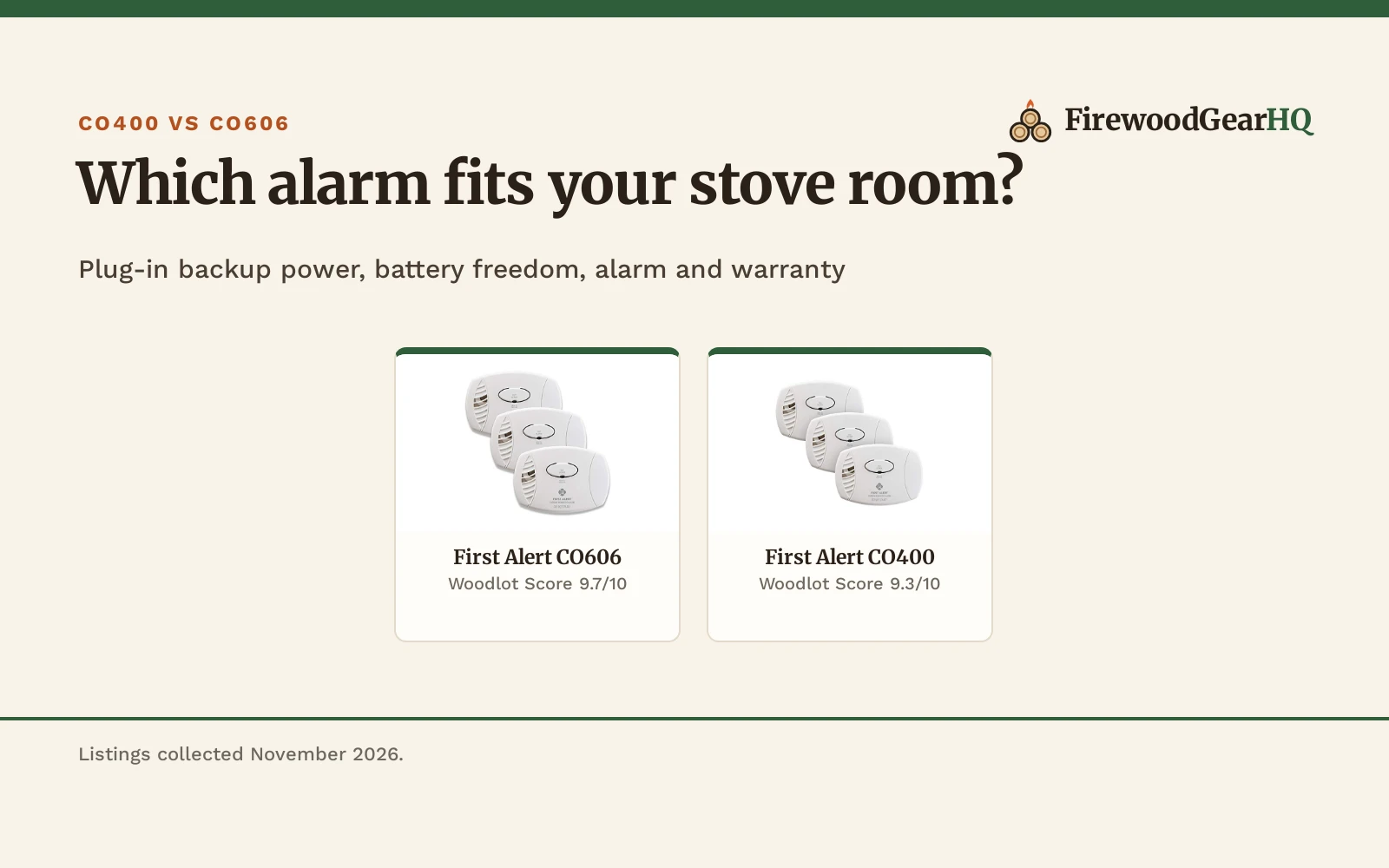
 First Alert Plug in Carbon Monoxide Alarm | CO6069.7/10View on Amazon
- 2
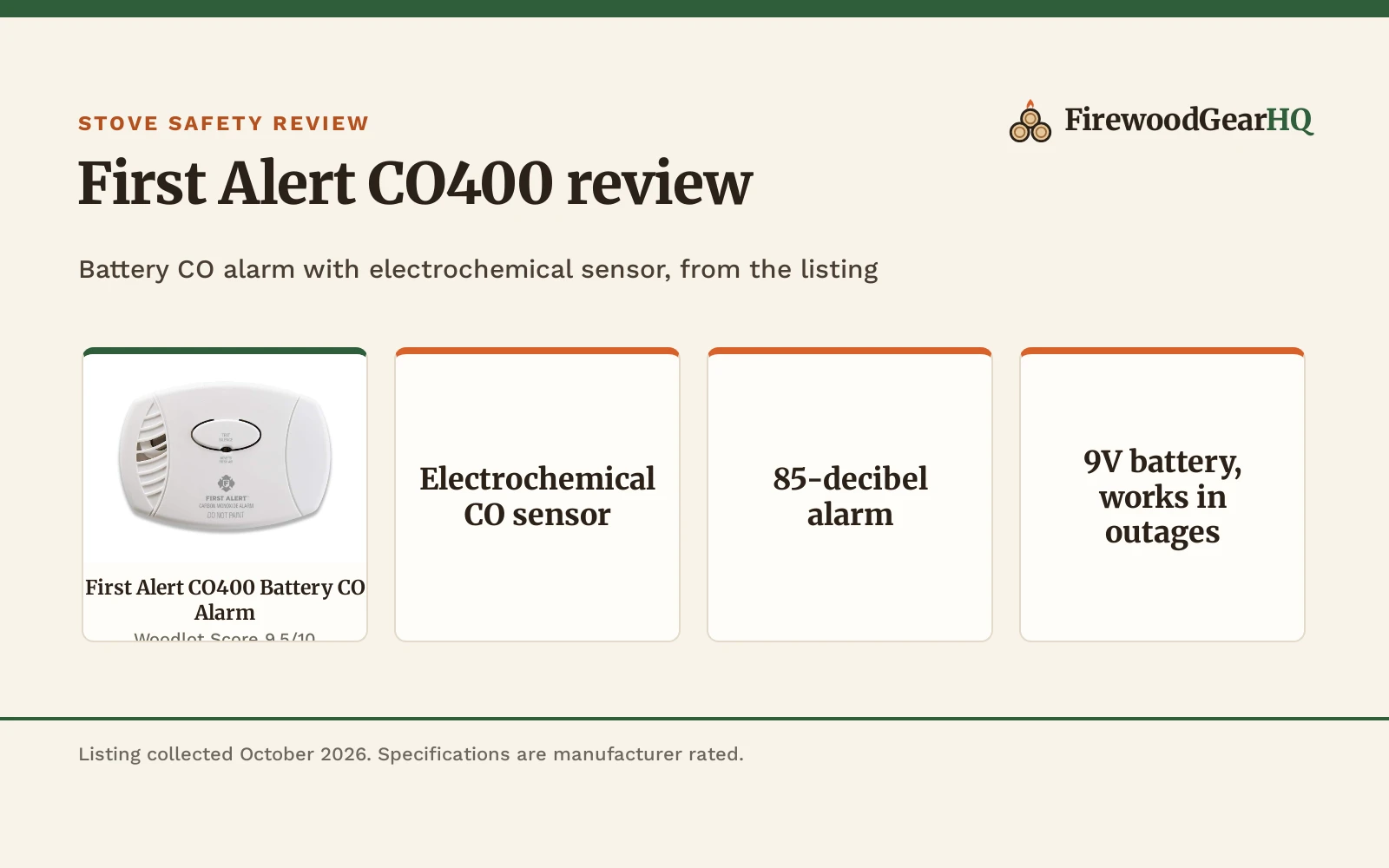
 First Alert Battery Carbon Monoxide Alarm9.3/10View on Amazon
Verdict: In this First Alert CO400 vs CO606 comparison, choose the First Alert CO400 if you want a battery alarm that works almost anywhere with no outlet nearby. Choose the First Alert CO606 if you have a standard outlet where you want the alarm and want battery backup that keeps watch even when the power fails.
A wood stove warms the house through the cold months, and the rooms around it deserve a carbon monoxide alarm that suits how the house is wired and lived in. This comparison covers the battery side and the plug-in side, with an alarm from each side below.
FirewoodGearHQ earns a small commission if you buy through links on this page. The price you pay stays the same. Affiliate disclosure.
Two examples
First Alert Plug in Carbon Monoxide Alarm | CO606
A plug-in carbon monoxide alarm with 9V battery backup, an advanced electrochemical sensor, a loud 85 decibel alarm, an end of life signal chirp and a 7 Year Limited warranty, sold as a 3-pack.
Pros
- Plugs into any standard outlet, with 9V battery backup when the power fails
- Loud 85 decibel alarm when carbon monoxide levels reach dangerous levels
- End of life signal chirp shows when it is time to replace the unit
- 7 Year Limited warranty
Cons
- Needs a standard outlet nearby, so it cannot sit where no outlet is close at hand
- The 9V battery is backup only, so the alarm is made to plug into a standard outlet rather than run on batteries day to day
- Sold as a 3-pack, so a household that wants a lone alarm takes more than it needs
- When the end of life chirp sounds, the whole unit is replaced
First Alert Battery Carbon Monoxide Alarm
A battery-operated carbon monoxide alarm with an advanced electrochemical sensor, a loud 85 decibel alarm and a silence button, sold as a 3-pack with a 5 year limited warranty.
Pros
- Battery operated, so it works almost anywhere with no outlet nearby
- Loud 85 decibel alarm when carbon monoxide levels are elevated
- Silence button for simple operation
- 5 year limited warranty
Cons
- Battery power only, so the household must keep fresh batteries in the alarm
- The 5 year limited warranty is shorter than the 7 Year Limited warranty on the CO606
- Its first measure of 1.5 inches is larger than the CO606's 1.38 inches, so it needs a little more room in that direction
- No plug-in option, so it cannot draw on outlet power where an outlet sits handy
Side by side
| Product | Power | Alarm | Size | Weight | Warranty |
|---|---|---|---|---|---|
| First Alert CO606 | Plug in with 9V battery backup | 85 decibel alarm | 1.38 inches x 5.0 inches x 3.4 inches | 0.5 pounds | 7 Year Limited |
| First Alert CO400 | Battery operated | 85 decibel alarm | 1.5 inches x 5.0 inches x 3.4 inches | 0.5 pounds | 5 year limited warranty |
Figures are manufacturer stated, collected 15 November 2026.
First Alert CO400 vs CO606: Power and Placement
The split between these alarms is power. The First Alert CO400 runs on batteries, and the maker says battery-operated carbon monoxide alarms work almost anywhere. The First Alert CO606 plugs into any standard outlet and carries a 9V battery backup, so it keeps watch on carbon monoxide levels even if the power fails. For more on the trade-off, see the plug-in vs battery carbon monoxide alarm comparison.
Alarm and Sensor
Both alarms sound a loud 85 decibel alarm when carbon monoxide levels rise, and both use an advanced electrochemical carbon monoxide sensor. On the alarm itself the sides match, so the choice turns on power, size and warranty rather than on how loud the warning sounds.
Size and Weight
The alarms share much of their size and differ in the first measure. The First Alert CO400 measures 1.5 inches x 5.0 inches x 3.4 inches, and the First Alert CO606 measures 1.38 inches x 5.0 inches x 3.4 inches. Both list a weight of 0.5 pounds, and both come as a 3-pack.
Warranty and End of Life
The First Alert CO400 carries a 5 year limited warranty, and the First Alert CO606 carries a 7 Year Limited warranty. The CO606 also carries an end of life signal chirp, so the household knows when it is time to replace the unit for safety.
Scoring the woodpile
Each alarm is scored on performance, build, value, safety and warranty, using only what the maker publishes, with the weights on the How We Pick page.
| Product | Woodlot Score | Perf. /35 | Build /25 | Value /25 | Safety /10 | Warranty /5 |
|---|---|---|---|---|---|---|
| First Alert CO606 | 9.7 | 30 | 21 | 21 | 8 | 4 |
| First Alert CO400 | 9.3 | 28 | 20 | 20 | 0 | 3 |
The 8.8 and 9.8 limits frame every score. Scores follow the ranking in each guide, dropping by at least 0.1 per place, so each pick has its own number.
Wear eye protection and gloves for cutting, splitting and handling, follow every tool's manual, install stoves to code, and have the chimney inspected and cleaned every year. See EPA Burn Wise and NFPA heating safety. Read our Safety Disclaimer.
Around the Woodpile
- Place the CO606 on each level of the home and in each bedroom, as the maker advises, so the alarm covers the rooms where the household sleeps.
- Keep the CO400 where no outlet sits nearby, since battery power lets it work almost anywhere in the home.
- Listen for the end of life chirp on the CO606, which signals that the unit is ready to be replaced.
- Keep battery backup in place on the CO606 so the alarm keeps watch even when the power fails.
FAQ: wood, fire and gear
Should a carbon monoxide alarm go in the room with the wood stove?
The maker of the CO606 advises placing an alarm on each level of the home and in each bedroom, so the room with the wood stove is covered by the alarm on that level and each bedroom gets its own alarm. The battery-powered CO400 works almost anywhere, so it suits rooms with no outlet nearby.
Does the CO606 keep working when the power fails?
Yes. The CO606 plugs into a standard outlet and carries a 9V battery backup for continuous monitoring of carbon monoxide levels, even if there is a power failure.
What does the end of life chirp on the CO606 mean?
The chirp signals that it is time to replace the unit for safety, so the household knows the alarm has reached the end of its life.
Can the CO400 go anywhere in the house?
The maker says battery-operated carbon monoxide alarms work almost anywhere, and the CO400 needs no outlet. That makes it a fit for rooms where an outlet is not close at hand.
More firewood guides
See the plug-in vs battery carbon monoxide alarm comparison, the First Alert CO400 review, the battery vs hardwired carbon monoxide detector comparison and the best carbon monoxide detector roundup.