Best Chainsaw Helmet for Small Heads (2026): 5 Forestry Helmets Compared
Five chainsaw helmets for small heads compared by suspension adjustability, face shield design, hearing protection, ANSI compliance and warranty.

On this page
Top picks at a glance
As an Amazon Associate we earn from qualifying purchases.
- 1
 Best OverallHusqvarna 5927526019.6/10View on Amazon
- 2
 Best with BluetoothGREEN DEVIL Mervex9.6/10View on Amazon
- 3
 Best for Smallest CircumferenceYesRight YESR-AQMS9.5/10View on Amazon
- 4
 Best VentilatedTR Industrial TR880119.4/10View on Amazon
- 5
 NoCry 6-in-1 Industrial Chainsaw Helmet with Face Shield andView on Amazon
- 6
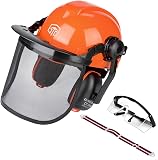 Forestry Safety Helmet System with Mesh VisorView on Amazon
- 7
 TOOLIOM Chainsaw Helmet with Face Shield and Ear MuffsView on Amazon
- 8
 SAFEBUILDER Forestry Safety Helmet with Build-in Visor MeshView on Amazon
When the morning air turns brisk in early fall, cutting firewood for the coming winter becomes the priority on a rural property. Working with a chainsaw demands serious head, face and hearing protection, but standard forestry helmets are notorious for wobbling or sliding down over the eyes when worn on smaller head sizes. Finding the best chainsaw helmet for small heads requires checking stated circumference minimums, suspension depth settings and secure chinstraps so the hard hat stays locked in place while you limb and buck.
FirewoodGearHQ may earn a small commission if you buy through links on this page. The price you pay stays the same. Affiliate disclosure.
Quick picks
- Best Overall Husqvarna 592752601: HDPE forestry helmet with 6-point suspension, 3 depth settings, 24 dB NRR hearing protection and a 1 year warranty. Check price on Amazon
- Best with Bluetooth GREEN DEVIL Mervex: ABS helmet with 53 to 63 cm fit range, chinstrap, Bluetooth 5.3 hearing protection and dual visors. Check price on Amazon
- Best for Smallest Circumference YesRight YESR-AQMS: Accommodates head circumferences from 52 to 64 cm with mesh visor and 25.9 dB SNR ear protectors. Check price on Amazon
- Best Ventilated TR Industrial TR88011: Ratchet-adjustable hard hat with six ventilation slots, 22 dB NRR earmuffs, and both mesh and plastic visors. Check price on Amazon
The picks

Husqvarna 592752601 Chainsaw Helmet with Metal
An HDPE forestry helmet with a 6-point textile suspension, 3 vertical depth adjustments, slip ratchet, metal mesh visor, sun peak and 24 dB NRR hearing protection.
Pros
- 6-point textile suspension includes 3 depth settings and slip ratchet for smaller head adjustment
- Adjustable ear muffs meet ANSI S3.19-1974 with a 24 dB NRR rating
- Meets ANSI Z89.1-2014 Type I Class E electrical insulation standards
- Listing spec table states a 1 year warranty
Cons
- Listing spec table contradicts bullets by listing cycling use and included chaps and gloves
- Neck guard must be purchased separately per the listing bullets
- Specific circumference measurements in inches or centimeters are not stated
- Metal mesh face shield lets fine sawdust through compared to a solid clear shield

GREEN DEVIL Forestry Chainsaw Safety Helmet
An ABS forestry helmet system fitting head circumferences from 53 to 63 cm (20.86 to 24.80 in), equipped with Bluetooth 5.3 hearing protection, dual visors, 6-point suspension and a chinstrap.
Pros
- Stated fit range of 53 to 63 cm (20.86 to 24.80 in) accommodates smaller head circumferences
- Adjustable chinstrap with molded chin-cup keeps helmet secure during firewood work
- Dual-layer eye and face protection with clear polycarbonate shield and built-in smoke visor
- Bluetooth 5.3 ear muffs provide 27 dB NRR hearing protection and up to 80 ft wireless range
Cons
- Heaviest helmet in this comparison at a listed 3.5 pounds
- No concrete warranty term is stated on the listing
- Requires regular recharging for the Bluetooth hearing protection functions
- Clear polycarbonate visor scratches more easily than wire mesh in brush

Chainsaw Helmet with Face Shield and Ear
A forestry safety helmet with an adjustable 52 to 64 cm head size range, mesh face shield, 25.9 dB SNR ear protectors and a listed weight of 0.93 kg.
Pros
- Minimum stated fit of 52 cm is the smallest circumference in this group
- Lightweight design listed at 0.93 kg reduces neck fatigue
- Includes movable mesh face shield and 25.9 dB SNR ear protectors
- Listing states the helmet meets ANSI Z89.1 standards
Cons
- Spec table lists material type as mesh instead of stating the shell plastic
- Ear protection is rated in European SNR (25.9 dB) rather than North American NRR
- No warranty term is stated on the listing
- Suspension lacks numbered depth settings found on premium helmets

TR Industrial Forestry Safety Helmet and Hearing
An orange forestry safety hard hat with a ratchet adjustment knob, six ventilation slots, 22 dB NRR earmuffs, and both plastic and mesh visors.
Pros
- Includes both a clear plastic visor and a ventilated mesh visor
- Six ventilation slots allow heat to escape during warm cutting days
- Ratchet-style knob provides straightforward circumference adjustment
- Meets ANSI Z89.1 Type 1 Class C, and earmuffs meet ANSI S12.42 and S3.19
Cons
- Head circumference range in inches or centimeters is not stated on the listing
- Item weight is not stated in the listing or specifications
- Spec table contains a contradiction, listing material as polyester knit
- No warranty term is stated on the listing

Husqvarna Orange Protective Helmet
A basic orange protective helmet shell from Husqvarna with pull-on closure, listed at 1 kg, without included face or hearing protection.
Pros
- Husqvarna branded protective hard hat shell
- High-visibility orange color for work in the woods
- Listed weight of 1 kg
- Pull-on closure design
Cons
- Does not include a face shield or hearing protection ear muffs
- Spec table contains severe errors, listing MMA league and an impeller belt component
- No head circumference sizing, suspension details or ANSI standards are stated
- No warranty term is stated on the listing
More options to compare
 NoCry 6-in-1 Industrial Chainsaw Helmet with Face Shield andCheck price on Amazon
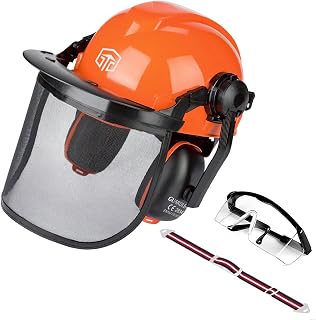 Forestry Safety Helmet System with Mesh VisorCheck price on Amazon
 TOOLIOM Chainsaw Helmet with Face Shield and Ear MuffsCheck price on Amazon
 SAFEBUILDER Forestry Safety Helmet with Build-in Visor MeshCheck price on Amazon
Compare the picks
| Model | Woodlot Score | Fit Range | Suspension | Hearing Protection | Face Shield | Weight (listed) | Warranty (stated) |
|---|---|---|---|---|---|---|---|
| Husqvarna 592752601 | 9.6/10 | Not stated; 3 depth settings | 6-point textile, slip ratchet | 24 dB NRR (ANSI S3.19) | Metal mesh and sun peak | 1.9 pounds | 1 year |
| GREEN DEVIL Mervex | 9.6/10 | 53-63 cm (20.86-24.80 in) | 6-point, chinstrap | 27 dB NRR, Bluetooth 5.3 | Clear PC shield, smoke visor | 3.5 pounds | Not stated |
| YesRight YESR-AQMS | 9.5/10 | 52-64 cm | Adjustable headgear, buckle | 25.9 dB SNR | Mesh visor | 0.93 kg | Not stated |
| TR Industrial TR88011 | 9.4/10 | Not stated; ratchet knob | 6 ventilation slots | 22 dB NRR (ANSI S3.19) | Plastic and mesh visors | Not stated | Not stated |
| Husqvarna 588 64 60-01 | 9.2/10 | One size | Pull-on | Not included | Not included | 1 kg | Not stated |
Specifications are manufacturer rated, collected 12 October 2026. Weights are as listed on each product listing. Only one of these listings states a concrete warranty term.
How we scored them
Each helmet is scored out of 10 on performance, build, value, safety and warranty, using only what the listing publishes. The weights are on our How We Pick page.
| Product | Woodlot Score | Perf. /35 | Build /25 | Value /25 | Safety /10 | Warranty /5 |
|---|---|---|---|---|---|---|
| Husqvarna 592752601 | 9.6 | 30 | 20 | 20 | 8 | 3 |
| GREEN DEVIL Mervex | 9.6 | 32 | 21 | 20 | 7 | 0 |
| YesRight YESR-AQMS | 9.5 | 28 | 18 | 21 | 6 | 0 |
| TR Industrial TR88011 | 9.4 | 27 | 16 | 20 | 6 | 0 |
| Husqvarna 588 64 60-01 | 9.2 | 18 | 14 | 12 | 0 | 0 |
Scores run from 9.2 to 9.8: each product’s point total is placed on that range, so more points always means a higher score.
Buying guide: choosing the best chainsaw helmet for small heads
Circumference minimums and suspension depth
Standard forestry helmets are built for broad head shapes, often leaving smaller heads loose inside the shell. Look closely at the listed minimum head size: models stating a 52 or 53 cm minimum provide a closer fit than generic one-size shells. Even more critical is suspension depth adjustment. A helmet can fit around the brow yet sit far too low, resting on your ears or knocking against eye protection. Multi-position vertical depth settings, such as 3-setting slip-ratchet suspensions, allow operators with smaller crowns to elevate the shell to the proper height.
Chinstraps and retention during firewood cutting
Bucking rounds on uneven woodlot ground means constantly tilting your head down. When a hard hat is slightly loose, gravity pulls the heavy face visor and earmuffs forward, tipping the brim over your field of view. A 6-point suspension with an adjustable chinstrap keeps the shell anchored securely against your head, preventing the helmet from shifting off during rigorous chainsaw operation.
Face protection: wire mesh visors versus clear shields
Forestry helmets feature either metal mesh screens or clear polycarbonate shields, and some include both. Metal mesh visors provide ventilation and do not fog in humid weather, deflecting flying wood chips while allowing airflow. Clear plastic visors stop fine sawdust and liquid bar oil, but they require periodic cleaning and can scratch in dense brush. A flip-up 90-degree pivot mechanism lets you raise the visor when refueling or stacking splits.
Hearing protection and noise attenuation ratings
Chainsaws produce high noise levels that require consistent hearing defense. Integrated ear muffs must seal completely around the ear canal to function properly. On smaller heads, wide helmets can prevent ear cups from exerting sufficient inward clamping force. Look for ear muffs with independent vertical and sideways pivots that allow you to align the cups firmly against the side of your skull, meeting ANSI S3.19 standards with ratings from 22 dB to 27 dB NRR.
Impact standards and electrical ratings
A legitimate chainsaw helmet must meet ANSI Z89.1 standards for Type I top impact protection. Type I helmets are designed to cushion the crown against falling branches and debris. Check the electrical classification as well: Class C conductive helmets offer no electrical protection, whereas Class E helmets are insulated against high-voltage contact. Secondary components should meet ANSI Z87.1 for eye shields and ANSI S3.19 for ear protection.
For a full inventory of personal protective equipment needed around felling and bucking, consult our chainsaw safety gear checklist, or review our guide on best chainsaw chaps.
Wear eye protection and gloves for cutting, splitting and handling, follow every tool's manual, install stoves to code, and have the chimney inspected and cleaned every year. See EPA Burn Wise and NFPA heating safety. Read our Safety Disclaimer.
Around the Woodpile
- Always adjust internal suspension depth and headband tension before pulling the chainsaw starter cord, confirming the shell does not tip forward when bending over a log.
- Ensure the ear muff cushions create a full perimeter seal against your head without resting on the brim of the hard hat or the temples of safety glasses.
- Clean wood chips, bar oil residue and sawdust off the mesh screen and sweatband after each cutting session before storing the helmet in a dry location out of direct sunlight.
- Inspect the shell, suspension clips and visor pivot pins for stress marks or cracks before seasonal firewood prep, replacing any worn components.
Frequently Asked Questions
Why do standard chainsaw helmets slip on smaller heads?
Many standard hard hats rely on a wide shell designed for larger hat sizes, with headbands that do not cinch down far enough for smaller heads. When adjusted as tight as possible, the shell often sits too low on smaller heads, causing the ear cups and face shield to sit out of alignment and slip forward when bending over rounds.
What helmet size range is needed for a small head?
Look for listings that specify a minimum circumference of 52 cm or 53 cm (20.86 inches). Helmets featuring 6-point suspensions with adjustable vertical depth settings provide the best security for smaller head shapes.
Do I need a chinstrap on a chainsaw helmet?
While standard ground forestry work often uses ratchet headbands alone, a chinstrap is beneficial for operators with smaller heads. A chinstrap prevents the added weight of the face shield and earmuffs from dislodging the helmet when looking downward during bucking.
What safety standards should a forestry helmet meet?
The helmet shell should meet ANSI Z89.1 Type I standards for top impact protection. Earmuffs should meet ANSI S3.19 or ANSI S12.42 hearing protection standards, and face shields should comply with ANSI Z87.1 or CE EN 1731 impact requirements.
Can I use a bare hard hat for chainsaw work?
A bare hard hat protects only the crown of your head from falling overhead limbs. It lacks the integrated eye and face shield needed to stop flying wood chips and the hearing protection required to dampen saw exhaust noise. Chainsaw work requires full protective coverage.
Related guides
Explore our complete chainsaw gear hub for additional protective equipment, including dedicated recommendations for chainsaw helmets with chin straps and our chainsaw chaps size chart. Keep your hands protected with the best chainsaw gloves, and match your protective gear with the right cutting tool by reviewing the best chainsaws for firewood. For proper woodlot cutting practices, read our guide on how to buck firewood safely with a chainsaw. Once your logs are bucked to length, split your firewood using the best log splitters for home use or the best splitting mauls.