How to Use a Cant Hook
How to use a cant hook to roll, turn, and position heavy firewood logs safely, with step-by-step technique, leverage tips, and key safety precautions.

On this page
Top picks at a glance
As an Amazon Associate we earn from qualifying purchases.
- 1
 Wood-Mizer Steel Cant Hook9.7/10View on Amazon
- 2
 SPEED FORCE 47 Inch TimberJack Forestry/Logging/Log9.7/10View on Amazon
- 3
 58 in Felled Cant Hook Logging Tool9.6/10View on Amazon
- 4
 Wood-Mizer Steel Cant HookView on Amazon
- 5
 Timber Tuff TMW-30 Cant Hook with Timber Tuff and 4-Feet LongView on Amazon
- 6
 WOODCHUCK Wct03 Timberjack Peavey and Cant HookView on Amazon
- 7
 Stihl Genuine 0000 881 2701 Felling Lever with Cant HookView on Amazon
Rolling heavy logs by hand during autumn cutting or spring firewood cleanup strains your lower back and risks slips. Knowing how to use a cant hook lets you turn, roll, and position large trunks with mechanical leverage instead of physical force. To use a cant hook, place the blunt toe against the log, swing the curved hook over the trunk so the point bites into the bark, and apply steady handle leverage to rotate the timber. Keeping a wide stance on the uphill side lets the lever do the work while keeping your body clear of the roll path.
More options to compare
 Wood-Mizer Steel Cant HookCheck price on Amazon
 Timber Tuff TMW-30 Cant Hook with Timber Tuff and 4-Feet LongCheck price on Amazon
 WOODCHUCK Wct03 Timberjack Peavey and Cant HookCheck price on Amazon
 Stihl Genuine 0000 881 2701 Felling Lever with Cant HookCheck price on Amazon
FirewoodGearHQ may earn a small commission if you buy through links on this page. The price you pay stays the same. Read our affiliate disclosure.
The quick answer
A cant hook turns handle leverage into rotational force through a rigid lever and pivoting clasp. The blunt metal toe rests against the log as a fulcrum, and the hinged clasp wraps over the trunk to bite into the wood. Working the handle transfers your effort into torque that turns the trunk while keeping your footing clear of the roll path.
Cant hook specifications and capacities
Cant hooks vary in handle length, jaw capacity, and weight across steel, aluminum, and solid hardwood models. The comparison table below compiles manufacturer specifications from reference logging tools to show typical dimensions.
| Tool model | Handle length | Log diameter capacity | Tool weight |
|---|---|---|---|
| Wood-Mizer Steel Cant Hook | 60 in (28 in handle length in specs) | 8 to 32 in | 10.5 lb |
| VEVOR Felled Cant Hook | 59 in | Up to 32 in | 10.8 lb |
| FAHKNS Timberjack Log Roller | 50.8 in | 3 to 25 in | Not stated |
| Timber Tuff TMW-30 | 36 in usable (4 ft total) | Up to 14 in (3 to 16 in capacity) | 4.2 lb (9 lb in bullet text) |
| VIKING MOUNTAIN TOOL WORKS Cant Hook | 47 in (48 in title) | 8 to 32 in | 9 lb |
| XROPURR Felled Cant Hook | 51 in | Up to 19 in | 9.93 lb |
Use these published figures to match tool leverage and jaw capacity to your timber.
How to use a cant hook step by step
Rolling heavy timber requires methodical preparation and deliberate lever motion to prevent strains and runaway logs.
Clear the work area and check your footing
Clear away fallen branches, loose bark, and rocks around the log and your path. Solid footing is essential because a slip under load can cause severe injuries.
Position yourself on the uphill side
Always stand on the uphill side of the log when working on an incline. Never stand downhill, as gravity can roll the trunk over your feet if it breaks free.
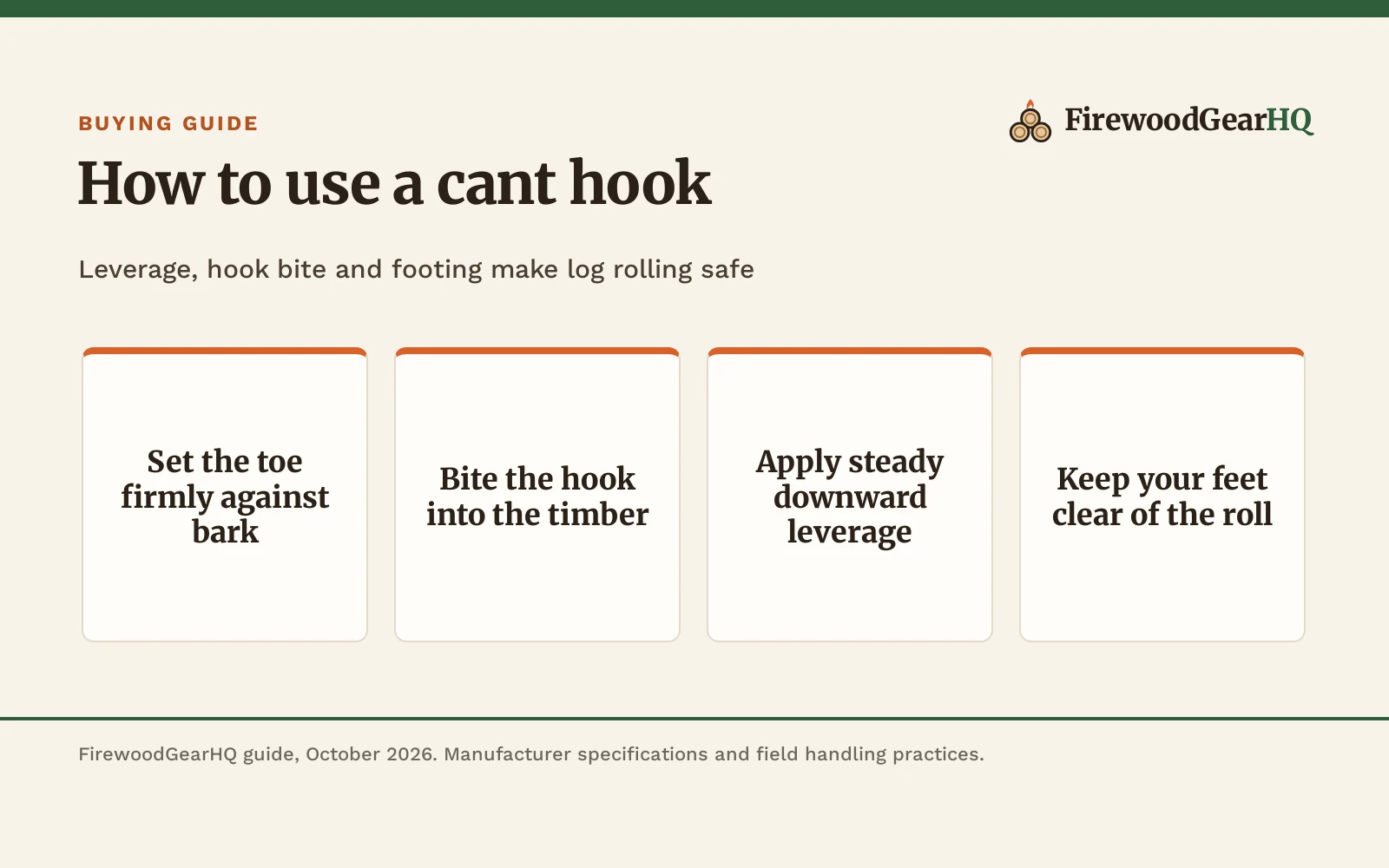
Set the toe firmly against the bark
Place the blunt toe against the trunk so the small teeth press into solid wood. On loose bark, scrape a small patch clear so the tool cannot slip sideways.
Bite the hook into the timber
Swing the curved arm over the trunk so the pointed clasp falls onto the far side. Seat the sharp point securely into solid wood before applying leverage.
Apply steady downward leverage
Grip the handle with both hands, bend your knees, and push smoothly using your legs. As the lever moves, the clasp and toe grip the circumference and roll the log away from your stance.
Reposition the hook to continue rolling
Once the stroke completes, disengage the clasp and slide the tool along the circumference to reset the bite into fresh wood. Repeat until the log reaches position.
Safety rules when rolling heavy timber
Follow these woodland safety principles whenever working around timber:
- Wear protective equipment: Put on steel-toe boots, leather gloves, and eye protection. Near sawing work, wear an approved forestry helmet with face shield, hearing protection, and chainsaw chaps. See our chainsaw safety gear checklist and guide to the best chainsaw chaps.
- Never stand downhill: Gravity pulls rolling timber with immense force. Always stand on the uphill slope so wood travels away from your feet.
- Avoid pinch points: Keep fingers clear of the swinging hook and log surfaces. Grasp only the handle grip.
- Check for branch tension: Relieve pinned limbs before rolling to prevent violent spring poles.
- Maintain a clear work zone: Never roll timber while someone stands in the travel path.
OSHA logging standards emphasize establishing secure footing, planning an escape path, and verifying log stability before rolling operations commence.
Cant hook vs peavey for firewood work
While both tools share a swinging hook on a lever handle, their tips serve different purposes:
- Cant hook: Features a blunt end with a toothed metal toe that grips curved bark and flat cants. It is the preferred tool around sawmills, log decks, and firewood processing areas. Read our comparison in cant hook vs peavey.
- Peavey: Replaces the blunt toe with a sharp steel spike to jab between stacked logs or pry frozen trunks free.
For bucking rounds and handling firewood on flat ground, a cant hook is safer and more stable because the toe will not spear the soil. See our review of the best cant hook options.
Rolling logs to buck firewood safely
A cant hook assists when bucking fallen trees into stove-length rounds. Cutting directly on soil drives saw chains into dirt, dulling teeth and requiring sharpening with the best chainsaw sharpener.
To avoid dirt strikes, cut downward through the trunk until the bar passes the center, leaving a hinge along the bottom. Turn off the saw or engage the chain brake, set the saw aside, and use your cant hook to roll the log until the uncut wood faces upward to finish cuts cleanly from above.
Combining a cant hook with a timberjack foot raises timber off the forest floor. The FAHKNS listing notes that its timberjack stand lifts logs up to 10.6 in above the ground to prevent bar pinching. Learn more in our guide to the best log lifter and our guide on how to bucking firewood safely with a chainsaw.
Choosing handle length and material
Handle dimensions determine mechanical leverage for moving heavy timber:
- Long handles (58 to 60 in): Longer handles maximize leverage for stubborn rounds. Wood-Mizer lists an 8 to 32 in log capacity on its 60 in steel tool, and VEVOR lists capacity up to 32 in on its 59 in tool. However, OAOLOWF lists a 16 in opening on its 58 in model, showing that handle length alone does not dictate jaw opening.
- Medium and compact handles (36 to 48 in): Shorter tools offer easier maneuvering in brush. Timber Tuff lists a 4 ft hardwood model with a 36 in usable handle for logs up to 14 in (specifying 3 to 16 in capacity). VIKING MOUNTAIN TOOL WORKS lists a 48 in aluminum model (47 in in listing text) rated for 8 to 32 in logs, noting that logs larger than 16 to 18 in become difficult to roll safely and recommending keeping sizes under 18 in.
Hardwood handles absorb shock in winter cold, carbon steel provides maximum bending strength, and aluminum offers lightweight durability. For moving rounds to the pile, pair your tool with gear from our firewood handling hub or the best log tongs.
Turn a stack's length, height and depth into full and face cords, and estimate how much wood a winter takes.
Frequently Asked Questions
Can you use a cant hook by yourself?
Yes. A cant hook is designed for a single operator to move, turn, and roll heavy logs without assistance by converting handle leverage into rotational torque.
Should you push or pull a cant hook when rolling logs?
Both methods work depending on terrain. Pushing downward on the handle uses leg drive and body weight, making it safer on slopes where timber must roll away from your feet. Pulling is common on flat log decks when rolling logs onto ramps.
What size log can a cant hook roll?
Gripping capacity depends on the model. Wood-Mizer lists an 8 to 32 in capacity on its 60 in tool, FAHKNS specifies an adjustable range from 3 to 25 in, and Timber Tuff specifies 3 to 16 in on its hardwood model. VIKING MOUNTAIN TOOL WORKS recommends keeping log sizes under 18 in for safe handling.
How do you keep a cant hook from slipping on wet bark?
Ensure the point bites into solid wood rather than loose outer bark. Scrape away loose bark with the toe or seat the point into a bark furrow before applying full pressure.
What is the difference between a cant hook and a peavey?
A cant hook has a blunt metal toe with gripping teeth to roll logs on land and decks. A peavey has a sharp steel spike at the tip to pry stacked logs or frozen timber apart.
Can a cant hook lift logs off the ground for cutting?
A standard cant hook rolls logs across the ground. Models with a removable timberjack stand, such as the FAHKNS tool, can lift logs up to 10.6 in off the ground for bucking.
Related guides
See the firewood handling hub, the best cant hooks and our guide on cant hook vs peavey. Cutting timber? Start with the best chainsaw for firewood, protect yourself with our chainsaw safety gear checklist, and sharpen chains with the best chainsaw sharpener. Also see our best log lifter. Also see our best log tongs. Also see our best log carrier. Also see our how to move heavy logs safely. Also see our how to bucking firewood safely with a chainsaw. Also see our best chainsaw chaps. Also see our best chainsaw gloves. Also see our what is a sawbuck. Also see our log carriers for firewood with wheels.