Can You Bring Firewood Indoors? Safe Indoor Storage Guide
Can you bring firewood indoors safely, why bulk wood stays outside, how to manage pests and mold, and how to stage wood near your fireplace.
 By FirewoodGearHQ Editorial
Updated October 9, 2026
By FirewoodGearHQ Editorial
Updated October 9, 2026
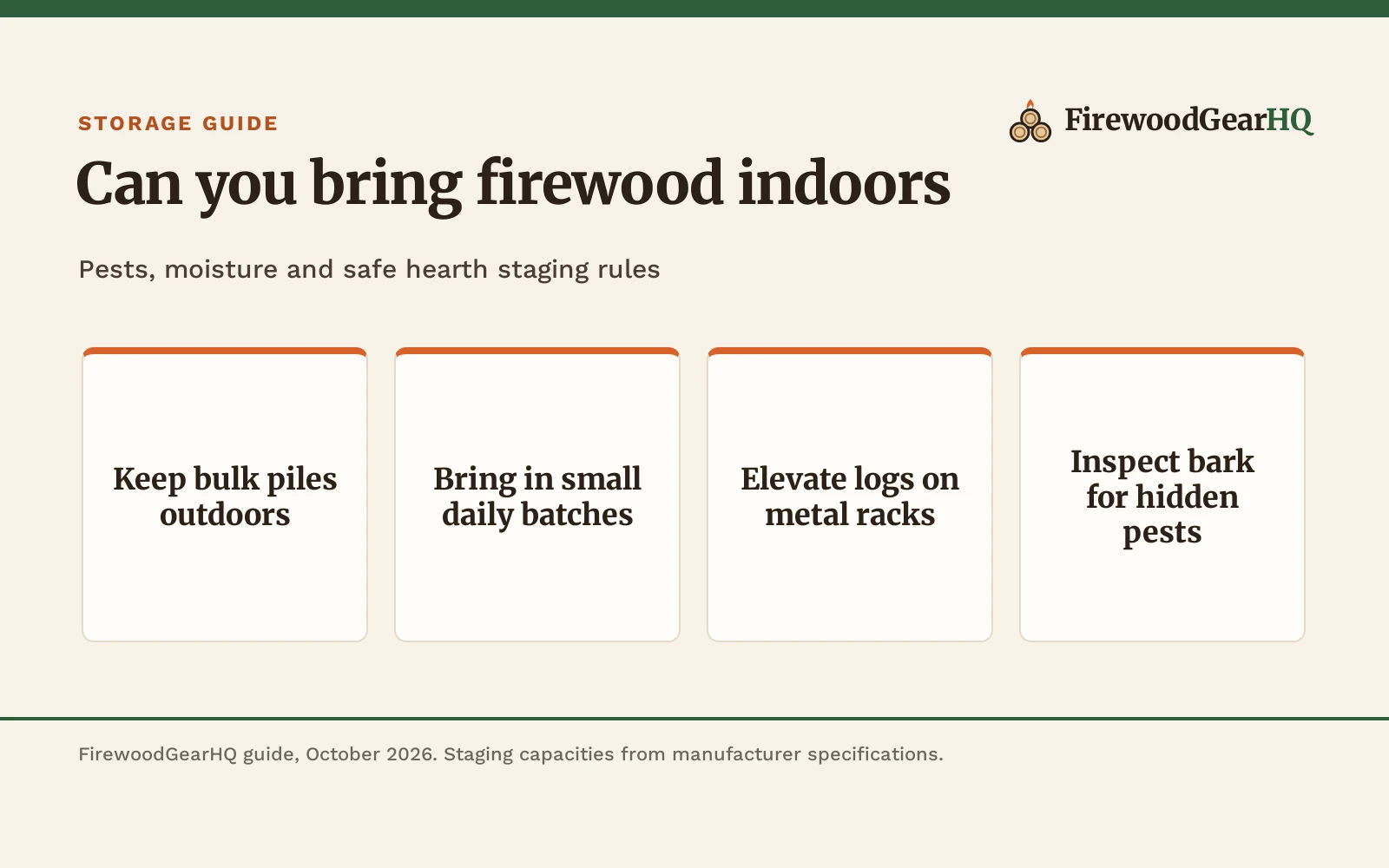
Can you bring firewood indoors? Yes, you can bring firewood indoors, but only in small amounts meant for immediate burning. Storing large stacks of wood inside invites wood-boring insects, carpenter ants, and mold into your living space. Outdoor firewood belongs in an exterior woodpile, where sun and wind keep it dry, while indoor hearth staging should hold only enough fuel for an evening fire.
FirewoodGearHQ earns a commission when you buy through links on our product pages, at no extra cost to you. Read our affiliate disclosure.
The quick answer
Bring inside only what you plan to burn over a short period. Stacking cords or large piles of firewood inside a basement, garage, or living room causes distinct problems: wood-boring pests, indoor moisture buildup, and hearth clutter. Outdoor winter weather keeps insects dormant beneath tree bark, but room heat revives them quickly. Once warmed, beetles, termites, and spiders crawl out of the woodpile and into your living area. Firewood also carries ambient moisture and fungal spores, which can raise indoor humidity and promote mold growth on finished walls. To enjoy a wood stove or fireplace safely, store your primary firewood supply outdoors, and keep only a small batch inside on an elevated metal rack.
Indoor firewood staging capacity compared with outdoor storage
| Storage style and brand | Stated dimensions or capacity | Storage location | Staging role and indoor notes |
|---|---|---|---|
| Compact curved rack (VEVOR) | 40 lb weight capacity, 17.7 x 12.4 x 16.3 in | Hearthside | Holds 10-20 logs for 4-5 hours of fireplace burning; includes removable canvas carrier |
| Medium steel holder (MOFEEZ) | 110 lb capacity, 17.61″D x 12.5″W x 16.54″H | Living room | Holds 10-20 pieces of wood for a 4-5 hour fire; enclosed base contains crumbling bark |
| Compact stand with carrier (VyGrow) | Over 110 lbs capacity, 12.59″D x 17.32″W x 17.51″H | Hearth or patio | Features a wood board foundation and adjustable foot pads; includes 37.6″Lx12.8″W carrier |
| Vertical pipe rack (pamo OTTO) | 38.2 inches tall, 11″D x 20.5″W x 38.2″H | Hearth wall | Built from 3/4″ industrial steel pipes; includes felt pads and rubber feet to protect indoor flooring |
| Two-tier tool stand (VEVOR) | 400 lbs load capacity, 17.91″D x 12.99″W x 30.12″H | Hearth or garage | Reinforced 2-Tier wrought iron frame holding stacked logs alongside 4 fireplace tools |
| Covered outdoor rack (Mr IRONSTONE) | 2,600 pounds load capacity (350 pounds shelf capacity) | Outdoor yard or porch | Keeps logs 4.13 inches off the ground; holds bulk fuel outdoors away from house walls |
Listing specifications show a sharp contrast between indoor hearth holders and outdoor bulk racks. Indoor units from makers like VEVOR and MOFEEZ are sized for 10-20 logs, providing fuel for 4-5 hours of burning. Meanwhile, heavy outdoor racks from makers like Mr IRONSTONE are built to hold bulk weight outdoors, keeping logs 4.13 inches off wet soil. Note that listing details can show internal contradictions: Mr IRONSTONE claims a maximum load capacity of 2,600 pounds in its description, yet its spec table lists a 350 pounds shelf weight capacity. Similarly, facka advertises a 400 lb capacity in its description while listing a 300 pounds capacity in its spec table. Always respect the lower rating and keep bulk cords outside.
Can you bring firewood indoors safely?
Bringing split logs inside without compromising your home requires separating long-term storage from short-term staging. Follow these steps to keep insects, moisture, and debris under control.
Keep your main woodpile outdoors
The only place for bulk firewood storage is outside in an open, well-ventilated area. Stacking whole cords against an exterior house wall or inside an attached garage creates a direct bridge for termites and carpenter ants to reach your home’s structural framing. Keep your primary woodpile stacked outdoors on a dedicated rack with an overhead shelter, such as the best firewood rack with cover, so air circulates freely around the logs while rain and snow stay off the top. For more tips on setting up safe wood piles, explore our firewood storage hub.
Stage only what you burn over a short period
Limit indoor firewood to what you will burn during an evening or over a weekend. Wood kept inside for extended periods acclimates to household warmth, prompting dormant insect larvae to hatch and wood-boring beetles to emerge. Staging a small supply ensures that logs move quickly from your indoor holder into the firebox before any hidden pests leave the bark.
Use an elevated metal hearth rack
Never stack firewood directly on bare flooring, carpet, or hearth tiles. Piling wood on floors traps moisture underneath, prevents airflow, and leaves stubborn stains from damp bark and tannins. A raised metal stand provides stable staging while lifting logs above the floor. For example, pamo includes rubber feet and felt pads with its steel pipe rack to prevent scratching wood or stone floors, while Mr IRONSTONE elevates stored wood 4.13 inches above the ground to maintain bottom airflow.
Inspect bark for pests before carrying logs inside
Take a few moments at your outdoor woodpile to inspect every split log before carrying it across the threshold. Look closely for insect tunnels, sawdust frass from carpenter ants, spider webs, and egg masses. Tap split logs together firmly outside to shake loose clinging dirt, dried leaves, and sheltering bugs. Strip away loose pieces of bark where earwigs and wood lice like to hide. If a log shows deep rot or active insect activity, leave it outside to burn immediately or discard it.
Use a closed carrier to contain debris
Hauling split firewood in your arms leaves a trail of dirt, moss, and bark chips across carpets and hallways. Use an enclosed firewood carrier or a basket with solid sides to transport logs cleanly. For example, LivinWell makes a log tote from 16 oz waxed canvas weighing 1.3 pounds with closed basket ends designed to contain dirt, while Josmimic lists a metal firewood basket with a solid base that holds debris in 1 trip from the woodpile. Transporting firewood in an enclosed tote keeps loose bark off your floors and simplifies hearth maintenance.
Rules for storing firewood inside without pests or mess
Follow these essential rules to keep indoor firewood staging clean and safe:
- Elevate logs off the floor: Use a dedicated steel or iron stand rather than stacking logs on rugs or hearth tiles.
- Rotate your indoor stock: Burn older indoor logs before fresh ones so that no single piece of wood sits inside for weeks.
- Never use chemical bug sprays: Do not spray firewood with household insecticides or bug spray. Burning pesticide-treated wood releases harmful chemical fumes into your home.
- Sweep the hearth area regularly: Vacuum or sweep up fallen wood dust and bark debris promptly using a dedicated hearth broom and shovel.
- Maintain clearance from heat sources: Keep stacked logs at a safe distance from the open fireplace opening or wood stove doors to prevent stray embers from igniting the pile.
Risks of storing too much firewood inside your home
Bringing large volumes of firewood indoors introduces serious structural and environmental hazards to a residence. The most immediate concern is pest introduction. Firewood harvested from fallen timber or standing dead trees naturally hosts insects, including subterranean termites, carpenter ants, powderpost beetles, and bark beetles. While freezing winter temperatures keep these pests dormant outdoors, the warm environment of a heated home signals spring conditions, causing insects to emerge and seek out indoor structural wood.
Moisture is another significant hazard. Firewood that has absorbed outdoor precipitation or has not fully dried releases water vapor as it warms by the hearth. In an enclosed living space, evaporating moisture raises indoor humidity levels, creating ideal conditions for fungal growth and surface mold along baseboards and adjacent walls. Stacking large quantities of wood inside also creates unnecessary fuel loads near heat sources and clutters living areas, making routine fireplace maintenance difficult and increasing the risk of accidental tipping.
Kiln-dried firewood for indoor hearth staging
If you prefer firewood that is clean enough for immediate hearthside storage without insect concerns, commercial kiln-dried wood offers a practical alternative. During the kiln drying process, split logs are placed in high-temperature kilns that drive out moisture and eradicate insect larvae, mold spores, and fungi.
For example, Old Potters offers kiln-dried hickory firewood in packages containing 1.5 Cu Ft weighing 38-45 lbs with 16 Inch logs. The maker notes that its wood is USDA Certified for sanitation and safety, ensuring that logs are free from wood-boring pests before entering your home. While packaged kiln-dried wood costs more than seasoned cordwood split from local logs, its cleanliness makes it suitable for hearthside storage baskets. However, even with kiln-dried wood, keeping bulk quantities outdoors and staging only what you need by the hearth remains the cleanest approach.
Turn a stack's length, height and depth into full and face cords, and estimate how much wood a winter takes.
Frequently Asked Questions
How much firewood can you bring indoors at one time?
Bring inside only what you plan to burn over an evening or a short stretch. Compact hearth racks like those from VEVOR hold about 10-20 logs, which provides enough fuel for 4-5 hours of fireplace burning without creating an inviting habitat for pests.
Can bringing firewood inside introduce termites and carpenter ants?
Yes. Firewood bark often shelters dormant termites, carpenter ants, and wood-boring beetles. Winter cold keeps these pests inactive outdoors, but indoor heating quickly revives them. Storing logs indoors for extended periods allows these insects to crawl out onto floors and walls.
How far off the floor should indoor firewood be stored?
Firewood should be elevated on a raised metal rack rather than resting directly on flooring. For example, Mr IRONSTONE lists an elevated rack design that maintains 4.13 inches of clearance off the floor, promoting air circulation and keeping loose bark away from carpets.
Is kiln-dried wood safer to store inside than air-dried logs?
Yes. Commercial kiln drying heats wood to temperatures that eradicate insect larvae, eggs, and mold spores. Packaged firewood like the hickory logs from Old Potters is USDA Certified, making it cleaner for indoor hearth baskets than standard air-dried firewood.
What is the cleanest way to carry firewood into the house?
Use an enclosed canvas carrier or a metal firewood basket. Log totes with closed ends prevent loose bark, dirt, and moss from spilling across living room floors. Brands like MOFEEZ and VyGrow supply steel hearth stands with matching removable carriers, allowing you to haul wood from your outdoor pile in 1 trip.
Can bringing damp firewood inside cause indoor mold?
Yes. Damp logs release moisture into the air as they warm up indoors. In an enclosed living room, that extra water vapor raises household humidity and encourages mold spores to settle on walls, baseboards, and hearth carpets.
Related guides
See our inside wood rack for firewood guide, our indoor firewood rack ideas setup, and our fireplace tools set with wood rack comparison. Explore outdoor staging options in our reviews of the firewood rack for porch, the metal wood racks outdoor for firewood, the cheap firewood rack, the firewood shed outdoor with roof, and the cover for firewood storage rack. For complete hearth care, read our guides to the best fireplace tool set, the best ash bucket for fireplace, the best fire starter for indoor fireplace, the how long to season firewood guide, and the best firewood moisture meter.
About the author
The FirewoodGearHQ editorial team researches firewood and wood heating equipment from published specifications, ratings and warranty terms, and scores every pick the same way. We do not run our own product trials.