Electric vs Kinetic Log Splitter: Which One Should You Buy?
Learn how electric hydraulic and kinetic log splitters compare on cycle speed, force, motor size and maintenance so you can choose the right machine for your woodpile.

On this page
Top picks at a glance
As an Amazon Associate we earn from qualifying purchases.
- 1
 PROYAMA 7T Electric Log Splitter9.6/10View on Amazon
- 2
 KABIN Kindle Quick Log Splitter9.7/10View on Amazon
- 3
 7 Ton Electric Log Splitter9.6/10View on Amazon
- 4
 Sun Joe LJ602E 5-Ton 15 Am Electric Log Splitter w/HydraulicView on Amazon
- 5
 YARDMAX YS0650 6.5 Ton Electric Log SplitterView on Amazon
- 6
 PowerSmart Electric Log SplitterView on Amazon
- 7
 Ironton Horizontal Electric Log SplitterView on Amazon
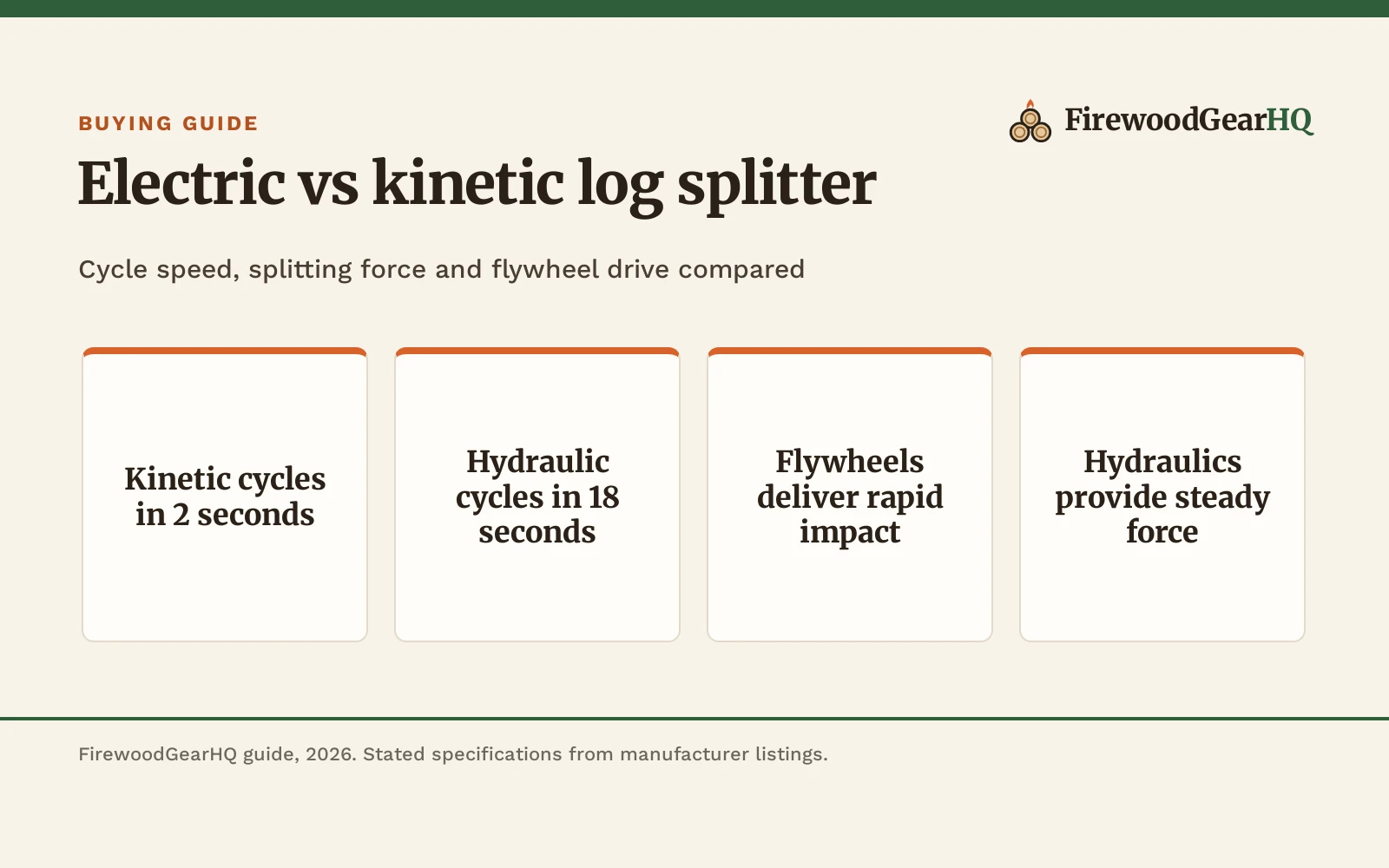
When autumn arrives and woodpile chores begin, deciding between an electric vs kinetic log splitter comes down to cycle speed versus steady hydraulic force. If you process straight-grained firewood and want fast output, choose a kinetic log splitter for its rapid 2 to 3 second cycle time. If you split knotty hardwood or want quiet operation, choose an electric hydraulic log splitter because its hydraulic ram delivers steady force up to its rated capacity, with stated cycle times of 18 seconds on reference listings.
More options to compare
 Sun Joe LJ602E 5-Ton 15 Am Electric Log Splitter w/HydraulicCheck price on Amazon
 YARDMAX YS0650 6.5 Ton Electric Log SplitterCheck price on Amazon
 PowerSmart Electric Log SplitterCheck price on Amazon
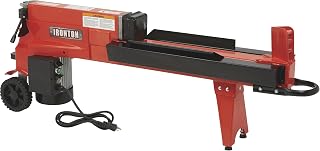 Ironton Horizontal Electric Log SplitterCheck price on Amazon
FirewoodGearHQ may earn a small commission if you buy through links on this page. The price you pay stays the same. Read our affiliate disclosure.
Electric vs kinetic log splitter: the quick answer
Electric hydraulic splitters use an electric motor and pump to advance a cylinder ram steadily. Kinetic splitters use an electric motor to spin dual flywheels, releasing stored momentum in an instant strike. For clean logs, kinetic speed excels; for knotty wood, hydraulic force is more forgiving. Explore the best log splitter for home use or review our log splitter comparison.
Electric vs kinetic log splitter comparison chart
| Specification | Electric hydraulic | Kinetic |
|---|---|---|
| Drive mechanism | Motor driving hydraulic pump and ram | Motor driving flywheels and rack-and-pinion |
| Cycle time | 18 seconds stated (Rockcub, Ezasin) | 2 to 3 seconds stated (BouPower, Forestwest) |
| Manufacturer rated force | 7 to 16 tons | 7 to 18 tons |
| Motor power | 15 to 17.4 amps (1500W to 1600W, 2.5 to 3 HP) | 13.6 to 16 amps (1500W, 2.0 HP) |
| Hydraulic fluid required | Yes (Rockcub lists 28MPa / 4060 PSI) | No (dry mechanical drive) |
| Max log length | 20.5 to 22 inches across listings | 16 to 18.5 inches across listings |
| Max log diameter | 16 inches (Ezasin; others not stated) | 15 inches (BouPower; others not stated) |
| Weight | 95 to 124 pounds across listings | 139.6 to 246 pounds across listings |
| Operating sound | Quiet hum (Ezasin lists 65 dB) | Motor hum plus metallic impact |
| Knot handling | Steady hydraulic push up to bypass limits | Impact momentum; can stall on knots |
Learn what is cycle time on a log splitter and review how does a log splitter work.
Key differences between electric and kinetic log splitters
Cycle speed and productivity
An electric hydraulic splitter takes 18 seconds per cycle, as listed for Rockcub and Ezasin. Kinetic models cycle in 2 to 3 seconds, as listed for BouPower and Forestwest, tripling production on straight rounds. Compare mechanisms in our guide on kinetic vs hydraulic log splitters.
Splitting force and knot handling
Rockcub lists 7 tons at 28MPa (4060 PSI) and Ezasin lists 16 tons. Hydraulic rams push steadily against knots. Kinetic models deliver impact force, rated at 7 tons by BouPower and 18 tons by Forestwest, but can stall in twisted grain. See how many tons log splitter do i need.
Multi-wedge attachments expand versatility for straight rounds. Rockcub includes a 4-Way Cross Wedge for kindling production, and PPOLB provides a detachable cross blade cutter head for producing multiple pieces at once. Cross wedges require greater pushing force and work best on clear grain without knots.
Electrical draw and maintenance
Motors draw 13.6 to 17.4 amps. Units drawing 17.4 amps (Ezasin) need a 20-amp circuit, while 13.6 to 15-amp units can use 15-amp circuits. See our guide to cheap wood splitters. Thermal overload protection prevents motor damage; Ezasin includes an integrated sensor that trips if current exceeds 20A. Hydraulic models need oil care (see log splitter maintenance and what hydraulic fluid for a log splitter). Kinetic units require rack lubrication.
Sound levels
Ezasin lists 65 dB for quiet residential splitting, while kinetic flywheels produce a louder mechanical clack.
How to choose between electric and kinetic log splitters
- Wood grain: Straight birch or pine suits kinetic speed; twisted oak favors hydraulic push.
- Log size: BouPower handles 18.5 inches long and 15 inches diameter; Rockcub fits 22-inch logs; Ezasin fits 20.5 inches long and 16 inches diameter. See what size log splitter do i need.
- Portability and height: Rockcub weighs 95 pounds and PPOLB weighs 112.4 pounds; kinetic units weigh 139.6 pounds (BouPower) to 246 pounds (Forestwest). Forestwest provides a high stand and work trays to avoid bending, while BouPower features a low-profile chassis for easier log loading. Compare tools in log splitter vs splitting maul.
What happens with knotty or difficult logs
When kinetic momentum cannot break a knot, the ram stops and the operator must release the lever. Hydraulic splitters continue pushing; if wood resists all available force, the bypass valve opens safely. Read why wont my log splitter split and electric log splitter troubleshooting.
Two-stage hydraulic pumps help balance cycle speed and power. Ezasin pairs a dual-gear pump with its 1600W motor, maintaining smooth ram travel until resistance builds, then shifting to deliver crushing force through stubborn wood grain.
Safety and operation differences
Follow the one operator rule: only one person operates controls and positions wood. Always keep hands clear of the wedge and ram, and wear approved eye protection. See our log splitter safety rules. PPOLB uses two-hand controls, Rockcub offers a foot pedal, and kinetic splitters require strict vigilance due to 2-second ram speeds.
Turn a stack's length, height and depth into full and face cords, and estimate how much wood a winter takes.
Frequently Asked Questions
Is a kinetic log splitter faster than an electric hydraulic splitter?
Yes. Kinetic units cycle in 2 to 3 seconds, compared with 18 seconds for typical electric hydraulic splitters.
Can an electric hydraulic log splitter handle knotty hardwood?
Yes. Hydraulic rams push steadily up to their rated 7 to 16 tons, opening a bypass valve if a knot exceeds capacity.
Do kinetic log splitters require more maintenance?
No, but they require gear cleaning and lubrication rather than hydraulic fluid checks.
Can I run an electric or kinetic log splitter on a household outlet?
Yes, if circuit amperage matches. Models drawing 13.6 to 15 amps can use 15-amp circuits; 16 to 17.4-amp models require 20-amp circuits.
Are kinetic log splitters louder than electric hydraulic splitters?
Yes. Hydraulic models run quietly (65 dB on Ezasin), while kinetic splitters create metallic engagement noise.
Which log splitter is safer for a single operator?
Both are safe for a single operator. Slower 18-second hydraulic cycles are more forgiving than rapid 2-second kinetic strokes.
Related guides
See the log splitters hub, the electric log splitters category and the kinetic log splitters category. Also see our best vertical log splitter, gas vs electric log splitter, why is my log splitter slow, horizontal vs vertical log splitter, renting vs buying a log splitter, can you tow a log splitter on the road, how to winterize a log splitter, log splitter recalls what owners should check, best log splitter cover and best kindling splitter.