45cc vs 60cc Chainsaw: Which One Should You Buy?
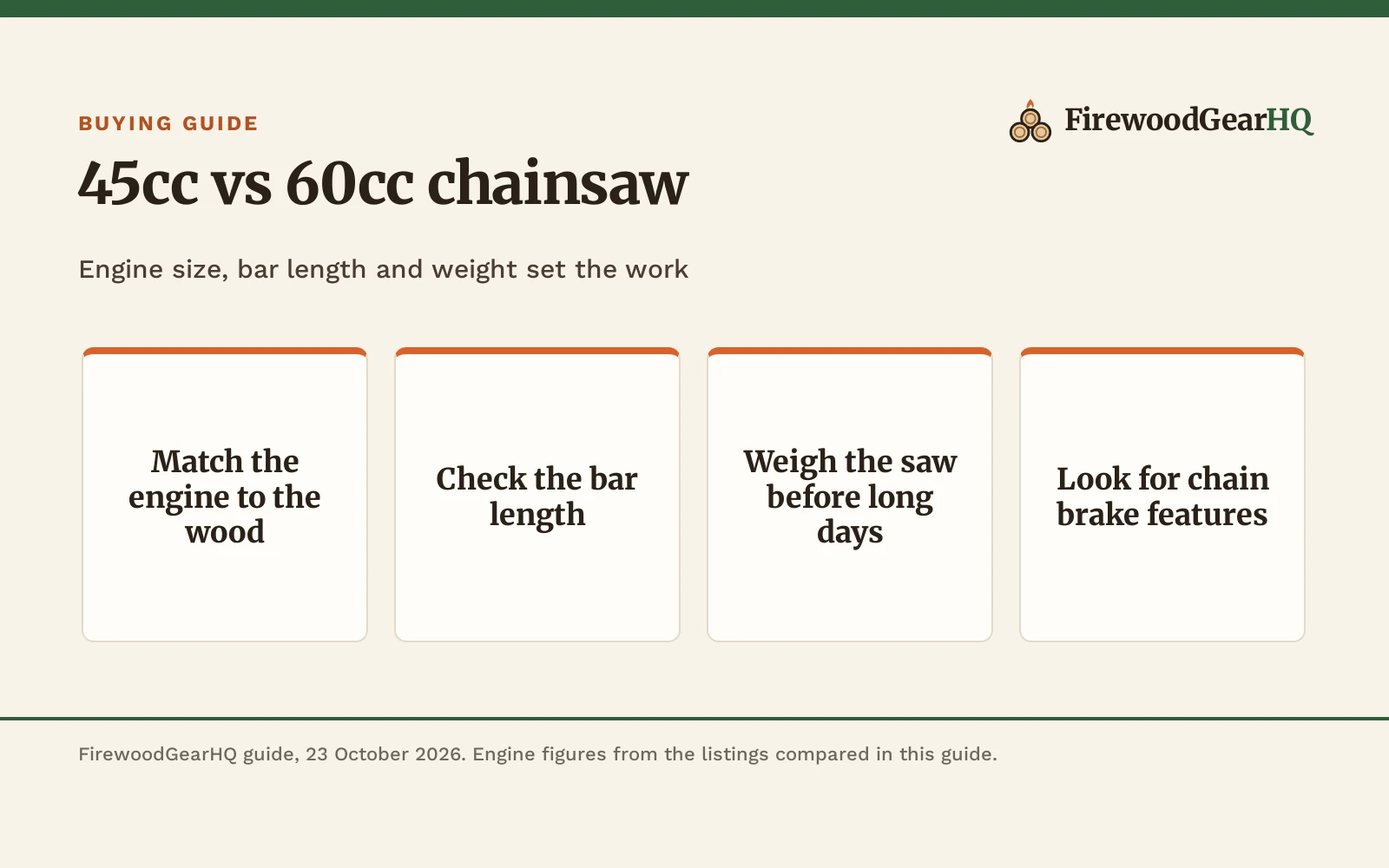
A 45cc saw is a light limbing and bucking tool for smaller wood, while a 60cc-class saw pulls longer bars and works through bigger rounds with less strain.

On this page
Top picks at a glance
As an Amazon Associate we earn from qualifying purchases.
- 1
 Husqvarna 460 Rancher Gas Powered Chainsaw9.7/10View on Amazon
- 2
 Husqvarna 120 Mark III Gas Chainsaw9.7/10View on Amazon
- 3
 Husqvarna 455 Rancher Gas Chainsaw9.7/10View on Amazon
Cutting season sets the rhythm of a wood-burning year: the trees marked in summer come down, the rounds get bucked and split, and the stacks go up before the first hard frost. The saw you carry into that work shapes every hour of it. The question behind 45cc vs 60cc chainsaw is really a question about engine size and the work it can sustain. A 45cc saw is a light limbing and bucking tool for smaller wood, while a 60cc-class saw works through bigger rounds with less strain. For a firewood year built on cutting your own wood, the larger class is the working saw and the smaller class is the helper.
FirewoodGearHQ may earn a small commission if you buy through links on this page. The price you pay stays the same. Read our affiliate disclosure.
The quick answer
Buy the 60cc class if you cut firewood all season. A 45cc saw handles limbing, pruning and bucking small logs with less weight to carry, but it runs out of authority in big rounds. The four gas saws in the gear section below sit in the 60cc class: their listings state 60cc, 62CC, 63CC and 68CC, and three of them wear a 20 inch bar. That is the class that bucks and processes at firewood scale without working at its limit all day.
45cc vs 60cc chainsaw: what engine size actually changes
Displacement is the headline, but four things matter most.
Power through the cut
Bigger displacement keeps the chain moving in bigger wood instead of bogging down. The four saws below list 3.4HP, 3.5 hp, 3.5hp and 4.5HP, with engine speeds of 8500 rpm or 13000 RPM as stated. Those output figures show why the 60cc class holds its speed in wood that would slow a smaller saw.
Bar length
A longer bar reaches across bigger rounds in fewer passes. Three of the four saws below list a 20 inch bar, and the NEO-TEC 68CC offers a choice of 22 or 24 inch bars. Shorter bars mean more repositioning on big wood, so match the bar to the rounds you cut.
Weight on a long day
Displacement adds weight, and weight adds up over a day of bucking. The listings that state weight in pounds give 15.5 pounds, 17.3 pounds and 24 pounds, while the fourth lists 7.8 kg. Carry the class you can run all afternoon, because a saw that tires you out gets set down early.
Fuel and oil
Bigger engines generally burn more mix per hour of cutting. The NEO-TEC listing is the only one to state its tanks: 550ml of fuel and 260ml of oil, mixed at 25:1 (the listing also gives 1L:40ML and 1 US Gallon:151.4ML). The other three listings do not state tank sizes, so plan refueling by the work at hand and keep bar oil topped up.
The gear: 4 gas saws, ranked
Every saw below is a gas-powered 2-cycle saw in the 60cc class, ranked by what its listing clearly delivers: stated output, bar options, safety features and listing consistency. The table gives the headline figures, and the note under it explains the order.
| Saw | Listed engine | Bar | Stated weight | Why it ranks here |
|---|---|---|---|---|
| NEO-TEC 68CC | 68CC, 4.5HP | 22 or 24 inch | 24 pounds | Highest stated output at 13000 RPM and the longest bar options, with a quick-stop chain brake |
| JPNTECH 60cc | 60cc, 3.5 hp | 20 inch | 17.3 pounds | The namesake 60cc class, with dual throttle switches and an inertia-activated chain brake |
| TECHMOO 62CC | 62CC, 3.4HP | 20 inch | 15.5 pounds | Lowest stated weight in pounds, a fast stop chain brake and a stated 1-Year Warranty |
| PINKWAY 63CC | 63CC, 3.5hp | 20 inches | 7.8 kg | Ranks last on listing contradictions, explained below |
A note on the PINKWAY listing: the title says 63CC while the spec table reads 63 ACG for included components and power source, and the bullets claim 3.5hp while the spec table lists 3.26 horsepower. The title also calls a gasoline saw cordless. The listing does state a 2 Year Manufacturer warranty and a low-kickback chain, but contradictions like these make it hard to know which figure to trust, so this saw sits at the bottom of the ranking.
Picking the right class for your woodpile
Start from the biggest wood you cut in a normal season. If your rounds are mostly small and you value light handling, a 45cc saw earns its place. If you buck large rounds week after week, the 60cc class pays for its extra weight in speed and ease. Two practical checks help:
- Bar against the wood: the bar should clear the widest rounds you cut. The three 20 inch saws above handle most firewood rounds, while the 22 or 24 inch option on the NEO-TEC 68CC suits the largest.
- Weight against the day: 15.5 pounds and 24 pounds feel very different late in the day. For long cutting days, the lighter end of the class is the kinder choice.
Whatever class you choose, dress for the saw: chaps, a helmet with face screen and hearing protection, gloves and boots, on every cut. The saws above list chain brakes and low-kickback chains, which help, but they do not replace gear or careful handling. Keep the chain sharp with a chainsaw sharpener, and see the best chainsaw for firewood roundup for the wider field.
Frequently Asked Questions
Is a 60cc chainsaw too much saw for firewood?
Not if you cut your own wood all season. The 60cc class is the working size for bucking rounds week after week, while a 45cc saw is the lighter second saw for limbing and small wood. Match the class to the volume of wood, not to the smallest job.
What bar length suits a 60cc-class saw?
The three 60cc-class saws above list a 20 inch bar, and the NEO-TEC 68CC offers 22 or 24 inch. Choose the bar that clears the widest rounds you cut regularly, and remember a longer bar adds weight and needs a steady hand.
Can a 45cc saw handle big rounds?
It will work harder and slower. Bigger displacement holds chain speed in bigger wood, which is the whole argument for stepping up to the 60cc class when big rounds are the norm. For felling work beyond routine bucking, hire a certified pro.
How heavy are these 60cc-class saws?
The listings state 15.5 pounds, 17.3 pounds and 24 pounds, with the PINKWAY listing giving 7.8 kg. That spread is the real cost of the bigger class: more power to carry between cuts.
What fuel mix do these gas saws use?
Only the NEO-TEC listing states a ratio: 25:1 fuel-oil mix, given as 1L:40ML or 1 US Gallon:151.4ML. The other listings do not state a ratio, so follow the manual that comes with the saw and never guess the mix.
What safety gear goes with a 60cc saw?
Chaps, a helmet with face screen and hearing protection, gloves and boots, on every cut. The saws above list chain brakes and low-kickback chains as fitted features; see the chainsaw chaps guide for leg protection. Never cut alone.
Related guides
Compare chain grinds in the square vs round ground chainsaw chain guide, or weigh fuel types in gas vs battery chainsaw. For the wider field, see the best chainsaw for firewood roundup and the best chainsaw chain for hardwood.