Wood Stove Fan vs Ceiling Fan: Which One Should You Buy?
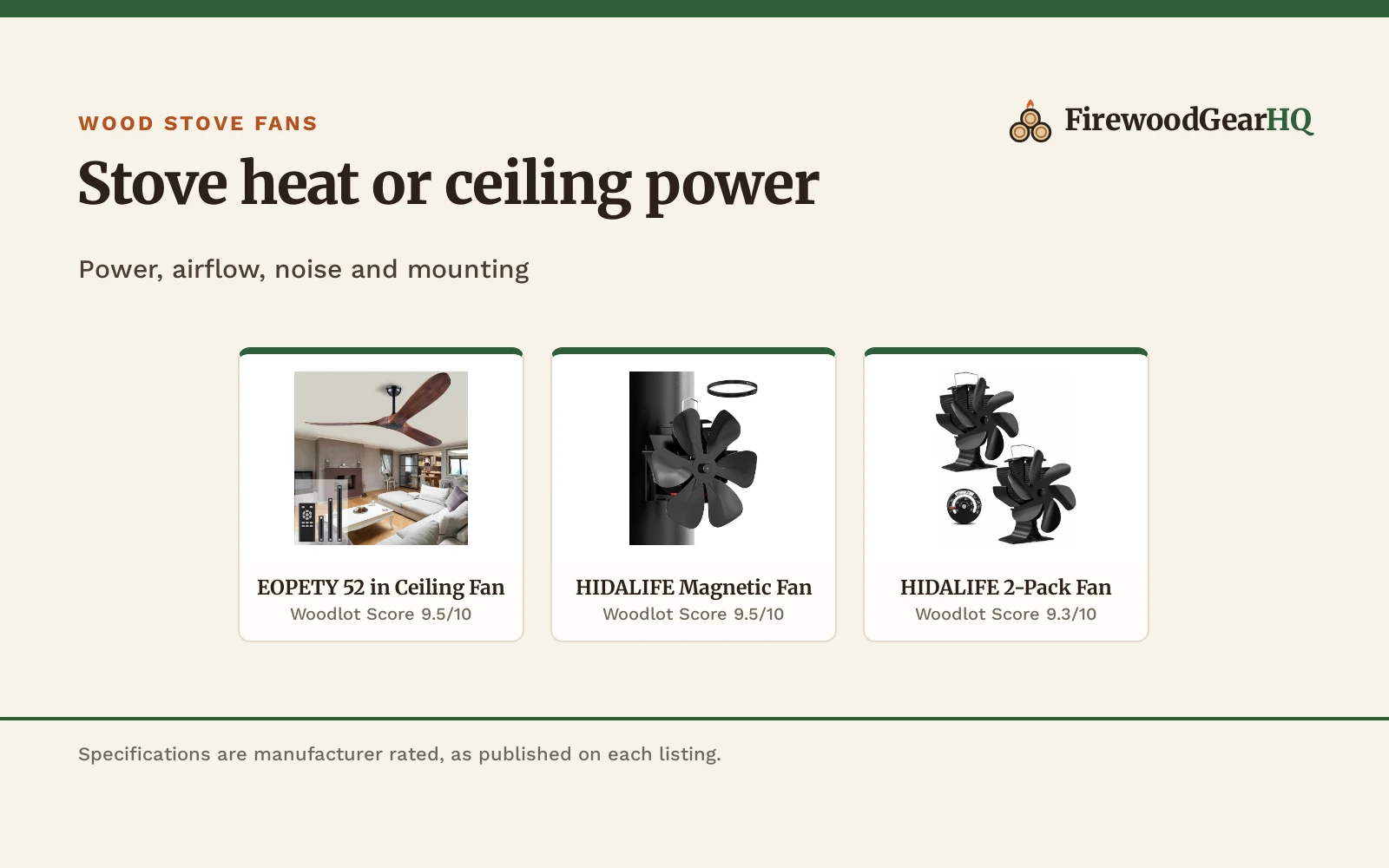
Wood stove fans and ceiling fans compared on power, airflow, noise, mounting and warranty, with two stove fan examples and one ceiling fan example.

On this page
Top picks at a glance
As an Amazon Associate we earn from qualifying purchases.
- 1
 Hongso Pre-Wired GFK-160 GFK-160A BM-1288 Fireplace Blower9.7/10View on Amazon
- 2
 52 Inch Ceiling Fan No Light ,Wood Outdoor Ceiling Fans for9.5/10View on Amazon
- 3
 Wood Stove Thermometer Magnetic9.7/10View on Amazon
- 4
 Ecofan AirDeco I Heat Powered Stove FanView on Amazon
- 5
 Dual Motors Heat Powered Fireplace FanView on Amazon
- 6
 Tomersun Wood Stove Fan Heat Powered Stove Fan HeaterView on Amazon
- 7
 Ecofan AirMax Heat Powered Stove FanView on Amazon
- 8
 Ecofan UltrAir Heat Powered Stove FanView on Amazon
Verdict: Choose a wood stove fan if the goal is moving heat off the stove with no electricity and no installation beyond the stove itself. Choose a ceiling fan if the goal is moving large volumes of air through the whole room, with speed control and a remote.
A hot stove warms the air right around it, and that warm air needs help reaching the far side of the room. Both sides in this wood stove fan vs ceiling fan comparison move air, but they do it in opposite ways: one runs on stove heat alone, the other on household power. This guide compares the two approaches on power, airflow, noise, mounting and warranty, with three examples from the listings.
FirewoodGearHQ may earn a small commission if you buy through links on this page. The price you pay stays the same. Affiliate disclosure.
| # | Product | Woodlot Score | Buy |
|---|---|---|---|
| 1 | 52 Inch Ceiling Fan No Light ,Wood Outdoor Ceiling | 9.5/10 | Buy on Amazon |
| 2 |  HIDALIFE Wood Stove Fan Heat Powered | 9.5/10 | Buy on Amazon |
| 3 |  HIDALIFE 2 Pack Wood Stove Fan Heat Powered Fan | 9.3/10 | Buy on Amazon |

52 Inch Ceiling Fan No Light ,Wood Outdoor Ceiling
A 52 in ceiling fan with a 30W DC motor, 6 speeds, reverse and timer on a remote, up to 5500 CFM airflow and below 35 dB noise, with a lifetime motor warranty.
Pros
- Up to 5500 CFM stated airflow
- 6 speeds, reverse and timer on a remote with memory function
- Below 35 dB in the bullets; silent DC motor
- Lifetime motor warranty plus 3-year free replacement for blades and remote
Cons
- Spec table says 30 dB and 2 year warranty; bullets say below 35 dB, lifetime and 3-year; trust the bullets
- Needs household power and a ceiling mount
- No light included
- 52 in span needs a large room and ceiling clearance

HIDALIFE Wood Stove Fan Heat Powered
A heat-powered 6-blade wood stove fan that mounts magnetically to the flue pipe, with about 220 CFM airflow, 122F to 422F operating range and less than 25 dB noise.
Pros
- Heat powered; no electricity required
- Magnetic flue pipe mount, no stand needed
- About 220 CFM with 122F to 422F operating range
- Less than 25 dB; 2 lb, easy to reposition
Cons
- Maker claims about 38% less fuel or wood use; that is the maker's claim
- Needs an iron flue pipe for the magnet
- No warranty term stated
- Single speed stated
HIDALIFE 2 Pack Wood Stove Fan Heat Powered Fan
A 2-pack of 6-blade heat-powered wood stove fans in anodized aluminum, tabletop mount, 25 dB stated noise.
Pros
- Two fans in the box
- Anodized aluminum, rust-proof with good thermal conductivity
- Heat powered; no electricity
- Tabletop mount, no installation
Cons
- Thin listing: one bullet, no airflow figure stated
- 25 dB noise only in the spec table
- No warranty term stated
- Needs a flat stove top surface
More options to compare
 Ecofan AirDeco I Heat Powered Stove FanCheck price on Amazon
 Dual Motors Heat Powered Fireplace FanCheck price on Amazon
 Tomersun Wood Stove Fan Heat Powered Stove Fan HeaterCheck price on Amazon
 Ecofan AirMax Heat Powered Stove FanCheck price on Amazon
 Ecofan UltrAir Heat Powered Stove FanCheck price on Amazon
Wood stove fan vs ceiling fan: side by side
| Factor | Wood stove fan | Ceiling fan | Example figures |
|---|---|---|---|
| Power source | Heat-powered, no electricity | 30W DC motor, household electric | Magnetic: 122F to 422F range |
| Airflow | 220 CFM (magnetic example) | Up to 5500 CFM | 2-pack: not stated |
| Noise (stated) | Less than 25 dB | Below 35 dB | 2-pack: 25 dB (spec table) |
| Mounting | Stove top or magnetic flue pipe | Ceiling, flat or sloped to 45 degrees | Downrods: 5, 10 or 15 in |
| Speed control | 1 speed | 6 speeds, reverse, timer | Remote with memory function |
| Reversible | Not stated | Yes, summer and winter modes | Not applicable |
| Warranty (stated) | Not stated | Lifetime motor; 3-year blades/remote | 90-day return policy |
Side figures are typical of the listings we reviewed; example figures are manufacturer rated, collected 22 October 2026.
Power: stove heat vs household electric
The wood stove fan side runs on heat alone: the HIDALIFE magnetic fan listing states heat driven operation with no electricity required, using the heat of the stove to distribute warm air, and an operating range of 122F to 422F. The ceiling fan side runs on household power: the EOPETY listing states a 30 watt DC motor. A stove fan only spins while the stove is hot; a ceiling fan runs whenever there is power, hot stove or not. If the use case is a power outage, only the stove fan side keeps moving air.
Airflow and noise
The listed airflow figures sit far apart. The HIDALIFE magnetic fan lists about 220 CFM; the EOPETY ceiling fan lists up to 5500 CFM. The 2-pack HIDALIFE listing states no airflow figure. On noise, the HIDALIFE magnetic fan lists less than 25 dB, the 2-pack lists 25 dB in its spec table, and the EOPETY lists below 35 dB in its bullets. Do not compare the two sides on these figures alone: a stove fan pushes warm air a short distance off the stove, while a ceiling fan circulates the whole room’s air. The listings on the two sides describe different jobs, so treat the numbers as what each example moves, not as a winner. The EOPETY listing adds one practical note: if airflow seems low, check that the fan is not set to winter mode.
Mounting and placement
Stove fans sit on or near the stove: the 2-pack HIDALIFE lists a tabletop mount, and the magnetic HIDALIFE attaches to the flue pipe with a magnet, which the listing calls safer than a normal stand fan. The magnetic fan works with gas, pellet or wood burning stoves and camping stoves with an iron pipe, indoors or outdoors. The ceiling fan mounts to the ceiling with 5, 10 or 15 in downrods for different ceiling heights and fits sloped ceilings up to 45 degrees, indoors or in covered outdoor spots; custom downrod lengths are available on request. A stove fan needs no installation beyond placement; a ceiling fan needs a ceiling mount and wiring.
Speeds, reverse and seasonal use
Control is where the ceiling fan pulls ahead. The EOPETY lists 6 speeds, reverse and a timer, all on a remote, with a memory function that restores the last speed after a power cut. Its reversible function offers cooling in summer and warm-air circulation in winter, and one remote can operate multiple fans of the same size. The magnetic fan lists 1 speed; the 2-pack listing states no speed figure. A stove fan is a winter-only tool; the ceiling fan listing states year-round use.
Warranty and support
The listings differ most on paper here. The EOPETY ceiling fan lists a lifetime motor warranty with 3-year free replacement for blades and remote, a 90-day return policy and 24/7 customer support, plus clear instructions, step-by-step videos and professional technical support from its factory. Neither HIDALIFE listing states a warranty term. The spec table on the EOPETY listing says 2 year warranty, which contradicts the bullets; go by the bullets. A lifetime motor warranty is only as good as the maker behind it, but it is the only written coverage in this comparison.
Where each fan fits
The two sides answer different rooms. A wood stove fan fits the burn season: it sits on the stove or the flue pipe, starts when the stove heats up, and pushes warm air out into the room, which the HIDALIFE listing says helps distribute warmth rather than leaving it near the stove. A ceiling fan fits the whole house year-round: the EOPETY listing states cooling in summer and warm-air circulation in winter, moving air in rooms the stove never reaches. Many stove owners run both, letting the stove fan feed warm air off the stove while the ceiling fan keeps the house’s air moving.
Three examples
How we scored them
Each example is scored on performance, build, value, safety and warranty, using only what the listing publishes. The weights are on our How We Pick page. No listing here states a safety certification, so safety scores zero; only the ceiling fan listing states a warranty term.
| Product | Woodlot Score | Perf. /35 | Build /25 | Value /25 | Safety /10 | Warranty /5 |
|---|---|---|---|---|---|---|
| EOPETY 52 in Ceiling Fan | 9.5 | 29 | 21 | 20 | 0 | 4 |
| HIDALIFE Magnetic Fan | 9.5 | 30 | 21 | 21 | 0 | 0 |
| HIDALIFE 2-Pack Fan | 9.3 | 26 | 19 | 19 | 0 | 0 |
Scores run from 9.2 to 9.8: each product’s point total is placed on that range, so more points always means a higher score.
Wear eye protection and gloves for cutting, splitting and handling, follow every tool's manual, install stoves to code, and have the chimney inspected and cleaned every year. See EPA Burn Wise and NFPA heating safety. Read our Safety Disclaimer.
Frequently Asked Questions
Can a ceiling fan replace a wood stove fan?
For moving room air, a ceiling fan moves far more: the EOPETY example lists up to 5500 CFM against the magnetic stove fan’s 220 CFM. But a ceiling fan needs household power and does not push heat directly off the stove the way a heat-powered fan does. Many stove owners run both.
Do wood stove fans need electricity?
No. The HIDALIFE listings state heat driven operation with no electricity required: the fan uses the stove’s heat to spin, operating between 122F and 422F on the magnetic model. That is why stove fans keep working during a power outage.
How loud are these fans?
The listings state quiet figures: less than 25 dB for the HIDALIFE magnetic fan, 25 dB in the 2-pack’s spec table, and below 35 dB for the EOPETY ceiling fan. The spec table noise figures disagree slightly with the bullets on two listings, so go by the bullets.
Will a wood stove fan work on a pellet stove?
The magnetic HIDALIFE listing states use with gas, pellet or wood burning stoves and camping stoves, as long as they have an iron pipe for the magnet. The 2-pack listing states no stove types, so check the listing before buying for a pellet stove.
Can I run a ceiling fan in winter?
Yes. The EOPETY listing states a reversible function with warm-air circulation in winter and cooling in summer, plus a timer. Run it on low in reverse to push warm air down without a draft.
Do stove fans work when the power is out?
Yes. Both HIDALIFE listings state heat driven operation with no electricity required, so the fan spins as long as the stove is hot. The ceiling fan stops with the power. That is the core reason to pick the stove fan side for outage-prone winters.
Related guides
See the best wood stove fans for a farmhouse, heat powered vs electric stove fan and the best wood stove fans for power outages. Browse the wood stove accessories list for more hearth gear.