What Is a Top Handle Chainsaw?
A top handle chainsaw places the rear grip directly over the engine body for tree canopy work, offering compact control for arborists while requiring special safety care.
 By FirewoodGearHQ Editorial
Updated October 9, 2026
By FirewoodGearHQ Editorial
Updated October 9, 2026
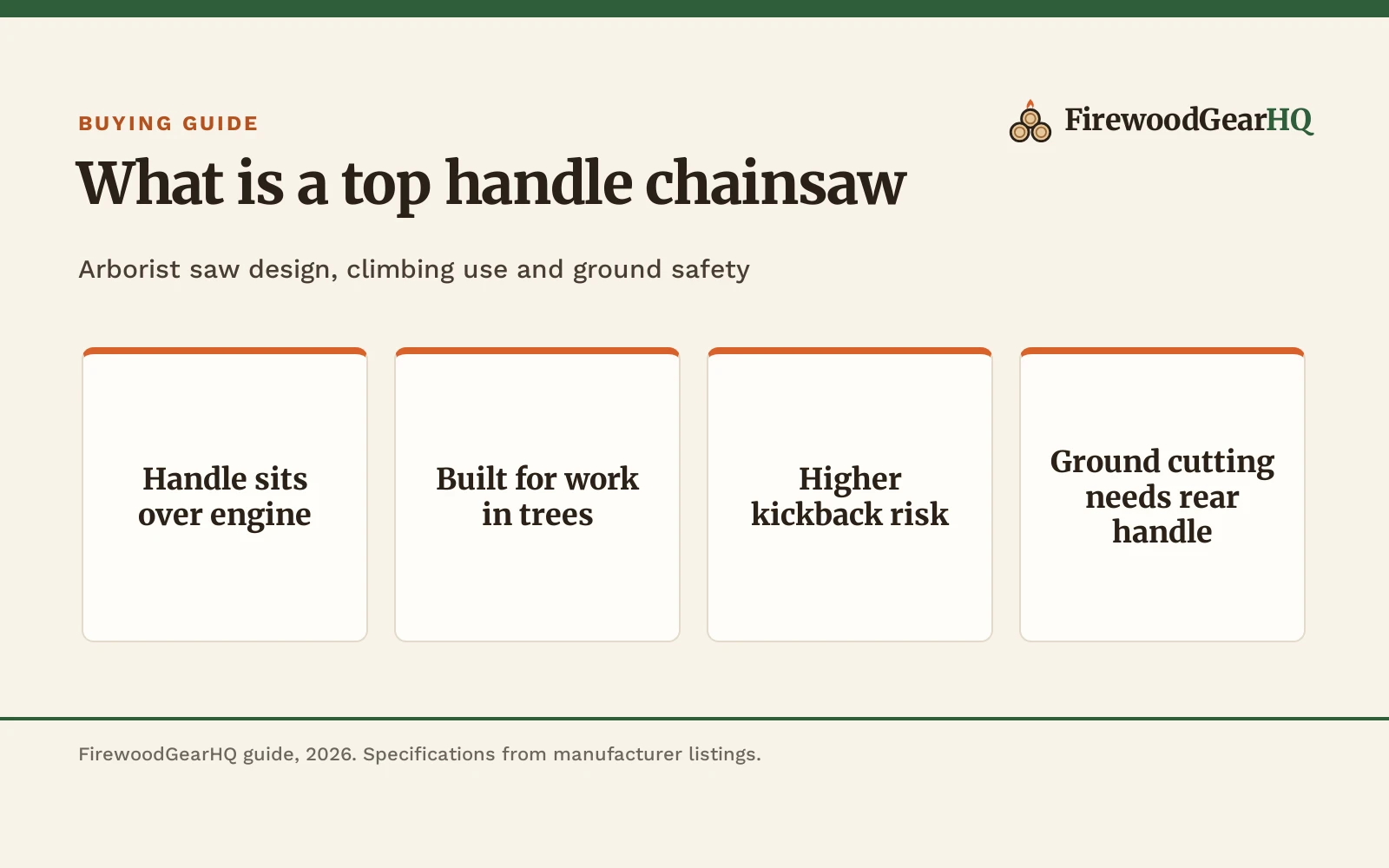
If you ask what is a top handle chainsaw, it is a specialized power saw built with its throttle handle mounted on top of the motor housing rather than behind it. This compact layout shortens the tool and places the primary grip directly above the engine housing, giving professional arborists the clearance and balance needed to work in tree canopies. It is designed for aerial pruning, limbing, and tree surgery where traditional rear-handle saws are too long or awkward to maneuver.
FirewoodGearHQ earns a commission when you buy through links on our product pages, at no extra cost to you. Read our affiliate disclosure.
The quick answer
A top handle chainsaw places the rear grip and throttle trigger directly over the engine body. This design creates a short, maneuverable tool for professional tree care workers operating in climbing harnesses, ropes, or aerial buckets. In dense branches, the compact profile lets a climber make clean pruning cuts without a long rear handle bumping into tree limbs or rigging ropes. However, grouping both hands close together on top of the powerhead severely reduces leverage against rotational kickback. Because of that elevated kickback risk and an awkward working posture on the ground, top handle saws are designed specifically for work aloft in trees, while firewood cutting, bucking rounds, and ground yard cleanup are best handled with a standard rear handle chainsaw.
Top handle chainsaw specifications comparison
| Model | Power source | Engine or power | Guide bar | Weight |
|---|---|---|---|---|
| Husqvarna T435 | Gas Powered | 35.2cc | 12 in. | 7.5 lbs |
| V-MODEST VM2511 | Gas Powered | 25cc | 12 in. | 5.5 lbs |
| Holzfforma JonCutter G2500 | Gas Powered | 25.4cc | 12 in. | 8.6 lbs |
| Holzfforma G111 | Gas Powered | 35.2cc | Not stated | 10 lbs |
| NEO-TEC 2500E | Gas Powered | 25cc | 12 in. | 10.3 lbs |
| DEWALT DCCS674B | Battery Powered | 60V | Not stated | Not stated |
| ECHO CS-355T | Gas Powered | 35.8CC | 14 in. | Not stated |
Published specifications from these manufacturer listings show the compact parameters of these models. Across the reference listings, gas engine displacements range from 25cc to 35.8CC, installed guide bars measure 12 in. to 14 in., and listed tool weights range from 5.5 lbs to 10.3 lbs.
What is a top handle chainsaw
To understand the design, compare how a person holds different power saws. On a traditional chainsaw, the rear handle extends behind the engine and fuel tank, while the front handle wraps around the top and side of the crankcase. This spreads the operator’s hands wide apart, providing solid balance and leverage when cutting firewood or felling timber.
A top handle chainsaw rearranges that layout completely. The rear control handle, which houses the trigger throttle and throttle lockout, is positioned directly over the top of the engine housing. The front wrap handle sits just forward of the rear grip. This positions the top grip directly above the engine and places both hands closer together. The entire machine becomes much shorter from front to back, allowing an arborist to work in close branch unions without the back of the saw catching on bark or rigging.
Because these saws operate aloft, manufacturers include tree-specific rigging attachments. For example, the Husqvarna T435 listing features a heavy-duty rope attachment point for hoisting the saw into the canopy, while the NEO-TEC listing includes a metal lanyard ring for climbing harness attachment. These anchor points allow arborists to clip the tool to a harness saddle while climbing into position.
Top handle vs rear handle chainsaws
Handle placement and balance
The defining difference between the two configurations is hand spacing. A rear handle saw positions the rear hand far behind the engine, while a top handle saw places the rear grip on top of the engine housing. Having the top grip directly over the powerhead lets an arborist balance the machine with less forearm strain when maneuvering around limbs or working from an aerial lift. On the ground, however, that close hand spacing offers very little leverage to pivot the saw through firewood logs.
Single-hand operation and climbing mobility
Some product listings, including the PROYAMA and NEO-TEC models, advertise single-hand control or one-handed operation for trimming branches. Although some marketing materials suggest one-handed cutting aloft, tree care safety standards and OSHA guidelines require both hands to grip the saw during operation. One-handed cutting leaves the operator with minimal control if the guide bar pinches or kicks back, dramatically increasing the risk of severe lacerations.
Leverage and kickback control
Kickback occurs when the moving chain at the upper quadrant of the guide bar tip contacts wood or pinches in a cut, throwing the bar violently upward and backward toward the operator. With a rear handle saw, wide hand spacing gives the operator the leverage needed to manage the saw, while the upward rotational movement pushes the front hand guard into the operator’s forward wrist, tripping the chain brake. With a top handle saw, both hands sit close together near the powerhead. The operator has far less leverage to counter that sudden upward rotation, making kickback events significantly harder to arrest.
What are top handle chainsaws used for
Top handle chainsaws are purpose-built for working aloft in trees. Their primary roles include:
- In-canopy pruning: Removing dead, broken, or crowded branches from inside mature tree crowns where long saws cannot fit.
- Crown reduction and thinning: Trimming select upper limbs to reduce wind resistance or clear utility line clearances.
- Aerial limb removal: Cutting small branch sections that must be lowered down with rigging ropes rather than dropped freely.
- Bucket truck trimming: Operating within the restricted space of an aerial lift basket without knocking the saw body against the railings.
They are not designed for bucking firewood on the ground, clearing fallen logs, or felling trees. For tree felling, large branch removal, or hazardous canopy work, always consult certified tree care professionals rather than attempting dangerous cuts yourself.
Why homeowners should not use a top handle chainsaw for firewood
Homeowners shopping for yard tools frequently see top handle chainsaws and assume their light weight makes them ideal for cutting firewood. For example, the V-MODEST listing highlights a bare weight of 5.5 lbs and the Husqvarna T435 lists at 7.5 lbs. However, using an arborist saw to cut firewood on the ground creates serious ergonomic and safety hazards.
Cutting firewood rounds at ground level requires working around your knees and waist. Holding a top handle saw down low forces you to bend forward at a steep, uncomfortable angle because your throttle hand sits above the engine rather than behind it. This posture quickly strains your back and neck. More importantly, working near ground debris, brush, and uneven logs increases the chance that the bar tip touches an unseen branch. If kickback occurs while you are hunched over the saw, your head and upper body are directly in the kickback arc.
A conventional rear handle saw provides the proper grip spacing, downward leverage, and upright stance needed for bucking firewood. If you need a saw for cordwood, read our guide to the best chainsaw for firewood. For general yard cleanup, pruning small branches, and clearing storm debris from the ground, choose a compact model from our best small gas powered chainsaw guide, or select a cordless option from our best battery chainsaw for homeowners review. If you need to reach overhead limbs from ground level, a manual pole saw allows you to trim branches safely without climbing.
Chainsaw safety gear and operating rules
Operating any chainsaw requires strict adherence to personal protective equipment and jobsite precautions. Before starting a saw, put on the required protective gear:
- Cut-retardant chaps: Specialized chainsaw chaps or protective pants containing fibers designed to jam the chain drive sprocket upon contact.
- Helmet system: A hard hat equipped with a wire mesh face screen and integrated hearing protection.
- Cut-resistant boots: Heavy leather boots with steel toes and non-skid tread.
- Work gloves: Heavy leather gloves to protect against chain teeth, wood splinters, and vibration.
- Eye protection: Safety glasses worn beneath the helmet face screen to guard against fine wood shavings.
Follow core operating rules established by the OSHA logging safety guidelines. Always keep both hands firmly gripping the saw handles with thumbs wrapped around the tubing. Never cut alone; ensure another person is within visual or vocal range in case an emergency occurs. Maintain clear footing and never cut with the upper quadrant of the guide bar nose to avoid rotational kickback. Always inspect tools for mechanical safety, ensure the inertia chain brake functions properly, and check for equipment recalls through official consumer safety channels. If you want to verify your equipment, see our guide on how to check if your chainsaw or log splitter is recalled, and explore our protective recommendations in the chainsaw gear section.
Wear cut-resistant chaps, a helmet with face screen and hearing protection, gloves and sturdy boots. Know where the kickback zone is (the upper tip of the bar), keep the chain brake working and the chain sharp, and never cut alone in the woods. Felling trees is hazardous work: hire a professional for large, leaning or storm-damaged trees, especially near buildings or power lines. See OSHA logging safety for chain saw operators. Read our Safety Disclaimer.
Frequently Asked Questions
Why use a top handle chainsaw instead of a rear handle saw?
Professional arborists choose top handle chainsaws for work inside tree crowns or bucket trucks because the compact body and top grip allow maneuverability in tight branch forks where a long rear handle would collide with tree trunks or climbing lines.
Can a homeowner use a top handle chainsaw on the ground?
While physically possible, safety organizations and power equipment manufacturers strongly advise against it. Clustered hand placement provides little leverage to counter sudden kickback, and working at ground level forces an awkward, hunched posture that causes severe back strain.
Why top handle chainsaw models require special training?
Because the operator’s hands sit close together directly over the engine, arresting a sudden rotational kickback requires exceptional strength and technique. Combined with aerial hazards like climbing ropes and falling limbs, safe operation demands formal arborist training.
What are top handle chainsaws good for?
Top handle chainsaws excel at in-tree pruning, thinning crowded branches, removing diseased canopy wood, and aerial tree surgery where an arborist needs a compact, balanced tool aloft.
What is the best top handle chainsaw?
For certified arborists working aloft, top professional gas models include the Husqvarna T435 with its 35.2cc engine and the ECHO CS-355T with its 35.8CC engine, while cordless options like DEWALT’s 60V platform offer quiet canopy operation without exhaust fumes. For homeowners cutting firewood on the ground, a top handle saw is the wrong tool; choose a dedicated rear handle saw designed for bucking firewood logs.
Are top handle chainsaws legal for non-professionals to buy?
Yes. Consumers can legally buy top handle saws from retail and online stores. However, manufacturers package and market them specifically for commercial tree workers because ground use presents severe kickback risks for untrained operators.
Related guides
See our chainsaws hub, the best chainsaw for firewood and the best small gas powered chainsaw. For trimming branches from the ground without climbing, explore our best manual pole saw guide. If you prefer cordless tools, see the best battery chainsaw for homeowners and the best electric chainsaw. Find safety gear recommendations in our chainsaw gear section. Keep your cutting gear working properly with the best chainsaw sharpener and replacement loops from the best chainsaw chain guide. For equipment safety notices, read our guide on how to check if your chainsaw or log splitter is recalled.
About the author
The FirewoodGearHQ editorial team researches firewood and wood heating equipment from published specifications, ratings and warranty terms, and scores every pick the same way. We do not run our own product trials.