Types of Wood Burning Stove: Compared
Home wood burning stove types run freestanding or insert, cast iron or steel, catalytic or non-catalytic, with portable stoves as examples.

On this page
Top picks at a glance
As an Amazon Associate I earn from qualifying purchases.
- 1
 H&ZT Large Hot Tent Stove9.5/10View on Amazon
- 2
 Portable Wood Burning Stove9.4/10View on Amazon
- 3
 Wakeman Outdoors Portable Camping Stove Wood9.3/10View on Amazon
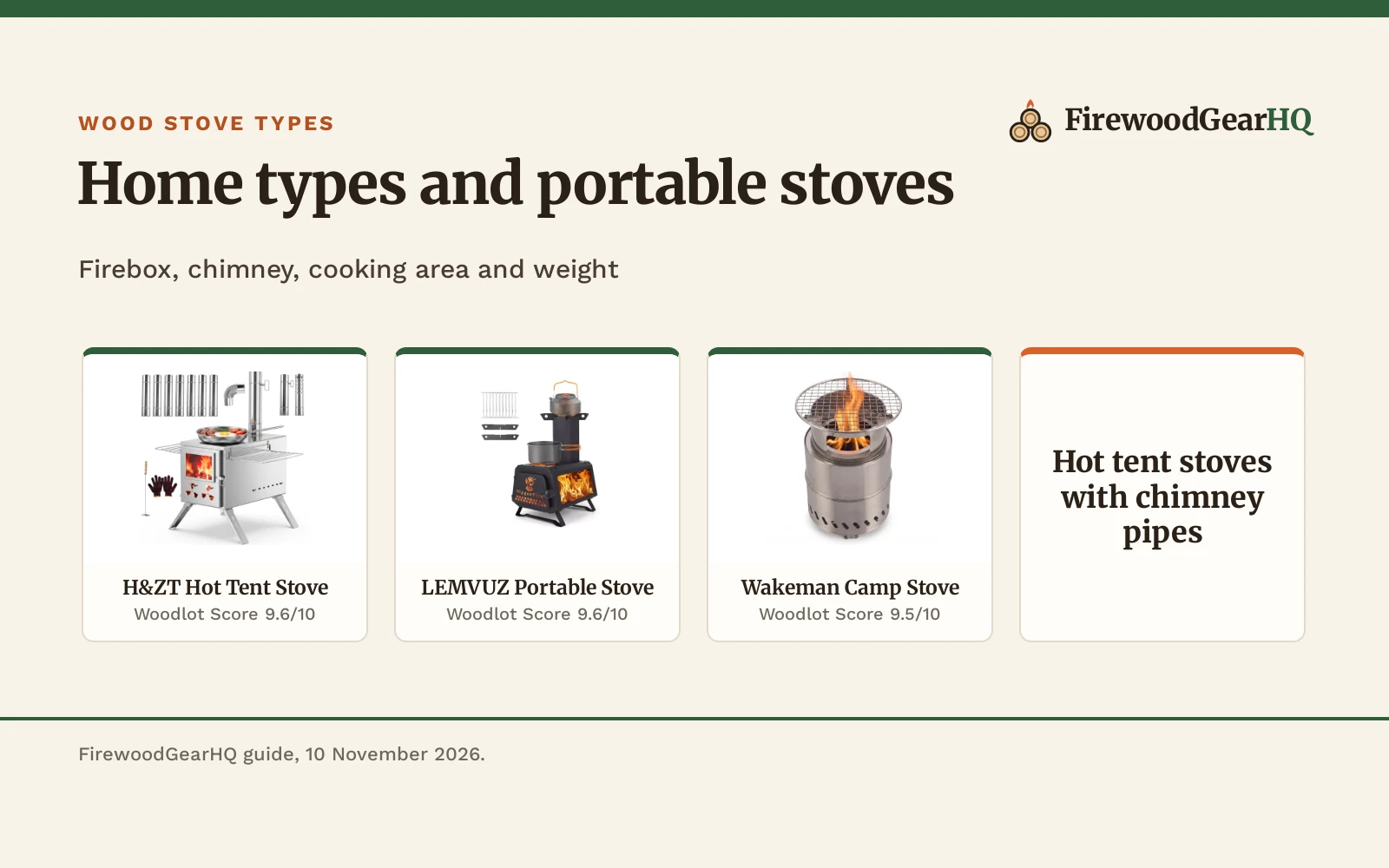
When the stack is split and the cold season comes, the question is which stove the wood goes into: a stove that heats a tent, a stove that cooks at camp, or a stove that does both. The types of wood burning stove for a home split by fitting and build: a freestanding stove stands on the floor, an insert fits inside an open fireplace, cast iron and steel are the common builds, and catalytic and non-catalytic split how the stove burns smoke, with EPA rules setting the standard for home stoves. The stoves in this guide are portable stoves, not home stoves: a hot tent stove, a folding camp stove and a compact camp stove, shown as examples of the portable side.
FirewoodGearHQ earns a small commission if you buy through links on this page. The price you pay stays the same. Read our affiliate disclosure.
| # | Product | Woodlot Score | Buy |
|---|---|---|---|
| 1 | H&ZT Large Hot Tent Stove | 9.5/10 | Buy on Amazon |
| 2 | Portable Wood Burning Stove | 9.4/10 | Buy on Amazon |
| 3 | Wakeman Outdoors Portable Camping Stove Wood | 9.3/10 | Buy on Amazon |
H&ZT Large Hot Tent Stove
A large hot tent stove in 430 stainless steel with 9 chimney pipes, for heating larger tents and cooking at camp.
Pros
- 9 chimney pipes: 6 straight pipes, 1 spark arrestor, 1 elbow and 1 damper pipe
- 430 stainless steel with a high-temperature coating
- Larger firebox for stronger heat in larger tents
- Expanded cooking area for boiling water and keeping food warm
Cons
- No weight is stated in the listing
- Large size is made for larger tents, so small tents need a different stove
- No warranty term is stated
- No packed size is stated in the listing
Portable Wood Burning Stove
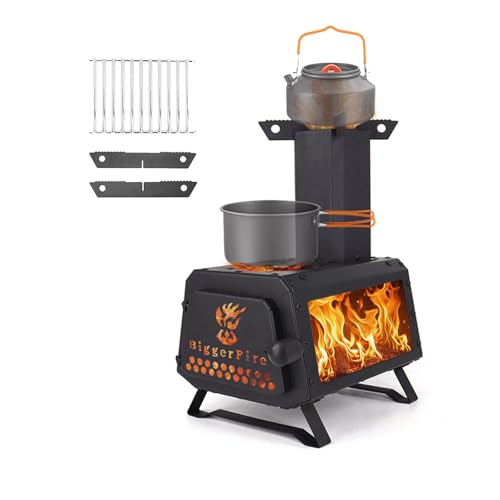
A compact portable wood stove with three-sided air vents, a glass side window and an X-shaped pot holder, for camping heating and outdoor cooking.
Pros
- Three-sided air vents with a built-in grate for efficient burning
- Heat-resistant glass side window for a view of the flames
- X-shaped pot holder with an extra-wide base and a low center of gravity
- No assembly required, for grab-and-go use
Cons
- Smoke is reduced, not removed, so the stove stays outdoors
- No warranty term is stated
- No chimney is included, so it burns in the open air
- 8.8 pounds, heavier than the Wakeman stove at 2.43 lbs
Wakeman Outdoors Portable Camping Stove Wood
A portable camping stove and fire pit in stainless steel that folds to 6.25 in tall, with a grate for pots and pans.
Pros
- Folds to 6.25 in tall for the included carry bag
- 8.5 in by 8.5 in grate supports a pot or pan from 4.7 in to 13 in in diameter
- 304 stainless steel tray for high-heat resistance
- Weighs 2.43 lbs, lighter than the LEMVUZ stove at 8.8 pounds
Cons
- The listing names both 202 and 201 stainless steel for the body, so the grade is unclear
- Grate fits pots and pans from 4.7 in to 13 in in diameter only
- No warranty term is stated
- No chimney is included, so it burns in the open air
The quick answer
A wood burning stove burns wood in a firebox or an open tray. For a home, the type follows fitting and build: freestanding or insert, cast iron or steel, catalytic or non-catalytic, with EPA rules setting the standard. The stoves in this guide are portable stoves for camp, and they differ by firebox or tray, chimney pipes, cooking area and weight: a hot tent stove with a chimney, a folding fire pit, and a compact stove with a large firebox.
Types of wood burning stove
For a home, the types split by fitting, build and burn. A freestanding stove stands on the floor and heats the room around it, while an insert fits inside an open fireplace and uses the chimney the house already has. Cast iron holds heat and gives it back slowly, while steel heats fast and cools fast. A catalytic stove passes smoke through a catalyst to burn it, while a non-catalytic stove burns smoke with another flow of air, and EPA rules set the standard they must meet. The stoves in this guide are portable stoves, not home stoves, and the table below shows the 3 portable forms in this guide.
| Portable form | What it is | Example in this guide |
|---|---|---|
| Hot tent stove | A stove with a chimney for heating a tent | H&ZT Hot Tent Stove |
| Folding camp stove fire pit | A folding fire pit for cooking and heat at camp | Wakeman Camp Stove |
| Compact camp stove | A compact stove with a large firebox for cooking and heating outdoors | LEMVUZ Portable Stove |
Use the table to match the stove to the trip, not to decide on heat output. None of the listings in this guide states a BTU figure or a burn time, so compare them on the firebox or tray, the chimney and the cooking area the listing states. For a stove that heats a house, see our best wood stove for heating a house guide.
What sets the portable stoves apart
Firebox
The firebox, or the tray on an open fire pit, holds the wood and sets how much wood the stove takes at a time. The H&ZT stove (on Amazon) lists a larger firebox for stronger heat, and the LEMVUZ stove (on Amazon) lists a large firebox with three-sided air vents. The Wakeman stove (on Amazon) is a fire pit with an open top, so the fire sits in the tray rather than in a closed box.
Chimney and smoke
A chimney carries smoke up and out of a tent. The H&ZT stove includes 9 chimney pipes: 6 straight pipes, 1 spark arrestor, 1 elbow and 1 damper pipe. The other stoves in this guide have no chimney, so they burn in the open air and are for outdoor use.
Cooking area
A cooking area is the grate or top plate where a pot sits. The Wakeman stove has an 8.5 in by 8.5 in grate that supports a pot or pan from 4.7 in to 13 in in diameter. The H&ZT stove lists an expanded cooking area for boiling water and keeping food warm. The LEMVUZ stove has an X-shaped pot holder and a top plate for boiling water and cooking at the same time.
Weight and packing
Weight matters when a stove has to travel. The Wakeman stove weighs 2.43 lbs and folds to 6.25 in tall for the included carry bag. The LEMVUZ stove weighs 8.8 pounds and needs no assembly. The H&ZT stove lists no weight, so check the listing before planning a carry.
The stoves in this guide
The stoves below are all portable stoves for camp, in 3 forms: the H&ZT hot tent stove with its chimney pipes for heating a tent, the Wakeman folding fire pit for cooking at camp, and the LEMVUZ compact stove with a large firebox for cooking and heating outdoors. They differ by firebox or tray, chimney, cooking area and weight, so match the form to the trip.
Safety
Use the Wakeman and LEMVUZ stoves outdoors only, away from walls and overhangs, never inside a tent or a garage. The H&ZT stove is made for a hot tent, with its chimney pipes carrying smoke out of the tent, so follow the maker instructions for the tent and the pipes. Keep a CO alarm nearby and burn seasoned wood only.
FAQ: wood, fire and gear
What is a hot tent stove?
A hot tent stove is a wood burning stove with a chimney that runs out of a tent to heat it. The H&ZT stove in this guide is a hot tent stove, with 9 chimney pipes and a larger firebox.
Can a wood burning stove cook food?
Yes, on the stoves in this guide. The H&ZT stove lists an expanded cooking area, the Wakeman stove has a grate for pots and pans, and the LEMVUZ stove has an X-shaped pot holder and a top plate for boiling water and cooking at the same time.
How heavy is a portable wood burning stove?
It varies. The Wakeman stove weighs 2.43 lbs and folds to 6.25 in tall, and the LEMVUZ stove weighs 8.8 pounds. The H&ZT stove lists no weight.
Do camp stoves need a chimney?
The camp stoves in this guide have no chimney. The H&ZT hot tent stove includes 9 chimney pipes, while the Wakeman and LEMVUZ stoves burn in the open air.
What should I check before buying a wood burning stove?
Check the firebox, the chimney pipes, the cooking area and the weight against the trip. None of the listings in this guide states a BTU figure or a burn time, so compare them on the figures the listing states.
More firewood guides
See the wood stoves hub, the stove accessories, the best chimney brush for a wood stove and the airtight vs non-airtight wood stove guide.