Sharp Pebble Puck Review: Pros, Cons & Who It’s For
A research-based look at the Sharp Pebble dual-grit axe sharpening puck: 150 and 320 grit silicon carbide, what the listing promises, what it leaves out and who should buy it.

On this page
Top picks at a glance
As an Amazon Associate we earn from qualifying purchases.
- 1
 Sharp Pebble Dual Grit Axe Sharpening Puck9.6/10View on Amazon
- 2
 Angerstone Axe & Hatchet Sharpener9.6/10View on Amazon
- 3
 Lansky Puck9.5/10View on Amazon
When fall splitting gets underway and you pull your axes out of the shed, a dull bit turns clean splits into tiring bounces. This sharp pebble puck review looks at a dedicated dual-grit field stone designed for keeping chopping edges keen without hauling bench equipment out to the woodpile. We have not used this stone ourselves; the review is based on the manufacturer’s listing on Amazon, collected 14 October 2026, and what its specs mean for firewood work. At 1.2 lb with 150 coarse and 320 fine grit faces, it offers a portable way to restore working edges, though the listing leaves its warranty unstated.
FirewoodGearHQ may earn a small commission if you buy through links on this page. The price you pay stays the same. Read our affiliate disclosure.

Sharp Pebble Dual Grit Axe Sharpening Puck
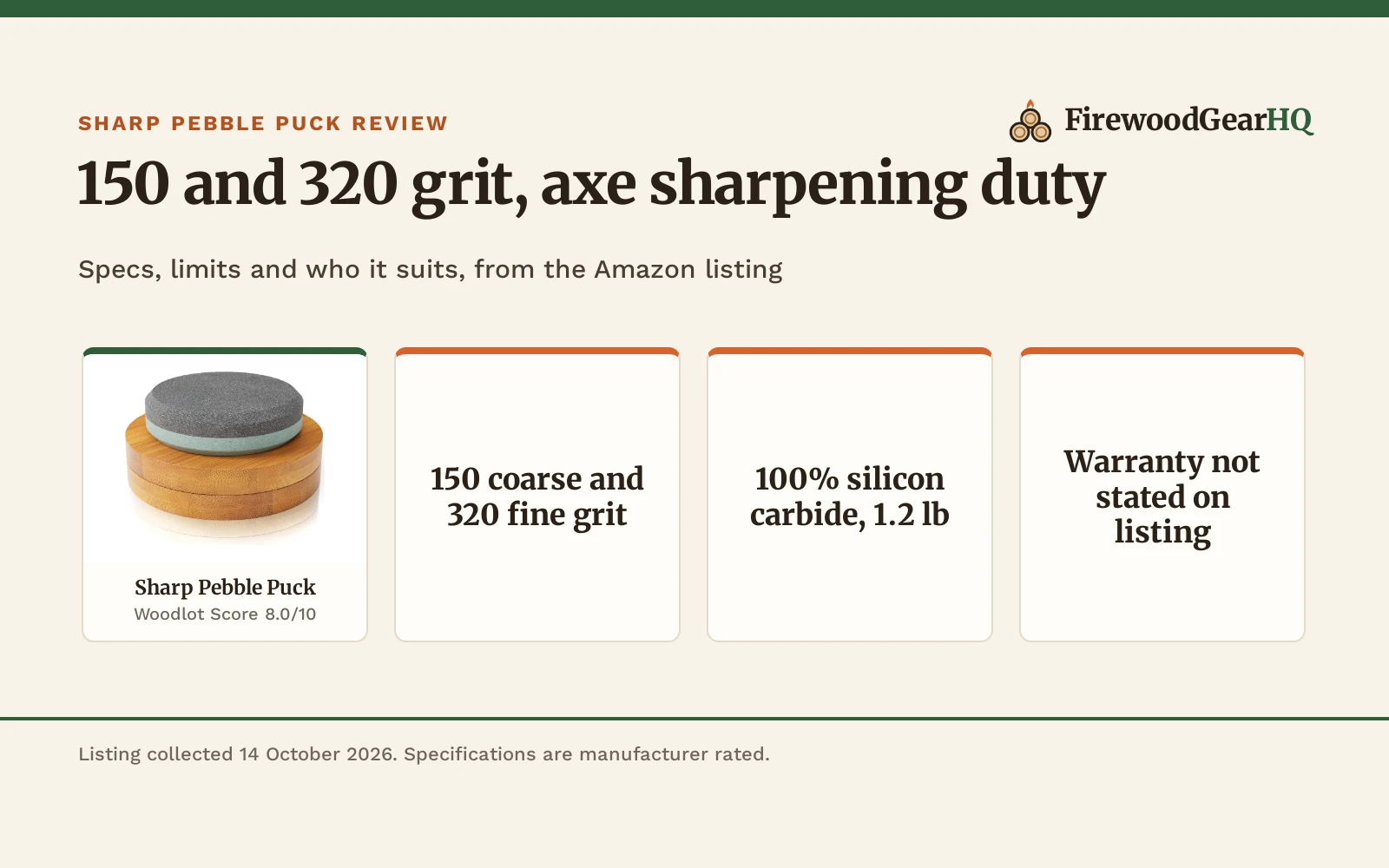
A round dual-grit axe sharpening stone made from silicon carbide, combining a 150-grit coarse side and a 320-grit fine side with a contoured grip, 3.9 by 3.9 by 1.1 in dimensions, and a 1.2 lb listed weight.
Pros
- Dual-grit design with 150 grit for dull edges and 320 grit for refining
- 100% silicon carbide abrasive cuts fast on hardened carbon steel axe bits
- Contoured round disk shape is easy to grip and guide along curved axe bits
- Spec table lists a bamboo storage box to protect the stone between sharpening sessions
Cons
- Warranty term not stated on this listing
- 320 grit is the finest stage, so bringing a razor polish requires a finer bench stone
- Listing spec table states a bamboo storage box while the title and bullets do not mention it
- Bullet points claim 40% larger surface area without stating what stone it is compared against
Sharp Pebble puck review: the short verdict
Puck sharpeners are a familiar sight in forestry camps and woodlots because they put a controllable grinding surface directly in your palm. Instead of sliding a heavy axe head over a stationary waterstone, you keep the axe steady and bring the stone to the steel. Sharp Pebble’s dual-grit disk packages a 150-grit coarse abrasive on one side and a 320-grit fine abrasive on the other, molded into a contoured round puck measuring 3.9 by 3.9 by 1.1 in.
For maintaining firewood tools, that grit spread hits a practical middle ground. The 150-grit side has enough bite to grind away burrs and smooth out rough nicks left from striking hidden knots or ground dirt, while the 320-grit side restores a crisp working bevel that bites cleanly into hardwood rounds. The trade-offs sit in the listing paperwork: no warranty duration is stated, and the spec table lists a bamboo storage box that the main description never mentions.
Key specs
| Product | Coarse Grit | Fine Grit | Weight |
|---|---|---|---|
| Sharp Pebble Puck | 150 grit | 320 grit | 1.2 lb |
Specifications are manufacturer rated, as published on the Amazon listing. The bullet points specify 100% silicon carbide, whereas the technical details table lists the material as Carborundum. Both terms describe silicon carbide abrasive, so the composition is consistent even if the labeling differs. The listing table also records Included Components as an axe sharpening stone and a bamboo storage box, though the bullets and product title omit the box entirely. The 1.2 lb listed weight reflects a solid, dense stone that provides reassuring heft during sharpening strokes.
The puck
What the Sharp Pebble puck does well
A practical dual-grit spread for working axes
A working firewood axe does not need a mirror polish; it needs an even, sturdy bevel that will not roll or chip when forced through knots. The 150-grit dark face provides rapid stock removal, making quick work of minor rolled edges and field dullness. Once the bevel is restored, flipping the disk to the 320-grit green face refines the scratches, leaving a clean working edge ready for cutting and splitting chores.
Silicon carbide abrasive cuts hard steel quickly
The maker states the disk is molded from silicon carbide. Silicon carbide grains are hard and sharp, fracturing under pressure to expose fresh cutting facets. This makes the abrasive cut carbon steel axe bits with minimal downward pressure, reducing hand fatigue during seasonal tool maintenance.
Contoured shape for hand control
Measuring 3.9 in across and 1.1 in thick, the puck fills the palm comfortably. The listing describes an ergonomic design with contoured edges that let your thumb and fingers grip the sides firmly while your palm supports the back. This circular disk format allows smooth, overlapping circular strokes along the curved profile of an axe bit, which is harder to achieve with rectangular bench stones.
Versatility across outdoor edge tools
While sized for axes and hatchets, the maker highlights versatility across a wide range of homestead and garden tools. The same 150 and 320 grit surfaces can dress lawnmower blades, brush clearing machetes, kindling hatchets, and spades. Having a single portable stone that handles multiple rough-duty edges simplifies your gear kit around the property.
Limitations
- No warranty stated on this listing. The listing bullets include a general satisfaction statement, but no concrete warranty term in days, months, or years is provided. We score warranty at zero when no duration is published.
- 320 grit is the finest stage. While 320 grit produces an ideal working edge for chopping and splitting chores, carvers and green woodworkers seeking a polished, shaving-sharp edge will still need much finer waterstones or a leather strop.
- Contradiction on included components. The technical details table lists a bamboo storage box alongside the stone, but the bullet points and title make no mention of any box. Check with the seller if secure storage packaging is critical to your purchase.
- Unsubstantiated surface area claim. The product description claims 40% larger surface area, but fails to identify what benchmark or competing stone it is being measured against.
- Hand discipline required. Moving a stone across a stationary axe blade puts your fingers in close proximity to the cutting edge. Users must maintain a disciplined grip and wear protective gloves throughout the process.
How we scored it
The Woodlot Score evaluates performance, build, value, safety, and warranty, using only published specifications from the product listing. The complete rating criteria are explained on our How We Pick page.
| Product | Woodlot Score | Perf. /35 | Build /25 | Value /25 | Safety /10 | Warranty /5 |
|---|---|---|---|---|---|---|
| Sharp Pebble Puck | 9.6 | 29 | 21 | 21 | n/a | 0 |
Scores run from 9.2 to 9.8: each product’s point total is placed on that range, so more points always means a higher score. Safety counts only for powered gear or where the listing states safety features; where it does not apply, the score is taken over the remaining 90 points.
Who should buy the Sharp Pebble puck, and who should skip it
Buy it if
- You cut and split firewood regularly and want an easy, portable method to keep axes and hatchets keen at the chopping block.
- You prefer a puck shape that moves along a stationary curved axe head rather than balancing an axe on a flat bench stone.
- You want a coarse 150 grit for fixing minor edge damage and a 320 grit for quick edge refinement in one stone.
- You maintain multiple homestead cutting tools including brush machetes and lawnmower blades.
Skip it if
- You need to fix deep edge chips or reshape a severely battered profile, where a flat steel file from our axe sharpening guide removes metal much faster.
- You want a razor-polished, hair-shaving bevel for precision woodcraft or timber framing.
- You require a confirmed written warranty before purchasing.
- You prefer a handled guide or handheld sharpener that keeps hands further away from the cutting bit.
Alternatives to consider
Flat bastard mill file. For serious edge repair, reprofiling a blunt axe, or removing deep notches after striking a rock, a traditional flat mill file cuts carbon steel far more aggressively than any whetstone puck. Keep a file in your shed for heavy reshaping and use the puck for routine sharpening.
Handheld carbide sharpener. For woodcutters who prefer preset sharpening angles and built-in finger guards, handheld sharpeners with carbide inserts offer an alternative to freehand puck grinding.
Traditional bench stones. If you sharpen primarily at a dedicated workshop bench, full-size rectangular oilstones or waterstones provide a wider, flatter surface, though they lack the puck’s portability at the woodpile.
Safety and gear
Clear the swing area (overhead too), split on a solid chopping block at a comfortable height, keep your feet apart with the block in front of you, and wear eye protection and sturdy boots. Replace a cracked or loose handle before you swing again. Read our Safety Disclaimer.
Sharpening an axe requires the same deliberate care as swinging one. Always secure the axe head in a bench vise or wedge it firmly into a notch on a heavy chopping block before bringing the stone to the steel. Never attempt to sharpen an axe balanced freely on your knees or held loosely in your lap. Wear heavy leather work gloves to shield your hands, and hold the puck with your thumb and fingers tucked safely behind the abrasive perimeter. When taking your newly sharpened edge to the woodpile, ensure a completely clear swing zone free of bystanders, pets, and ground obstacles. A keen bit bites reliably into wood grain, whereas a dull, rounded edge risks glancing off logs toward your boots.
Around the Woodpile
- Keep fingers tucked behind the perimeter. Hold the puck firmly with your thumb and fingers supported by the palm as directed in the listing, ensuring your fingertips never wrap around the face toward the stationary cutting edge.
- Store the stone in a dry container. Keep the puck stored in a dry box or container between sharpening sessions so the silicon carbide abrasive does not chip against steel splitting wedges and tools.
- Stabilize the axe head before grinding. Clamp the axe head tight or secure the poll solidly against a chopping block so the tool cannot shift while you execute overlapping circular strokes.
- Rinse away accumulated metal swarf. Grinding steel bits leaves fine metal particles embedded across the porous abrasive; rinse the stone thoroughly after use to keep the 150 and 320 grit faces cutting freely.
Frequently Asked Questions
What grits does the Sharp Pebble puck provide?
The listing states the stone provides two grits: a coarse 150-grit black side used to sharpen dull edges, and a fine 320-grit green side designed to restore slightly dulled edges and refine the finish left by the coarse grit.
Can the Sharp Pebble puck sharpen an axe or hatchet?
Yes. The listing specifically names ax blades, hatchets, and tomahawks. The coarse 150-grit face removes minor nicks, while the fine 320-grit face refines the cutting edge.
What warranty comes with the Sharp Pebble puck?
The Amazon listing does not state a concrete warranty duration. While the bullet points mention a satisfaction claim, no duration in days, months, or years is provided. We record the warranty as unstated.
What components are included in the package?
The listing presents conflicting details: the technical specifications table lists both an axe sharpening stone and a bamboo storage box under included components, whereas the product title and bullet points describe only the sharpening stone.
How do you use the Sharp Pebble puck on an axe edge?
The listing instructs holding the disk firmly with your thumb and fingers, supported by the palm of your dominant hand. You apply the stone to the blade using overlapping circular motions, advancing steadily along the entire cutting edge.
Related guides
Browse our complete library of woodcutting tools on the axes and mauls hub, learn step-by-step bench technique in our guide on how to sharpen a splitting axe, and compare other sharpening options in our best axe sharpener roundup. If you are looking to add another splitter to your shed, see our top recommendations in the best splitting axe guide.