Safety Features of a Chainsaw: What to Look For
Safety features of a chainsaw, from the chain brake and hand guard on the saw to the chaps, helmet and boots to wear with it.

On this page
Top picks at a glance
As an Amazon Associate I earn from qualifying purchases.
- 1
 Husqvarna Functional Protective Power Kit with Chainsaw Chaps9.8/10View on Amazon
- 2
 NoCry ANSI Z89.1 Rated Arborist Helmet9.7/10View on Amazon
- 3
 Chainsaw Chaps 8-layer Protective Apron Wrap Adjustable9.7/10View on Amazon
Fall cutting fills the woodpile before the cold sets in, and the saw earns its keep in short, hard sessions between stacking and splitting. A sharp chain, a steady stance and a clear work area matter, and so does the gear built into the saw and worn on the body. The safety features of a chainsaw are the parts and habits that keep a kickback, a slip or a tired moment from turning into an injury.
FirewoodGearHQ earns a small commission if you buy through links on this page. The price you pay stays the same. Read our affiliate disclosure.
Safety features of a chainsaw at a glance
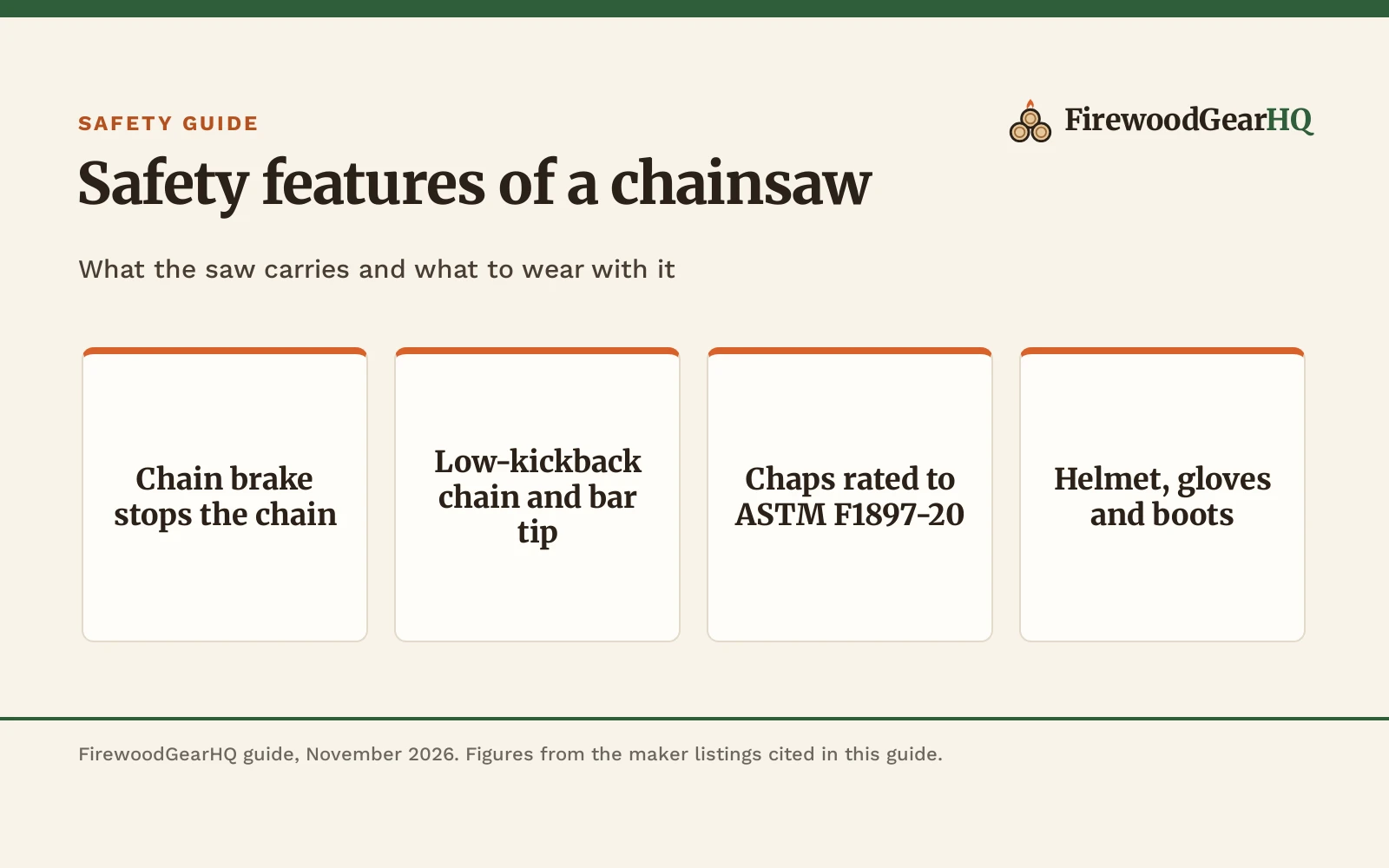
The saw carries its own protection: a chain brake that stops the chain when the hand guard kicks forward, a throttle lock that keeps the trigger from opening by accident, a low-kickback chain and a bar tip to keep clear of contact, a chain catcher below the bar, and a bar cover for carrying and storage. The wearer adds the rest: chaps that stall a moving chain, a helmet with a face screen and hearing protection, gloves and boots. Each part covers a different moment, and none of them replaces attention to the cut.
Built-in saw features
Chain brake and hand guard
The front hand guard sits ahead of the top handle, and pushing it forward trips the chain brake, which stops the chain. A kickback throws the bar up toward the operator, and the guard meets the hand as the saw rises. Check the brake before cutting: with the chain moving, push the guard forward and the chain should stop, then pull it back to release it.
Throttle lock and stop switch
The throttle lock keeps the trigger from opening by accident, so the engine cannot rev up until the operator grips the saw and squeezes the trigger on purpose. The stop switch cuts the engine, and on most saws it sits where the thumb can reach it without letting go of the handle. A saw that idles with the chain moving needs a shop visit before it cuts wood.
Low-kickback chain and bar tip
A low-kickback chain has depth gauges and cutters shaped to take a smaller bite, which makes the nose of the bar less likely to grab and throw the saw. The bar tip is the part that kicks, so keep the upper part of the nose from touching wood or anything solid; that matters more than any setting. A sharp chain also kicks less than a dull chain, because it cuts instead of riding over the wood.
Chain catcher and bar cover
The chain catcher is a small peg or plate below the bar that catches a chain if it snaps or jumps off the bar, so it does not whip back toward the operator. The bar cover slides over the bar and chain whenever the saw is carried or stored, which keeps the cutters from nicking gear and keeps hands off the chain. Put the cover on before the saw goes in the truck or on the shelf.
The gear to wear with the saw
Chaps are the main piece of chainsaw leg protection, and the makers state what to look for: layered fiber that stalls a moving chain, a fit that covers the leg from waist to ankle, and a stated standard. The Notch chaps (on Amazon) carry 5 layers of chain-stopping fiber in a 600D shell, run 36 inches long, and fit waists from 28 to 48 inches, with a 2-inch waist belt and 1-inch leg straps. The ZELARMAN chaps (on Amazon) carry 8 layers, run 42 inches long, fit waists up to 48 inches, and shorten by 2 inches when the waistband folds down. The CRISERT chaps (on Amazon) carry 8 layers and are rated to stop a chain moving at 20 m/s. The FORESTER chaps wrap 360 degrees from calf to below the knee, run 37 inches long, and use a 1200D shell. The GeerDuo chaps (on Amazon) pair with a work apron that holds 10 pockets and fit waists from 25 to 49 inches.
Standards give the fit a check that a bare claim alone does not. The Notch chaps are UL certified to ASTM F1897-20 and meet OSHA 1910-266, the ZELARMAN chaps meet ASTM F3325-20 and ASTM F1897-20 and meet OSHA 1910-266 and ANSI Z133.1, and the CRISERT chaps meet EN ISO 11393-2. Look for the standard in the maker details before ordering, and match the length to the leg: the chaps here run 36 inches, 37 inches and 42 inches, with the CRISERT chaps sized for heights from 65 to 75 inches and a waist that adjusts to 52 inches.
Weight matters on a long day at the woodpile. The Notch chaps weigh 2.8 pounds, the Stihl chaps (on Amazon) weigh 4.0 pounds, and the Husqvarna pants weigh 1.87 pounds. Chaps that bind at the knee or slip at the waist get left in the truck, so try the fit with the boots and gloves on and walk the woodpile before cutting.
A helmet with a face screen and hearing protection covers the head and ears, and it belongs with the chaps on every cut. Safety glasses sit under the face screen for flying chips, gloves keep a grip on the saw and keep splinters out of the hands, and boots with a firm tread keep footing on sawdust and bark. See the chainsaw safety chaps guide for fit, the safety helmet for chainsaw guide for head protection, and the chainsaw safety boots guide for footwear.
Before cutting
Check the chain before the saw starts: it should sit snug on the bar with a little give, the cutters should look sharp and even, and the bar oil should be topped up. Clear the work area of trip hazards and loose limbs, and keep a helper within call. Never cut alone. A dull chain makes the saw work harder and kick more, so sharpen it or swap it before it starts riding over the wood.
Fuel and oil go in with the saw on the ground and the engine off, away from the woodpile and any open flame. Wipe up spills before starting. When the saw is running, hands stay on the handles, the body stays out of the line of the bar, and the cut stays below shoulder height. If the chain pinches in the cut, stop the saw and free it with a wedge instead of forcing it.
FAQ: wood, fire and gear
Do chainsaw chaps stop a running chain?
Chaps do not stop a chain by being hard: the layers of fiber pull out and jam the drive sprocket, which stalls the chain. The CRISERT chaps are rated to stop a chain moving at 20 m/s, and the Notch and ZELARMAN chaps meet ASTM F1897-20. Chaps are leg protection, not a promise: keep the bar away from the body and let the brake and the chaps back each other up.
What length chaps do I need?
Measure from the waist to the ankle and match the chaps to that length. The chaps here run 36 inches, 37 inches and 42 inches, and the ZELARMAN chaps shorten by 2 inches when the waistband folds down. Chaps that stop above the boot leave the ankle open, so cover the leg to the boot top.
What does ASTM F1897-20 mean?
It is the standard for leg protection for chainsaw users, and chaps that meet it carry layers rated to stall a moving chain. The Notch chaps are UL certified to ASTM F1897-20 and the ZELARMAN chaps meet ASTM F3325-20 and ASTM F1897-20. A standard in the maker details beats a bare claim, so look for the number before ordering.
Does every chainsaw have a chain brake?
Most modern saws do, and the front hand guard works the brake. Push the guard forward and the chain stops; pull it back to release it. A saw with no working brake is a saw to leave in the shop until it is fixed, because the brake is the part that answers a kickback.
Can I wear chaps over work trousers?
Yes, chaps go over trousers and fasten at the waist and legs. The Notch chaps fit waists from 28 to 48 inches, the GeerDuo chaps fit waists from 25 to 49 inches, and the Stihl chaps fit waists from 30 to 42 inches. Fasten every strap, buckle or zip, and check that the chaps cover the leg from waist to ankle before cutting.
More firewood guides
See the chainsaw safety chaps guide, the chainsaw safety training guide, the chainsaw safety tips guide, the safety helmet for chainsaw guide, the chainsaw safety boots guide, the best safety glasses for chainsaw use guide, the best earplugs for chainsaw use guide, and the Forester chainsaw chaps review. For bar length, see the chainsaw size guide.