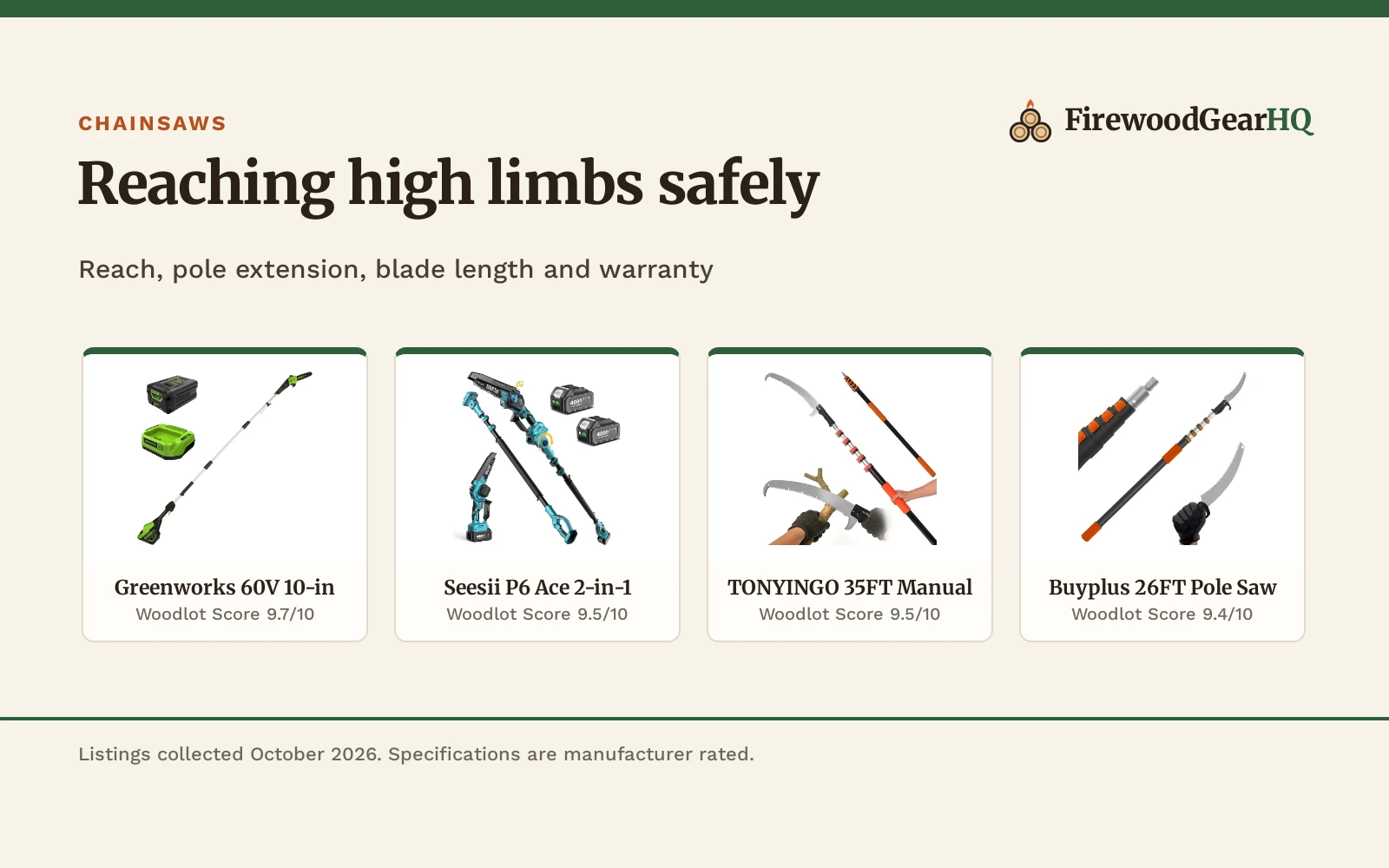
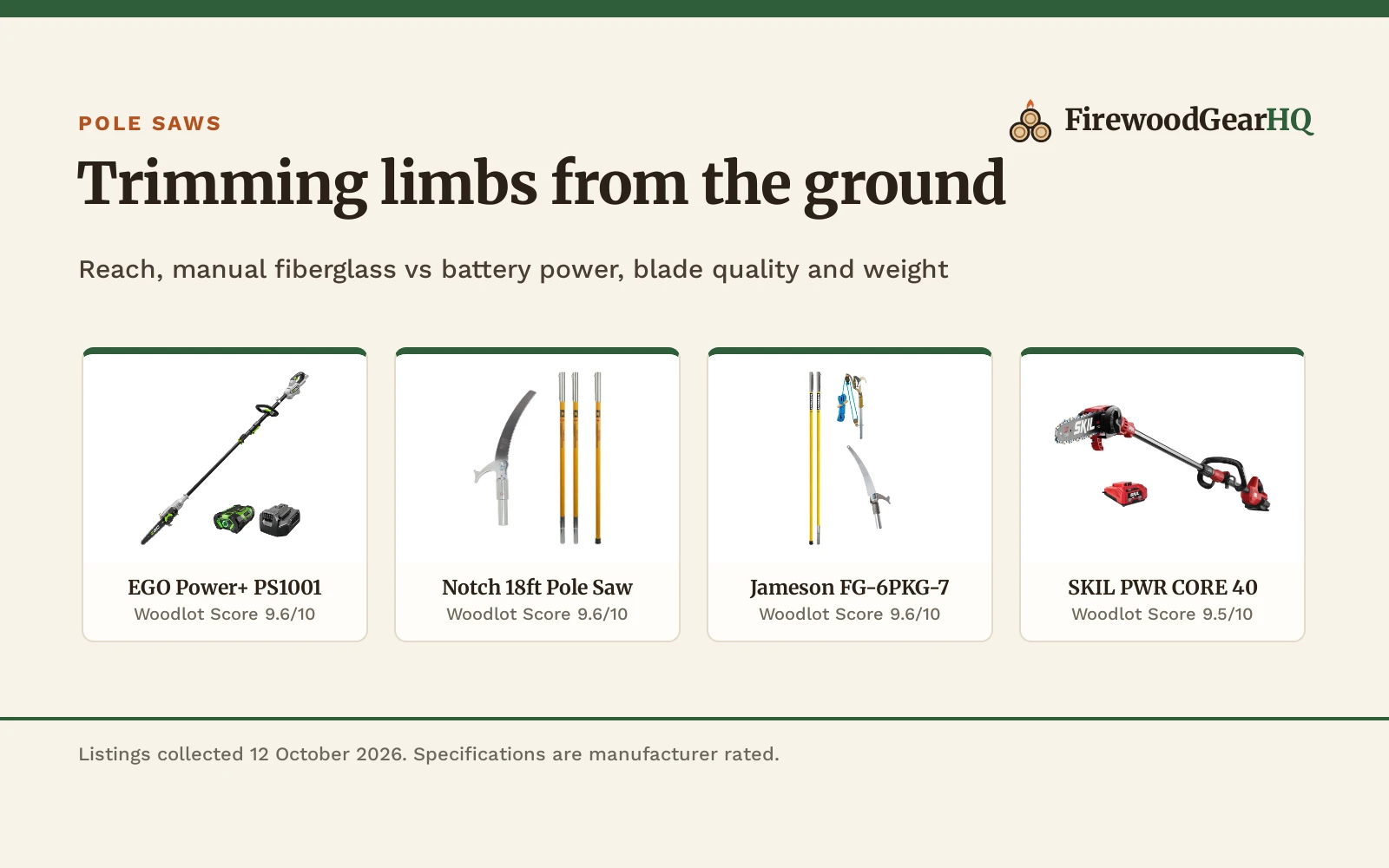
Pole Saw vs Chainsaw: Which One Should You Buy?
Pole saw vs chainsaw: a pole saw reaches high limbs from the ground while a chainsaw cuts at close range. Explained with reach and bar figures for tree work.

On this page
Top picks at a glance
As an Amazon Associate we earn from qualifying purchases.
- 1
 Greenworks 60V 10 in Electric Pole Saw9.7/10View on Amazon
- 2
 Husqvarna 460 Rancher Gas Powered Chainsaw9.7/10View on Amazon
- 3
 TaskStar 2-in-1 Pole Saw for Tree Trimming9.6/10View on Amazon
- 4
 Supstable Cordless Pole Saw & Hedge Trimmer 6-in-1View on Amazon
- 5
 2-in-1 Cordless Pole SawView on Amazon
- 6
 Electric Pole Saw 8-Inch Corded Pole Saw for Tree TrimmingView on Amazon
- 7
 SENIX 8A Corded Electric Pole SawView on Amazon
- 8
 EGO PSA1020 10-Inch Carbon Fiber Pole Saw Attachment for EGOView on Amazon
- 9
 WEN 4019 6-Amp 8-Inch Electric Telescoping Pole SawView on Amazon
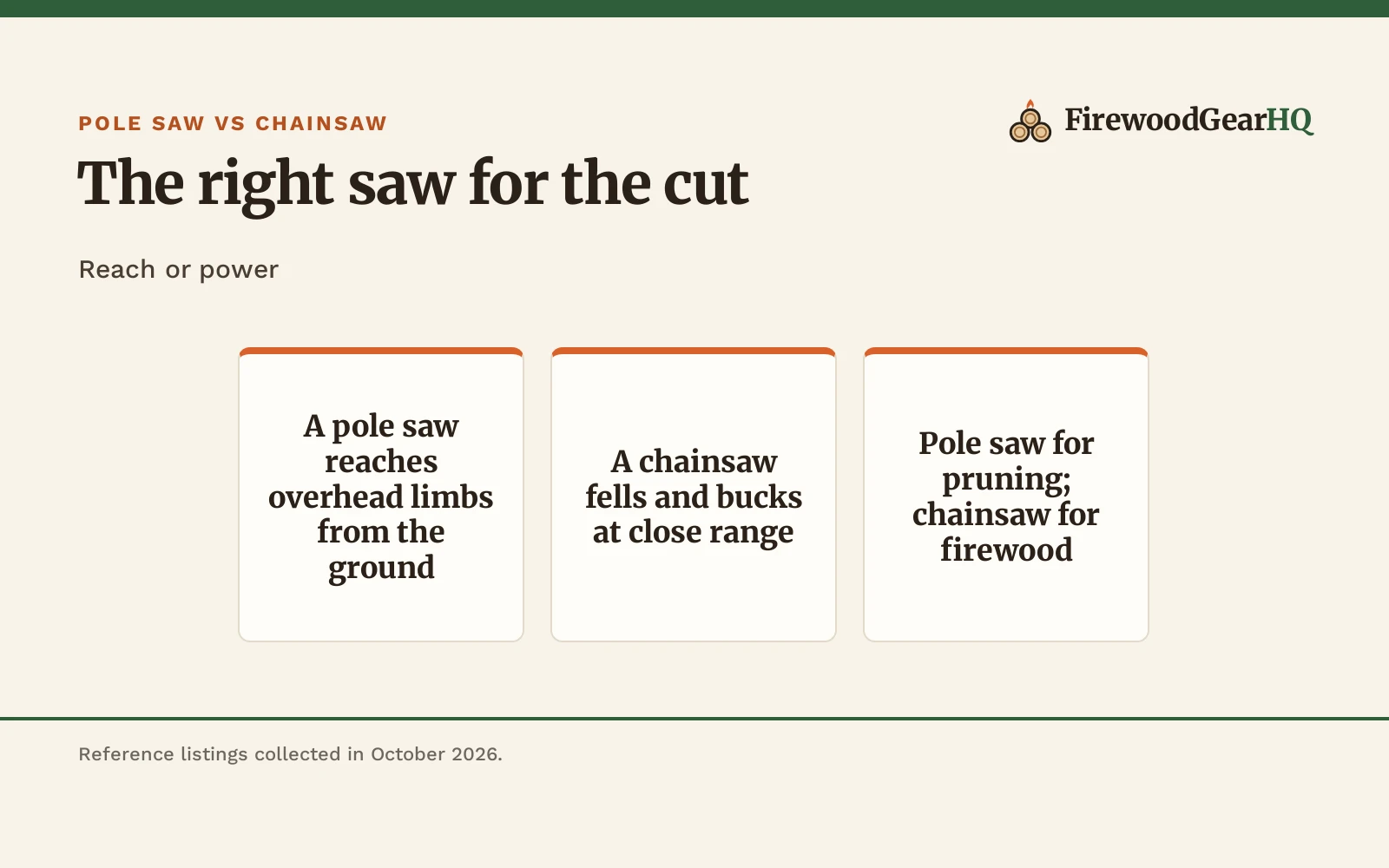
A pole saw is a small chainsaw on a long pole: it reaches high limbs while your feet stay on the ground. A chainsaw is the close-range tool: more power and a bigger bar for felling, bucking and splitting rounds. The pole saw vs chainsaw question is really about where the wood is: overhead or at hand.
More options to compare
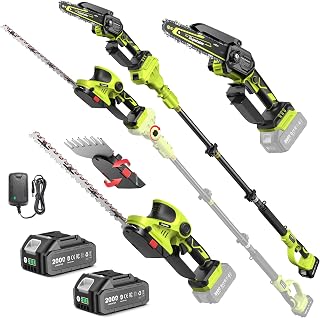 Supstable Cordless Pole Saw & Hedge Trimmer 6-in-1Check price on Amazon
 2-in-1 Cordless Pole SawCheck price on Amazon
 Electric Pole Saw 8-Inch Corded Pole Saw for Tree TrimmingCheck price on Amazon
 SENIX 8A Corded Electric Pole SawCheck price on Amazon
 EGO PSA1020 10-Inch Carbon Fiber Pole Saw Attachment for EGOCheck price on Amazon
 WEN 4019 6-Amp 8-Inch Electric Telescoping Pole SawCheck price on Amazon
FirewoodGearHQ may earn a small commission if you buy through links on this page. The price you pay stays the same. Read our affiliate disclosure.
pole saw vs chainsaw: the difference in one paragraph
A pole saw trades power for reach: a small bar on an extension pole that cuts limbs overhead without a ladder. A chainsaw trades reach for power: a bigger bar and motor that fells trees and bucks logs at ground level. One prunes; the other produces firewood.
What a pole saw does
Most of the listings we reviewed are 2-in-1 tools: a mini chainsaw head that mounts on an extension pole, though the Husqvarna 122LKP is a dedicated gas pole saw. Reach is the headline figure: 15.9 FT on the AVADA for DeWALT 20V MAX batteries, 16ft on the Velotrex with 2×4.0 batteries, 12-foot on the Husqvarna 122LKP gas pole saw, and 13,2 FT on the ANJOSISSEL. Power runs 1200W brushless on the DeWALT-compatible units, 21V and 40V on the battery models, and 21.7CC on the Husqvarna gas unit. The Husqvarna cuts limbs up to 8 inches thick. A pole saw is the pruning tool: dead limbs, storm damage and low branches, all cut from the ground.
What a chainsaw does
A chainsaw is the production tool. The mini chainsaws in the reference set run 6 in and 8 in bars on 21V batteries, handy for limbing and small bucking. Full-size saws run longer bars for felling and bucking firewood rounds. A chainsaw does what a pole saw cannot: drop a tree, buck a trunk into rounds, and rip through a full cord of wood. It is also the more dangerous tool, with the bar inches from your hands and the cut at body height.
When the pole saw is the better choice
Any time the work is overhead. Pruning dead limbs, clearing storm damage, trimming branches over the driveway or the roof: the pole saw keeps you off the ladder, which is the safety win. The 2-in-1 designs are the flexible buy: use the head on the pole for reach, then detach it as a mini chainsaw for close work. For a homeowner who trims trees but does not cut firewood, the pole saw is the whole kit.
When the chainsaw is the better choice
Any time the work is firewood. Felling, limbing at ground level, bucking rounds and cutting a winter’s worth of wood all need a real chainsaw. A pole saw’s small bar and long pole make it slow and awkward for bucking; a chainsaw’s bar and power make it the production tool. If you heat with wood, the chainsaw is non-negotiable and the pole saw is the companion for pruning season.
Battery and power in the listings
The battery pole saws in the reference set run 21V, 40V and 20V MAX systems. The 2-in-1 6 in mini chainsaw and pole saw runs 21V with 2 batteries and an auto oiler in the box. The Ukoke 40V 8 in pole saw ships a 2.0Ah battery and charger. The DeWALT-compatible units run 20V MAX batteries with a 1200W brushless motor, and the Velotrex ships 2×4.0 batteries for longer runtime. The outlier is the Husqvarna 122LKP: a 21.7CC gas pole saw with a 12-foot reach for users who want no batteries at all. Brushless motors appear on the 1200W units; brushed motors are not named in these listings. For occasional pruning, a 21V or 20V battery saw with two batteries covers the job; for all-day clearing, gas or the 40V system with its 2.0Ah pack makes more sense.
Bar sizes and what they cut
Bar length sets the cut. The mini chainsaw heads in the listings run 6 in and 8 in bars: fine for limbs and small bucking. The Husqvarna gas pole saw cuts limbs up to 8 inches thick. A pole saw bar is deliberately small because a long bar on a long pole would be unmanageable overhead. When the wood is bigger than the bar can handle in one pass, that is the signal to switch to the chainsaw. Match the bar to the wood, not the other way around.
Choosing between the pole saw listings
Reach is the first filter. The listings state 15.9 FT on the AVADA for DeWALT 20V MAX batteries, 16ft on the Velotrex with 2×4.0 batteries, 12-foot on the Husqvarna 122LKP gas pole saw, and 13,2 FT on the ANJOSISSEL. Pick the reach that covers your tallest pruning work; the extra feet on the 16ft Velotrex matter when the limbs are high. Power is the second filter: the DeWALT-compatible units run a 1200W brushless motor on 20V MAX batteries, the Ukoke runs 40V with a 2.0Ah battery and charger, and the Husqvarna runs 21.7CC of gas for users who want no batteries at all. The Husqvarna also states it cuts limbs up to 8 inches thick, the only cutting-capacity figure in the set. For occasional pruning near the house, a 21V or 20V battery saw with two batteries in the box is the easy buy; for all-day clearing, the 40V system or the gas Husqvarna keeps you cutting longer.
Frequently Asked Questions
Can a pole saw replace a chainsaw?
No. A pole saw prunes overhead limbs; it cannot fell a tree or buck a trunk efficiently. The 2-in-1 models with a detachable mini chainsaw head come closest, handling small close-range cuts. For firewood production you need a real chainsaw. See our mini chainsaw vs full size chainsaw for the size question.
How high can a pole saw reach?
The listings state 15.9 FT, 16ft, 12-foot and 13,2 FT of total reach. That is the pole plus the operator’s height: enough for most pruning without a ladder.
Are pole saws good for cutting firewood?
Only for small stuff. A pole saw can limb a downed tree and cut small branches, but bucking rounds is slow with a small bar. For firewood, use a chainsaw and keep the pole saw for pruning.
Gas or battery pole saw?
The listings include both: 21V, 40V and 20V battery models plus a 21.7CC gas Husqvarna. Battery is quieter and lighter for occasional pruning; gas suits long sessions. See our corded vs cordless chainsaw for the power question.
Do I still need a ladder with a pole saw?
That is the point of the tool: no. With 12 to 16 ft of reach, the pole saw cuts from the ground what would otherwise need a ladder. Never cut from a ladder with a chainsaw; the pole saw is the safe alternative.
Related guides
Also see our brushless vs brushed chainsaw and the best safety glasses for chainsaw use.