Oil Filled Radiator vs Electric Fireplace: Which One Should You Buy?
Two 1500W oil filled radiator examples compared with the electric fireplace side on heat, looks, noise and safety, with a verdict on which suits your room.

On this page
Top picks at a glance
As an Amazon Associate I earn from qualifying purchases.
- 1
 De'Longhi Oil filled Radiator Heater9.5/10View on Amazon
- 2
 Amazon Basics Portable Oil Radiator Heater9.4/10View on Amazon
Verdict: Choose an oil filled radiator if you want steady, quiet heat from a portable heater you can roll from room to room. Choose an electric fireplace if you want the look of a fire as the center of the room, with heat as its other job.
The wood is split and stacked for the season, and the stove is ready for the cold nights. For a bedroom or an office the stove cannot reach, this oil filled radiator vs electric fireplace comparison weighs two plug-in options: a radiator that warms with oil filled fins, and a fireplace that warms behind a flame glow. Both examples in this comparison are oil filled radiators, so the fireplace side is judged on what the type offers rather than on a named example.
FirewoodGearHQ earns a small commission if you buy through links on this page. The price you pay stays the same. Affiliate disclosure.
Two examples
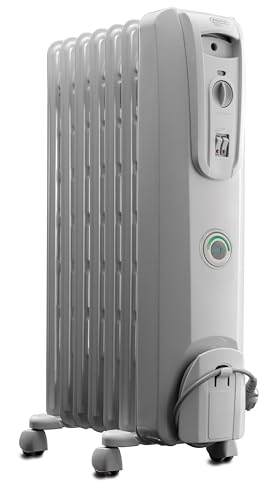
De'Longhi Oil filled Radiator Heater
A 1500W oil filled radiator with ComfortTemp, a thermal slot design, an anti-freeze setting, a thermal cut-off and fully enclosed heating elements, on smart snap wheels with a 3 year warranty.
Pros
- ComfortTemp the maker claims runs up to 20% more efficiently than the same unit at max setting without it
- Anti-freeze setting switches the heater on below 41 degrees F
- Thermal cut-off and fully enclosed heating elements
- Permanently sealed oil reservoir never needs refilling
Cons
- Two dimension figures in the listing do not match
- Tip-over shutoff not stated in the listing
- No room size figure stated, only small to medium spaces
- Listed at 23.15 lb, heavier than the Amazon Basics example at 17.42 lb
Amazon Basics Portable Oil Radiator Heater
A 1500W oil filled radiator with 7 oil filled steel fins, 3 heat settings, ETL certification, tip-over and overheat protection, caster wheels and a handle, heating up to 144 sq ft.
Pros
- 3 heat settings: High 1500W, Medium 1000W, Low 600W
- Heats up to 144 sq ft
- ETL certified with tip-over and overheat protection
- Caster wheels and a handle for moving room to room
Cons
- No warranty term stated
- No anti-freeze setting stated
- No thermostat figure stated
- Stated coverage tops out at 144 sq ft
More options to weigh up
 De'Longhi Dragon Digital Oil Filled Radiator HeaterCheck price on Amazon
 DeLonghi Dragon Digital Oil Filled Radiator HeaterCheck price on Amazon
 Dumos Oil Filled Radiator Heater with Adjustable ThermostatCheck price on Amazon
 Sweetcrispy Oil Filled Radiator Heater for Indoor Use 1500WCheck price on Amazon
 DR. INFRARED HEATER DR-991 Portable Electric Fireplace SpaceCheck price on Amazon
 duraflame Freestanding Electric Fireplace Stove Heater withCheck price on Amazon
Side by side
| Woodlot Score | Watts | Heat settings | Safety | Warranty | |
|---|---|---|---|---|---|
| De’Longhi EW7707CM | 9.5/10 | 1500 | Not stated | Thermal cut-off, enclosed elements | 3 years |
| Amazon Basics Radiator | 9.4/10 | 1500 | 3: 1500W, 1000W, 600W | ETL, tip-over, overheat protection | Not stated |
Those numbers are what each brand claims on its listing, collected 13 November 2026, not shop measurements. Each figure describes only the example named in its row.
Oil filled radiator vs electric fireplace: how they heat
An oil filled radiator heats oil sealed inside steel fins, and the fins give off steady heat into the room. The Amazon Basics example keeps giving off heat after it switches off, and it runs with no fan noise. An electric fireplace heats with an electric element behind a flame effect, and the glow is the point as much as the warmth. A radiator suits a room that needs steady background heat; a fireplace suits a room where the fire look matters and the heat is a bonus.
Noise, looks and moving them around
Both radiator examples run without a fan, so neither adds fan noise to a bedroom or office. The Amazon Basics example rolls on caster wheels with a handle, and the De’Longhi example moves on smart snap wheels with a handle. A radiator is a tall, slim heater that tucks against a wall; a fireplace is often a piece of furniture with a mantel look that usually stays in one place.
Safety: what each listing states
The Amazon Basics example is ETL certified and lists tip-over protection and overheat protection that switch the heater off. The De’Longhi example lists a thermal cut-off, fully enclosed heating elements and a gently rounded design. Keep any heater clear of anything that burns, plug it straight into the wall, and check the smoke alarms in the room.
How the examples were scored
Each example is scored on performance, build, value, safety and warranty, using only what the listing publishes.
| Product | Woodlot Score | Perf. /35 | Build /25 | Value /25 | Safety /10 | Warranty /5 |
|---|---|---|---|---|---|---|
| De’Longhi EW7707CM | 9.5 | 30 | 21 | 20 | 5 | 3 |
| Amazon Basics Radiator | 9.4 | 29 | 20 | 21 | 7 | 0 |
A tool’s weighted point total is placed between the 8.8 bottom and the 9.8 top of our scale; within a guide each rank shows at least 0.1 less than the one above it.
Wear eye protection and gloves for cutting, splitting and handling, follow every tool's manual, install stoves to code, and have the chimney inspected and cleaned every year. See EPA Burn Wise and NFPA heating safety. Read our Safety Disclaimer.
Around the Woodpile
- Roll the Amazon Basics example on its caster wheels and carry it by its handle; move the De’Longhi example on its handle and smart snap wheels.
- Keep any heater clear of anything that burns and plug it straight into the wall.
- The Amazon Basics example switches off on tip-over and overheat; the De’Longhi example has a thermal cut-off.
- The De’Longhi oil reservoir is permanently sealed and never needs refilling.
FAQ: wood, fire and gear
Is an oil filled radiator or an electric fireplace better for a bedroom?
A radiator suits a bedroom that needs steady, quiet heat, since both examples here run with no fan noise. A fireplace suits a bedroom where the flame look matters more than steady heat.
Do oil filled radiators stay warm after you switch them off?
The Amazon Basics example keeps giving off heat after it switches off, since the oil in its 7 fins holds warmth. Let the fins cool before you move the heater or put anything near it.
Do electric fireplaces need a chimney or vent?
No. An electric fireplace plugs into a wall outlet and burns no fuel, so it needs no chimney or vent. Keep it clear of anything that burns, as with any heater.
Can I leave an oil filled radiator on overnight?
The Amazon Basics example lists tip-over and overheat protection that switch the heater off, and the De’Longhi example lists a thermal cut-off. Keep the heater clear of anything that burns, plug it straight into the wall, and follow the maker instructions.
More firewood guides
See the oil filled radiator vs space heater comparison, the electric fireplace vs space heater comparison, and can I use a propane heater indoors.