Motor Oil vs Bar Oil: Which One Belongs in the Oiler
Motor oil and bar oil both look like oil, but one is made for engines and the other is made to cling to a moving chain.

On this page
Top picks at a glance
As an Amazon Associate I earn from qualifying purchases.
- 1
 Husqvarna 24PK Genuine OEM XP 2-Cycle Oil 1 Gallon Mix 2.6oz9.6/10View on Amazon
- 2
 Oregon Premium Bar & Chain Oil9.4/10View on Amazon
- 3
 Husqvarna X-Guard Premium All Season Bar & Chain Oil9.4/10View on Amazon
- 4
 Castrol EDGE 5W-30 Advanced Full Synthetic Motor OilView on Amazon
- 5
 Castrol EDGE 0W-20 Advanced Full Synthetic Motor OilView on Amazon
- 6
 Castrol GTX 10W-30 Conventional Motor OilView on Amazon
- 7
 Castrol GTX Full Synthetic 5W-30 Motor OilView on Amazon
- 8
 Castrol GTX Full Synthetic 0W-20 Motor OilView on Amazon
- 9
 Lucas Oil 10115 Semi-Syn 2-Cycle Motor OilView on Amazon
Fall cutting season is here, and the motor oil vs bar oil question comes up every year when the chain oiler runs low and the shelf holds engine oil instead of bar oil. They are not the same thing. Motor oil is blended to flow inside an engine; bar oil is blended to cling to a moving bar and chain. None of the four oils below is sold as bar oil, so read them as engine oils and check your saw’s manual before anything goes into the oiler.
More options to weigh up
 Castrol EDGE 5W-30 Advanced Full Synthetic Motor OilCheck price on Amazon
 Castrol EDGE 0W-20 Advanced Full Synthetic Motor OilCheck price on Amazon
 Castrol GTX 10W-30 Conventional Motor OilCheck price on Amazon
 Castrol GTX Full Synthetic 5W-30 Motor OilCheck price on Amazon
 Castrol GTX Full Synthetic 0W-20 Motor OilCheck price on Amazon
 Lucas Oil 10115 Semi-Syn 2-Cycle Motor OilCheck price on Amazon
FirewoodGearHQ earns a small commission if you buy through links on this page. The price you pay stays the same. Read our affiliate disclosure.
Motor Oil vs Bar Oil: The Short Answer
Bar oil belongs in the chain oiler and motor oil belongs in an engine. The listing facts make the split clear: these motor oils are graded for engines (5W-30, 0W-20), approved to engine specs like API SQ and ILSAC GF-7A, and blended to pump through an engine, while bar oil is made to stick to the bar and ride the chain. A thin engine oil leaves the chain quickly, so the honest fix for a dry oiler is a jug of bar oil. See our chainsaw bar oil alternative guide for what works in a pinch and what to avoid.
The Four Motor Oils, Ranked
Every oil below is a motor oil, ranked from the highest-scoring pick to the lowest on the listed specs.
1. Castrol EDGE 5W-30 Advanced Full Synthetic, 5 Quarts. The listing states a full synthetic 5W-30 in a 5-quart jug, claims 20,000 miles between oil changes or one year, and lists approvals that exceed API SQ, SP and SN PLUS with ILSAC GF-7 and GM dexos1 Gen 3. The flash point is listed as 230 °C, and the maker lists a warranty of “12 Months,” the only concrete warranty term among the four. One listing wrinkle: the spec table gives the item weight as 3.7 pounds, which does not fit a 160-fluid-ounce jug when the other 5-quart listings state about 9 pounds, so read that figure as a listing error. It ranks first on the strongest stated protection claims and the stated warranty.
2. Valvoline Advanced Full Synthetic SAE 5W-30, 5 QT. The listing states a full synthetic 5W-30 in a 5-quart jug at 9 pounds, with 40% stronger wear protection, 15% better deposit defense and up to 2.5X better heat protection than industry standards. It meets ILSAC GF-7A and API SQ, SP and SN PLUS, plus GM dexos 1 Gen 3, and lists grades from 0W-16 to 20W-50. The flash point is listed as 394 °F. No warranty term is stated. It ranks second: a deep spec list, but no warranty term.
3. Valvoline MaxLife High Mileage 5W-30 Synthetic Blend, 5 Quart. The listing states a synthetic blend 5W-30 for engines with 75,000 miles or more, with seal conditioners to help prevent leaks and reduce oil consumption. It claims 20% better wear protection and 15% better sludge defense than industry standards, meets ILSAC GF-7A and API SQ, SP and SN PLUS, and comes as 160 fluid ounces at 9.5 pounds. The flash point is listed as 394 °F. No warranty term is stated. It ranks third as a blend rather than a full synthetic.
4. Mobil 1 High Mileage Full Synthetic 0W-20, 5 Quart. The listing states a full synthetic 0W-20 for engines with 75,000 miles or more, with a seal conditioner and additives to fight sludge, in a 5-quart bottle at 9.2 pounds. The maker claims protection for 15,000 miles, but the listing carries an asterisk and the footnote text is not given, so the claim’s conditions are not visible. The warranty line reads “Limited Warranty – Please contact manufacturer for full details,” which states no concrete term. It ranks fourth because the headline claim cannot be checked in the listing.
Why the Oiler Wants Bar Oil
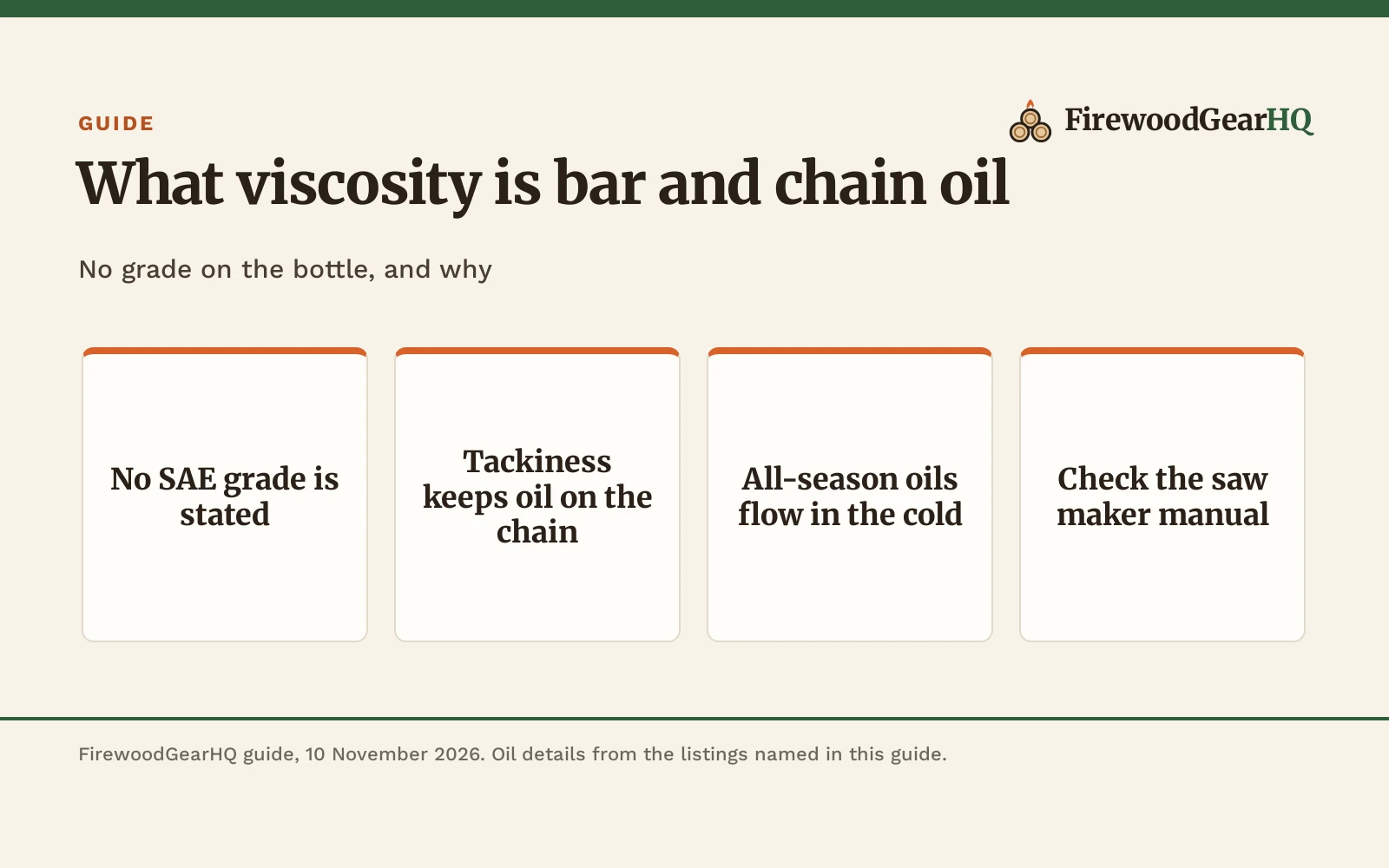
An engine oil is blended to flow: it pumps through small passages and drains back to be used again. A bar and chain do the opposite job, throwing oil outward as the chain rounds the nose. Bar oil is blended to cling through that trip so the cut stays wet. Pour a thin motor oil into the oiler and much of it leaves before it does any work, which is why the saw maker fills that tank with bar oil, not engine oil. If you want a proper jug, start with the best bar oil for a pole saw picks, which compare bar oils the same way.
Cutting-Day Safety
Oil choice matters, but the gear on your body matters more. For chainsaw work the standard kit is chaps, a helmet with a face screen and hearing protection, gloves and boots. Watch for kickback and never cut alone. If a tree needs felling or the job feels big, bring in a pro rather than working it out yourself. Pair the saw with one of the best chainsaws for firewood and keep the chain sharp.
FAQ: wood, fire and gear
Can I use 5W-30 motor oil as bar oil?
Not as a plan. The 5W-30 oils above are listed and approved as engine oils, and the listings do not describe them as bar oil. Bar oil is blended to cling to the bar, while engine oil is blended to flow, so motor oil leaves the chain quickly. Keep a jug of bar oil with the saw instead.
What is the difference between motor oil and bar oil?
The job. Motor oil lubricates inside an engine and is graded and approved to engine specs such as 5W-30, API SQ and ILSAC GF-7A. Bar oil lubricates the outside of the bar and chain and is made to stick there at chain speed. Same shelf, different work.
Can I use two-stroke oil as bar oil?
No. Two-stroke oil is blended to mix with fuel and burn in the engine, not to cling to a bar. Our two-stroke oil vs bar oil comparison walks through the mix-ups to avoid.
Will motor oil damage my chainsaw?
In the engine, use the grade and spec your saw’s maker calls for; the listings above meet common specs like API SQ and ILSAC GF-7A. In the bar oiler, motor oil will not lubricate the bar and chain the way bar oil does, so a dry-running bar and chain wear sooner. When in doubt, match the oil to the tank.
How do I know the bar is getting oil?
Check the bar oil tank before each cutting session and watch for a light film of oil on the chain as it runs. If the chain looks dry or the cut starts to smoke, stop and refill before you keep cutting. A conventional vs synthetic choice is covered in our conventional vs synthetic chainsaw bar oil guide.
More firewood guides
See the best bar oil for a pole saw picks and the best chainsaw for firewood roundup. Also see our chainsaw bar oil alternative guide. Also see our conventional vs synthetic chainsaw bar oil comparison. Also see our two-stroke oil vs bar oil comparison. Also see our best two-stroke oil for ethanol fuel. Also see our synthetic vs conventional two-stroke oil guide.