Conventional vs Synthetic Chainsaw Bar Oil: Which One Should You Buy?
Conventional vs synthetic chainsaw bar oil compared on temperature range, viscosity, tackiness and eco profile, with real figures from ten bar oil listings.

On this page
Top picks at a glance
As an Amazon Associate we earn from qualifying purchases.
- 1
 Prime Guard Premium Bar & Chain Oil9.5/10View on Amazon
- 2
 STP Premium Chainsaw Bar Oil9.5/10View on Amazon
- 3
 Oregon Premium Bar & Chain Oil9.4/10View on Amazon
Bar oil is the one consumable your chainsaw drinks as fast as fuel, and the conventional vs synthetic chainsaw bar oil question comes up every time someone restocks. The short answer: conventional petroleum bar oil is the proven default for most cutting, while synthetic and bio-based oils earn their keep in cold weather, around waterways, and anywhere you want less petroleum in the chips. The listings below show both sides with real figures, so here is how to choose.
FirewoodGearHQ may earn a small commission if you buy through links on this page. The price you pay stays the same. Read our affiliate disclosure.
The quick answer
Buy conventional bar oil if you cut in normal conditions and want the proven default: the Oregon Premium, Husqvarna X-Guard and Stihl Platinum listings carry all-season ratings, and tackifiers that keep oil on the chain are stated across all four conventional listings. Buy synthetic or bio-based bar oil if you cut in deep cold, near streams and gardens, or want a non-toxic formula: the DEWALT Green and DGP Pro100 listings are soy and plant-oil based, biodegradable, and rated from -15°F or -20°F up to 500°F. Either way, keep the oiler full; a dry bar ruins a chain faster than any oil choice.
What conventional bar oil is
Conventional bar oil is petroleum-based, refined for tackiness so it clings to a chain moving at full speed instead of slinging off. The Oregon Premium listing is a 1 gallon (128 fl oz / 4500 ml) all-season oil with a 5W-30 viscosity grade, pitched at reducing throw-off and resisting resin, sap and gum build-up. The Husqvarna X-Guard is a 1 quart mineral oil, also all-season, rated down to 15°F (-9°C), with tackifier additives and a 5W-40 grade, suited to battery and gas saws. The STP 32 fl oz listing adds a zinc anti-wear agent (ZDDP) and a tackifier, with a 5W-30 grade, aimed at minimizing resin build-up. The Stihl Platinum listings, in 1 quart and 1 gallon, use highly refined oils with a concentrated tackiness additive for high-speed, heavy-duty cutting, also 5W-30. The pattern is consistent: petroleum base and tackifier across all four, with all-season ratings on the Oregon, Husqvarna and Stihl listings and corrosion protection stated on the Oregon, Husqvarna and Stihl listings.
What synthetic and bio-based bar oil is
Synthetic and bio-based bar oils replace some or all of the petroleum with engineered or plant-derived base stocks. The DEWALT Green listing, sold as 16 oz and 32 oz cases of 2, is soy-based and biodegradable, non-toxic, and rated from -15°F to 500°F; the maker claims up to a 300% higher viscosity index than conventional petroleum chain oils, which is the maker’s claim for steadier lubrication across temperatures. The DGP Pro100 is a 1 gallon bio-based oil made from North American plant oils with 96% bio-derived content, USDA Certified Biobased, with a flash point of 575°F, a smoke point around 500°F and a pour point of -20°F. The smaller DEWALT biodegradable bottles, 16 oz and 32 oz, list a 500°F flash point, with the 32 oz using plant oils. These are 100% loss lubricants by design: the oil ends up on the ground, which is why the eco formulas exist.
Conventional vs synthetic chainsaw bar oil: how they differ
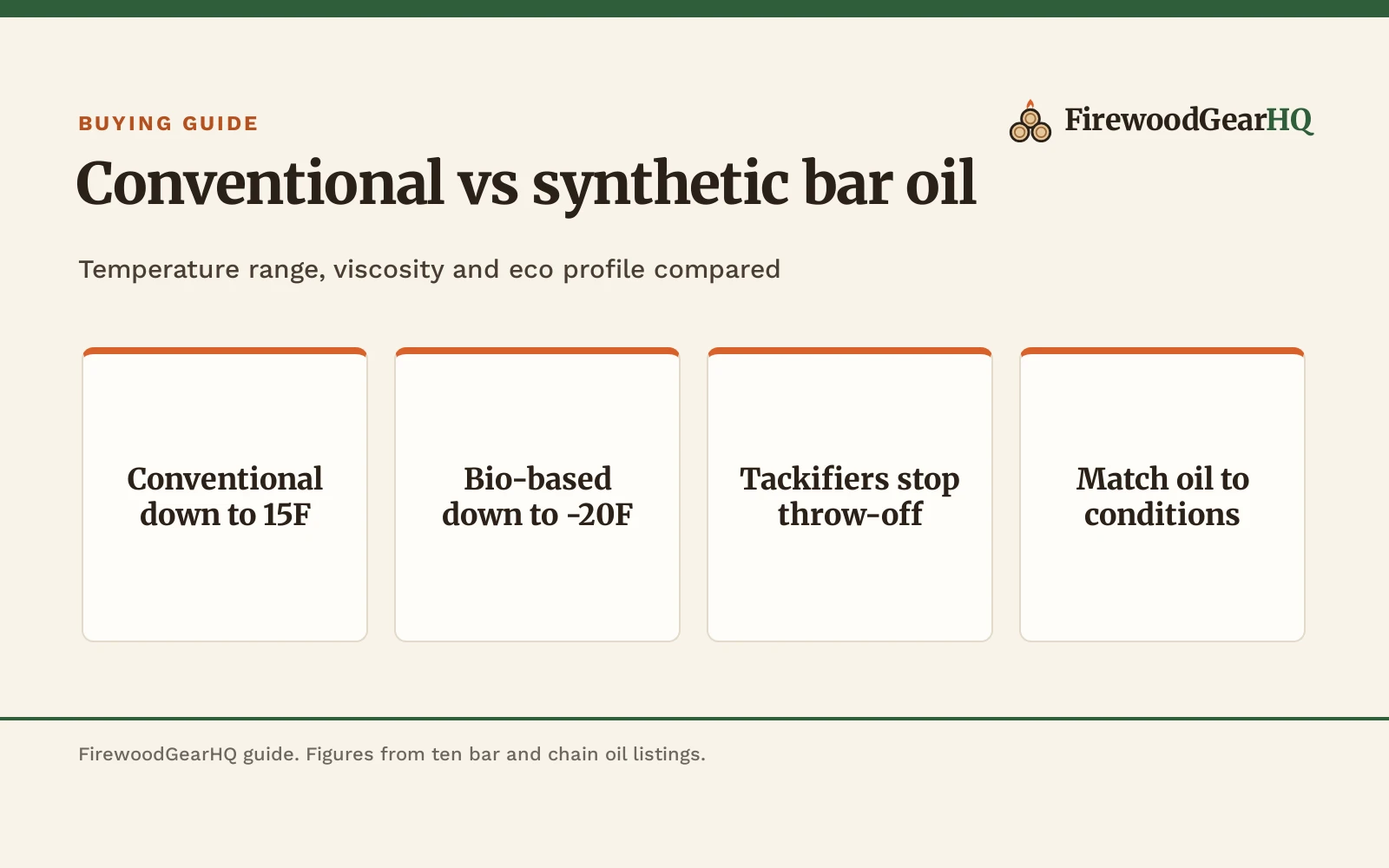
Temperature range is the clearest split. Conventional listings here bottom out at 15°F on the Husqvarna or carry a general all-season claim like the Oregon 5W-30. The bio-based listings go lower: -15°F for the DEWALT Green and -20°F pour point for the DGP Pro100, with high ends at 500°F. If you cut firewood through a northern winter, that low-end margin is the practical difference.
Viscosity behavior is the second split. Conventional oils state familiar grades: 5W-30 on the Oregon, STP and Stihl, 5W-40 on the Husqvarna. The plant-oil-based DEWALT 32 oz biodegradable states SAE 50. The DEWALT Green leans on its viscosity index claim instead of a grade, arguing the oil thins less when hot and thickens less when cold. Either approach works; what matters is that the oil still flows to the bar nose on a cold morning and still clings at full chain speed.
Tackiness is common ground. Both sides formulate against throw-off: tackifiers in the Oregon, Husqvarna, STP and Stihl listings, and high tack stated on the DGP Pro100. A bar oil that slings off is wasted money whatever its base stock, so tack is a feature to check on any bottle.
Environmental profile is where bio-based wins outright. The DEWALT Green is soy-based, biodegradable and non-toxic; the DGP Pro100 is 96% bio-derived, USDA Certified Biobased and practically non-toxic, made for use around waterways and sensitive areas. Conventional petroleum oils make no such claim. If your cutting happens near a well, a stream or a garden, that is a real reason to switch.
Which should you buy?
Buy conventional if you cut in moderate weather, away from water, and want the standard proven option: the Oregon gallon, the Stihl gallon and the Husqvarna quart cover the standard case, with 5W-30 or 5W-40 grades and tackifiers doing the work. Match the bottle to your saw: quart bottles suit occasional users, gallon jugs suit anyone heating with wood.
Buy synthetic or bio-based if you cut below about 15°F, work near water or food-growing areas, or simply prefer a non-toxic oil: the DEWALT Green cases and the DGP Pro100 gallon carry the temperature and eco ratings to justify it. The DGP’s -20°F pour point and 575°F flash point are the widest margins in these listings.
Whichever you choose, the bigger maintenance wins are the same: keep the oil tank full, clean the bar groove and oil holes when you sharpen, and flip the bar now and then for even wear. See our chainsaw bar oil alternative guide for what works in a pinch, and the chainsaw oil for battery chainsaw picks for battery-saw specifics.
Frequently Asked Questions
Can I use synthetic bar oil in any chainsaw?
Yes. The listings show synthetic and bio-based oils suited to gas, electric and pole saws, just like conventional oil. Bar oil is a 100% loss lubricant, so compatibility is about flow and tack, not the powerhead. Check that the oil flows at your working temperature.
Is biodegradable bar oil as good as conventional?
On the stated figures, it holds its own and beats conventional on temperature range: -15°F to 500°F on the DEWALT Green and a -20°F pour point on the DGP Pro100, against 15°F on the Husqvarna conventional. The DEWALT Green also claims a 300% higher viscosity index than conventional petroleum oils, which is the maker’s claim. Tackiness against throw-off is stated on both sides.
What viscosity bar oil should I use in winter?
Use an oil rated for your coldest mornings. The Husqvarna conventional is rated to 15°F, while the DEWALT Green goes to -15°F and the DGP Pro100 pours at -20°F. If your saw’s oiler seems slow on a cold start, the oil is too thick for the temperature, whatever the label says.
Does bar oil go bad on the shelf?
The listings state no shelf life. Petroleum bar oil keeps for years sealed; bio-based oils can have shorter practical life once opened, so buy the bottle size you will use. A gallon suits a heating season; a quart suits occasional storm cleanup.
Can I mix conventional and synthetic bar oil?
The listings do not address mixing. Topping up a tank with a different oil is common practice and the oils are miscible enough in the tank, but for the rated temperature performance, run one oil straight rather than a blend.
Related guides
See the chainsaw bar oil alternative guide, the chainsaw oil for battery chainsaw picks, the chainsaw types guide and the chainsaw problems and solutions guide.