Infrared vs Convection Patio Heater: Which One Should You Buy?
Infrared and convection patio heaters compared on heat delivery, output, coverage, fuel, controls and safety features, with three examples from the listings and a verdict on which side suits your space.

On this page
Top picks at a glance
As an Amazon Associate we earn from qualifying purchases.
- 1
 ThermoMate 1500W Electric Patio Heater9.7/10View on Amazon
- 2
 Mr. Heater 2009.6/10View on Amazon
- 3
 Mr. Heater 809.6/10View on Amazon
- 4
 DR. INFRARED HEATER Portable Infrared Indoor and OutdoorView on Amazon
- 5
 SereneLife Outdoor Electric Patio HeaterView on Amazon
- 6
 Portable Outdoot Electric HeaterView on Amazon
- 7
 ThermoMate Infrared HeaterView on Amazon
- 8
 Electric Outdoor Heater Wall-Mounted Wifi ControlView on Amazon
- 9
 Sundate Ceiling Electric Outdoor Heater Wifi ControlView on Amazon
Verdict: Choose an infrared patio heater if you want silent, directional warmth aimed at a seating area; the Heat Storm example mounts three ways and the pasapair example adds WiFi control and a timer. Choose a convection patio heater if you need big-area heat for a barn, job site or workshop; the Mr. Heater example puts out 80,000 BTU over up to 2,000 sq ft.
The stove is loaded for the night, but the patio chairs sit empty once the evening air turns cool. That is the moment for infrared vs convection patio heater: two different ways to stretch the outdoor season. This comparison covers both sides, then three examples from the listings we reviewed, so you can match the heater to your patio, deck or job site.
FirewoodGearHQ may earn a small commission if you buy through links on this page. The price you pay stays the same. Affiliate disclosure.
| # | Product | Woodlot Score | Buy |
|---|---|---|---|
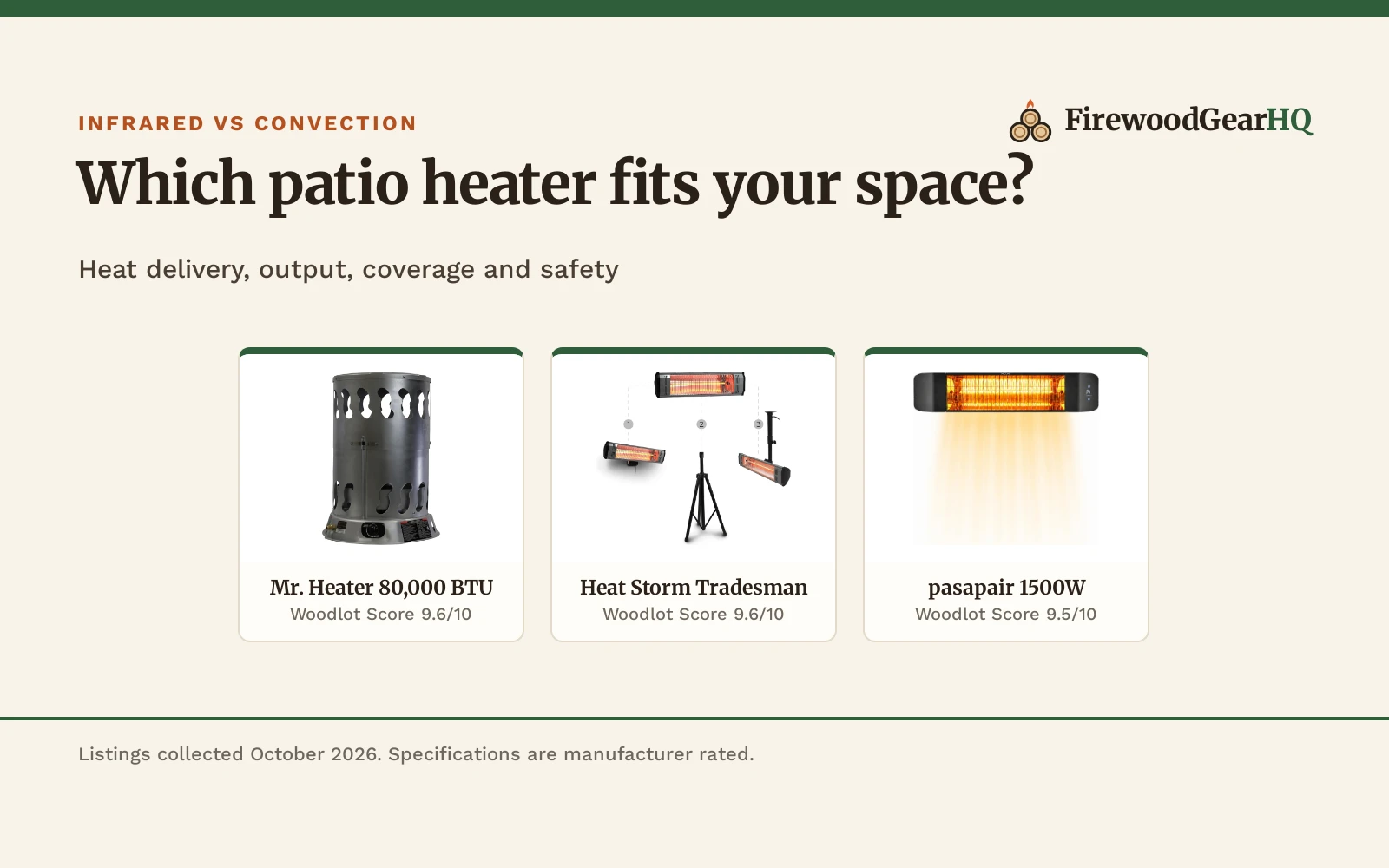
| 1 | Mr. Heater 80,000 BTU Convection Heater Portable | 9.6/10 | Buy on Amazon |
| 2 |  Heat Storm Tradesman 1500 Watt Infrared Heater | 9.6/10 | Buy on Amazon |
| 3 |  PASAPAIR 1500W Electric Infrared Patio Heater | 9.5/10 | Buy on Amazon |

Mr. Heater 80,000 BTU Convection Heater Portable
A portable propane convection heater with 80,000 BTU on high, 360 degree heating for up to 2,000 sq ft, and a thermo-electric safety valve.
Pros
- 80,000 BTU high and 30,000 BTU low settings
- Heats up to 2,000 sq ft, per the bullets
- Thermo-electric safety valve shuts off gas flow if the flame goes out
- 1 Year Limited warranty, plus 10 ft hose, piezo lighter and regulator
Cons
- Spec table lists 15,000 - 25,000 BTU and 625 sq. ft. against the title and bullets
- Propane tank not included; 20 lb. minimum tank size stated
- Outdoor and ventilated use only, per the listing
- 13.4 pounds before the tank

Heat Storm Tradesman 1500 Watt Infrared Heater
A 1,500 watt carbon fiber infrared heater with directional radiant heat, three mounting options, a remote and an IPX4 rating for indoor and outdoor use.
Pros
- 1,500 watts of directional infrared heat, silent operation
- Tripod, wall mount and ceiling or pole hardware included
- IPX4 rating for indoor and outdoor use
- Built-in tip-over safety shutoff
Cons
- No warranty term is stated
- 156 sq ft of coverage suits a seating area, not a large space
- Needs a 120 volt outlet within reach of the 8-foot cord
- No power levels or timer are stated
PASAPAIR 1500W Electric Infrared Patio Heater
A 1,500 watt wall-mount infrared patio heater with 3-second radiant heat, 4 power levels, WiFi app and remote control, a timer and an IP65 rating.
Pros
- 4 power levels: 150W, 550W, 850W and 1500W
- WiFi app and remote control with a 1 to 9 hour timer
- 3-second radiant heat with fanless operation
- IP65 rating for outdoor wall mounting
Cons
- No safety feature is stated
- No warranty term is stated
- Wall mount only; no tripod or portable option stated
- Outdoor use stated; no indoor use stated
More options to compare
 DR. INFRARED HEATER Portable Infrared Indoor and OutdoorCheck price on Amazon
 SereneLife Outdoor Electric Patio HeaterCheck price on Amazon
 Portable Outdoot Electric HeaterCheck price on Amazon
 ThermoMate Infrared HeaterCheck price on Amazon
 Electric Outdoor Heater Wall-Mounted Wifi ControlCheck price on Amazon
 Sundate Ceiling Electric Outdoor Heater Wifi ControlCheck price on Amazon
Side by side
| Factor | Infrared patio heater | Convection patio heater | Listing notes |
|---|---|---|---|
| How it heats | Radiant heat warms people and objects directly | Heats the air in a cylindrical chamber, 360 degrees | Heat Storm: focused radiant heat; Mr. Heater: 360 degree convection |
| Heat output | 1,500 watts (both examples) | 80,000 BTU high, 30,000 BTU low | Mr. Heater table lists 15,000 – 25,000 BTU; see review |
| Coverage | Heat Storm: 156 sq ft | Mr. Heater: up to 2,000 sq ft | Mr. Heater table says 625 sq. ft.; see review |
| Fuel and power | Electric, 120 volts, 12.5 A | Propane, 20 lb. minimum tank | Mr. Heater includes 10 ft hose and regulator |
| Controls | Remotes; pasapair adds WiFi app, 4 power levels, 1 to 9 hour timer | High and low settings; built-in piezo lighter | pasapair levels: 150W, 550W, 850W, 1500W |
| Weather rating | Heat Storm: IPX4; pasapair: IP65 | Outdoor use stated | Both infrared examples state IP codes |
| Safety features | Heat Storm: tip-over safety shutoff | Mr. Heater: thermo-electric safety valve | pasapair states no safety feature |
| Warranty | None stated | Mr. Heater: 1 Year Limited | Heat Storm and pasapair state no warranty term |
| Example: Heat Storm | 1,500 watts, 10.9 pounds | Not applicable | Tripod, wall and ceiling mounts |
| Example: Mr. Heater | Not applicable | 80,000 BTU, 13.4 pounds | 1 Year Limited warranty |
Figures are manufacturer rated as listed, collected 22 October 2026.
The infrared side
Infrared heaters warm people and objects directly with radiant heat instead of heating the surrounding air, and both examples use a carbon fiber element for silent, fanless operation. The Heat Storm example is a 1,500 watt heater with tripod, wall mount and ceiling or pole hardware plus a remote, an IPX4 rating for indoor and outdoor use, and 156 sq ft of coverage. The pasapair example is a 1,500 watt wall-mount heater with 3-second radiant warmth, 4 power levels of 150W, 550W, 850W and 1500W, WiFi app and remote control, a 1 to 9 hour timer, and an IP65 rating. Infrared suits seating areas: the heat is directional, so you aim it at the chairs rather than warming the whole yard. See infrared patio heaters for a deck for more directional options, and ceiling-mounted vs wall-mounted patio heaters if mounting is the question.
The convection side
Convection heaters warm the air itself, which then circulates around the space. The Mr. Heater example is a portable propane heater with a cylindrical chamber for 360 degree heating, high and low settings of 80,000 and 30,000 BTUs, heating up to 2,000 sq ft. It carries a thermo-electric safety valve that shuts off gas flow if the flame goes out, and ships with a 10 ft hose, built-in piezo lighter and regulator. The spec table gives a 13.4-pound weight and a 1 Year Limited warranty. Convection suits big, ventilated spaces: barns, workshops and job sites where warming the air is the whole job. See propane patio heaters for small patios if your space is closer to a table than a barn.
Infrared vs convection patio heater on an open patio
On an open patio the two types behave very differently. Infrared heat lands on people and furniture, so a breeze steals less of it; convection heat warms the air, so wind carries it away. The listings do not state wind performance, so treat that as physics, not a listing claim. Neither side wins on coverage alone: the Heat Storm infrared example covers 156 sq ft, while the Mr. Heater convection example heats up to 2,000 sq ft, but those figures describe different heating methods and different spaces.
Fuel, power and controls
Both infrared examples plug into a 120 volt outlet at 12.5 amps, while the Mr. Heater convection example burns propane from a 20 lb. minimum tank. Electric means no fuel to haul and no exhaust; propane means heat anywhere with no cord, plus the tank to manage. Controls differ too: both infrared examples include remotes, and pasapair adds a WiFi app, 4 power levels and a 1 to 9 hour timer, while Mr. Heater offers high and low settings with a piezo lighter. Compare fuels further in electric vs propane patio heaters.
Three examples
How we scored them
Each example is scored on performance, build, value, safety and warranty, using only what the listing publishes. Safety here means stated safety features or certifications, such as a tip-over shutoff or a gas safety valve. Only Mr. Heater states a warranty term, 1 Year Limited. The weights are on our How We Pick page.
| Product | Woodlot Score | Perf. /35 | Build /25 | Value /25 | Safety /10 | Warranty /5 |
|---|---|---|---|---|---|---|
| Mr. Heater 80,000 BTU | 9.6 | 32 | 19 | 20 | 7 | 2 |
| Heat Storm Tradesman | 9.6 | 30 | 20 | 20 | 7 | 0 |
| pasapair 1500W | 9.5 | 30 | 20 | 21 | 0 | 0 |
Scores run from 9.2 to 9.8: each product’s point total is placed on that range, so more points always means a higher score.
Install stoves and inserts to the manufacturer's instructions and your local code, usually by a certified installer with a permit and inspection. Keep the listed clearances to combustibles, run working smoke and carbon monoxide detectors, have the chimney inspected and cleaned every year to prevent creosote fires, burn only seasoned wood, and check local burn rules. See EPA Burn Wise, NFPA heating safety, CPSC carbon monoxide guidance and the Chimney Safety Institute of America (CSIA). Read our Safety Disclaimer.
Around the Woodpile
- Aim an infrared heater at the seating area; its heat lands on people, not the air.
- Run propane convection heaters only in well-ventilated spaces, as the Mr. Heater listing directs.
- Keep the 10 ft hose and regulator connections clear of foot traffic around the Mr. Heater.
- Use the pasapair timer so the heater does not run all night unattended.
Frequently Asked Questions
Is infrared or convection better for a patio?
Infrared suits seating areas because its radiant heat lands on people directly; convection suits large ventilated spaces because it warms the air. Match the type to the space, not to a general ranking.
Do infrared patio heaters work in wind?
The listings state no wind figures. Radiant heat is less affected by moving air than warmed air, but treat that as physics rather than a listing claim.
What fuel does a convection patio heater use?
The Mr. Heater example burns propane from a 20 lb. minimum tank and ships with a 10 ft hose and regulator. The infrared examples plug into a 120 volt outlet.
Do these patio heaters have safety shutoffs?
Heat Storm states a built-in tip-over safety shutoff, and Mr. Heater states a thermo-electric safety valve that shuts off gas flow if the flame goes out. The pasapair listing states no safety feature.
Related guides
See the wood stoves hub, electric infrared patio heaters for small patios, chiminea vs patio heater and patio heaters for windy areas.