How to Seal Wood Burning Stove Pipe: Materials and Steps
How to seal a wood burning stove pipe: pick the right sealant for each joint, lay a steady bead, and let it set before the next fire.

On this page
Top picks at a glance
As an Amazon Associate I earn from qualifying purchases.
- 1
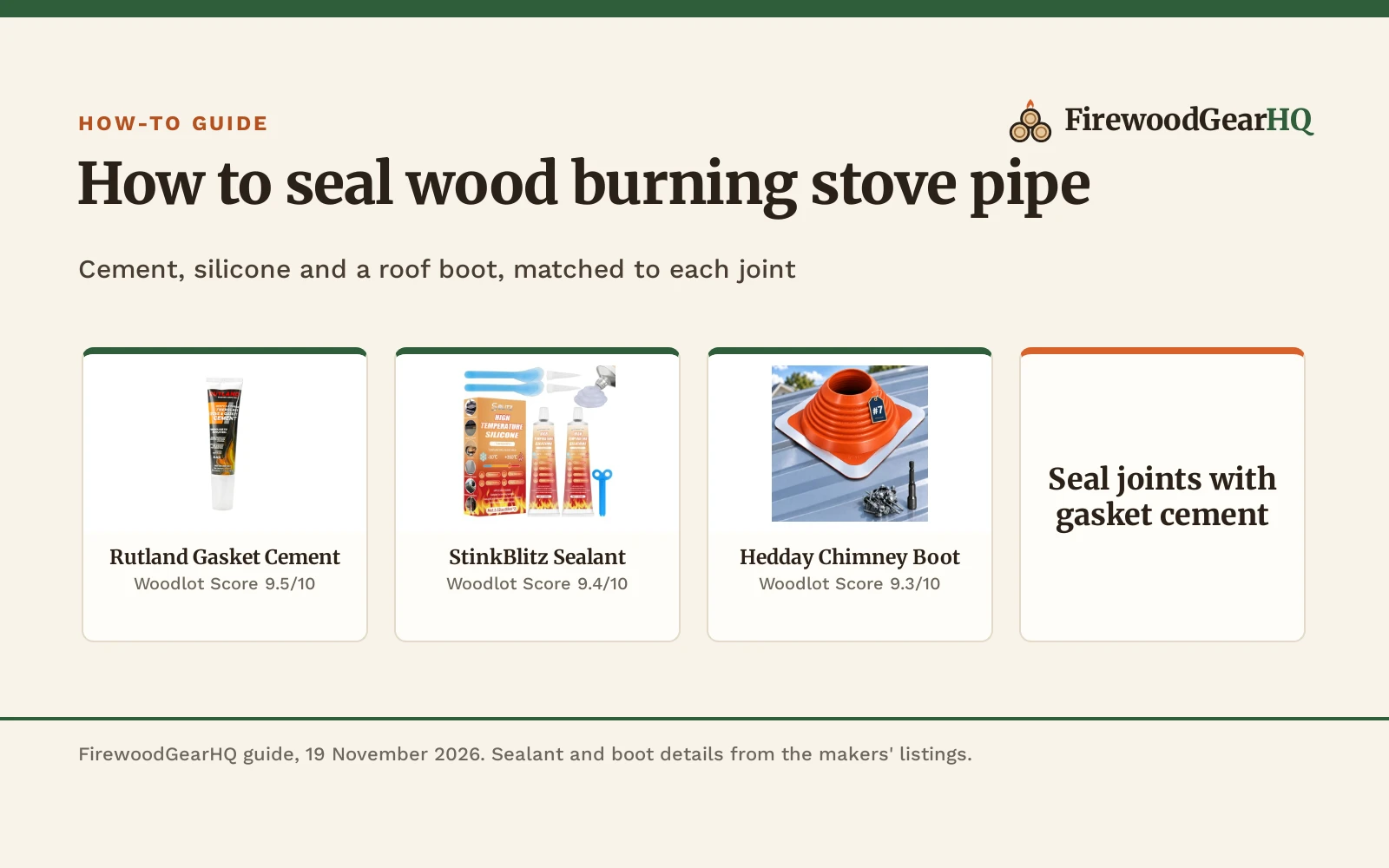
 Rutland EZ Spread Wood Stove Gasket Cement9.5/10View on Amazon
- 2
 High Temp Silicone Sealant, Heat Resistant Glue9.4/10View on Amazon
- 3
 #7 High Temp Silicone Chimney Boot for Metal Roof9.3/10View on Amazon
Come autumn, the stove is lit again and the house fills with the smell of wood smoke, but not all of it comes from the firebox. A thin gray wisp curling out of a pipe joint, or a soot stain creeping along a seam, means the seal has given up over the summer. Learning how to seal wood burning stove pipe keeps smoke in the flue and heat in the room, and it takes little more than the right sealant and a steady hand.
FirewoodGearHQ earns a small commission if you buy through links on this page. The price you pay stays the same. Read our affiliate disclosure.
| # | Product | Woodlot Score | Buy |
|---|---|---|---|
| 1 | Rutland EZ Spread Wood Stove Gasket Cement | 9.5/10 | Buy on Amazon |
| 2 | High Temp Silicone Sealant, Heat Resistant Glue | 9.4/10 | Buy on Amazon |
| 3 | #7 High Temp Silicone Chimney Boot for Metal Roof | 9.3/10 | Buy on Amazon |
Rutland EZ Spread Wood Stove Gasket Cement
A 2.3 oz tube of black gasket cement rated to 2000F for sealing wood stove door gasket rope and furnace joints, made in the USA.
Pros
- Rated to 2000F, the highest heat rating of the three
- Spreads like silicone glue for patching seams and resetting a gasket door
- Sets from contact with air and holds through repeated heating cycles
- 18 month warranty against defects in material and manufacture
Cons
- Small 2.3 oz tube, so several joints may need more than one tube
- Black color shows on light enamel or pale stove finishes
- Built for gasket rope and furnace joints, not for roof penetrations
- Sold in a single 2.3 oz size, with no larger tube
High Temp Silicone Sealant, Heat Resistant Glue
A clear high-temp silicone sealant rated from -58F to 662F that skins over in 10 to 15 minutes and sets fully in 24 hours.
Pros
- Rated to 662F intermittent and 500F continuous, with flexibility down to -58F
- Skins over in 10 to 15 minutes, sets fully in 24 hours, no clamping needed
- Stays flexible through heat cycles instead of cracking or shrinking
- Precision nozzle lays a clean bead without a caulking gun; dries clear
Cons
- 662F intermittent rating is far below gasket cement, so it does not suit the highest-heat joints
- Maker advises checking a hidden spot first on some surfaces
- Clear finish is hard to see on glass and light enamel
- No warranty term is stated
#7 High Temp Silicone Chimney Boot for Metal Roof
A flexible red silicone chimney boot with a metal square base that fits pipe OD 6 to 11 in and includes 25 roofing screws and a hex socket bit.
Pros
- Fits pipe OD 6 to 11 in, covering a wide range of pipe sizes
- Flexible rubber base conforms to metal roof contours for a watertight seal
- Includes 25 roofing screws and a hex socket bit
- Flexible material prevents cracking and accommodates pipe expansion and vibration
Cons
- Made for metal roofs, so it does not suit other roof types
- Red flashing stands out on a roof that is not red
- Needs trimming to size, so the cut must match the pipe
- No warranty term is stated
How to seal wood burning stove pipe: the quick answer
Seal the joints with a high-temp gasket cement or silicone sealant rated for the heat at that joint, and seal the roof penetration with a flashing boot that fits the pipe. Let the stove go cold, clean the joint, lay a steady bead, and let it set as the maker states. If a pipe run needs moving, or a new hole through the roof, that work belongs to a certified pro.
What seals a stove pipe
Three materials cover the job, and each suits a different place on the pipe. Gasket cement is the high-heat choice for stove door gaskets and furnace joints: Rutland EZ Spread is rated to 2000F. High-temp silicone is the flexible choice for seams and gaskets that move with heat: the StinkBlitz sealant (on Amazon) is rated from -58F to 662F and stays flexible through heat cycles. A flashing boot is the choice where the pipe passes through the roof: the Hedday boot fits pipe OD 6 to 11 in and seals the metal roof around the pipe. Match the material to the joint and its heat.
Sealing the joints, step by step
Work with the stove cold and the flue clear. Find the leak before you start: look for soot stains and gaps at each joint, and check the door gasket rope. Brush the joint clean so the sealant bonds to bare metal, not soot. Lay a steady bead of gasket cement along a gasket rope or furnace joint, or a bead of high-temp silicone along a seam, and press it into place. Let the seal set as the maker states: the StinkBlitz sealant skins over in 10 to 15 minutes and sets fully in 24 hours. Rutland cement sets from contact with air, so leave the joint alone until it has set. Keep smoke and carbon monoxide alarms working, and keep up the annual chimney inspection. If the pipe itself is damaged, or the work means moving a pipe run or cutting a new roof opening, call a certified pro.
Sealing the roof penetration
Where the pipe leaves the roof, the seal is a boot, not a bead of cement. The Hedday boot (on Amazon) is a flexible red silicone flashing with a metal square base: trim it to size, apply silicone to the aluminum flashing, press it onto the roof, and fasten it with the included screws. The flexible base conforms to the roof so the seal stays watertight as the pipe expands with heat. Roof work is high work, so if the slope or the height puts you off, hire a pro.
The gear for sealing stove pipe
Each of these three picks handles a different part of the job: cement for the joints, silicone for the seams, and a boot for the roof.
FAQ: wood, fire and gear
What sealant goes on a wood stove pipe?
Use a gasket cement for stove door gaskets and furnace joints, such as the Rutland cement rated to 2000F, and a high-temp silicone sealant for seams and gaskets that move with heat, such as the StinkBlitz sealant rated from -58F to 662F.
Can regular silicone go on a stove pipe?
Only if it is a high-temp silicone with a stated heat rating. The StinkBlitz sealant is rated to 662F intermittent and 500F continuous, with flexibility down to -58F.
How long does stove pipe sealant take to set?
It depends on the sealant. The StinkBlitz silicone skins over in 10 to 15 minutes and sets fully in 24 hours, with no clamping needed. Rutland gasket cement sets from contact with air.
How to seal a stove pipe where it goes through the roof?
Use a flashing boot sized to the pipe. The Hedday boot fits pipe OD 6 to 11 in: trim it to size, apply silicone to the aluminum flashing, press it onto the roof, and fasten it with the included screws.
Why is smoke coming from a stove pipe joint?
The seal at that joint has likely failed. Rutland gasket cement is made to stop smoke and soot escaping through the firebox, so a failed gasket rope or a cracked joint is where to look.
More firewood guides
See the stove accessories hub, the wood stove pipe installation guide and the guide to snapping stove pipe together. For the parts, see wood stove pipe parts and gasket rope vs gasket tape. For chimney sealing, see the best sealant for brick chimney, and for roof boots see the best stove pipe boots under 50.