Hatchet vs Splitting Maul: Which One Fits Your Woodpile?
Hatchets and splitting mauls compared on length, weight, head steel and handle, with two examples of each from the listings we reviewed.

On this page
Top picks at a glance
As an Amazon Associate we earn from qualifying purchases.
- 1
 14.4" Camping Hatchet with Full Tang Forged Construction &9.8/10View on Amazon
- 2
 Fiskars Pro IsoCore 6 lb Splitting Maul9.7/10View on Amazon
- 3
 Edward Tools Wood Splitting Maul 17”9.7/10View on Amazon
- 4
 INTERTOOL 16” Wood Splitting HatchetView on Amazon
- 5
 Hitdudu Splitting AxeView on Amazon
- 6
 KSEIBI 274150 Camping Hatchet Axe Durable Camping Hatchet forView on Amazon
- 7
 DESHIL 10-Inch Camping Hatchet Axe Mini Wood Hatchet forView on Amazon
- 8
 NedFoss Warthog Camping Hatchet AxeView on Amazon
- 9
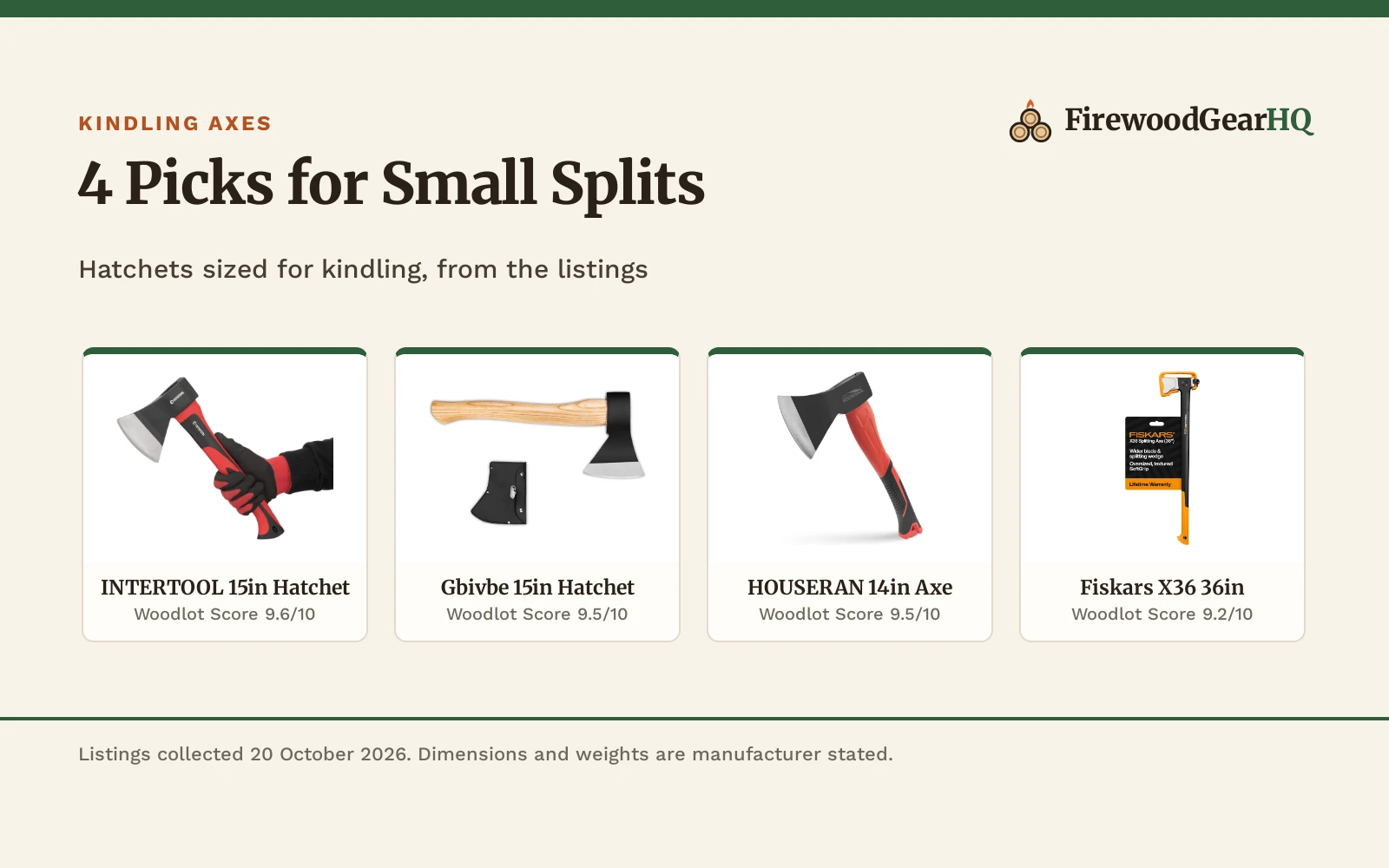
 INTERTOOL 15 Inch Camping Hatchet Axe with SheathView on Amazon
Verdict: Hatchet vs splitting maul? Pick a hatchet if your work is kindling, camp chores and small logs: the examples here run 14.2 to 15 inches, with the WICING stating a 2.08 lb total weight and the DESHIL stating no weight, made for one-handed work. Pick a splitting maul if your work is rounds: the 36 inch Estwing states a 4.5 lb head while the Timber Titan states 4.5 lb total with no separate head weight, on 16 to 36 inch handles for full swings. Neither replaces the other; the woodpile decides.
Splitting season is on and the rounds are waiting, so the question is which tool earns the swing. Hatchet vs splitting maul is really a question of scale: hatchets split kindling and small stuff one-handed, mauls split rounds with both hands and body weight behind them. This comparison covers what separates the two sides, with two examples of each from the listings we reviewed.
FirewoodGearHQ may earn a small commission if you buy through links on this page. The price you pay stays the same. Affiliate disclosure.


Estwing 4.5 lb Wood Splitting Maul with 36-Inch
A 4.5 lb head splitting maul on a 36 inch fiberglass handle, with a forged head hardened to 50 to 55 HRC.
Pros
- 4.5 lb head on a 36 inch handle for powerful swings
- Forged head hardened to 50 to 55 HRC
- Dual-injection fiberglass handle, stated over 70% fiberglass
- Splitting head design stated for big logs and stubborn wood
Cons
- 6.5 lb total weight is the heaviest tool here
- Spec table names the manufacturer as Groz, contradicting the Estwing brand
- Made in India, per the listing
- No warranty term in the listing

ESTWING Timber Titan, 16" Splitting Maul
A 16 inch splitting maul forged in one piece from American steel, with a shock reduction grip and 4.5 lb weight.
Pros
- Forged in one piece, no castings or welds
- Shock reduction grip stated to cut vibration by 70%
- Made in the USA from American steel
- 4.5 lb, a handy weight for a short maul
Cons
- 16 inch length gives less leverage than the 36 inch maul
- No head weight stated separately
- No warranty term in the listing
- Short handle suits smaller rounds, not big logs

Camping Hatchet, 14.2-inch Splitting Axe
A 14.2 inch hatchet in 1065 high manganese steel with a hickory handle, 53 to 56 HRC, sheath and sharpening stone included.
Pros
- 1065 high manganese steel, 53 to 56 HRC
- Hickory handle, the classic choice
- Leather sheath and sharpening stone included
- 2.08 lb, light for one-handed work
Cons
- 14.2 inches is short for splitting anything large
- No warranty term, only customer support contact
- Dual wedge head is a maker claim, not a measured figure
- 2.08 lb head-plus-handle weight limits splitting force

DESHIL 15-Inch Wood Splitting Hatchet Axe Forged
A 15 inch hatchet with a forged carbon steel head and a fiberglass shock-reduction handle, with a locking blade cover.
Pros
- Forged 45 carbon steel head with rust-resistant coating
- Fiberglass shock-reduction handle with anti-slip texture
- Flat back for light hammering tasks
- Locking blade cover included
Cons
- Title says 15 inch but the spec table lists 10 inches
- No weight stated anywhere in the listing
- No warranty term in the listing
- Throwing-axe mention in the title is off-topic for firewood
More options to compare
 INTERTOOL 16” Wood Splitting HatchetCheck price on Amazon
 Hitdudu Splitting AxeCheck price on Amazon
 KSEIBI 274150 Camping Hatchet Axe Durable Camping Hatchet forCheck price on Amazon
 DESHIL 10-Inch Camping Hatchet Axe Mini Wood Hatchet forCheck price on Amazon
 NedFoss Warthog Camping Hatchet AxeCheck price on Amazon
 INTERTOOL 15 Inch Camping Hatchet Axe with SheathCheck price on Amazon
Compare the picks
| Factor | Hatchet examples | Maul examples | Edge |
|---|---|---|---|
| Length | 14.2 to 15 in (stated) | 16 to 36 in (stated) | Tie |
| Weight | 2.08 lb (WICING); not stated (DESHIL) | 4.5 lb total; 6.5 lb total (stated) | Tie |
| Head steel | 1065 manganese 53-56 HRC; forged carbon steel | One-piece forged; forged 50-55 HRC | Tie |
| Handle | Hickory; fiberglass | Steel with shock grip; fiberglass | Tie |
| Stated uses | Kindling, small logs, camp chores | Big logs, stubborn wood | Tie |
Example figures are manufacturer rated, as published on each listing and collected 21 October 2026.
Size and weight: hatchet vs splitting maul
The hatchet examples here are 14.2 and 15 inches long; the WICING weighs a stated 2.08 lb and the DESHIL states no weight. The maul examples are 16 inches and 36 inches, weighing 4.5 lb and 6.5 lb respectively. That gap is the whole comparison: a hatchet is a one-handed tool you carry to the fire pit, a maul is a two-handed tool you bring to the round. Do not judge a side better on weight alone; each weight fits its job.
Head steel and hardness
The WICING hatchet states 1065 high manganese steel at 53 to 56 HRC, and the DESHIL states forged 45 carbon steel with a rust-resistant coating. The 36 inch Estwing states a forged head at 50 to 55 HRC, and the Timber Titan states one-piece forged American steel with no hardness figure. All four listings state forged steel heads, so neither side wins on materials from these listings; the difference is how much head weight sits behind the edge.
Handles
The hatchets split on handle material: hickory on the WICING, fiberglass on the DESHIL. The mauls do the same: steel with a shock reduction grip on the Timber Titan, fiberglass on the 36 inch Estwing. Hickory is the classic that can be replaced; fiberglass and steel shrug off overstrikes. The DESHIL adds a flat back for light hammering, a camp-friendly extra the mauls do not claim.
What each side is for
The hatchet listings name kindling, small logs, fire pits, wood stoves, camping and backyard chores. The maul listings name splitting big logs and stubborn wood, with the 36 inch Estwing built for powerful swings and reach. Match the tool to the wood in front of you: kindling and camp work goes to the hatchet, rounds go to the maul, and a serious woodpile wants both.
Two examples
How we scored them
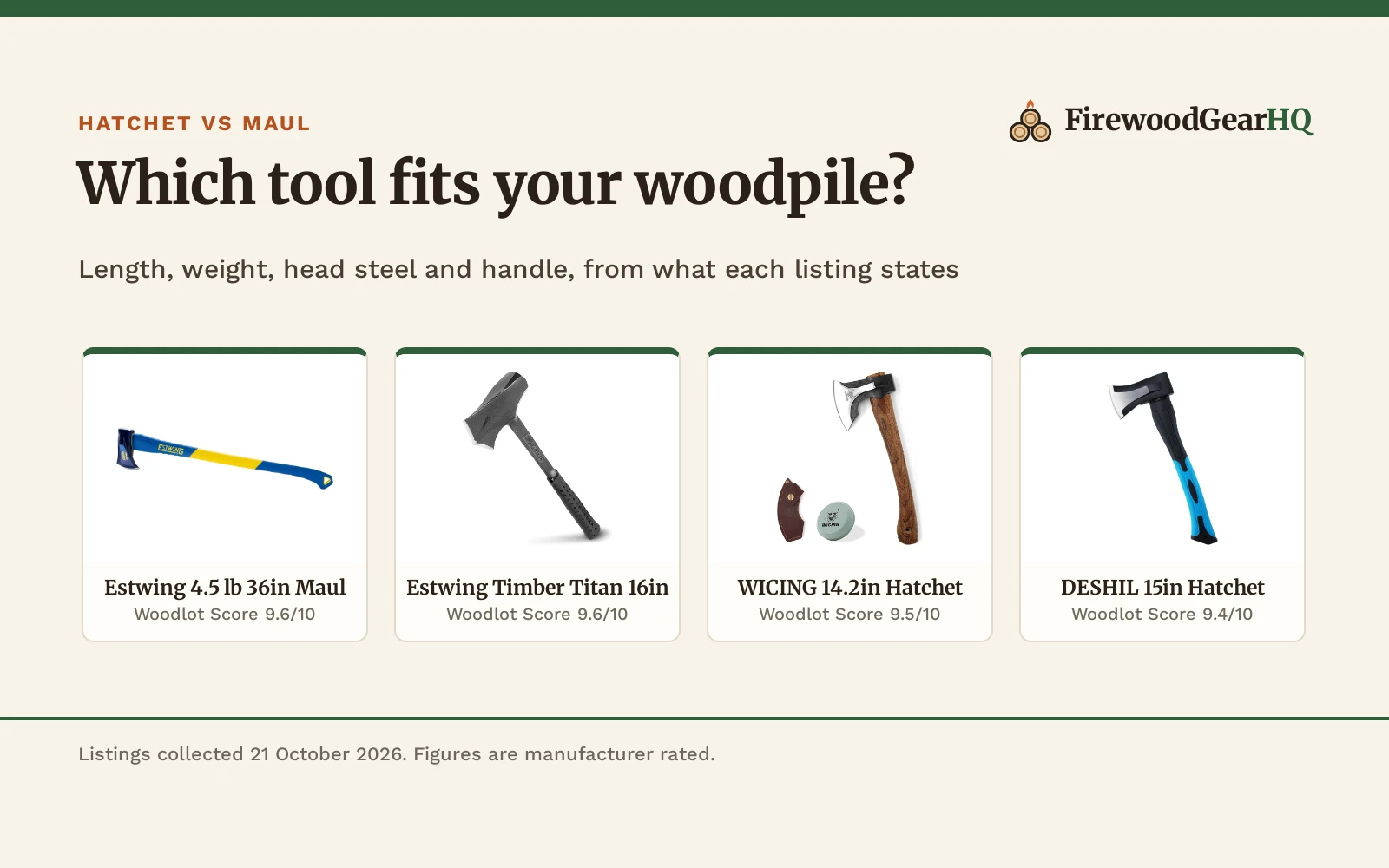
Each example is scored on performance, build, value, safety and warranty, using only what the listing publishes. The weights are on our How We Pick page. None of these listings states a safety certification or a warranty term, so every example here scores zero on those two criteria; the ranking comes from stated steel, build and value.
| Product | Woodlot Score | Perf. /35 | Build /25 | Value /25 | Safety /10 | Warranty /5 |
|---|---|---|---|---|---|---|
| Estwing 4.5 lb 36in Maul | 9.6 | 29 | 21 | 20 | n/a | 0 |
| Estwing Timber Titan 16in | 9.6 | 28 | 21 | 20 | n/a | 0 |
| WICING 14.2in Hatchet | 9.5 | 27 | 20 | 20 | n/a | 0 |
| DESHIL 15in Hatchet | 9.4 | 24 | 19 | 19 | n/a | 0 |
Scores run from 9.2 to 9.8: each product’s point total is placed on that range, so more points always means a higher score. Safety counts only for powered gear or where the listing states safety features; where it does not apply, the score is taken over the remaining 90 points.
Clear the swing area (overhead too), split on a solid chopping block at a comfortable height, keep your feet apart with the block in front of you, and wear eye protection and sturdy boots. Replace a cracked or loose handle before you swing again. Read our Safety Disclaimer.
Around the Woodpile
- Clear your swing zone before every swing; a maul needs room for a full arc.
- Split on a solid chopping block, not on the ground, so the edge never meets dirt or stone.
- Keep the edge covered in transport; two examples here include a sheath or blade cover.
- Wear eye protection and sturdy boots; splitting throws chips and a missed swing lands low.
Frequently Asked Questions
Should I get a hatchet or a splitting maul?
It depends on the wood. For kindling, camp chores and small logs, the hatchet examples here at 14.2 to 15 inches are the right scale. For rounds and stubborn wood, the maul examples with 4.5 lb heads are. Most woodpiles end up needing both.
Can a hatchet split firewood?
Small stuff, yes. The hatchet listings here name kindling, small logs and fire pits. For full-size rounds, a hatchet lacks the head weight and handle length, which is exactly what the maul examples provide.
How heavy should a splitting maul be?
The two examples here are 4.5 lb and 6.5 lb total. The 36 inch Estwing states a 4.5 lb head; the Timber Titan states 4.5 lb total with no separate head weight. Heavier heads split tougher wood with less swing speed, but they tire you faster. Our guide on how heavy a splitting maul should be goes deeper.
Is a longer handle better on a maul?
Longer handles give more leverage and reach: 36 inches on the big Estwing versus 16 on the Timber Titan. But length needs swing room, and a short maul is handier in tight quarters. Match the handle to your space and your rounds.
Do I need to sharpen a splitting maul?
Mauls split with a wedge profile more than a razor edge, but a clean edge still helps. The WICING hatchet even ships a sharpening stone. See our guide on how to sharpen a splitting axe.
Related guides
See the best splitting maul and the best splitting maul for large logs, the best hatchet for kindling and the best hatchet for splitting wood. Also see the best splitting axe and the axes and mauls hub.