Chainsaw Chain File Guide: Pick the File, Set the Angle, File the Chain
A chainsaw chain file guide: pick the round file that matches the chain pitch, hold the angle the guide marks, and finish the depth gauges with a flat file.

On this page
Top picks at a glance
As an Amazon Associate I earn from qualifying purchases.
- 1
 STIHL 5605 007 1028 Complete Saw Chain Filing Kit For9.3/10View on Amazon
- 2
 Oregon Universal Chainsaw Field Sharpening Kit9.7/10View on Amazon
- 3
 Buhobha 10-Piece Chainsaw Sharpening Kit9.2/10View on Amazon
A chain that throws dust instead of chips is telling you it is dull, and the fix is a file, not a new chain. This chainsaw chain file guide shows how to pick the round file that matches the chain pitch, hold the angle the guide marks, file the cutters, and lower the depth gauges with a flat file. Where a number appears, it comes from a filing kit listing, and we name the kit so you can check it.
FirewoodGearHQ earns a small commission if you buy through links on this page. The price you pay stays the same. Read our affiliate disclosure.
The quick answer
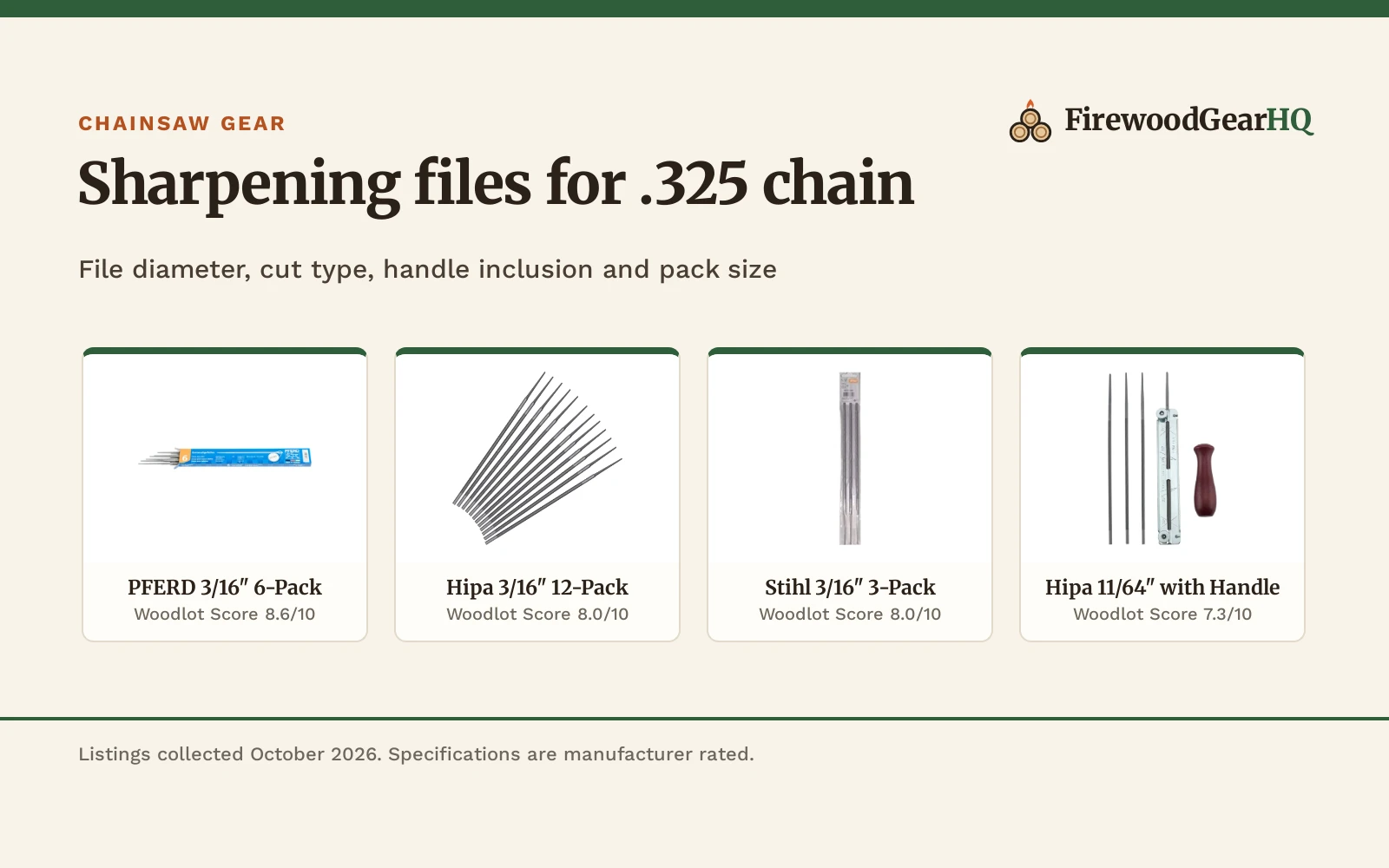
Match the round file to the chain pitch, hold the file at the angle the guide marks, file each cutter with the same strokes on both sides, and finish the depth gauges with the flat file. A 3/16-inch file fits 0.325-inch chains, per the Stihl kit (on Amazon), and the Oregon, LIBRATON and KAKEI kits carry 5/32-inch, 3/16-inch and 7/32-inch round files with a 6-inch flat file. A file guide comes with the kits, most kits also include a depth gauge, and some add a check gauge, and the whole job happens at the bench or in the field with the saw held still.
File size chart
File diameter follows chain pitch. The Stihl kit states its 3/16-inch file is for 0.325-inch chains, and the Husqvarna kit (on Amazon) covers 3/8-inch LO PRO pitch chains. The other rows follow the standard match between file diameter and chain pitch; check the chain marking or the kit guide for the pitch before picking a file.
| File diameter | Chain pitch | Notes |
|---|---|---|
| 5/32 inch (4.0 mm) | 3/8-inch low profile | Oregon and LIBRATON kits include this file |
| 3/16 inch (4.8 mm) | 0.325-inch | Stihl kit pairs this file with 0.325-inch chains |
| 7/32 inch (5.5 mm) | 3/8-inch | Oregon and LIBRATON kits include this file |
Some sets add 1/8-inch, 11/64-inch and 13/64-inch files for other chain sizes, and the UF-SHARP set carries all six round file sizes with a 6-inch flat file.
What a filing kit holds
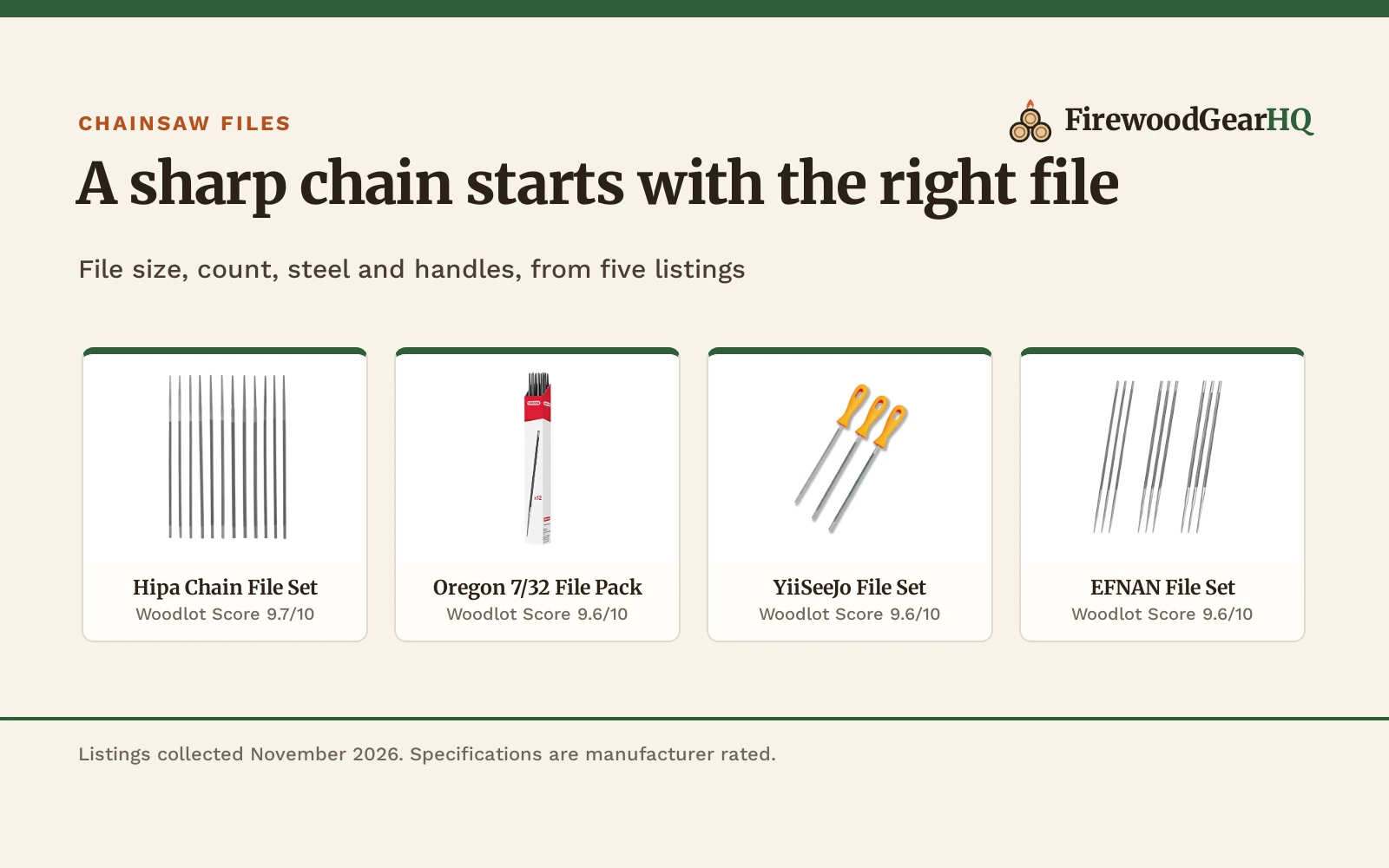
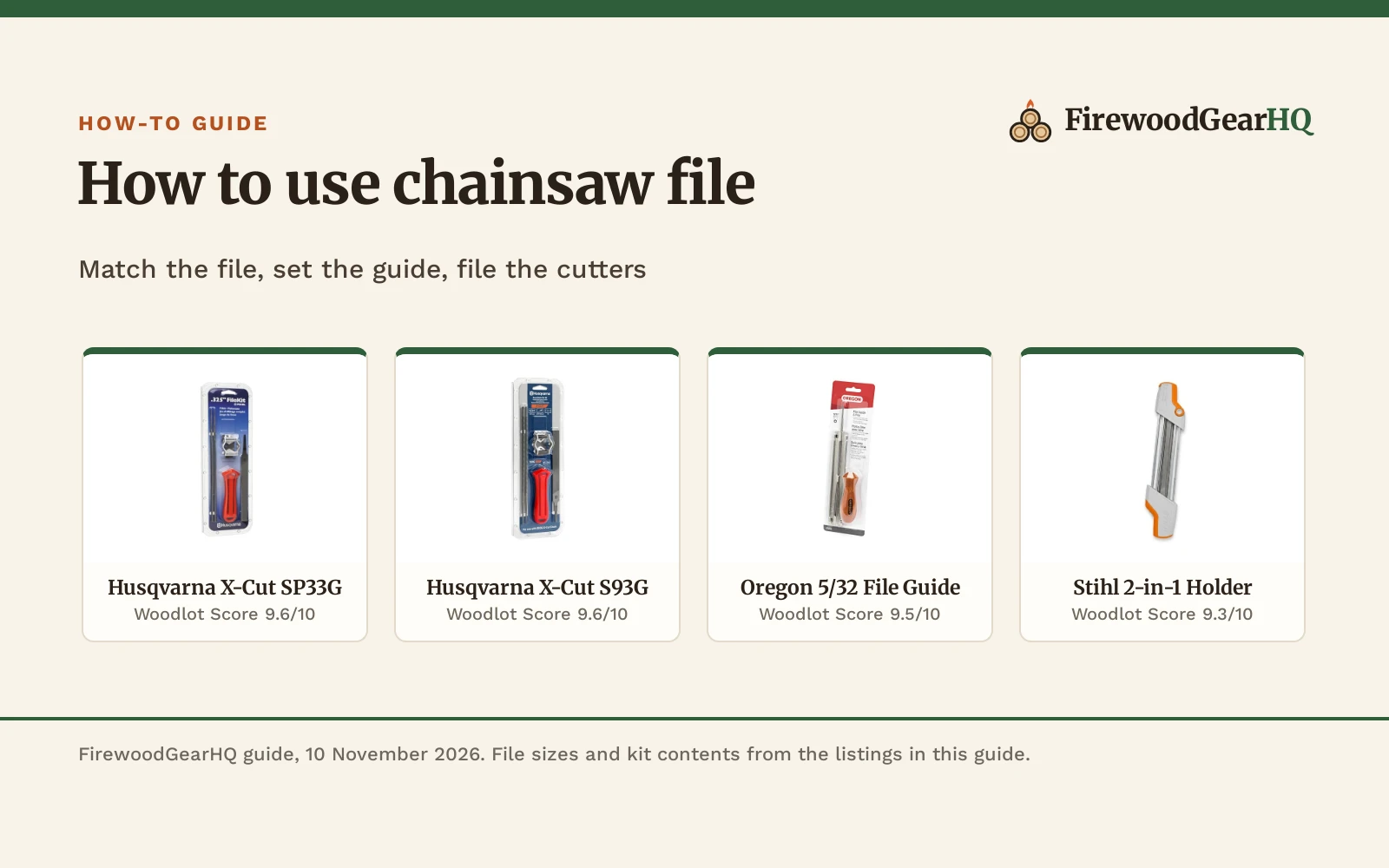
A filing kit is a set of round files, a flat file and a guide in a pouch, and most kits add a depth gauge. The Oregon kit (on Amazon) holds 5/32-inch, 3/16-inch and 7/32-inch round files, a 6-inch flat file, a file guide, a universal file handle and an instruction sheet in a rolled pouch. The Stihl kit holds a filing guide, a round file with handle, a depth gauge tool, a flat file with handle and a tool pouch. The Husqvarna kit holds a file handle, a combination file guide with a 2-in-1 roller file guide and depth gauge, two round files and one flat file. The LIBRATON kit adds a quick check gauge and a bar groove gauge, and the Stepvian kit (on Amazon) adds a 13 mm and 19 mm T-bar wrench with a dual-taper groove-cleaning tip.
Round files run about 8 inches long, 12 inches with the handle, per the LIBRATON listing, and the Buhobha kit (on Amazon) lists its files at 9-3/4 inches with the file holder at 7-3/4 inches. Handles matter for grip: the LIBRATON and Stepvian kits use ergonomic PP handles with a TPR rubber coating, while the KAKEI kit uses a hardwood handle and the UF-SHARP kit uses an upgraded universal handle.
Chainsaw chain file guide, step by step
Step 1: Find the pitch and pick the file
Read the pitch from the chain marking or the saw manual, then pick the round file from the chart above. A 3/16-inch file fits 0.325-inch chains, and the Husqvarna kit is made for 3/8-inch LO PRO pitch chains. The file should sit in the cutter with its top edge above the tooth; a file that is too small sinks in, and one that is too large rides high and rounds the edge.
Step 2: Hold the saw still and set the guide
Set the saw on a bench or a stump so the bar cannot move, and work with the chain brake on so the chain stays put. Set the file guide on the bar or hold it against the cutter, and set the angle the guide marks: the UF-SHARP guide marks 10, 25, 30 and 35 degrees. Hold the file level with the bar and keep the same angle on every cutter.
Step 3: File the cutters
Push the file through the cutter in one direction, from the inside out, and lift it clear on the way back; a file cuts on the push stroke only. Give each cutter the same strokes, then work the cutters on the other side of the chain the same way. Check the edge as you go: a sharp cutter shows a clean, bright edge with no burr.
Step 4: Lower the depth gauges
Each cutter has a depth gauge ahead of it that sets how deep the cutter bites. Lay the depth gauge tool over the cutter and run the flat file across the top of the gauge until it meets the tool. The UF-SHARP 2-in-1 depth gauge offers .025-inch and .030-inch settings, so use the setting the kit guide gives for the chain. A gauge left high makes the saw cut slowly; one filed too low makes the chain grab.
Step 5: Clean the bar groove and check the chain
Clear the bar groove with the groove cleaner so oil can reach the chain: the Stepvian kit has a dual-taper groove-cleaning tip, and the LIBRATON kit includes a bar groove gauge. Wipe the filings off the bar, oil the chain, and pull it around the bar by hand to check it moves freely before cutting.
Safety before you file
Filing is quiet work, but the chain is still sharp and the saw is still a chainsaw. Wear chaps, a helmet with a face screen and hearing protection, gloves and boots whenever the saw is in your hands, and never cut alone. Keep the chain brake on while filing so the chain cannot move, and keep hands clear of the cutters. When the saw runs again, watch for kickback and keep a firm grip with both hands. See our chainsaw safety tips before the first cut. A sharp chain cuts faster and with less force than a dull one, so a filed chain is also a safer chain to run.
FAQ: wood, fire and gear
Can you sharpen a chainsaw chain with a file?
Yes. A round file matched to the chain pitch does the cutting edge, a file guide holds the angle, and a flat file with a depth gauge tool sets the depth gauges. Kits from Stihl, Husqvarna and LIBRATON carry the whole set in a pouch.
What size file do I need for my chainsaw chain?
Match the file to the chain pitch: a 3/16-inch file fits 0.325-inch chains, per the Stihl kit, and the Husqvarna kit covers 3/8-inch LO PRO pitch chains. The Oregon, LIBRATON and KAKEI kits carry 5/32-inch, 3/16-inch and 7/32-inch round files, so check the chain marking before picking one.
What angle do I file a chainsaw chain at?
Use the angle the file guide marks. The UF-SHARP guide marks 10, 25, 30 and 35 degrees, and the Husqvarna combination guide is made to hold the correct filing angle. Hold the same angle on every cutter.
How do I know when the depth gauges need filing?
Lay the depth gauge tool over the cutter: if the gauge stands above the tool, file it down with the flat file. The UF-SHARP 2-in-1 depth gauge offers .025-inch and .030-inch settings.
Do I need a file guide to sharpen a chain?
A guide is not required, but it holds the filing angle steady, and the depth gauge tool sets the depth gauges. The Husqvarna combination guide pairs a 2-in-1 roller file guide with a depth gauge, and the Oregon kit includes a file guide with an instruction sheet.
More firewood guides
See the chainsaw gear hub, the best chainsaw sharpener and the best chainsaw for firewood. Also see our manual chainsaw chain sharpener guide, our chainsaw chain repair guide, and our best bar and chain oil picks.