Carbide Chain vs Steel Chain: Which Should You Buy?
Carbide chain vs steel chain compared on sharpness life, sharpening, toughness and cost, with two carbide examples from the listings.

On this page
Top picks at a glance
As an Amazon Associate we earn from qualifying purchases.
- 1
 BYANE 20-Inch Carbide Chainsaw Chain 3/8" Pitch .050" Gauge9.6/10View on Amazon
- 2
 VEVOR Manual Pole Saw9.4/10View on Amazon
- 3
 BYANE 20-Inch Carbide Chainsaw Chain .325" Pitch .050" Gauge9.6/10View on Amazon
- 4
 BYANE 20-Inch Carbide Chainsaw Chain .325" Pitch .063" GaugeView on Amazon
- 5
 BYANE 18-Inch Carbide Chainsaw Chain .325" Pitch .063" GaugeView on Amazon
- 6
 BYANE 20-Inch Carbide Chainsaw Chain 3/8" Pitch .050" GaugeView on Amazon
- 7
 18" Carbide Chainsaw ChainView on Amazon
Verdict: Choose carbide chain for dirty wood, sand-caked logs and frozen hardwoods: the listings claim up to 10 times the sharpness life of standard steel. Choose steel chain for clean wood where standard files keep it sharp and the purchase price stays low. Both listings here are carbide; the steel side is described from their own comparison claims.
The chain dulls fast in dirty wood, and that is where carbide chain vs steel chain becomes a real question. This guide compares the two sides on sharpness life, sharpening, toughness and cost, using two carbide chain listings as concrete examples and the listings’ own claims about standard steel chains for the other side.
FirewoodGearHQ may earn a small commission if you buy through links on this page. The price you pay stays the same. Read our affiliate disclosure.

BYANE 20-Inch Carbide Chainsaw Chain 3/8" Pitch
A 20-inch carbide chainsaw chain, 3/8 in pitch, .050 gauge, 72 drive links.
Pros
- Stays sharp up to 10x longer than steel, per listing
- Low-kickback geometry stated
- Fits Stihl and Husqvarna saws
- Hardened rivets and brazed carbide tips
Cons
- Needs a diamond sharpener; steel files will not work
- Brittle: chips on metal, nails, stones
- Wood cutting only, per listing
- No warranty term stated

BYANE 20-Inch Carbide Chainsaw Chain .325" Pitch
A 20-inch carbide chainsaw chain, .325 in pitch, .050 gauge, 81 drive links.
Pros
- Stays sharp up to 10x longer than steel, per listing
- Low-kickback geometry stated
- Japanese chrome-plated leads stated
- Fits many Stihl pro saws
Cons
- Needs a diamond sharpener; steel files will not work
- Brittle: chips on metal, nails, stones
- Check .050 gauge against 2022 and older MS271 bars
- No warranty term stated
More options to compare
 BYANE 20-Inch Carbide Chainsaw Chain .325" Pitch .063" GaugeCheck price on Amazon
 BYANE 18-Inch Carbide Chainsaw Chain .325" Pitch .063" GaugeCheck price on Amazon
 BYANE 20-Inch Carbide Chainsaw Chain 3/8" Pitch .050" GaugeCheck price on Amazon
 18" Carbide Chainsaw ChainCheck price on Amazon
Side by side
| Model | Score | Chain | Pitch / Gauge | Drive Links | Sharpener |
|---|---|---|---|---|---|
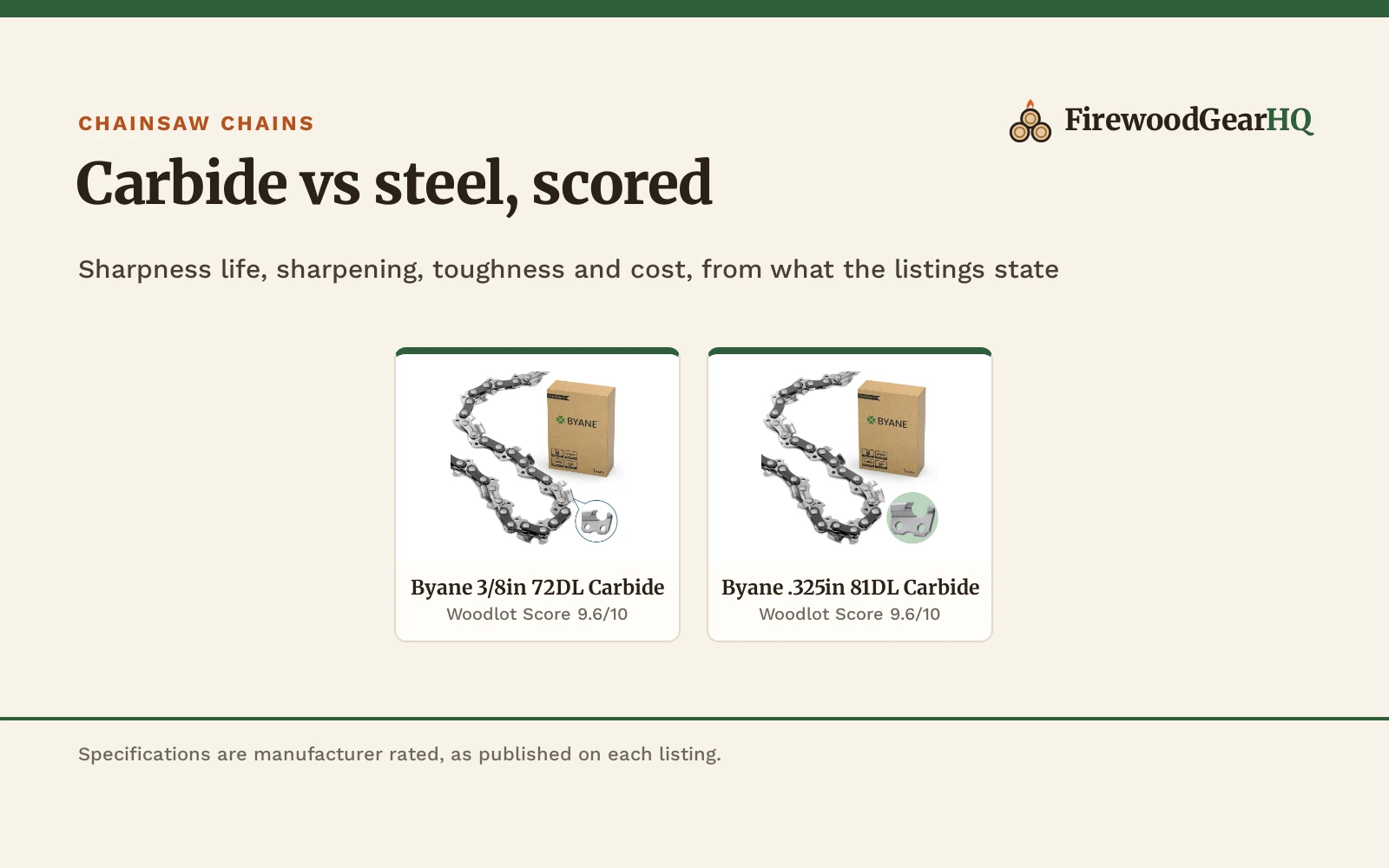
| Byane 3/8in 72DL Carbide | 9.6/10 | Carbide | 3/8 in / .050 | 72 | 7/32 in diamond |
| Byane .325in 81DL Carbide | 9.6/10 | Carbide | .325 in / .050 | 81 | 3/16 in diamond |
Specifications are manufacturer rated, as published on each listing and collected 19 October 2026.
carbide chain vs steel chain: the difference in one paragraph
Carbide cutters stay sharp up to 10 times longer than standard steel, per both listings, and they are the pick for dirty wood, sand-caked logs and frozen hardwoods where standard chains fail. Steel chains dull faster but sharpen with standard files, cost less up front, and survive the odd nail or stone that would chip brittle carbide tips. Carbide needs a diamond coated sharpener; steel needs a regular file and more frequent use of it.
Sharpness life
This is the carbide headline: both Byane listings claim the cutters stay sharp up to 10 times longer than standard steel chains, thanks to patented carbide-tipping technology, precision-brazed carbide tips and hardened rivets. The .325-inch listing adds Japanese chrome-plated leads. For dirty wood and sand-caked logs, where the listing says standard chains fail, that claim is the whole argument: less time filing, more time cutting.
Sharpening
Carbide wins on intervals and loses on tools. Both listings are explicit: maintenance requires a diamond coated sharpener, 3/16 inch on the .325-inch chain and 7/32 inch on the 3/8-inch, because standard steel files will not effectively sharpen carbide material. Steel chains sharpen with standard files you already own, but need it far more often. If you do not own a diamond sharpener and do not want one, steel is the practical pick.
Toughness and what breaks them
Carbide is hard but brittle. Both listings warn the same way: strictly wood cutting only, and avoid nails, wire, fencing and stones, because hitting them can chip or shatter the carbide tips. Steel is the forgiving side: a rock or nail dulls it rather than breaking it, and a few file strokes bring it back. On clean wood with no metal risk, steel costs less and fails softer; on dirty or frozen wood, carbide keeps cutting where steel gives up.
Fit and compatibility
The two carbide examples cover different saws. The 3/8-inch 72DL fits Stihl MS290, MS311, MS362, 038 and Husqvarna 455, 455 Rancher and 460. The .325-inch 81DL fits Stihl MS261, MS271, MS290 Farm Boss, MS291, MS310, MS361 and legacy 026 and 028, with a warning that 2022 and older MS271 models may use a .063-inch gauge bar. Both are 20 inches at .050 gauge. Match pitch, gauge and drive link count to your bar before ordering, whichever side you choose.
Cost over time
The listings frame carbide as the economic pick through longevity: cutters that stay sharp up to 10 times longer than standard steel, reducing chain replacement frequency. That is the math to run: a carbide chain costs more up front and needs a diamond coated sharpener, while a steel chain costs less and sharpens with files you already own but needs sharpening far more often. For occasional clean-wood cutting, steel wins on total outlay. For heavy dirty-wood work, the listings argue carbide pays back in fewer replacements and less downtime.
Two examples
How we scored them
Each chain is scored on performance, build, value, safety and warranty, with the weights published on our How We Pick page. Both listings state low-kickback geometry, and neither states a warranty term, so the ranking leans on the stated durability claims and fit range. The 3/8-inch leads on broader Stihl and Husqvarna compatibility.
| Product | Woodlot Score | Perf. /35 | Build /25 | Value /25 | Safety /10 | Warranty /5 |
|---|---|---|---|---|---|---|
| Byane 3/8in 72DL Carbide | 9.6 | 32 | 22 | 21 | 4 | 0 |
| Byane .325in 81DL Carbide | 9.6 | 30 | 22 | 21 | 4 | 0 |
Scores run from 9.2 to 9.8: each product’s point total is placed on that range, so more points always means a higher score.
Wear cut-resistant chaps, a helmet with face screen and hearing protection, gloves and sturdy boots. Know where the kickback zone is (the upper tip of the bar), keep the chain brake working and the chain sharp, and never cut alone in the woods. Felling trees is hazardous work: hire a professional for large, leaning or storm-damaged trees, especially near buildings or power lines. See OSHA logging safety for chain saw operators. Read our Safety Disclaimer.
What to check before you buy
Match the chain to the bar, not the brand
Both examples here are 20-inch chains at 3/8 pitch and .050 gauge, one with 72 drive links fitting the Stihl MS290 and one with 81 drive links fitting the Stihl MS261. Those three numbers, pitch, gauge and drive link count, must match the bar; get any one wrong and the chain will not fit or will not run safely. The listings add a specific warning: 2022 and older MS271 models may need a .063-inch gauge, so check the bar markings or the manual before ordering. The chain that fits is the only chain worth comparing.
Cutter shape: semi-chisel against full chisel
The listings name both cutter shapes: semi-chisel and full chisel. Semi-chisel cutters hold their edge longer in dirty wood and are more forgiving to sharpen, which pairs naturally with the carbide value proposition of long sharpness life. Full chisel cutters bite faster in clean wood but dull quicker and demand more skill at the file. For firewood duty, where the wood is rarely clean, the semi-chisel geometry is the practical pick; for clean felling cuts, full chisel earns its speed.
Price the sharpener with the chain
A carbide chain without a diamond sharpener is a chain you cannot maintain. Both listings state that standard steel files will not effectively sharpen carbide; the diamond coated sharpener, in 3/16 inch or 7/32 inch to match the chain, is a required accessory, not an optional extra. Add its cost to the chain before comparing against steel, and remember the trade the listings describe: up to 10 times the sharpness life of standard steel against tips that can chip or shatter on nails, wire, fencing and stones. Hardened rivets and brazed tips give stable cutting under high loads, but no chain survives metal.
Frequently Asked Questions
Is carbide chain worth it for firewood?
For dirty or frozen wood, the listings say yes: up to 10 times the sharpness life of standard steel, built for exactly those conditions. For clean stacked wood, steel is cheaper to buy and easier to sharpen.
Can I sharpen a carbide chain with a regular file?
No. Both listings state that standard steel files will not effectively sharpen carbide; you need a diamond coated sharpener, 3/16 inch or 7/32 inch depending on the chain.
What happens if a carbide chain hits a nail?
The listings warn the tips can chip or shatter on metal impact, including nails, wire, fencing and stones. Both are strictly wood cutting only.
How do I know the chain fits my saw?
Match pitch, gauge and drive link count to your bar. Both examples are 20 inches at .050 gauge; check the model lists and the .063-inch gauge warning on older MS271 bars.
Does carbide chain kick back less?
Both listings state engineered low-kickback geometry for smoother, more controlled cutting. Kickback also depends on the saw, the bar and your technique.
How long does a carbide chain last?
The listings claim up to 10 times longer sharpness than standard steel, with hardened rivets and brazed tips for stable cutting under high loads. Actual life depends on the wood, the dirt in it, and avoiding metal.
Related guides
Also see pole saw vs chainsaw and corded vs cordless chainsaw.