Birch vs Maple Firewood: Which One Should You Buy?
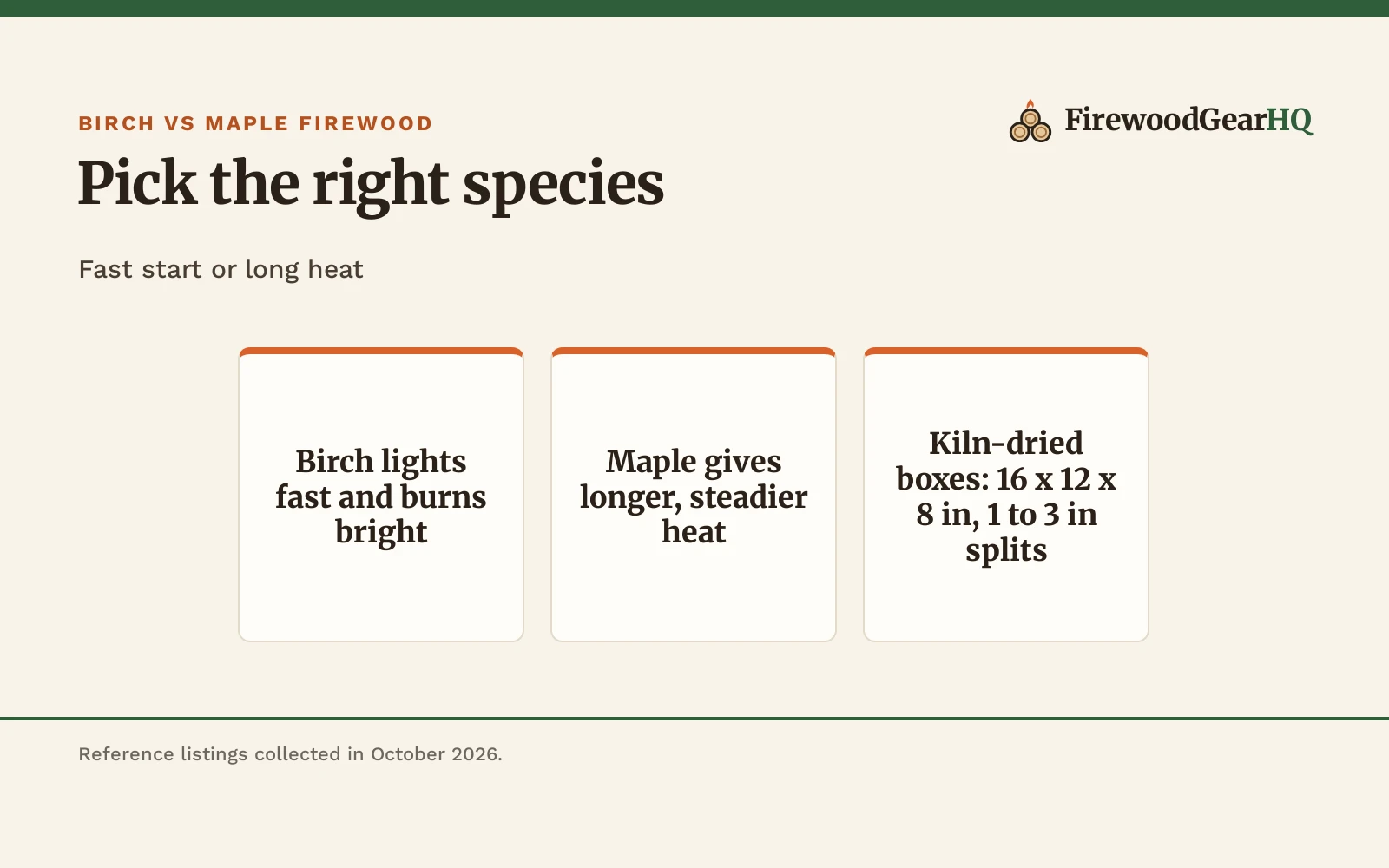
Birch vs maple firewood: birch lights fast and burns bright while maple gives longer, steadier heat. Compared with kiln-dried figures for wood stoves.

On this page
Top picks at a glance
As an Amazon Associate we earn from qualifying purchases.
- 1
 Woodhaven 8-Foot Raised Firewood Rack w/Cover9.8/10View on Amazon
- 2
 Wilson Birch Split FirewoodView on Amazon
- 3Wilson Split FirewoodView on Amazon
Birch lights fast and burns bright; maple burns longer and steadier. The birch vs maple firewood question is really about your stove habits: birch is the easy starter that gets a fire going in minutes, while maple is the workhorse that holds heat through the night. Both are good firewood; they just do different jobs.
More options to compare
 Wilson Birch Split FirewoodCheck price on Amazon
- Wilson Split FirewoodCheck price on Amazon
FirewoodGearHQ may earn a small commission if you buy through links on this page. The price you pay stays the same. Read our affiliate disclosure.
birch vs maple firewood: the quick answer
Birch is the lighter, faster-burning wood: it catches easily, burns with a bright flame and works brilliantly for starting fires and shoulder-season heating. Maple is the denser, slower-burning wood: it takes longer to catch but gives steadier, longer-lasting heat per load. Burn birch when you want a quick fire; burn maple when you want the stove to stay hot.
How birch burns
Birch is famous for lighting easily: the bark catches even when the wood is less than perfectly dry, which is why birch is the traditional fire-starter of the north. It burns with a bright, lively flame and good heat, but it burns through faster than dense hardwoods, so you feed the stove more often. The Light ‘n Go birch bonfire log burns for at least 1.5 hours from a single match on its paperboard wick, which shows how readily birch catches. Birch splits easily and dries faster than maple, so it is ready sooner after cutting. The trade-off is burn time: a stove full of birch gives a hot, bright fire that needs refueling sooner.
How maple burns
Maple is the steady heat wood. It is denser than birch, so it takes longer to catch but then burns long and even with strong heat output. A maple load holds the stove hot between refuels, which is what you want for overnight burns and deep winter. Maple splits cleanly and seasons well, though it takes longer to dry than birch. If birch is the sprinter, maple is the distance runner: less exciting to light, more rewarding through the night. See our oak vs maple firewood for how maple compares to another dense hardwood.
Kiln-dried and store-bought wood
The reference listings show both species sold kiln dried in a 16 in x 12 in x 8 in box, split to 1 to 3 in diameter. Wilson lists kiln-dried birch and a birch, maple, oak or cherry mix, sustainably harvested in the upper peninsula of Michigan, with the kiln dry process stated to give a hotter burn, less smoke and no smoldering. Kiln drying matters more for maple than birch: maple’s density means it holds moisture longer, so kiln-dried maple lights reliably where green maple would sulk. Birch’s easy lighting means even air-dried birch starts well, but kiln-dried birch burns cleaner.
Which one for your stove
For starting fires and quick heat, birch. For overnight burns and steady winter heat, maple. For most stoves the best answer is both: keep birch for kindling and morning fires, and maple for the long loads that carry the house through the night. If you buy wood rather than cut it, the kiln-dried boxes in the listings take the seasoning question off the table for either species.
Burning characteristics compared
Side by side, the two species differ in four ways. Lighting: birch wins, with bark that catches readily and splits that start from a single match, as the 1.5-hour birch bonfire log demonstrates. Flame: birch burns bright and lively; maple burns with a steadier, less showy flame. Burn time: maple wins, holding heat longer per load thanks to its density. Heat per load: maple wins again for the same reason, giving more total heat between refuels. None of this makes birch bad firewood: for shoulder-season fires, quick morning warm-ups and fire pits, birch’s fast start and bright flame are exactly what you want. For the main heating season, maple’s long steady burn does the heavy lifting.
Splitting and storing
Birch splits easily and dries quickly, which makes it the forgiving species for home cutters: cut it, split it and it is ready sooner than maple. Maple splits cleanly too but takes longer to season because of its density. The listings sell both species as 1 to 3 in splits in a 16 in x 12 in x 8 in box, a size that fits most stoves and fireplaces without further cutting. Wilson notes the wood is sustainably harvested in the upper peninsula of Michigan, and that ordering multiple boxes gives a longer-lasting fire supply. Store either species off the ground under cover; the kiln-dried boxes arrive ready to burn, while green maple needs a full seasoning season before it earns its keep.
Buying boxed firewood: what to check
If you buy rather than cut, the listings give a concrete picture. Wilson sells kiln-dried birch and a birch, maple, oak or cherry mix in a 16 in x 12 in x 8 in box of splits 1 to 3 in diameter, shipped to your doorstep; the oak variant lists 8.7 kg, with weight varying per box. Kiln drying is the key line: the listing states the process wicks away moisture for a hotter burn, less smoke and no smoldering, and the wood is sustainably harvested in the upper peninsula of Michigan. For a longer-lasting fire the listing suggests ordering multiple boxes, and the multi-species mix lets you cook with different woods for different aromas. The Light ‘n Go birch bonfire log is the convenience extreme: a 5.91 kg kiln-dried white birch log with a paperboard wick that lights from one match and burns at least 1.5 hours, safe for cooking indoors and out, with a handle for carrying. Check the box size against your stove opening before ordering: 16 in splits fit most stoves and fireplaces, but measure first.
Frequently Asked Questions
Is birch or maple better for a wood stove?
Maple for heat, birch for starting. Maple’s density gives longer, steadier heat per load; birch catches faster and burns brighter. Most stove owners burn both: birch to start, maple to hold.
Does birch burn hotter than maple?
Birch gives a hot, bright, fast fire; maple gives strong, sustained heat over a longer burn. Per hour of burn time, maple delivers more total heat because it lasts longer.
How long does birch take to season?
Birch seasons faster than maple thanks to its lower density. The kiln-dried listings, dried to burn hot with less smoke, skip the wait entirely for either species.
Can you mix birch and maple in the stove?
Yes, and it is the classic combination: birch to catch the fire quickly, maple on top for the long burn. The two species complement each other.
Is the Wilson firewood kiln dried?
Yes. The Wilson listings state a kiln dry process that wicks away moisture for a hotter burn with less smoke, in 16 in x 12 in x 8 in boxes of 1 to 3 in splits.
Related guides
Also see our firewood cover vs tarp and the best firewood rack for a half cord.