Biodegradable vs Conventional Bar Oil: Which One Should You Buy?
Biodegradable vs conventional bar oil compared on three biodegradable listings: when plant-based oil fits, when petroleum does, and what each listing states.

On this page
Top picks at a glance
As an Amazon Associate I earn from qualifying purchases.
- 1
 Oregon Premium Bar & Chain Oil9.4/10View on Amazon
- 2
 Husqvarna X-Guard Premium All Season Bar & Chain Oil9.4/10View on Amazon
- 3
 Prime Guard Premium Bar & Chain Oil9.3/10View on Amazon
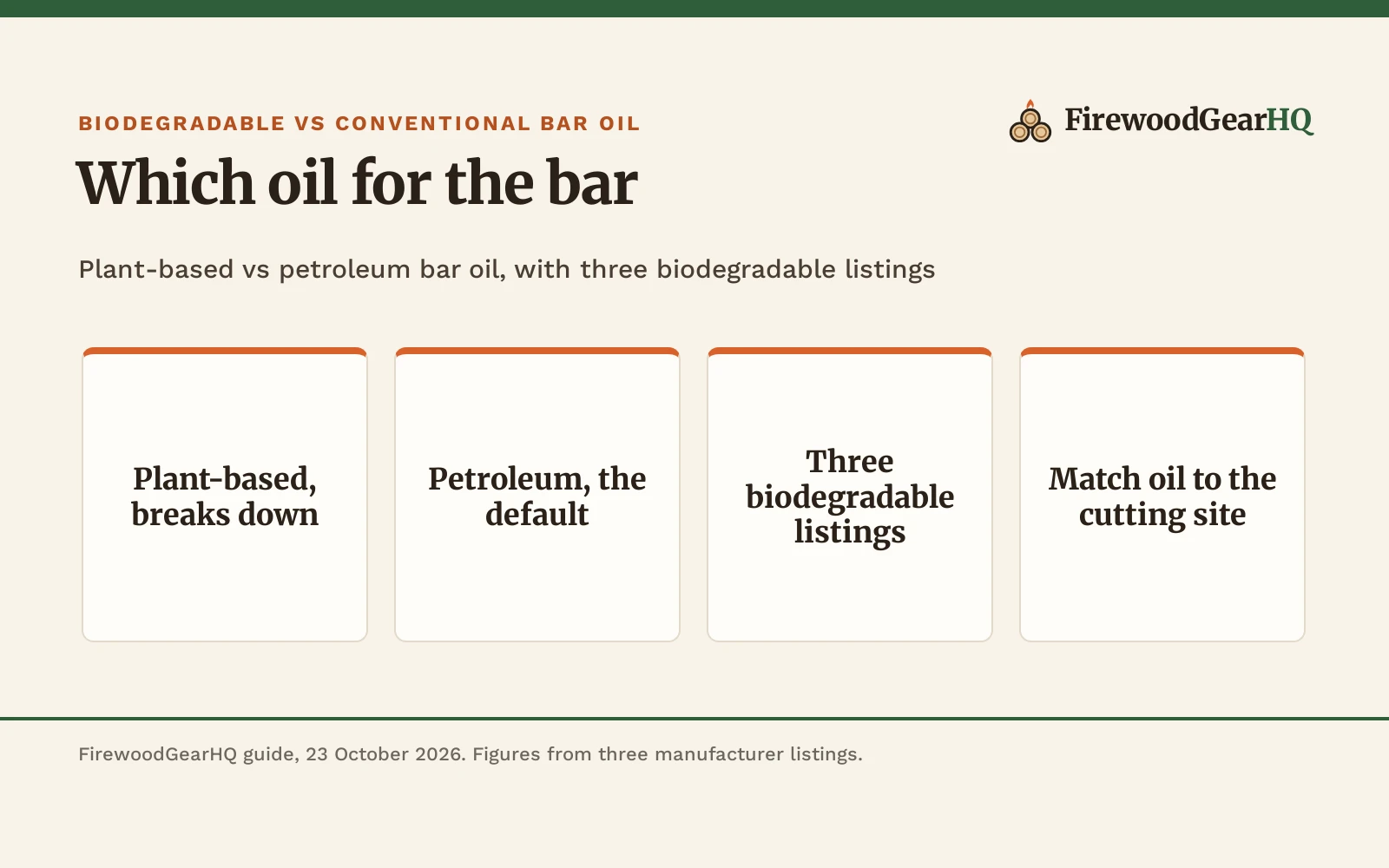
Biodegradable bar oil is plant-based and breaks down in the environment; conventional bar oil is petroleum-based and does not. That is the whole biodegradable vs conventional bar oil question: both lubricate the bar and chain, but the biodegradable type is made for cutting where the oil ends up in soil or water. Choose biodegradable when you cut near waterways, gardens or sensitive ground; conventional remains the default everywhere else.
FirewoodGearHQ earns a small commission if you buy through links on this page. The price you pay stays the same. Read our affiliate disclosure.
The quick answer
All three listings in this guide are biodegradable oils: plant or soy-based. The DEWALT and DGP listings describe non-toxic formulas aimed at 100% loss applications where the oil leaves the saw. No conventional oil is listed here, so the conventional side below is described in general terms. If none of your cutting happens near water or food-growing soil, conventional oil does the same lubricating job.
Biodegradable vs conventional bar oil: the biodegradable side
Biodegradable bar oil uses plant or soy-based stocks instead of petroleum. The DEWALT listing describes a soy-based, non-toxic oil rated from -15°F to 500°F; the DGP listing describes a 96% bio-derived oil, USDA Certified Biobased, rated from -20°F to about 500°F; the Liqui Moly listing describes a plant-based oil with OECD 301 B biodegradability. The DEWALT and DGP listings position themselves for 100% loss use, meaning the oil that flings off the chain, around waterways and sensitive areas; the Liqui Moly listing makes no such claim.
Tack and tenacity matter because bar oil must cling to the chain at speed. The DGP listing claims high tack to reduce sling; the DEWALT listing claims up to 300% higher viscosity index than conventional petroleum chain oils. Those are the makers’ claims, stated as listed.
The conventional side
Conventional bar oil is petroleum-based, tacky by design, and the long-standing default. It lubricates as well as anything in ordinary cutting; its drawback is persistence, since petroleum does not break down the way plant-based stocks do. No conventional listing is featured in this guide, so compare conventional options on tack, pour point and price per gallon.
The biodegradable oils in this guide
The DGP Pro100 leads on certifications. It is a 1 gallon biodegradable bar and chain oil with 96% bio-derived content, USDA Certified Biobased, meeting EPA requirements and passing OECD 201, 202 and 203, with a stated range of -20°F to about 500°F and a 575°F flash point. It is made in the USA from North American-grown plant oils.
The DEWALT is the branded option. It is a soy-based, non-toxic biodegradable oil in 16 oz bottles, sold as a case of 2, rated from -15°F to 500°F for gas and electric saws and pole saws. The listing claims up to 300% higher viscosity index than conventional petroleum chain oils.
The Liqui Moly 1280 is the simplest listing. It is a 1 L plant-based bio chain and saw oil with OECD 301 B biodegradability, stated for high-performance motor-saw chains under extreme conditions, with a 318°C flash point. The listing gives the fewest details of the three.
What the listings state
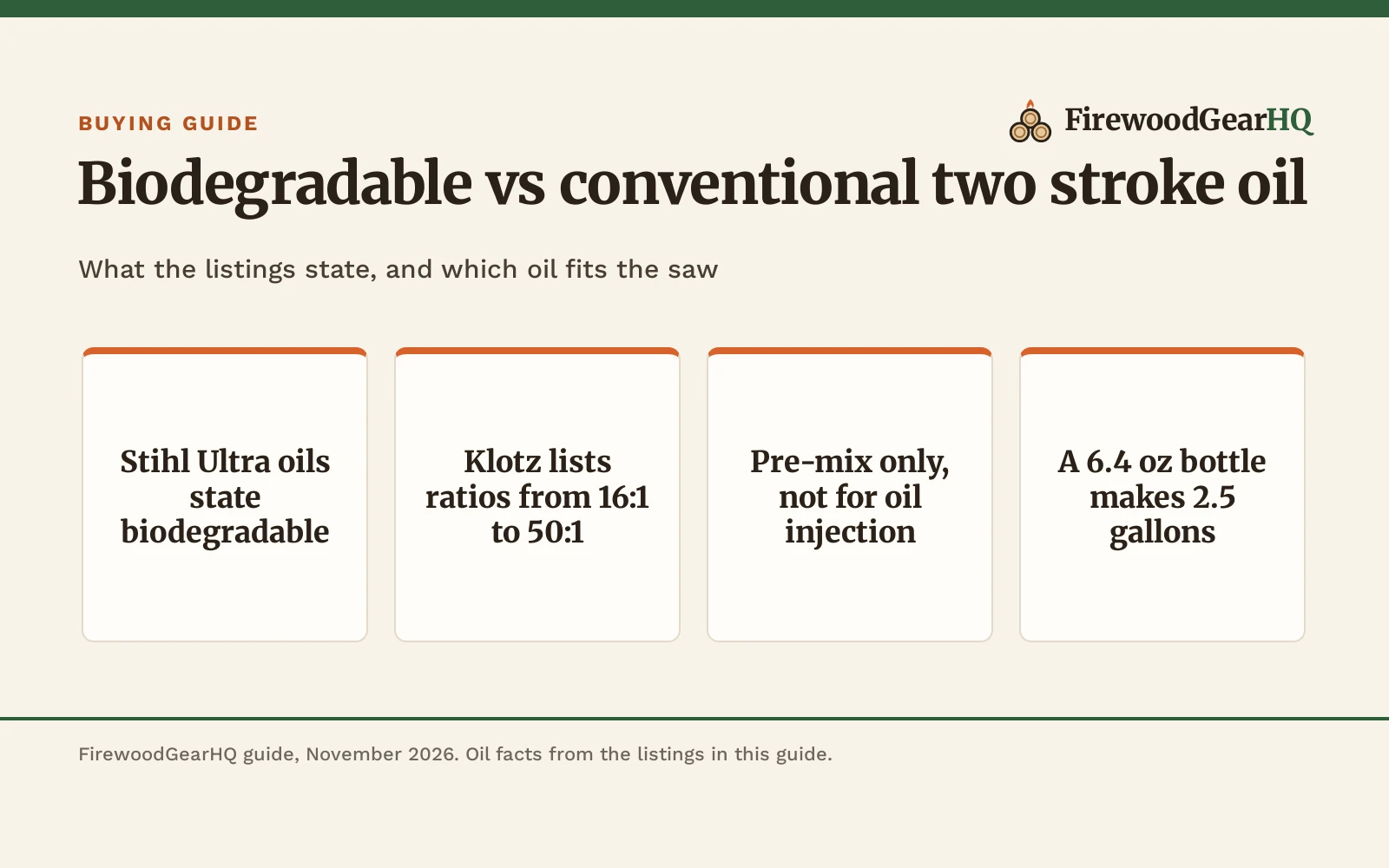
On temperature, the DEWALT states -15°F to 500°F and the DGP states -20°F to about 500°F; the Liqui Moly states a 318°C flash point. On size, the DEWALT is 16 oz in a case of 2, the Liqui Moly is 1 L, and the DGP is 1 gallon (128 fl oz). On certification, the DGP lists USDA Biobased, EPA and OECD 201, 202 and 203; the Liqui Moly lists OECD 301 B; the DEWALT lists none, leaning on its soy-based, non-toxic description.
Wear eye protection and gloves for cutting, splitting and handling, follow every tool's manual, install stoves to code, and have the chimney inspected and cleaned every year. See EPA Burn Wise and NFPA heating safety. Read our Safety Disclaimer.
Viscosity, tack and temperature range
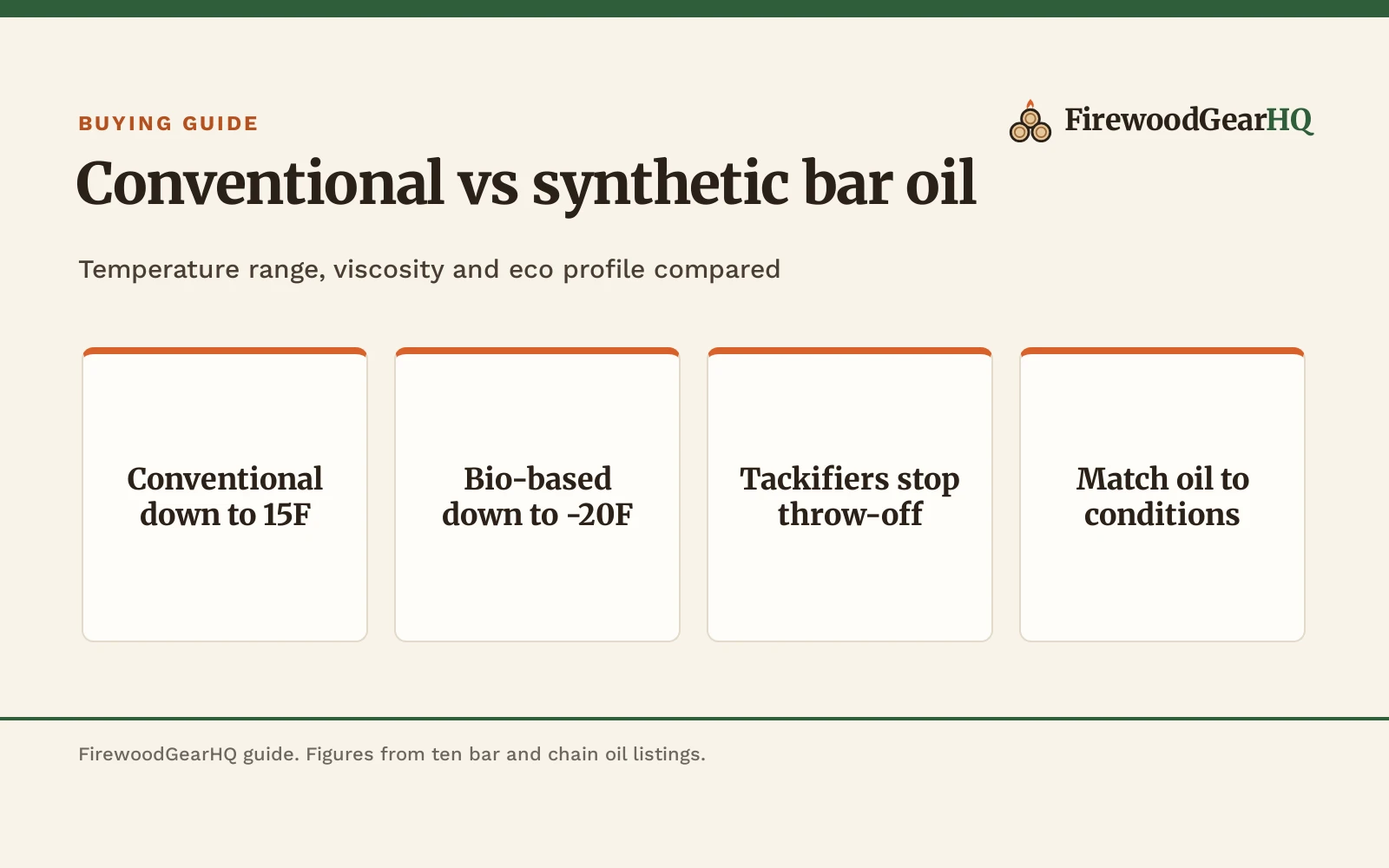
Bar oil has to cling to a fast chain and flow in the cold. The DEWALT listing claims up to 300% higher viscosity index than conventional petroleum chain oils, with a stated range of -15°F to 500°F. The DGP listing claims high tack to reduce sling, with a high smoke point around 500°F and a low pour point of -20°F. The Liqui Moly listing describes plant-based oil with outstanding adhesion and lubrication, and states a 318°C flash point against the DGP’s 575°F flash point. These are the makers’ figures; a higher viscosity index means the oil thins less as it heats, and tack keeps it on the chain instead of flinging off.
Sizes, weights and what ships
The three come in different quantities. The DEWALT is 16 oz bottles sold as a case of 2, with a listed liquid volume of 128 fluid ounces and an item weight of 8 pounds. The Liqui Moly is a 1 L bottle, listed at 33.81 fluid ounces and 0.7 kg. The DGP is 1 gallon, listed at 128 fluid ounces and 3.51 kg. Bar oil is a 100% loss consumable, so match the size to your cutting volume: the gallon suits steady firewood cutting, while the smaller bottles suit occasional use. The DGP and DEWALT listings both name gas and electric saws and pole saws; the Liqui Moly names high-performance motor-saw chains and lists lawn mower compatibility with a universal fit type.
Where each oil fits
The listings point at different work. The DGP names forestry, gardening and construction uses, and positions itself for 100% loss applications around waterways and sensitive areas. The DEWALT names mechanical and industrial uses, supports use around waterways and sensitive areas, and is made in the USA. The Liqui Moly is the simplest: a plant-based oil for high-performance chains under extreme conditions such as sawing hardwoods, with instructions to follow the saw and chain makers’ guidance. None of the three is a conventional petroleum oil, so the conventional comparison stays general.
FAQ: wood, fire and gear
Is biodegradable bar oil as good as conventional?
For lubrication, the listings say yes, with tack and viscosity claims to back it. The difference is environmental persistence, not cutting ability, per the makers.
When should I choose biodegradable?
When you cut near waterways, gardens, or other sensitive areas, per the DEWALT and DGP listings. Elsewhere, conventional oil is the standard choice.
Can I use biodegradable oil in any chainsaw?
The DEWALT and DGP listings state gas and electric saws and pole saws. Check your saw maker’s guidance, as the Liqui Moly listing advises.
What do the OECD numbers mean?
They are biodegradability standards named on the listings: OECD 301 B on the Liqui Moly, and OECD 201, 202 and 203 on the DGP. The listings cite them as certifications.
Which size should I buy?
The DEWALT is 16 oz in a case of 2, the Liqui Moly is 1 L, and the DGP is 1 gallon. Match the size to how much you cut; bar oil is a 100% loss consumable.
More firewood guides
See the chainsaw gear section, the best bar and chain oil guide and the best chainsaw sharpener guide.