Log Splitter vs Splitting Maul: Differences Explained
Log splitters and splitting mauls compared on handle length, weight, head design, striking leverage and upkeep, with four examples from the listings we reviewed.
 By FirewoodGearHQ Editorial
Updated October 9, 2026
By FirewoodGearHQ Editorial
Updated October 9, 2026
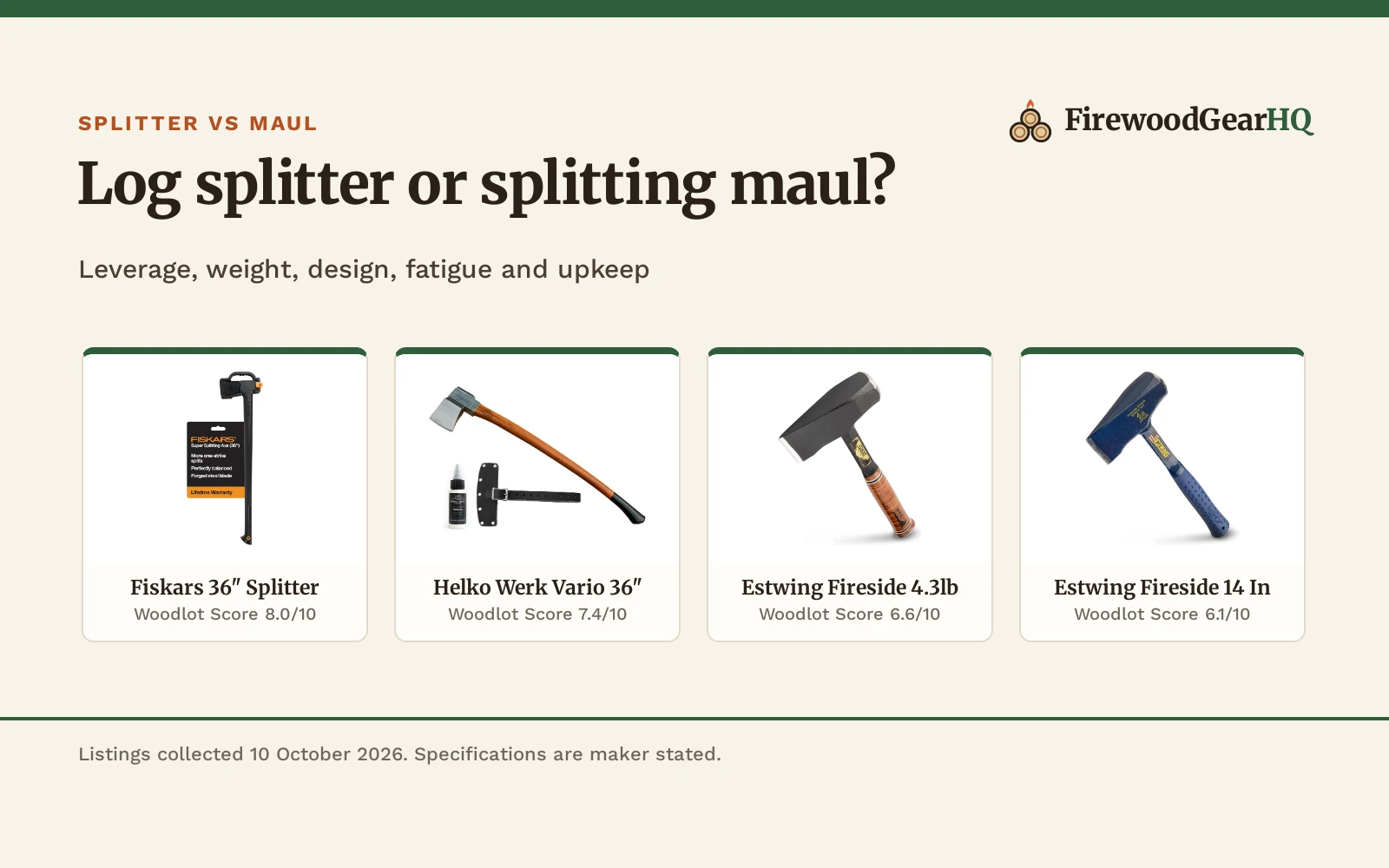
Verdict: In the log splitter vs splitting maul matchup, choose a log splitter if you process medium to large logs and want maximum striking leverage or mechanical force, as seen with our 36 in examples. Choose a splitting maul if you split firewood by hand, or need a compact tool like our 14 in examples for controlled kindling and hearthside work.
When deciding between a log splitter vs splitting maul, both tools split firewood along the grain, but they differ in handle leverage, striking force, tool weight, and the log sizes they handle best. This comparison examines how log splitters and splitting mauls differ across key design factors, using four distinct examples from the listings we reviewed.
FirewoodGearHQ earns a commission when you buy through links on this page, at no extra cost to you. Affiliate disclosure.
Side by side
| Factor | Log splitter | Splitting maul | Advantage |
|---|---|---|---|
| Primary tool format | Long 36 in handle wood splitter in our examples | Compact 14 in one handed maul in our examples | Splitter for leverage, maul for tight spaces |
| Example handle length | 36 in stated on both splitter listings | 14 in stated on both maul listings | Splitter examples provide longer reach |
| Intended log size | Medium to large logs and rounds | Kindling, small logs and fireplace wood | Splitters for large rounds, mauls for kindling |
| Swing technique | Full swing leveraging 36 in length | One handed swing using weighted wedge | Splitter for swing leverage, maul for one handed control |
| Stated warranty | Fiskars states lifetime warranty | No warranty term stated on either listing | Log splitter (Fiskars states lifetime) |
| Protective sheath | Included on both examples | Ballistic nylon included on both examples | Tie (sheaths included on both sides) |
| Weight specification clarity | Fiskars lists 6 pounds; Helko Werk contradicts (5, 6.5, 6.7, 8 ½ lbs) | EFF4SE lists 4.3 pounds; E3-FF4 lists 0.2 kg in table | Unclear: both sides publish contradictory weight figures |
| Example 1 comparison | Fiskars 36 In: 36 in, 6 pounds, lifetime warranty | Estwing EFF4SE: 14 in, 4.3 pounds, one-piece steel | Splitter for large rounds, maul for hearthside kindling |
| Example 2 comparison | Helko Werk Vario: 36 in, 5 lbs head, 8 ½ lbs total, C50 steel | Estwing E3-FF4: 14 in, 0.2 kg listed in table, shock grip | Unclear on specs; splitter for heavy wood, maul for campfire |
Ranges reflect the four listings we reviewed; example figures are maker stated, collected 9 October 2026.
Leverage and handle length
A longer handle provides greater swing radius to generate head speed and splitting leverage. The two log splitter listings in our comparison both feature 36 in handles, with the Fiskars listing explicitly noting that the longer length helps increase leverage and swing speed on medium to large logs. By contrast, the Estwing splitting maul examples in this review represent compact 14 in designs built for close-quarters work and one handed kindling prep. While a 36 in handle gives the splitter examples superior leverage for driving a wedge through tough rounds, the compact 14 in length on the Estwing mauls offers precise control when working near a hearth or campfire where full swings are unsafe or impractical.
Head geometry and wedge profile
Splitting tools use a wedge profile to drive wood fibers apart rather than cutting across them. The Fiskars example features a convex bevel blade with a low-friction coating designed to power through wood and release easily. The Helko Werk log splitter relies on a C50 high carbon steel head with a deep wedge profile designed to deliver powerful striking force into large rounds. The Estwing maul examples use a weighted wedge head with a hand-sharpened cutting edge, engineered to chop smaller logs and firewood with a one handed strike.
Weight and user fatigue
Tool weight directly influences physical fatigue during firewood preparation. The Fiskars splitter listing states a 6 pounds total weight, while the Helko Werk listing publishes conflicting weights: a 5 lbs head weight and an 8 ½ lbs total weight in the bullets, against a 6.7 pounds entry in its spec table. Swinging an 8 ½ lbs tool requires substantial physical exertion during extended sessions. The Estwing maul examples feature a lighter overall profile: the EFF4SE listing states a 4.3 pounds item weight, whereas the E3-FF4 spec table lists an unconfirmed 0.2 kg. While a 4.3 pounds tool is lighter than a full-size splitter, swinging it repeatedly with one hand can still fatigue the wrist and forearm, and its lighter mass produces less downward momentum on stubborn rounds.
Intended log size and volume
The listings in this comparison target different wood preparation tasks. The 36 in splitter examples are designed for processing medium to large logs outdoors, where a full swing arc drives the wedge into heavy firewood. The compact Estwing maul listings focus on hearthside kindling, small fireplace logs, and campfire wood where portability and one handed operation are prioritized. For woodcutters dealing with large quantities of knotty hardwood that exceed manual hand tool capacity, exploring motorized machinery may be necessary; our guide on how many tons of log splitter do I need details hydraulic tonnage requirements.
Upkeep and blade care
Manual firewood tools require ongoing maintenance to keep their cutting edges functional and safe. Both log splitter examples and both maul examples include protective sheaths: ballistic nylon on the Estwing models, vegetable-tanned full-grain leather on the Helko Werk, and an included sheath on the Fiskars. Helko Werk also includes a 1 Oz bottle of protective oil for its carbon steel head. Hickory handles, like the Grade A American hickory on the Helko Werk, benefit from occasional light oiling, while composite handles like the FiberComp on the Fiskars require no conditioning. When swinging manual splitters or mauls, always maintain a clear swing zone free of bystanders, wear eye protection, and verify that tool heads remain securely fastened.
Log splitter vs splitting maul: four examples
| Award | Product | Woodlot Score About the HQ ScoreThe Woodlot Score runs from 0 to 10 and weighs performance (35%), build (25%), value (25%), safety (10%, where it applies) and warranty (5%), using only what the manufacturer and the listing publish. How we pick › | |
|---|---|---|---|
 Fiskars A-Series Super Splitting Axe 36"
|
8.0/10 | Buy | |
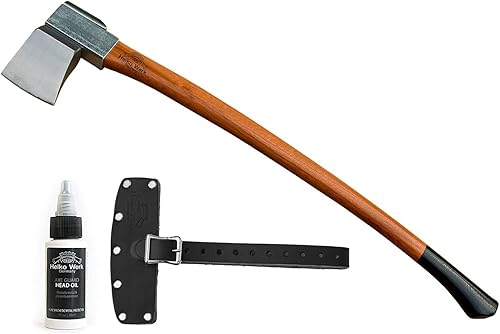 1844 Helko Werk Germany Vario Heavy Log Splitter
|
7.4/10 | Buy | |
 ESTWING Fireside Friend Splitting Maul
|
6.6/10 | Buy | |
 ESTWING Special Edition Fireside Friend
|
6.1/10 | Buy |
Fiskars A-Series Super Splitting Axe 36"
A 36 in splitting axe featuring a hardened forged steel blade, convex bevel geometry, low-friction coating, shock-absorbing FiberComp handle, and a lifetime warranty.
Pros
- Stated lifetime warranty
- Long 36 in handle provides leverage for medium to large logs
- Insert-molded head design prevents head loosening
- Includes a protective sheath
Cons
- Spec table contradicts bullets by listing handle material as wood
- At 36 in long, it is harder to control in tight spaces
- Listed 6 pounds total weight requires deliberate full swings
- Convex bevel blade requires specific sharpening technique
1844 Helko Werk Germany Vario Heavy Log Splitter
A heavy splitting tool made in Germany featuring a patented interchangeable C50 high carbon steel head, Grade A American hickory handle, and full grain leather sheath.
Pros
- Interchangeable bolt-on head design made from C50 carbon steel
- Grade A American hickory wood handle with matte lacquer finish
- Includes full grain leather sheath and 1 Oz bottle of protective oil
- Deep wedge profile delivers striking force for large rounds
Cons
- No warranty term is stated
- Listing contradicts itself on weight, stating 6.5 pound head in title, 5 lbs in bullets, and 6.7 pounds in spec table
- Listed total weight of 8 ½ lbs causes rapid fatigue during long sessions
- Bolt-on fastening components require periodic checking for tightness
ESTWING Fireside Friend Splitting Maul
A 14 in wood splitting maul forged in one piece from American steel, featuring a weighted wedge head with a 2.375 in blade edge and ballistic nylon sheath.
Pros
- Forged from one solid piece of American steel with no welds
- Compact 14 in handle works well for one handed splitting at the hearth
- Includes a ballistic nylon sheath to protect the cutting edge
- Weighted wedge design with 2.375 in blade edge splits kindling cleanly
Cons
- No warranty term is stated
- Title claims blue molded grip while bullets and spec table describe leather grip
- Short 14 in handle lacks leverage for large hardwood logs
- Listed 4.3 pounds weight causes arm fatigue during prolonged one handed swinging
ESTWING Special Edition Fireside Friend
A compact 14 in wood splitting maul forged in one piece from American steel, featuring a patented shock reduction grip and ballistic nylon sheath.
Pros
- Solid one-piece forged American steel construction
- Shock reduction grip claims 70% impact vibration reduction
- Includes a heavy duty ballistic nylon sheath
- Compact 14 in length is convenient for kindling and campfires
Cons
- No warranty term is stated
- Spec table lists an unrealistic weight of 0.2 kg
- Title specifies leather grip while bullets describe a molded grip
- Not designed for splitting large or knotty tree rounds
How we scored them
Each example is scored out of 100 on performance, build, value, safety and warranty, using only what the listing publishes. The weights are on our How We Pick page.
| Product | Woodlot Score | Perf. /35 | Build /25 | Value /25 | Safety /10 | Warranty /5 |
|---|---|---|---|---|---|---|
| Fiskars 36″ Splitter | 8.0 | 30 | 20 | 20 | 5 | 5 |
| Helko Werk Vario 36″ | 7.4 | 29 | 21 | 19 | 5 | 0 |
| Estwing Fireside 4.3lb | 6.6 | 27 | 18 | 18 | 4 | 0 |
| Estwing Fireside 14 In | 6.1 | 24 | 16 | 16 | 4 | 0 |
One operator only, with hands well clear of the wedge and the ram. Wear eye protection and gloves, set the splitter on stable, level ground, and keep kids and pets away from the work area. Run gas splitters outdoors only, and never reach in to clear a jammed log while the ram can move. Read our Safety Disclaimer.
Frequently Asked Questions
What is the main difference in log splitter vs splitting maul?
Log splitters focus on generating maximum splitting force, whether through motorized hydraulic tonnage or long-handled leverage like the 36 in examples in this review. Splitting mauls rely on a heavy, blunt wedge design; while standard mauls use full-length handles, compact examples like the 14 in Estwing listings prioritize one handed control for splitting kindling and smaller logs.
When should I choose a machine or maul for firewood?
When deciding between a machine or maul, consider your wood volume and physical endurance. A motorized hydraulic log splitter processes tough, knotty rounds without physical strain, whereas a manual splitting maul or striking tool requires human effort but operates anywhere without engine fuel, electrical cords, or hydraulic fluid maintenance.
Can a 14 in splitting maul handle large tree rounds?
No. A compact 14 in maul lacks the handle length, head weight, and swing momentum needed to burst through large or knotty tree rounds. The Estwing listings specifically describe one handed chopping for firewood and logs, making them best suited for kindling and small billets.
Why do some listings state contradictory weights?
Online retail listings often contain data entry discrepancies between product titles, bullet points, and specification tables. For example, one Helko Werk listing states a 6.5 pound head in the title but specifies a 5 lbs head weight and 8 ½ lbs total weight in the bullets, while one Estwing listing erroneously lists 0.2 kg in its spec table. Always check multiple listing fields before purchasing.
Related guides
See our complete guide on what is a splitting maul, explore weight considerations in how heavy should a splitting maul be, and learn proper swing mechanics in how to split wood with an axe. You can also explore top rated picks in our best splitting maul review or browse our complete log splitters hub.
About the author
The FirewoodGearHQ editorial team researches firewood and wood heating equipment from published specifications, ratings and warranty terms, and scores every pick the same way. We do not run our own product trials.