Best Small Gas Powered Chainsaw (2026): 5 Saws Compared
Five small gas powered chainsaws compared by engine size, bar length, weight, safety features and what each listing publishes for wood cutting and pruning.
 By FirewoodGearHQ Editorial
Updated October 9, 2026
By FirewoodGearHQ Editorial
Updated October 9, 2026
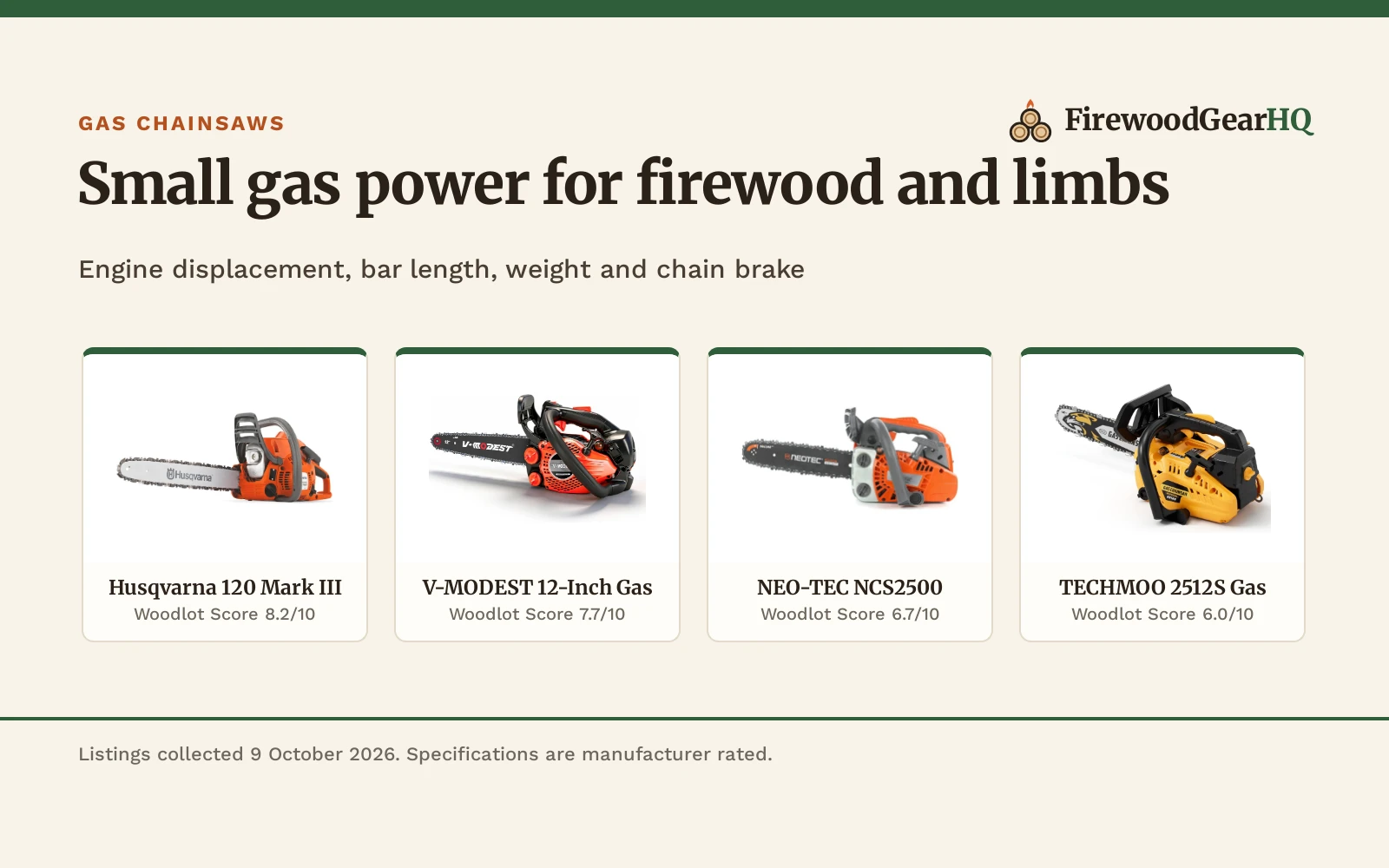
A small gas powered chainsaw gives you the cutting speed and endurance needed for firewood preparation, limb trimming and storm cleanup without dragging an extension cord or waiting on battery chargers. Saws in this class balance compact displacement with manageable weight, making them practical for woodlot chores and backyard maintenance. This guide compares five small chainsaws by engine displacement, guide bar length, operating weight, chain brake design and manufacturer specifications to help you find the best small gas powered chainsaw for your property.
FirewoodGearHQ earns a commission when you buy through links on this page, at no extra cost to you. Affiliate disclosure.
Quick picks
- Best Overall Husqvarna 120 Mark III: 38 cc X-Torq engine with a 14 in bar, inertia chain brake and LowVib dampeners. Check price
- Best Lightweight V-MODEST 12-Inch Gas: 5.5 lb dry weight with a 25 cc engine, dual-post chain brake and a 1-year warranty. Check price
- Best Budget Top-Handle NEO-TEC NCS2500: 25.4 cc engine delivering 12,000 RPM with a wrap-around handle and spring-assisted start. Check price
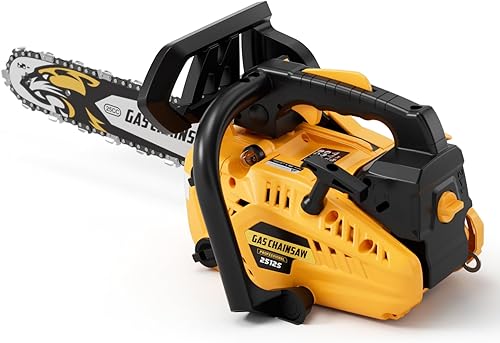
- Best Kit with Mixing Bottle TECHMOO 2512S Gas: 25 cc top-handle saw with rapid kickback brake, hand guard and 2L mixing bottle. Check price
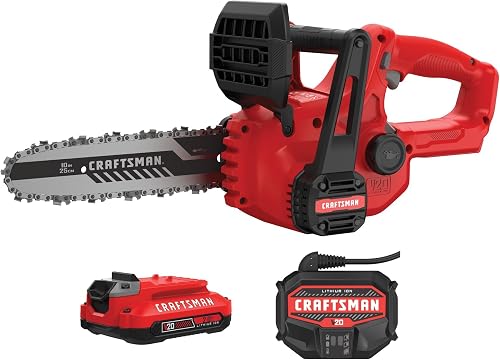
- Best Battery Alternative CRAFTSMAN CMCCS610D1: 20V cordless option with a 10 in bar and auto-oiler for light pruning without gas mixing. Check price
Compare the picks
| Model | Woodlot Score | Engine or power | Bar length | Weight | Chain brake |
|---|---|---|---|---|---|
| Husqvarna 120 Mark III | 8.2/10 | 38 cc, 1.88 hp | 14 in | 10.7 lb | Inertia activated |
| V-MODEST 12-Inch | 7.7/10 | 25 cc, 1.5 hp | 12 in | 5.5 lb | Dual-post system |
| NEO-TEC NCS2500 | 6.7/10 | 25.4 cc, 1.2 hp | 12 in | 8 to 8.2 lb | Not stated |
| TECHMOO 2512S | 6.0/10 | 25 cc, 1.2 hp | 12 in (24 in listed) | 11 lb | Rapid reaction |
| CRAFTSMAN CMCCS610D1 | 5.6/10 | 20V MAX, 2.0 Ah | 10 in | 5.9 to 7.9 lb | Not stated |
Specifications are manufacturer rated, collected 9 October 2026. Four of these five listings do not state a concrete warranty duration, and two omit any mention of a chain brake or safety certification, which directly affects their Woodlot Score.
The picks
| Award | Product | Woodlot Score About the HQ ScoreThe Woodlot Score runs from 0 to 10 and weighs performance (35%), build (25%), value (25%), safety (10%, where it applies) and warranty (5%), using only what the manufacturer and the listing publish. How we pick › | |
|---|---|---|---|
 Husqvarna 120 Mark III Gas Chainsaw, 38-cc
|
8.2/10 | Buy | |
 12 inch Top Handle Chainsaw Gas Powered 25cc
|
7.7/10 | Buy | |
 NEO-TEC 12 Inch Top Handle Gas Chainsaw 25.4cc
|
6.7/10 | Buy | |
 25CC Gas Chainsaw 2-Stroke Gasoline Top Handle
|
6.0/10 | Buy | |
 CRAFTSMAN Mini Chainsaw, 10 inch Mini Chainsaw
|
5.6/10 | Buy |
Husqvarna 120 Mark III Gas Chainsaw, 38-cc
A 38 cc gas chainsaw with a 14 in bar, an inertia-activated chain brake and vibration dampeners designed for homeowner wood cutting and pruning.
Pros
- 38 cc X-Torq engine rated at 1.88 hp
- 14 in bar with 3/8 pitch and .050 gauge chain
- Inertia-activated chain brake for operator safety
- LowVib dampeners between engine and chassis reduce vibration
Cons
- No warranty term is stated in the listing
- Heaviest gas model here at 10.7 lb
- Listing spec table contains an uncorrected 8 hp typo alongside 1.88 hp
- Requires manual fuel mixing with 2-cycle oil
12 inch Top Handle Chainsaw Gas Powered 25cc
A 5.5 lb top-handle gas chainsaw powered by a 25 cc two-stroke engine with a 12 in bar, dual-post chain brake and low-kickback chain.
Pros
- Lightweight at 5.5 lb dry weight
- Dual-post chain brake system and low-kickback chain
- Backed by a stated 1-year warranty
- Includes mixing bottle, funnel, bar cover, gloves and tool kit
Cons
- Small 25 cc engine produces 1.5 hp for light cutting
- Requires 25:1 fuel and oil mix
- Horsepower given as 1.5 hp in bullets and 1.51 hp in spec table
- Top-handle design requires disciplined two-handed grip
NEO-TEC 12 Inch Top Handle Gas Chainsaw 25.4cc
A 25.4 cc top-handle gas chainsaw with a 12 in bar, spring-assisted starting system and wrap-around handle for pruning and firewood prep.
Pros
- 25.4 cc two-stroke engine delivers 1.2 hp and 12,000 RPM
- Spring-assisted ignition system for easier pull starting
- 12 in bar with 3/8LP pitch and .050 gauge chain
- Integrated metal lanyard ring for harness attachment
Cons
- No chain brake or safety certification stated in listing
- No warranty term is stated in the listing
- Weight listed as 8 lb in bullet and 8.2 lb in spec table
- Listing claims one-handed operation despite safety risks
25CC Gas Chainsaw 2-Stroke Gasoline Top Handle
A 25 cc top-handle gas chainsaw with a rapid-reaction kickback brake, safety trigger and an included 2L fuel mixing bottle.
Pros
- Rapid-reaction kickback brake and front hand guard
- Includes 2L fuel mixing bottle and toolkit
- Cushioned full wrap handle and slip-free grip
- 25 cc two-cycle engine rated at 1.2 hp
Cons
- Severe listing contradiction: spec table lists a 24 in bar and chain
- Spec table incorrectly identifies power source as battery powered
- No warranty term is stated in the listing
- Heavy for a 25 cc top-handle saw at 11 lb
CRAFTSMAN Mini Chainsaw, 10 inch Mini Chainsaw
A 20V battery-powered cordless chainsaw with a 10 in bar, 2.0 Ah lithium-ion pack and automatic chain oiler for light branch cutting.
Pros
- Includes 20V MAX 2.0 Ah lithium-ion battery and charger
- Lightweight bare tool weight of 5.9 lb
- Automatic chain oiler with bolt-lock tensioning
- Integrated hook compatible with VERSATRACK wall storage
Cons
- Battery powered rather than gas powered
- Chain speed limited to 4.1 m/s for slower cutting
- No chain brake or safety standard stated in listing
- No warranty term is stated in the listing
How we scored them
Each chainsaw is scored out of 100 on performance, build, value, safety and warranty, using only what each listing publishes. The criteria weights are detailed on our How We Pick page.
| Product | Woodlot Score | Perf. /35 | Build /25 | Value /25 | Safety /10 | Warranty /5 |
|---|---|---|---|---|---|---|
| Husqvarna 120 Mark III | 8.2 | 32 | 22 | 20 | 8 | 0 |
| V-MODEST 12-Inch Gas | 7.7 | 27 | 20 | 21 | 7 | 2 |
| NEO-TEC NCS2500 | 6.7 | 27 | 20 | 20 | 0 | 0 |
| TECHMOO 2512S Gas | 6.0 | 22 | 16 | 16 | 5 | 0 |
| CRAFTSMAN CMCCS610D1 | 5.6 | 19 | 19 | 19 | 0 | 0 |
Buying guide: choosing the best small gas powered chainsaw
Selecting the right saw requires matching the tool’s powerhead layout, engine displacement and safety mechanisms to your specific firewood cutting and pruning needs.
Engine displacement and cutting power
Engine displacement in compact gas chainsaws generally ranges from 25 cc to 38 cc. A 25 cc two-stroke engine produces around 1.2 hp to 1.5 hp, which provides ample cutting speed for pruning branches, limbing felled saplings and cutting kindling. When processing thicker firewood rounds or working through dense hardwood, a 38 cc engine delivering 1.88 hp offers greater torque to pull the chain through the cut without bogging down. If you need a larger saw for bucking full firewood cords, consider our guide to the best chainsaw for firewood.
Top-handle vs rear-handle configuration
Handle placement fundamentally changes how a chainsaw balances. Rear-handle chainsaws place the rear grip and throttle trigger behind the engine block, with a wide front wrap handle. This layout spreads your hands farther apart, providing maximum leverage and control when bucking firewood on the ground or cutting at waist height. Top-handle chainsaws place the throttle control directly over the engine cylinder, resulting in a shorter, highly maneuverable powerhead designed for tight quarters in tree canopies. However, top-handle saws require strict two-handed control to prevent rotational kickback.
Guide bar length and chain pitch
Small gas chainsaws typically mount 12 in or 14 in guide bars. A 12 in bar keeps the powerhead compact and agile for branch trimming, while a 14 in bar increases usable cut capacity for modest firewood logs. Check the chain pitch and gauge when replacing cutting gear: compact saws frequently employ 3/8LP (low profile) or 1/4 in LP chain with .043 in or .050 in gauge drive links to minimize cutting resistance. To keep your chain sharp for clean cuts, review our recommendations for the best chainsaw sharpener, or explore options in our chainsaw chain comparison.
Operating weight and maneuverability
Weight is a primary consideration when cutting wood for extended sessions. In this roundup, dry powerhead weights range from 5.5 lb for ultra-compact top-handle models up to 10.7 lb for conventional rear-handle designs. Lighter saws reduce shoulder fatigue during branch work, but a heavier chassis often absorbs vibration more effectively and provides stability when cutting downward through woodpile rounds.
Chain brake systems and essential safety gear
A functional chain brake is the most vital safety component on any chainsaw. Inertia-activated chain brakes engage automatically during sudden rotational kickback, while manual brakes trip when the operator’s forward hand strikes the guard. Safe operation also demands proper personal protective equipment (PPE): cut-resistant chainsaw chaps, heavy leather gloves, protective work boots, and a forestry helmet system featuring a mesh face screen and hearing protection. Never operate a chainsaw alone, and always maintain a clear retreat path. For comprehensive operating guidelines, consult the OSHA logging eTool. Note that felling standing trees is hazardous; complex tree felling should always be left to certified professional arborists.
Two-stroke fuel and bar oil maintenance
Two-stroke gas engines require clean unleaded fuel mixed with quality two-cycle air-cooled engine oil. Check the manufacturer’s specified mix ratio, such as 25:1, and mix fuel in a dedicated container rather than inside the fuel tank. In addition to fuel mix, chainsaws require clean bar and chain oil to lubricate the guide bar groove and reduce friction. If you prefer to avoid mixing gas entirely, battery models such as those in our best battery chainsaw for homeowners and best electric chainsaw roundups offer push-button convenience for light yard chores.
Wear cut-resistant chaps, a helmet with face screen and hearing protection, gloves and sturdy boots. Know where the kickback zone is (the upper tip of the bar), keep the chain brake working and the chain sharp, and never cut alone in the woods. Felling trees is hazardous work: hire a professional for large, leaning or storm-damaged trees, especially near buildings or power lines. See OSHA logging safety for chain saw operators. Read our Safety Disclaimer.
Frequently Asked Questions
What is the best gas chainsaw?
The best gas chainsaw depends on your workload. For general firewood cutting, yard cleanup and property maintenance, a rear-handle model with an inertia-activated chain brake, such as the 38 cc Husqvarna 120 Mark III, offers balanced control and cutting power. For specialized overhead pruning and limbing, a lightweight top-handle saw provides superior maneuverability.
Are electric chainsaws as powerful as gas?
Battery and corded electric chainsaws match the cutting capability of small gas saws for light pruning, offering quiet operation and push-button starts. However, gas chainsaws generally achieve higher chain speeds and deliver sustained power without pausing to recharge batteries, making them preferable for extended firewood processing.
What kind of gas does a chainsaw take?
Gas chainsaws use standard regular unleaded gasoline. Use fresh gasoline without high ethanol content, as ethanol can attract moisture and degrade small fuel lines and carburetor components during seasonal storage.
Do chainsaws use mixed gas?
Yes, two-stroke chainsaw engines lack an internal oil reservoir and require two-cycle engine oil mixed directly into the gasoline to lubricate internal bearings and the cylinder. Running straight gasoline without oil will cause catastrophic engine seizure.
How to mix gas for a chainsaw?
Follow the specific fuel-to-oil ratio stated in your saw’s manual, such as 25:1. Pour the appropriate amount of two-cycle air-cooled engine oil into an approved fuel can, add the unleaded gasoline, and swirl the container thoroughly to blend the mixture before filling the saw’s fuel tank.
Related guides
Explore our complete chainsaws hub, our overview of gas chainsaws, and our guide to the best chainsaw for firewood. You can also explore protective gear in our chainsaw gear section and learn how to check if your chainsaw or log splitter is recalled.
About the author
The FirewoodGearHQ editorial team researches firewood and wood heating equipment from published specifications, ratings and warranty terms, and scores every pick the same way. We do not run our own product trials.