50cc vs 60cc Chainsaw: Which One Should You Buy?
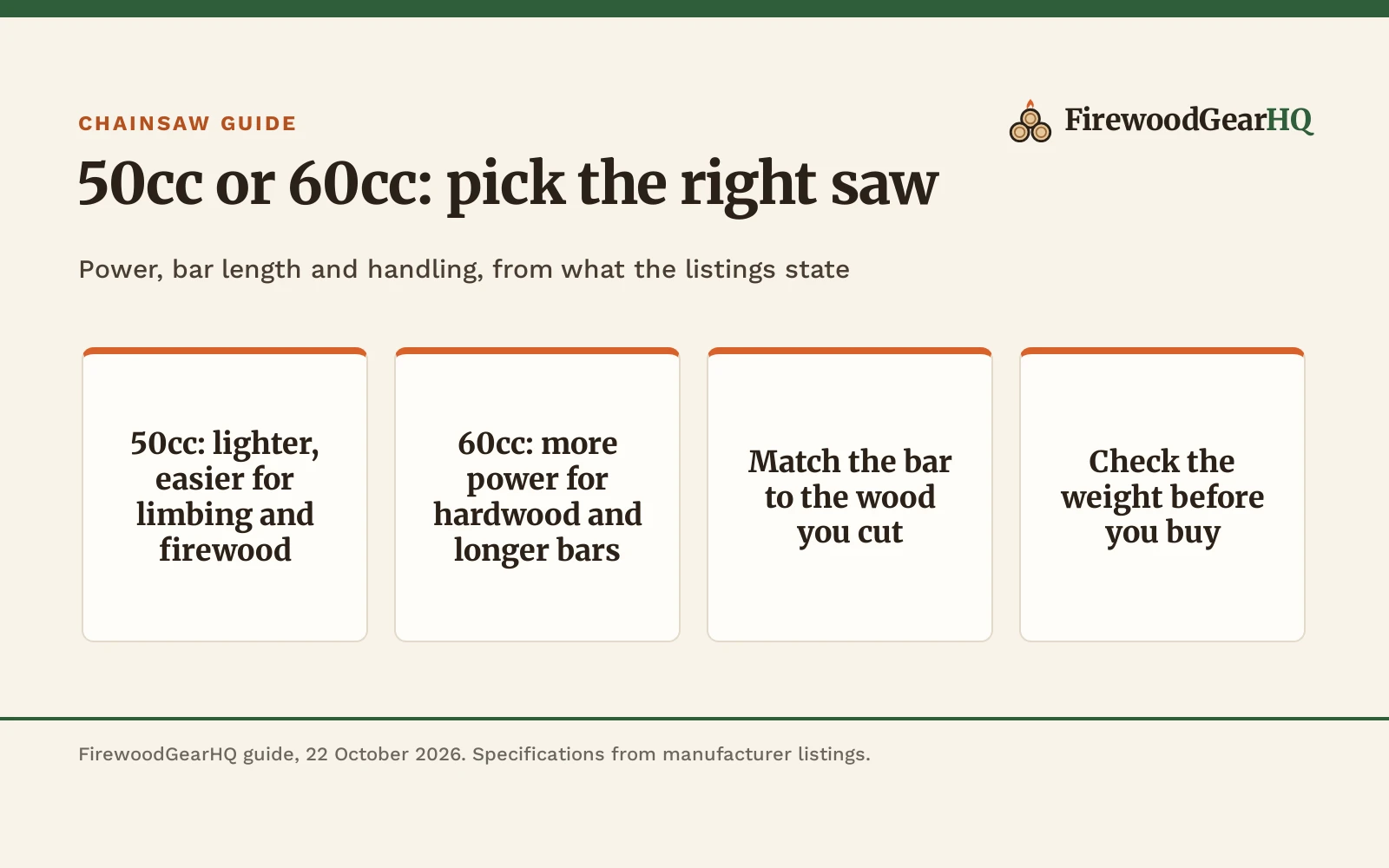
A 60cc saw pulls a longer bar and cuts faster in hardwood, while a 50cc saw is lighter and easier to handle for limbing and firewood. Here is how to pick.

On this page
Choosing between a smaller and a larger saw comes down to the wood you cut and how long you cut it. A lighter saw is easier to swing all afternoon, while a bigger engine pulls a longer bar through hardwood without bogging down. The 50cc vs 60cc chainsaw question has a straightforward answer: buy the 50cc if your work is limbing, bucking firewood and cutting small to medium trees, and buy the 60cc if you regularly cut hardwood, run a longer bar or fell larger trees.
As an Amazon Associate I earn from qualifying purchases. FirewoodGearHQ may earn a small commission if you buy through links on this page. The price you pay stays the same. Affiliate disclosure.
The quick answer
A 50cc saw is the sweet spot for most firewood cutters: light enough to handle for hours, strong enough for bucking logs and cutting small trees. A 60cc saw adds power for hardwood, bigger bars and faster cutting in demanding wood. If you only buy one saw and your wood is mixed, the 60cc gives you headroom. If you value light weight and your wood is soft or small, the 50cc is the easier saw to live with.
50cc vs 60cc chainsaw: what the extra displacement gets you
Displacement is engine size, and more of it means more power to the chain. The four saws here cluster around the 60cc mark: the VEVOR at 58CC and 3.22HP, the JPNTECH at 60cc, the 62CC at 3.5 HP and 7500 RPM, and the 63CC at 3.5hp and 8500 rpm. That power shows up as faster chain speed and the ability to pull a longer bar through dense wood without stalling. A 50cc saw in the same bar length will cut, but it works harder and cuts slower in hardwood.
Power ratings on these saws
The listings state horsepower for three of the four: 3.22HP on the 58CC VEVOR, 3.5 HP on the 62CC, and 3.5hp on the 63CC. The JPNTECH 60cc does not state a horsepower figure. Higher horsepower with the same bar length means the chain keeps speed in the cut instead of bogging down. For firewood bucking in softwood, the difference is modest. For oak, hickory or frozen wood, the extra power is noticeable.
Engine speed
The 63CC lists an engine speed up to 8500 rpm, and the 62CC lists a max speed of 7500 RPM. Higher engine speed generally means faster chain speed, which means faster cutting. The other two listings do not state engine speed. Do not compare rpm across brands too closely: the measurement conditions differ, and the listing rarely explains them.
The four saws, side by side
All four are 2-cycle gas saws with 20-inch bars, which makes them directly comparable. The VEVOR 58CC is the smallest displacement here at 58CC and 3.22HP, positioned as a general-purpose saw for trees, branches and land clearing. The JPNTECH 60cc sits at the round 60cc mark with a dual throttle switch design that requires both switches pressed to start, a safety feature the others do not list. The 62CC steps up to 3.5 HP and 7500 RPM with a choice of 20 or 22 inch guide bar, the only one here offering two bar lengths. The 63CC is the largest at 63CC and 3.5hp with an 8500 rpm engine speed, aimed at demanding cutting.
Which one for firewood
For bucking firewood rounds, any of the four will do the job. The 62CC with its bar-length choice is the most flexible: run the 20 inch for general work and step up to 22 inch for larger rounds. The VEVOR 58CC at 3.22HP is the lightest on power but still a 20-inch saw, which covers most firewood. The JPNTECH dual-switch start is worth a look if the saw will be used by less experienced hands.
Which one for felling
For felling small to medium trees, the extra power of the 62CC and 63CC matters. A 3.5 HP engine pulls the chain through the hinge wood faster and with less risk of pinching. The 63CC at 8500 rpm is the hottest saw here on paper. For trees beyond what a 20-inch bar handles, none of these is the right saw: step up in both displacement and bar length.
Bar length and what it means
Three of the four ship with a 20-inch bar, and the 62CC offers 20 or 22 inch. Bar length sets the maximum cut: a 20-inch bar handles logs up to about 20 inches in diameter with a single cut from one side, or larger with cuts from both sides. A longer bar cuts bigger wood but adds weight and needs more power to pull the chain. Match the bar to the largest wood you regularly cut, not the largest wood you have ever seen.
Weight and handling
The listings state weights from 15.4 pounds to 22 pounds, plus one in kilograms: the VEVOR 58CC lists 15.4 pounds, the JPNTECH 60cc lists 17.3 pounds, the NEO-TEC 62CC lists 22 pounds, and the PINKWAY 63CC lists 7.8 kg. Weight matters as much as power for a saw you carry all day. If you limb and buck for hours, the lighter saw wins on fatigue. If you make a few big cuts and stop, the heavier saw is fine.
Wear cut-resistant chaps, a helmet with face screen and hearing protection, gloves and sturdy boots. Know where the kickback zone is (the upper tip of the bar), keep the chain brake working and the chain sharp, and never cut alone in the woods. Felling trees is hazardous work: hire a professional for large, leaning or storm-damaged trees, especially near buildings or power lines. See OSHA logging safety for chain saw operators. Read our Safety Disclaimer.
Frequently Asked Questions
Is a 60cc chainsaw too big for a homeowner?
Not for firewood and tree work. A 60cc saw with a 20-inch bar is a common homeowner firewood saw: enough power for hardwood, still manageable to handle. It is only too big if your work is all limbing and small branches, where a lighter saw saves your arms.
Can a 50cc saw cut hardwood?
Yes, with a sharp chain and patience. A 50cc saw cuts hardwood slower than a 60cc and works harder doing it, which means more frequent chain sharpening and more care to avoid pinching. For occasional hardwood, a 50cc is fine. For steady hardwood cutting, the 60cc earns its keep.
What bar length do I need for firewood?
A 20-inch bar covers most firewood: it handles rounds up to 20 inches in one pass and larger rounds with two cuts. The 62CC here offers a 22-inch option for bigger wood. Longer than you need just adds weight and slows the chain.
Do I need a bigger saw for felling trees?
For small to medium trees, a 60cc saw with a 20-inch bar is enough. For large trees, you need both more displacement and a longer bar than anything here. Match the saw to the tree: the bar should reach through the trunk with room to spare.
Is 2-cycle gas harder to maintain than battery?
A 2-cycle saw needs mixed fuel, air filter cleaning and spark plug checks. The listings here do not detail maintenance schedules. Battery saws skip the fuel mixing but give up runtime and power at this displacement. For all-day firewood work away from outlets, gas is still the practical choice.
Related guides
Related: gas chainsaws, chainsaw chaps vs chainsaw jacket and best chainsaw safety kit for beginners.