Carbon Monoxide Detector vs Smoke Detector: What Wood Burners Need
CO detectors sense carbon monoxide gas while smoke detectors sense smoke particles; a wood-burning home needs both, and here are four CO detectors ranked by their stated features.

On this page
Top picks at a glance
As an Amazon Associate we earn from qualifying purchases.
- 1
 Kidde Smoke & CO Detector9.8/10View on Amazon
- 2
 X-Sense Smoke Detector Carbon Monoxide Alarm Combo9.7/10View on Amazon
- 3
 SITERWELL Smoke & CO Detector Interconnected9.6/10View on Amazon
- 4
 TOPTES CT-580 Portable Carbon Monoxide DetectorView on Amazon
- 5
 SITERWELL Carbon Monoxide Detector 7 Year Product Life CoView on Amazon
Carbon monoxide detector vs smoke detector is not an either-or choice: a carbon monoxide detector senses CO gas, which is invisible and odorless, while a smoke detector senses smoke particles from a fire. They watch for different dangers, and a home that burns wood needs both. The four CO detectors below are ranked by what their listings state, so you can pick the one that fits your stove room.
More options to compare
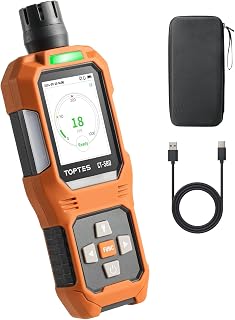 TOPTES CT-580 Portable Carbon Monoxide DetectorCheck price on Amazon
 SITERWELL Carbon Monoxide Detector 7 Year Product Life CoCheck price on Amazon
FirewoodGearHQ may earn a small commission if you buy through links on this page. The price you pay stays the same. Read our affiliate disclosure.
Carbon monoxide detector vs smoke detector: the difference
A smoke detector watches for particles in the air and sounds when it senses smoke from a fire. A carbon monoxide detector uses an electrochemical sensor, the sensor type every listing here states, to watch for CO gas building up in the room. CO comes from incomplete burning: the SITERWELL listing names gas or wood-burning fireplaces, gas appliances, boilers, heaters, clogged chimneys and running vehicles as sources. You cannot see or smell it, which is why the detector matters more than your nose.
For a wood burner, the two devices cover two different failure modes. The smoke detector covers the fire getting out: a chimney fire, a spark on the rug, an overheated flue. The CO detector covers the fire burning wrong: a smoldering load, a blocked flue, a stove starved of air, backdraft on a windy night. One does not replace the other.
Why wood burners should care about both
Wood heat puts combustion inside the living space, which is exactly the situation CO detectors are made for. The listings describe the same core features across brands: an 85-decibel alarm on both Kidde models, LED status lights that show power and alarm states, and Peak Level Memory that records the last CO detection. The Kidde models are UL listed or UL certified with a 10-year limited manufacturer warranty; the siterlink and SITERWELL listings state electrochemical sensors but no UL certification and no warranty term.
Placement follows the danger. CO mixes with room air, so the detector belongs in the rooms where people sleep and near the stove room, following the maker’s instructions. A smoke detector belongs on the ceiling where smoke rises. Check both when the burning season starts: the Kidde listings include a hush button that also silences the low-battery chirp, and the plug-in models show a steady green light when powered.
The CO detectors, ranked
1. Kidde 10-year battery model (B086S53M8K). The strongest listing here: a sealed 10-year lithium battery that never needs replacing, a digital display that updates every 15 seconds with the CO level, an 85-decibel alarm, three LEDs for normal operation, CO presence and replace-the-detector warnings, Peak Level Memory, UL certification and a 10-year limited manufacturer warranty. It measures 1.5 by 4.5 by 2.75 inches and weighs 8 ounces.
2. Kidde AA battery model (B004Y6V5CI). The same 85-decibel alarm and electrochemical sensor in a 2-AA battery package (batteries included), so it keeps watching during a power failure. LEDs show power and CO presence, Peak Level Memory is included, and it is UL listed with a 10-year limited manufacturer warranty on the alarm. It measures 1.5 by 4.5 by 2.75 inches and weighs 9.28 ounces. The trade against the winner is batteries you replace instead of a sealed 10-year cell.
3. SITERWELL 2-pack plug-in (B0DGL74V18). Two plug-in detectors with 10-year battery backup, an electrochemical sensor and a breathing-style status light (green for normal, yellow for fault, red for alarm). The listing names wood-burning fireplaces among the CO sources. Contradictions to note: the bullets give the size as 4.72 by 2.76 by 1.65 inches while the spec table says 2.24 by 3.62 by 2.24 inches, and the title says 2-pack while the spec table says 1 item; we trust the title and bullets. No UL certification and no warranty term are stated, which is why it ranks below the Kiddes despite the two-pack.
4. siterlink plug-in (B0DGL6JF13). A single plug-in detector with AC power, a 10-year battery backup for outages, a foldable plug for travel and a soft breathing-style green status light that will not disturb sleep. Setup is plug and play with no wiring. Contradiction: the title says plug-in AC while the spec table lists the power source as battery powered; the title and bullets win. Like the SITERWELL, it states an electrochemical sensor but no UL certification and no warranty term.
Install stoves and inserts to the manufacturer's instructions and your local code, usually by a certified installer with a permit and inspection. Keep the listed clearances to combustibles, run working smoke and carbon monoxide detectors, have the chimney inspected and cleaned every year to prevent creosote fires, burn only seasoned wood, and check local burn rules. See EPA Burn Wise, NFPA heating safety, CPSC carbon monoxide guidance and the Chimney Safety Institute of America (CSIA). Read our Safety Disclaimer.
Frequently Asked Questions
Do I need both a CO detector and a smoke detector?
Yes. They sense different dangers: smoke detectors sense smoke particles from a fire, while CO detectors sense carbon monoxide gas from incomplete burning. A wood-burning home should have both.
Where should I put a CO detector with a wood stove?
In the rooms where people sleep and near the stove room, following the maker’s instructions. CO mixes with room air rather than rising like smoke, so the detector does not need the ceiling spot a smoke detector wants.
How long do these CO detectors last?
Both Kidde listings state a 10-year limited manufacturer warranty, and the sealed-battery Kidde states a 10-year battery. The siterlink and SITERWELL listings state 10-year battery backup but no warranty term.
What does Peak Level Memory do?
Both Kidde listings state it records the last time carbon monoxide was detected, so you can see whether CO was present while you were away.
Will a CO detector work during a power outage?
The battery models keep working: the Kidde AA model runs on 2-AA batteries, the sealed-battery Kidde on its 10-year cell, and both plug-in models state a 10-year battery backup for outages.
Do CO detectors expire?
The sealed-battery Kidde uses an amber LED to say replace the detector, and both Kidde listings carry a 10-year limited manufacturer warranty. When the replace warning shows, replace the unit rather than just changing a battery.
Related guides
See the wood stoves hub and stove accessories, plus the best wood stove fan and the best wood stove thermometer.