Diamond Wedge vs Torpedo Wedge: Which One Should You Buy?
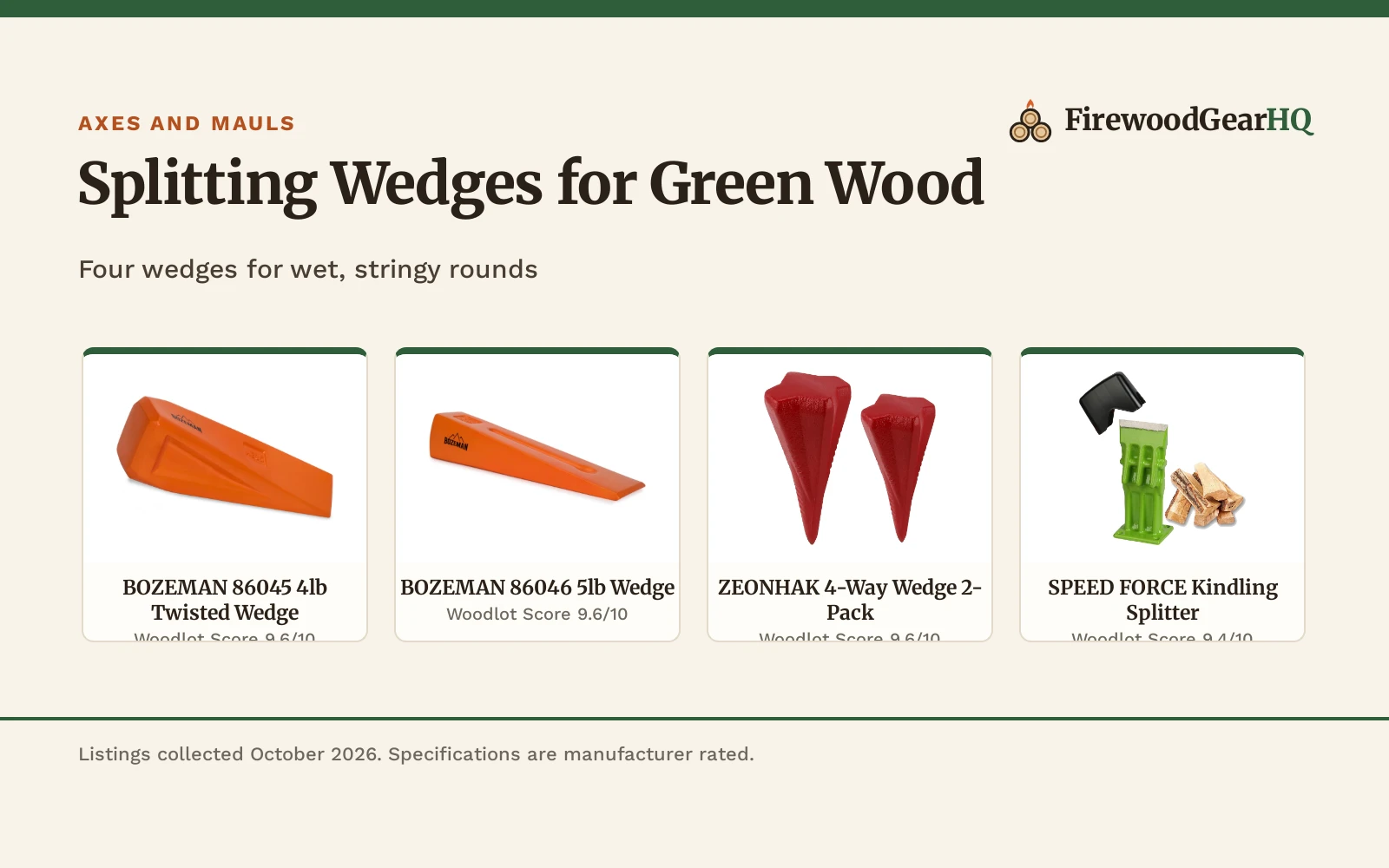
Diamond and torpedo wedges are two names for the same 4-way splitting wedge; here is how the design works, what the listings state, and when to pick one.

On this page
Top picks at a glance
As an Amazon Associate we earn from qualifying purchases.
- 1
 2 PCS 2 Sizes Diamond Wood Splitting Wedge9.6/10View on Amazon
- 2
 Hooyman Splitting Wedge 5 Pound Log Splitter Tool with Heavy9.7/10View on Amazon
- 3
 ESTWING Sure Split Wedge9.6/10View on Amazon
- 4
 Collins 4 lb. Forged Steel Diamond Splitting Wedge 7-inView on Amazon
- 5
 Diamond Wood Splitting Wedge Wood Grenade Splitting WedgeView on Amazon
- 6
 2 PCS 2 Sizes Diamond Wood Splitting WedgeView on Amazon
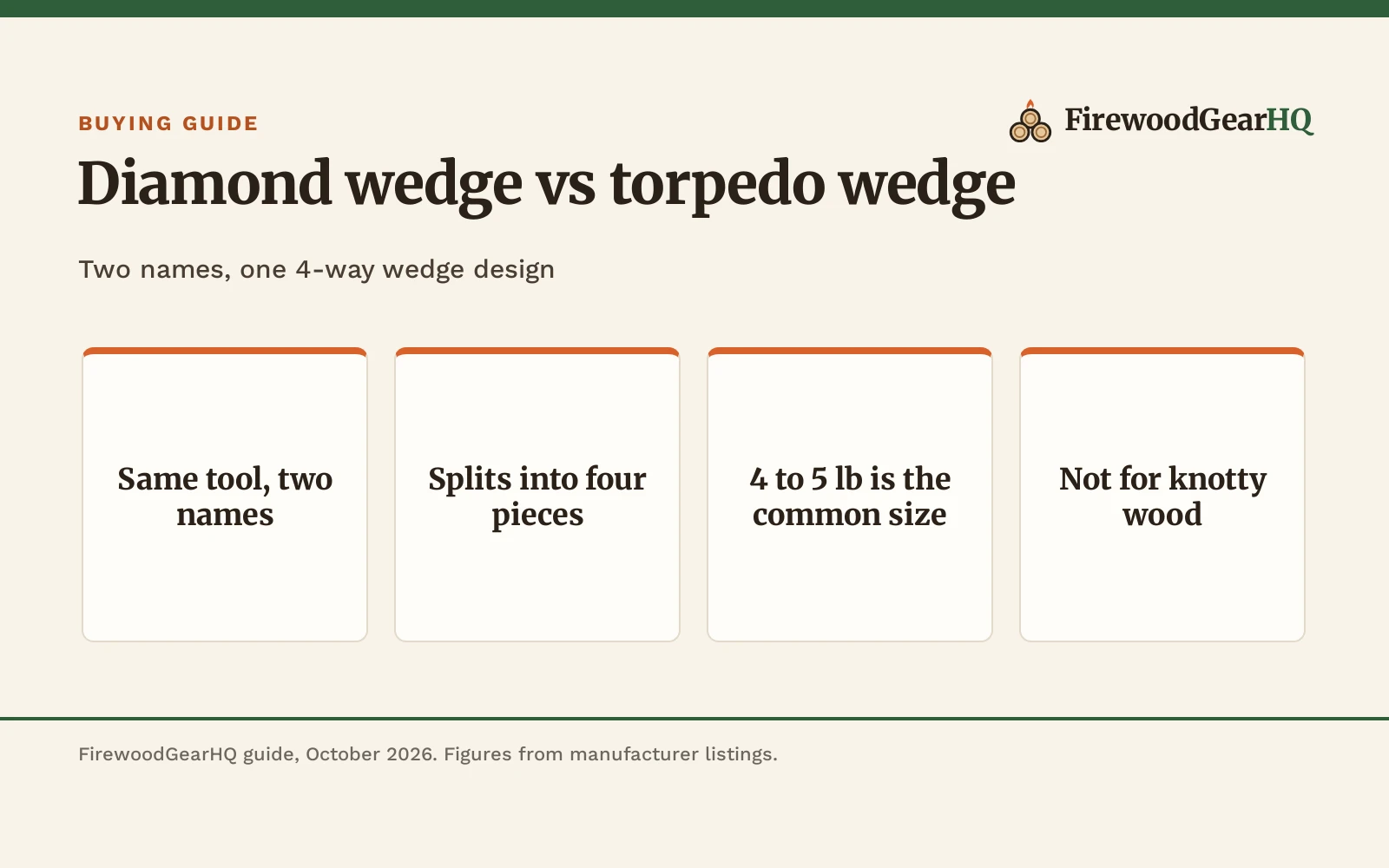
Diamond wedge vs torpedo wedge is mostly a naming question, because the listings show they are two names for the same tool: a 4-way splitting wedge with a diamond-shaped cross-section designed to split a log into four pieces. Edward Tools sells its wedge under both names in a single title, and the Felled, Collins, ZEONHAK and Otoolling listings all describe the same diamond cross-section and four-direction split. So the real question is not which name wins, but whether a 4-way wedge suits your wood and which size to buy.
More options to compare
 Collins 4 lb. Forged Steel Diamond Splitting Wedge 7-inCheck price on Amazon
 Diamond Wood Splitting Wedge Wood Grenade Splitting WedgeCheck price on Amazon
 2 PCS 2 Sizes Diamond Wood Splitting WedgeCheck price on Amazon
FirewoodGearHQ may earn a small commission if you buy through links on this page. The price you pay stays the same. Read our affiliate disclosure.
Diamond wedge vs torpedo wedge: the quick answer
A diamond wedge and a torpedo wedge are the same 4-way splitting wedge. The diamond cross-section weakens the log at multiple angles so one driven wedge opens up to four splits, which the listings say finishes the job in a fraction of the time of a flat chisel-style wedge. Torpedo and grenade are just nicknames for the shape. Buy by weight and features, not by name: the listings cluster around 4 lb, with a 5 lb wedge also included in the Otoolling 2-pack.
What the listings state
| Wedge | Stated weight | Stated size | Design notes |
|---|---|---|---|
| Felled diamond wedge | 4.1 lb (bullets; 3.94 lb in spec table) | 7 x 3 in | Heat-treated railway steel, spherical striking face, notches |
| Edward Tools diamond / torpedo wedge | 4 lb | 7 x 3 in | Drop forged steel, side grooves, lifetime warranty |
| Collins diamond wedge, 7 in | 4 lb (bullets say 4.5 lb; spec table says 16 oz) | 7 in | Drop forged, heat treated high carbon steel |
| ZEONHAK diamond wedge, 2-pack | 4 lb each | 6.7 x 2.8 in (bullets; spec table differs) | High carbon tool steel, red coating, raised edges |
| Otoolling diamond wedge, 2-pack | 4 and 5 lb | 7.09 x 4.72 x 3.74 in | Steel, serrated details, wedge cover included |
Where a listing contradicts itself, the table shows the bullets first: we trust the title and bullets over the spec table. The Felled bullets say 4.1 lb while its spec table says 3.94 lb. The Collins title says 4 lb, its bullets say 4.5 lb, and its spec table says 16 oz, which cannot be right for a steel wedge of this size. The ZEONHAK bullets say 6.7 by 2.8 in and 4 lb each, while its spec table lists 8.6 by 3.14 by 6.2 in and weights of 3.5 and 5 lb.
How a 4-way wedge works
A traditional splitting wedge is a flat chisel: drive it in and the log opens along one line. The diamond wedge adds angled faces, so the force projects in four directions, which is what opens up to four splits instead of one. The listings describe the same details in different words: Felled lists a sharp pointed tip for easy starting, a spherical striking face for centered blows and notches that keep the log from popping out; ZEONHAK lists a spherical hitting surface and a raised edge design for the same reason; Otoolling lists a sharp tip and serrated details; Edward Tools lists side grooves that keep the wedge seated until the split finishes.
Pair it with a real striking tool. Felled says to use its wedge with an 8-pound hammer, the wide, flat striking faces are made for hammer blows rather than axe edges: Felled says to use its wedge with an 8-pound hammer. A splitting maul is the usual partner; see our splitting axe guide if you split by axe instead.
When a 4-way wedge is the wrong tool
The listings are honest about limits. Felled says its wedge is not recommended for knotty woods or large diameter hardwoods, and Otoolling says the same about knotty or large hardwoods. A 4-way wedge needs straight-grained wood that wants to split; knots and big gnarly rounds just swallow it. For those, reach for a splitting maul or a log splitter for home use instead of a bigger hammer.
Picking a weight and a pack size
Four pounds is the standard: Felled, Edward Tools, Collins and ZEONHAK all sit at or near 4 lb, and the Otoolling 2-pack pairs a 4 lb wedge with a 5 lb one for tougher pieces. Heavier is not automatically better; Felled pairs its 4.1 lb wedge with an 8-pound hammer, and the 4 lb size is easier to place accurately. Two-packs from ZEONHAK and Otoolling make sense if you work two wedges in sequence on a stubborn round or simply want a spare in the truck. Otoolling also includes a wedge cover, a small extra the others do not list.
Clear the swing area (overhead too), split on a solid chopping block at a comfortable height, keep your feet apart with the block in front of you, and wear eye protection and sturdy boots. Replace a cracked or loose handle before you swing again. Read our Safety Disclaimer.
What to check before you buy
Start with the stated weight. Four pounds is the standard across the Felled, Edward Tools, Collins and ZEONHAK listings, and the Otoolling 2-pack adds a 5-pound wedge for tougher pieces; the Felled listing pairs its wedge with an 8-pound hammer. Next, check the size: most listings state around 7 by 3 inches, with the ZEONHAK at 6.7 by 2.8 inches in its bullets. Then look at the grip feature that keeps the wedge seated: notches on the Felled, raised edges on the ZEONHAK, serrated details on the Otoolling, or side grooves on the Edward Tools. Finally, read the whole listing, because three of the five contradict themselves somewhere: the Felled bullets say 4.1 lb while its spec table says 3.94 lb, the Collins title says 4 lb while its bullets say 4.5 lb, and the ZEONHAK bullets and spec table disagree on both size and weight. Trust the title and bullets over the spec table, and buy the single or the 2-pack based on whether you work one wedge or two.
Frequently Asked Questions
Is a diamond wedge the same as a torpedo wedge?
Yes. Edward Tools uses both names for one wedge, and every listing here describes the same diamond cross-section splitting four ways. Torpedo and grenade are nicknames for the shape.
What weight wedge should I buy?
The listings cluster at 4 lb, with a 5 lb option in the Otoolling 2-pack. Felled pairs its 4.1 lb wedge with an 8-pound hammer.
Can a 4-way wedge split knotty wood?
The Felled and Otoolling listings say not to use these wedges on knotty woods or large diameter hardwoods. Use a maul or a hydraulic splitter for those.
Do I need a 2-pack of wedges?
Not necessarily, but ZEONHAK and Otoolling sell pairs for working two wedges in sequence or keeping a spare. A single 4 lb wedge is the standard listing choice for straight-grained wood.
How do I keep a wedge from popping out?
Buy the feature the listings name for it: notches on the Felled, raised edges on the ZEONHAK, serrated details on the Otoolling, or side grooves on the Edward Tools. Each is the maker’s stated way of keeping the wedge seated.
Related guides
See the axes and mauls hub, the best splitting maul, the best splitting axe and the best log splitter for home use.